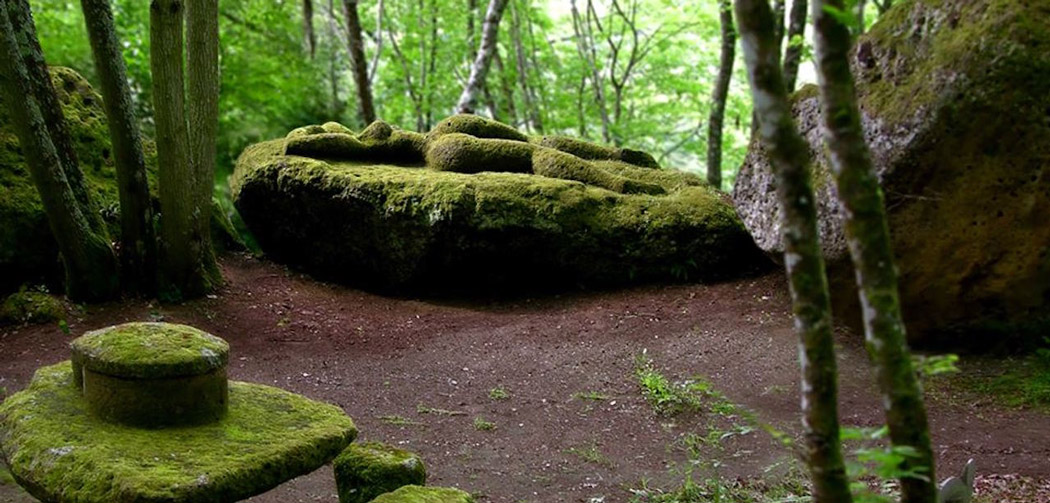
Opera Bosco: the "natural" Museum of Calcata reopens

Sunday 13 June the Opera Bosco open-air museum reopens, the flagship of the village of Calcata in the Province of Viterbo. A sensory journey that for years has made his works, created by Italian and international artists, part of the splendid nature of the Valle del Treja park.

An experience to be lived, where it will be possible to walk the natural paths created by works that blend with the ancient and the modern.

Guided tour of the path of new installations and the expansion of the wood that develops on the tufaceous plateau of Monticello

which stands out in the gorge of the Treja Valley in Calcata.

A site with millenary traces of the ancient culture of the inhabitants of these places, which transports into the imagination of scenarios and architecture

metaphorically returned from the installations of Art in Nature.

Walking the paths of Opera Bosco also means immersing yourself in a rich biodiversity that evokes the ancient primordial forests.

Program

11.00 am welcome at the entrance of Opera Bosco, Località Colle, Calcata (Vt) (indicated on the Google map)
· 11.30 am guided tour of the path of installations and works carved into the boulders, an integral part of the landscape
· 1.00 pm tasting of products from the biodistrict

There is a lounge area where you can have a packed lunch.

Reservation for pre-registration by 11.00 on Saturday 12 June:

This email address is being protected from spambots. You need JavaScript enabled to view it. - WA 328 2769123

Admission with annual membership card: € 15.00

Admission reserved for members of the Opera Bosco Museum of Art in Nature

with card collected on the day of the event.

(trekking shoes are recommended)

Here everything turns upside down; it is art that contextualizes nature!

Opera Bosco Museum of Art in Nature was born twenty five years ago from the need to generate an ecological transition in the world of contemporary art, highlighting, with the power of art, the indispensability of the natural environment. The founding artist of Opera Bosco, Anne Demijttenaere, in collaboration with Costantino Morosin and other artists, traces the path and creates a system of installations of Art in Nature inaugurated and open to the public in 1996. A declination of the international movement of Art in Nature that revolutionizes the perception and sense of art.

An exhibition, recreational and educational museum itinerary on three hectares of wood in the gorge of the Treja Valley in Calcata. A laboratory museum where the artists, in the realization of the works, extend the concept of aesthetics to the ecosystem, using only the natural material of the forest. Biodegradable works that arise, for the most part, from the material obtained from the maintenance of the forest that becomes raw material for the realization of the works. Work of great environmental and social value that indicates a symbolic ecological path to production of total quality.

Ephemeral works therefore, which live more or less long, memorized with the digital techniques that allow their diffusion. Opera Bosco organizes guided seminar tours weekly, educational workshops with fine arts academies, artists and amateur groups annually. Program of shows and concerts that take place in the three outdoor amphitheaters inside the Museum.

Opera Bosco is a place and a modus that can be replicated in other natural environments, such as in Venice where, promoted by MIBACT, it participated in the 2014 Architecture Biennale exhibition, with the creation of installations on the Certosa Island and in 2015, with a monumental installation created collectively by five artists on the island of San Secondo.

INFO and reservations
WhatsApp: 328 276 9123

e-mail: This email address is being protected from spambots. You need JavaScript enabled to view it.
https://luoghidelcontemporaneo.beniculturali.it/opera-bosco—museo-di-arte-nella-natura

powered by social2s
The smallest square in the world in Tuscany is not Italy in Miniature

Roccaforte (Fortress) di Santa Maria a Monte, a village in the Lower Valdarno, was for a long time a formidable military system.

From there a strategic part of Tuscany was controlled: the territory between the western offshoots of the Cerbaie hills and the course of the Arno river.

The fourteenth-century Florentine historian, Giovanni Villani, described it as the "strongest castle in Tuscany and the best equipped".

The hilly position in fact ensured control of an area that is fundamental for the geopolitics of the region. It was therefore disputed by the interested powers: essentially Lucca, Pisa and Florence.

For this reason, the village of Santa Maria a Monte, which includes many traces of its millenary history, displays important medieval testimonies, in some ways unique, to those who visit it.

What makes it interesting is in the first place its helical urban structure, on whose originality many scholars have expressed themselves. Some have even told of Leonardo da Vinci's interest in this spiral conformation of the town's urban layout.

This condition allowed the village to develop a subsequent and original urban layout, giving rise to "miniaturized" living and working spaces.

This is how visitors can understand this evolution through a series of structures, but above all of a square that from the end of the second half of the nineteenth century was named after Venice. As befits the most classic tradition of naming of Italian towns (toponymy).

This title refers to important spaces, witnesses of large gatherings and meetings. So when we talk about the square, road or street named after the beautiful city, everyone figures them to be of particular grandeur.

This is certainly not the case with "Piazza Venezia" in Santa Maria a Monte, which is indeed a candidate to be recognized as "the smallest square in the world".

This alleged primacy is not the result of a tourist promotion operation, but the result of an urban development, in fact.

In fact, in the beginning, the urban fabric of the village consisted of "courtyard houses", most likely dating back to the early Middle Ages.

As Giovanni Giusti explains, in his publication '' Santa Maria a Monte. Origins and evolutions of the urban structure '' in 1999. These peculiarities ''are the product of a transformation of original courtyards subdivided and clogged with building types of increasingly smaller dimensions and without any areas of relevance.''

For our Piazza Venezia we are talking about a space wedged between houses and officially accredited by urban signs, with the name of Piazza Venezia, in fact.

It covers an area of ​​about 30 (thirty!) square meters.

Dimensions therefore of a mini apartment, with the main access to three houses.

We are probably facing a record: Piazza Venezia in Santa Maria a Monte is the smallest square in the world. It has reached these dimensions for the use of tourists, not for a delimitation designed at a table, but for an urban phenomenon.

If we were to contextualize this corner of Santa Maria a Monte in a miniature reality, we would probably already be in the required order of magnitude.

As we have said, in this "micro-square" three houses have their access. In short, there are those who really live in miniature Italy, or in the smallest square in the world.

Other locations claim this record. In fact, we have news of other micro-squares such as “Piazza Padella” in Barbara (in the province of Ancona), Piazzetta Beata Vergine degli Angeli in Turin and Calleja del Panuelo, (Handkerchief Alley) in Cordoba, Spain.

As we have been able to document, there is often a tendency to qualify spaces with incomplete requirements as urban planning entities (street, square, course, etc.). In our opinion, that of Santa Maria a Monte has history, structures and functions that qualify its nature as a square.

However, there is a need for some sort of official certification that can define and then certify the requirements with which to assign the title.

In this regard, we would like to make a proposal: why not set up a board that evaluates the applications and defines the compliance of the candidates with the requirements that allow for the award of the title?

In fact, it seems to us a way to get to know and re-connect with the territories, enhancing their characteristics.

In this regard, we would like to predict the primacy of Piazza Venezia in Santa Maria a Monte: it is the result, not of a promotional initiative, but of two phenomena: tabernization and insolization (possibly architectural terms that translate from ‘tabernizzazione e l’insulizzazione’ where ‘tabernization’ may mean ‘formation of the internal dividing lines complementary to the centering axis’ and ‘insolization’ - ?).

But that is another story ...

powered by social2s

The civic museum of Santa Marinella, a wonderful city on the coast north of Rome, tells the life and history of the castle of Santa Severa.

The ticket includes a visit to all the halls and to the rooms of the fortress and 'maschio' tower. including the internal chapel of the castle.

Along the way, reproductions of costumes and armour are shown and daily life in the castle is illustrated.

The museum shows tools and technologies used by the inhabitants over the centuries and a reproduction of a medieval set table.

The museum is in the halls of the Santa Severa Castle.

powered by social2s

The Museum of Territory in Santa Marinella tells the relationship between man and the territory understood as an agricultural and mining landscape.

For many years, the Santo Spirito Hospital that managed all this territory had benefited from mining operations (we are not far from the Tolfa Mountains rich in alum deposits). As regards the agricultural exploitation of the land, then, we must remember that many areas were still swamps and that agriculture had to make these villages self-sufficient.

In the museum, therefore, geological peculiarities are represented and agricultural tools used during the last centuries are highlighted.

The museum is located inside the Castle of Santa Severa and includes both internal rooms and external areas, such as the barozze or calessi square, where you can admire some agricultural vehicles and milling machines that make up a fountain.

powered by social2s

The Museum of the Sea and Ancient Navigation of Santa Marinella shows the link with the sea over the centuries in this stretch of coast.

The exhibition starts from the Bronze Age with the Phoenician port of Pyrgi, where an important Etruscan sanctuary was located. The visit is also a splendid tour inside the castle of Santa Severa where the museum is located.

In one room, there is a reproduction of a side of a Roman ship loaded with amphorae and tools like an ancient Roman lamp.

The history of Pyrgi is that of a Phoenician commercial port that was very flourishing during the Etruscan period when it was the outlet to the sea of ​​the important city of Caere, today Cerveteri.

In the seven rooms of the museum are exhibits from Pyrgi, but also from the seabed of the coast which includes Cemtumcellae (today Civitavecchia), and reproduction of ancient naval instruments.

The museum was set up in the village of the Castle of Santa Severa in the rooms called La Polveriera, Il Caminetto and La Casa dei Somari.

powered by social2s

Liberty villas in Santa Marinella

Between the late nineteenth and early twentieth centuries, after the sale of the area by the Santo Spirito Hospital to the Odescalchi family who began the subdivision, Santa Marinella established itself as an important seaside resort.

Some buildings of very interesting liberty villas date back to this period: villas that still stand out for their 'free' architectural forms, the sinuosity of their decorations and their colors.

These include Villa Bettina along the Via Aurelia, Villa Emanuele, designed by the engineer Umberto Emanuele, and the Villino Cerrano built with reinforced concrete by the architect Gino Smorti.


Villa Saracena, Villa Califfa and Villa Moresca

Villa Saracena is part of one of three villas designed in 1955 by the famous architect Luigi Moretti, the one who designed the famous Watergate Hotel in Washington.

The villa was commissioned by the journalist Francesco Malgieri for his daughter, princess Luciana Pignatelli.

The three villas are adjacent and took the name of La Saracena, Califfa and Moresca. For their style and complementarity of forms they represent an interesting example of modern architecture.

Villa Saracena and Moresca were constructed in the same period between 1955 and 1957 in an area between the sea and the Marconi seafront, named after the scientist who stayed here and met his wife. It is  very long and narrow plot of land that has given birth to a particular shape: closed and locked off towards the road and open and sunny towards the sea with large windows that allow the landscape to enter inside.

The enameled and decorated tile flooring was created by the Neapolitan painter Grisotti.

Villa Califfa was later expanded in the 70s.

Villa Moresca has a slightly different history as despite being part of a project with a unitary style, it was built a few years later and the works were completed in 1981. It was to be the home of the architect Moretti who, however, would never see it completed because he died in 1973.


powered by social2s
Cellino San Marco. Agrifani Museum of Salento Civilization

[metaslider id="100259"]
The Museum of Salento Civilization in Cellino San Marco has a large collection of over 5000 pieces with agricultural equipment and tools of the past used until the mid-twentieth century. The exhibition winds along the corridors creating thematic spaces where you can find the artisanal laboratories of shoemakers, farriers, iron workers, umbrella fabricaters, sharpeners and others.

All of the domestic life was then reconstructed inside the houses with kitchen equipment, spinning mills and home weavers.
A large section is dedicated to agriculture and field work, with an incredible collection of ploughs and harnesses used for horses and donkeys. The Salento area could not go without the grape harvest and wine production area, while a special section is dedicated to the wonderful Sicilian carts.

The collection was started by the Agrifani family, collectors for three generations starting from Mario born in 1905 up to Marcello, agronomist and head of the Forestry Corps of Brindisi who toured all the countryside collecting the abandoned tools.

The museum is located inside the Due Palme winery

powered by social2s

Subscribe to Newsletter

Discover a territory through the emotions of the people that have lived it.