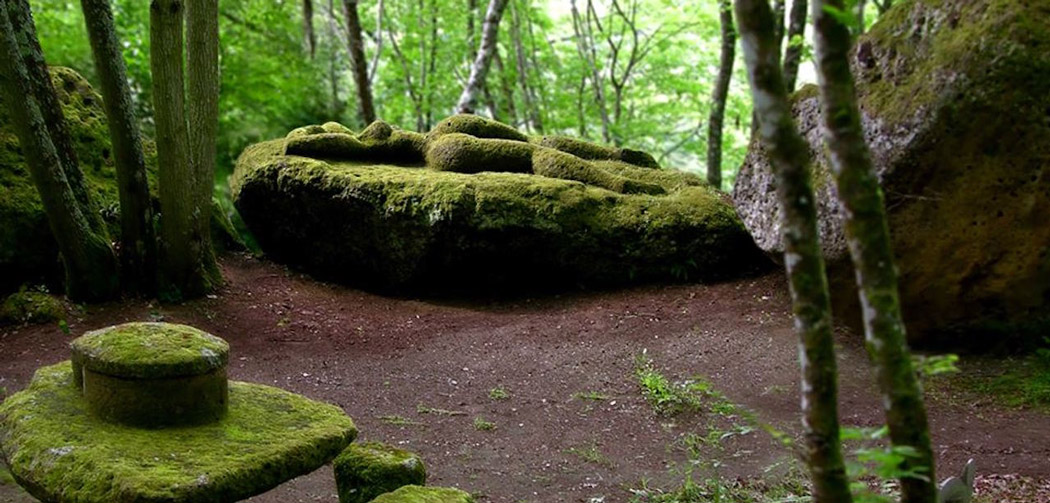
Opera Bosco: the "natural" Museum of Calcata reopens

Sunday 13 June the Opera Bosco open-air museum reopens, the flagship of the village of Calcata in the Province of Viterbo. A sensory journey that for years has made his works, created by Italian and international artists, part of the splendid nature of the Valle del Treja park.

An experience to be lived, where it will be possible to walk the natural paths created by works that blend with the ancient and the modern.

Guided tour of the path of new installations and the expansion of the wood that develops on the tufaceous plateau of Monticello

which stands out in the gorge of the Treja Valley in Calcata.

A site with millenary traces of the ancient culture of the inhabitants of these places, which transports into the imagination of scenarios and architecture

metaphorically returned from the installations of Art in Nature.

Walking the paths of Opera Bosco also means immersing yourself in a rich biodiversity that evokes the ancient primordial forests.

Program

11.00 am welcome at the entrance of Opera Bosco, Località Colle, Calcata (Vt) (indicated on the Google map)
· 11.30 am guided tour of the path of installations and works carved into the boulders, an integral part of the landscape
· 1.00 pm tasting of products from the biodistrict

There is a lounge area where you can have a packed lunch.

Reservation for pre-registration by 11.00 on Saturday 12 June:

This email address is being protected from spambots. You need JavaScript enabled to view it. - WA 328 2769123

Admission with annual membership card: € 15.00

Admission reserved for members of the Opera Bosco Museum of Art in Nature

with card collected on the day of the event.

(trekking shoes are recommended)

Here everything turns upside down; it is art that contextualizes nature!

Opera Bosco Museum of Art in Nature was born twenty five years ago from the need to generate an ecological transition in the world of contemporary art, highlighting, with the power of art, the indispensability of the natural environment. The founding artist of Opera Bosco, Anne Demijttenaere, in collaboration with Costantino Morosin and other artists, traces the path and creates a system of installations of Art in Nature inaugurated and open to the public in 1996. A declination of the international movement of Art in Nature that revolutionizes the perception and sense of art.

An exhibition, recreational and educational museum itinerary on three hectares of wood in the gorge of the Treja Valley in Calcata. A laboratory museum where the artists, in the realization of the works, extend the concept of aesthetics to the ecosystem, using only the natural material of the forest. Biodegradable works that arise, for the most part, from the material obtained from the maintenance of the forest that becomes raw material for the realization of the works. Work of great environmental and social value that indicates a symbolic ecological path to production of total quality.

Ephemeral works therefore, which live more or less long, memorized with the digital techniques that allow their diffusion. Opera Bosco organizes guided seminar tours weekly, educational workshops with fine arts academies, artists and amateur groups annually. Program of shows and concerts that take place in the three outdoor amphitheaters inside the Museum.

Opera Bosco is a place and a modus that can be replicated in other natural environments, such as in Venice where, promoted by MIBACT, it participated in the 2014 Architecture Biennale exhibition, with the creation of installations on the Certosa Island and in 2015, with a monumental installation created collectively by five artists on the island of San Secondo.

INFO and reservations
WhatsApp: 328 276 9123

e-mail: This email address is being protected from spambots. You need JavaScript enabled to view it.
https://luoghidelcontemporaneo.beniculturali.it/opera-bosco—museo-di-arte-nella-natura
powered by social2s

The Museum of the Sea and Ancient Navigation of Santa Marinella shows the link with the sea over the centuries in this stretch of coast.

The exhibition starts from the Bronze Age with the Phoenician port of Pyrgi, where an important Etruscan sanctuary was located. The visit is also a splendid tour inside the castle of Santa Severa where the museum is located.

In one room, there is a reproduction of a side of a Roman ship loaded with amphorae and tools like an ancient Roman lamp.

The history of Pyrgi is that of a Phoenician commercial port that was very flourishing during the Etruscan period when it was the outlet to the sea of ​​the important city of Caere, today Cerveteri.

In the seven rooms of the museum are exhibits from Pyrgi, but also from the seabed of the coast which includes Cemtumcellae (today Civitavecchia), and reproduction of ancient naval instruments.

The museum was set up in the village of the Castle of Santa Severa in the rooms called La Polveriera, Il Caminetto and La Casa dei Somari.

powered by social2s

The civic museum was established in 1992 to collect and tell the particularities of Sabaudia and is dedicated to the great researcher Marcello Zei who worked extensively here and in San Felice Circeo.

The museum is divided into two sectors: one biological (naturalistic) and one dedicated to the history of the past with a section on prehistoric archeology and one dedicated to classical archeology.

The sea is told with an aquarium that reproduces the fauna of the coast and with a collection of algae, sponges, madrepores, etc. .. and of all the species found in the marine system in front of the dunes.

In the prehistoric archeology section, the story is told through fossils and minerals from the Quaternary while in the classic section a wreck of a Roman ship carrying amphorae has been reconstructed and is located in the sea of ​​Sabaudia.

The sea is therefore always the reference point of the museum. Roman navigation with freight transport in the Mediterranean and a section dedicated to fishing complete the story of the relationship between man and sea.

powered by social2s

The Bolsena aquarium is located within the Territorial Museum of Lake Bolsena in the Rocca Monaldeschi.

It shows about thirty species including fish, amphibians and crustaceans, coming from the rivers and lakes of the provincial territory, in 22 special pools.

By visiting the aquarium you have the opportunity to learn about the complex ecological system of the lakes, and in particular of the Lake of Bolsena, and the relationship that this has had with man over the centuries.

In the tanks the habitats and the biological microclimates are reproduced from the water source to the lake and finally to the mouth of the river.

Among the successes of the aquarium is that of having studied the way of reproducing some species of fish to assist their reproduction in sustainable fish farms.

powered by social2s
Veroli Herbs Museum

The Herbs Museum is located inside Palazzo Morganti in the center of Veroli. It hosts a collection of herbs from the Ernici Mountains that illustrate the rich variety of flora with over 1200 species of plants including beautiful wild orchids.

The plants are classified according to the habitats at different altitudes and the healing properties of some medicinal plants are told with the help of botanists from Sapienza University of Rome and the University of Lecce.

In a room there is a collection of objects once used in herbal medicine and in ancient pharmacies.

powered by social2s

The Muve Museum of Ernico Volcanism is located in the heart of the town of Giuliano di Roma. 

It covers three floors, consisting of several rooms organized in thematic sections that offer an interesting insight into the topic of volcanism and geology in general.

Ernico Volcanism originated about 700,000 years ago following a geological phase of the opening of the Tyrrhenian Sea.


powered by social2s

The Collepardo EcoMuseo Centaurus Orto was created to promote all the natural, historical and artistic attractions of the area.

Its name comes from herbal garden tradition of the slopes of Ernici, referred to by the German historian Febronio as "Garden of the Centaur Chiron," the master of the Greek doctor Aesculapius.

The EcoMuseo is headquartered in the town hall "La Rocca" and on the facade stands the sculpture "Chiron wounded" by sculptor Patrik Alo.

powered by social2s

Subscribe to Newsletter

Discover a territory through the emotions of the people that have lived it.