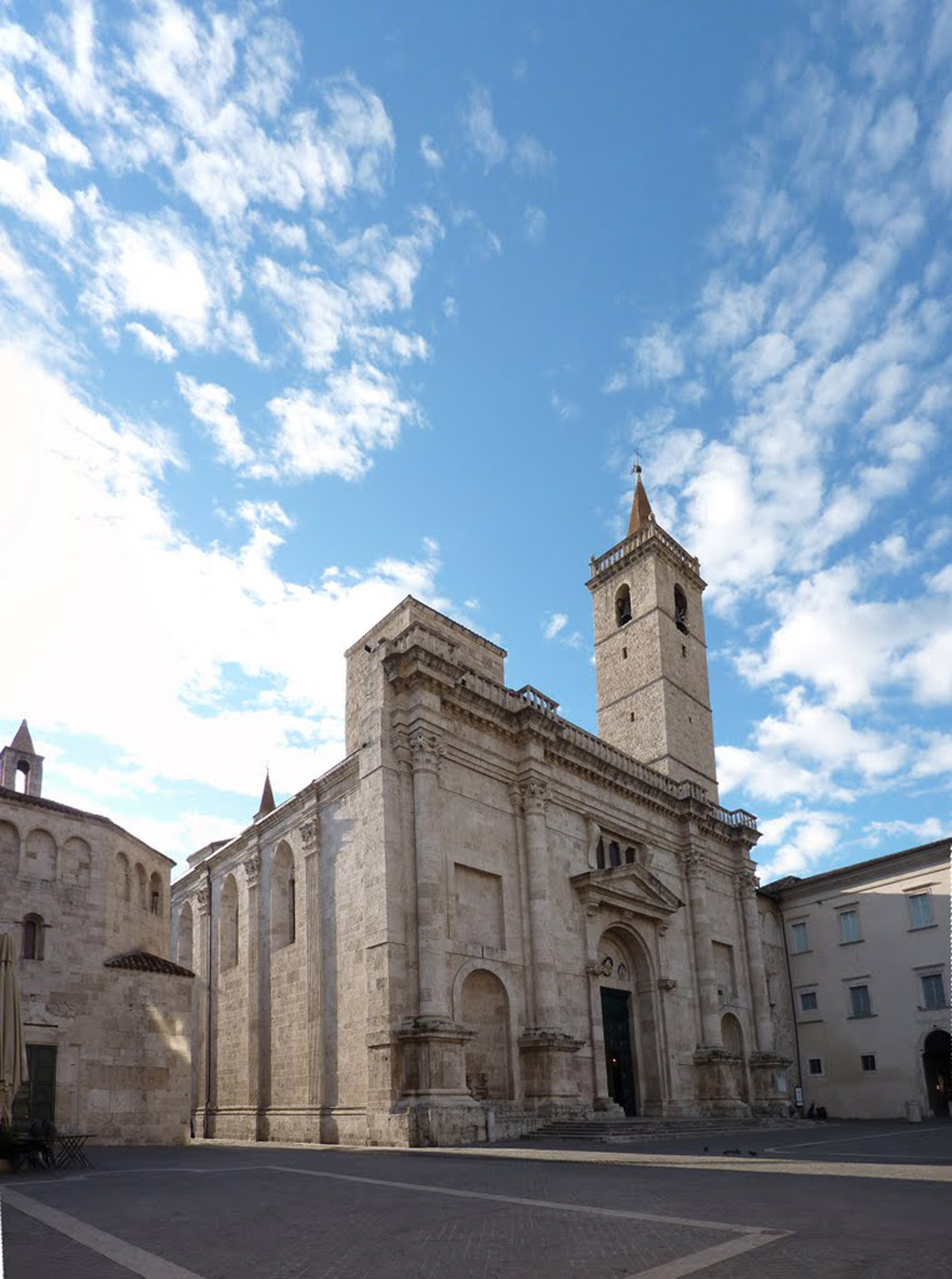
Ascoli Piceno. Medieval Town

Looking at the Valle del Tronto where Ascoli Piceno is located, one is immediately surprised by the large number of towers that characterize it.

At the height of its splendor in the Middle Ages, in Ascoli Piceno there were about 200 towers each built by rich families who wanted to show their power.

Today about 50 remain, some of which have been lowered to become part of houses, and 2 of them have become church bell towers.

The city is divided into 6 Sestrieri each of which has its own rider who competes in the Giostra della Quintana.

The heart of the medieval city was called La Piazzarola and was located around the Church of Sant’Angelo Magno. To this day, it is still an experience to get lost in the alleys between towers and ‘gardens surrounded by walls’. Until a century ago in this district there were the stables of the charcoal burners, who delivered the coal to the houses, and the laundry places.

Do not miss Rua di Stelle which runs along the Tronto river, and whose high up position is used by lovers for their romantic moments.

powered by social2s

Castrum Novum is an ancient Roman fortified centre founded in 264 BC. when Rome was preparing more and more to become a maritime power and to clash with Carthage. It is located in the territory of Santa Marinella on the coast north of Rome.

For this reason, before the First Punic War, it set up a series of ports and fortresses to protect them in order to counteract any Punic landings.

The centre was mentioned by Julius Caesar as the seat of the Colonia Iulia Castronovana and was to be all surrounded by walls. Its extension of about twelve hectares made it one of the largest Roman Castrums

In the castrum there is a system of fish ponds with imposing dimensions of 48 meters by 30 meters which is one of the largest in the Mediterranean.

Next to this piscicultural activity, the remains of a Roman house were found where there was probably a "taberna" and a post station for travelers to rest along the Via Aurelia.

Castrum Novum is one of the largest fortified centres of the Republican era which then became an important urban centre in the Imperial era. Recent excavations are bringing to light a theatre, a curia, houses, a small temple dedicated to Apollo, an aqueduct, other urban structures for the entertainment of the population, plus sewers.

powered by social2s

Via Aurelia was an important Roman road that connected Rome with Cerveteri and Pyrgi, passing along the Tyrrhenian coast.

The road was then extended to Pisa and then to Marseille, France by the emperor Augustus who called it the Via Julia Augusta.

The first stretch up to Cerveteri dates back to the third century BC and was built by the censor Aurelio Cotta.

There are no traces of the ancient route but there are still traces of the passage of this important communication route as a memorial stone at km 59,700 engraved with a text that recalls how the reconstruction of a nearby bridge called 'Ponte di Apollo' (with three arches but buried today) was made by the emperor Septimius Severus.

Another sign of the passage of the ancient Via Aurelia is at km 60.4 where there are the remains of a Roman bridge (the Ponte di Largo Imperio) of which only one sandstone arch remains, while at km 60.7 you can see the remains of an arch of the Via Roma bridge (today in a private garden).

Finally, at km 62.3 you can see the Ponte delle Vignacce restored in 1910.

powered by social2s

In the stretch of sea in front of Punta della Vipera in Santa Marinella you can recognize the remains of a system of tanks that made up a large fishpond, that is an area where fish were bred.

The pools are all inter-communicating and the complex has the dimensions of about 48 meters by 30 meters and dates back to the first century BC. With its imposing size, this is considered the largest such complex in the Mediterranean along with that of Torre Astura near Nettuno.

Probably nearby there was an imperial era villa testified by some traces of pavement, small walls and remains of marble decorations.

At Punta Vipera there was also an ancient Etruscan sanctuary built in 530 BC. which was then in operation throughout the Roman period and dedicated to the goddess Minerva, protector of births. I

n fact, finds have been unearthed that refer to various historical episodes such as the invasion of Dionysius from Syracuse in 384 BC. and the Roman settlement of Castrum Novum.

In the imperial period, then, a Roman villa was built on the ruins of the temple, or an agricultural centre that supplied all the neighbouring cities.

The centre was part of the Castrum Novum settlement and was probably also part of a subsequent post station along the Via Aurelia.

powered by social2s
Cellino San Marco. Roman coins and oven graves

Oven grave
The most ancient testimony of life in the area of ​​Cellino San Marco is from a tomb dating back to 2.000-1.800 BC The tomb was dug out of the nearby tuff rock (hence its name "oven") in the Li Veli district and consisted of three cells of different sizes and placed at different heights.
Roman coins
The testimony of the passage of the Romans who had brought to Brindisi the end of the Via Appia, the queen of the consular roads, and the port of embarkation for all the East is given by some Roman coins that are often found in the countryside.
It is certain that the Romans had built their villas, or settlements that we could define as "agricultural factories" where the fields were cultivated, the products of the land were transformed and where the farmers slept.
Perhaps some of today's farms were born just on top of ancient Roman villas.
powered by social2s
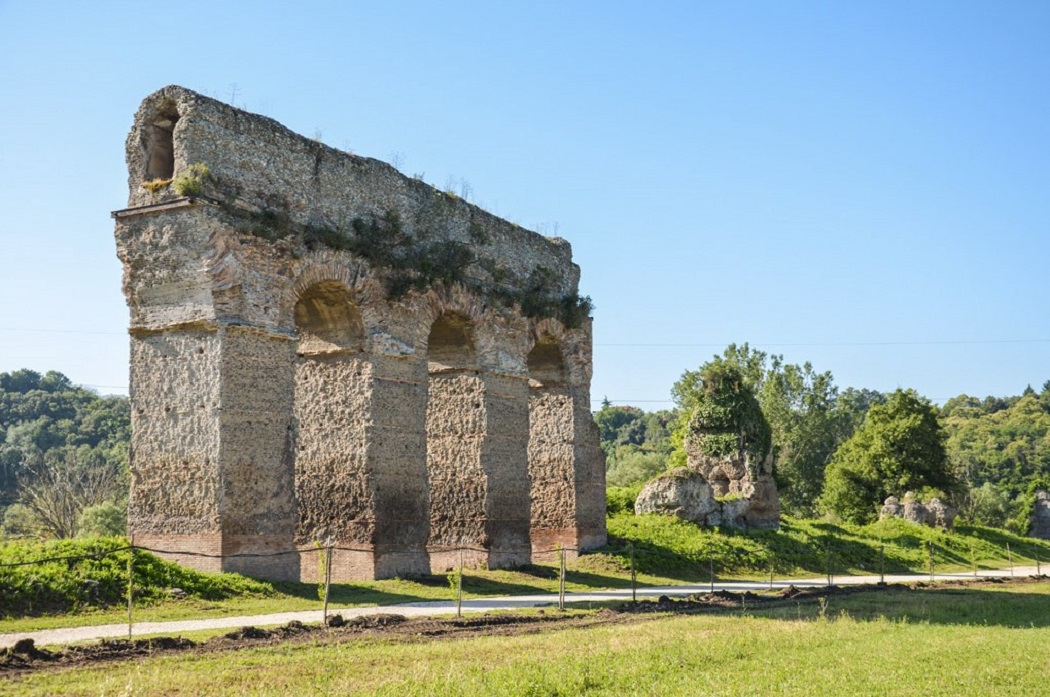
Aquaduct Anio Novus
 Aquaduct Anio Novus

The aqueduct Anio Novus dating back to 38 B.C..

It was built by Caligula along the Via Empolitana, running from Tivoli, it passes through Castel Madama and arrives in Ciciliano.

The greatest amount of remains are found in Tivoli, specifically in the area of the Arch Bridge, where a bridge crossed the Aqua Marcia and where the aqueduct crossed the river Aniene.

powered by social2s

Its history of the temple of the cough of Tivoli is not known precisely.

From a tombstone it seems that the building dates back to the time of Constantine I, the mid-fourth century, and it is built on the ruins of a Roman villa of the first century B.C., to commemorate the work performed on the Via Tiburtina.

There is no foundation to the medieval hypothesis that it was a temple dedicated to the personification of cough, to ward off the disease from the Tiburtina population.

The building became a church dedicated to the Virgin Mary in the tenth century using material from the nearby sanctuary of Hercules. Inside it has a few late medieval frescoes.

It was abandoned between the XVII and XVIII centuries and is privately owned.

powered by social2s

The area of ​​Albano Laziale was known for the villas of Roman patricians who sought shelter from the summer heat of Rome and wanted their residence dedicated to the Otium.

In the locality of Cavallacci there are the remains of a roman villa that dates back to the end of the Republican age.

The villa then had its heyday in the imperial age and was inhabited until the 5th century AD, when Rome fell under the barbarian invasions.

The villa had a series of terraces and also served as a centre for agricultural production, so that workers' homes were located inside it.

Some remains of masonry and floors of patrician rooms, of the cistern, of the rustic area are still visible.

The finds, rediscovered during the excavations, including terracotta objects and the marble head of Tiberio Gemello, can be seen in the Museo Civico di Albano which looks after the excavations.

powered by social2s

Recommended

Subscribe to Newsletter

Discover a territory through the emotions of the people that have lived it.