


For generations in Morcone and in Sannio we have maintained a balanced relationship with nature, learning to know what it could offer us. There is an imposing wealth of knowledge handed down by those who lived in closer contact with nature, such as shepherds, hunters, lumberjacks, etc.

A knowledge that was in danger of getting lost but we are coming back to preserving secular customs and traditions, rediscovering something of the dialect and our wise proverbs. Slowly, young farmers are getting to know the plants that grow in our countryside and how they were used.
Edible wild herbs are an important resource for healthy eating: they are much richer in vitamins and minerals than cultivated vegetables.
They are not the result of human selection but only of natural selection and arise spontaneously where they find the optimal conditions for their growth, without being forced by man.
They only cost a little effort to go looking for them.
I went back to Morcone, to rediscover the dialect names with which my grandmother had taught me to call the individual vegetables and how they were prepared in the kitchen, and also their medicinal properties.
I have already told you about some recipes.
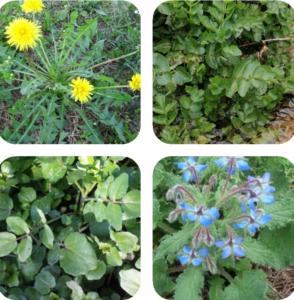
But remember that before learning to recognize herbs, flowers, berries and anything else that is edible, it is good to learn to recognize toxic plants. Always remember not to collect herbs on the edges of busy roads, in parks frequented by dogs or other animals.
Don't pick up anything you don't know and be accompanied by someone who knows them well. Make sure you are not in areas where harvesting is prohibited (e.g. in nature reserves) or that you are collecting species protected by local laws.
And collect the plants in order to always leave others in place.
In this recipe today, I want to propose a cream of borage, watercress, water celery and dandelion with broccoli tops for the crunchy part sauteed with oil and garlic.
A vegetarian version of the "Maritata Soup", a soup of the countryside that has ancient origins.
Firstly, cooking of the herbs is done by immersing them in boiling salted water for a few minutes, then they are drained and cooled with cold water and ice. In the case of risotto, omelettes, soups, etc ... the herbs should be squeezed a little.
For the recipe of the Maritata soup, in the old days the broth was prepared using discarded and "poor" meat cuts: feet, bones, pig ears, cotenne and so on. In a more modern versione we use: chicken, beef, sausage. To the broth we add celery, carrots, onions and a boquet of aromatic herbs such as laurel, thyme etc. and everything is cooked for at least three hours, the important part is to take out the froth that come out on top during cooking.
Once the broth is ready, we filter it to take out the extra fat, we separate the meat that we are going to cut into pieces and let it cool on the side. As a next step, we are going to cook the herbs and vegetables in our broth: not just wild herbs like cicory, borage and the cardillo herb, but also beets, endive and kale depending on the season.
At this point we add the vegetables, pre-washed and cut up, and we let them cook for 20 minutes adding the meat back into the pot, and the dish is served with a sprinkling of cheese and a swirl of EVO olive oil.
The soup takes its name "Maritata" (to be married to) from this perfect marriage between tha flavours of the meats and vegetables that we use.
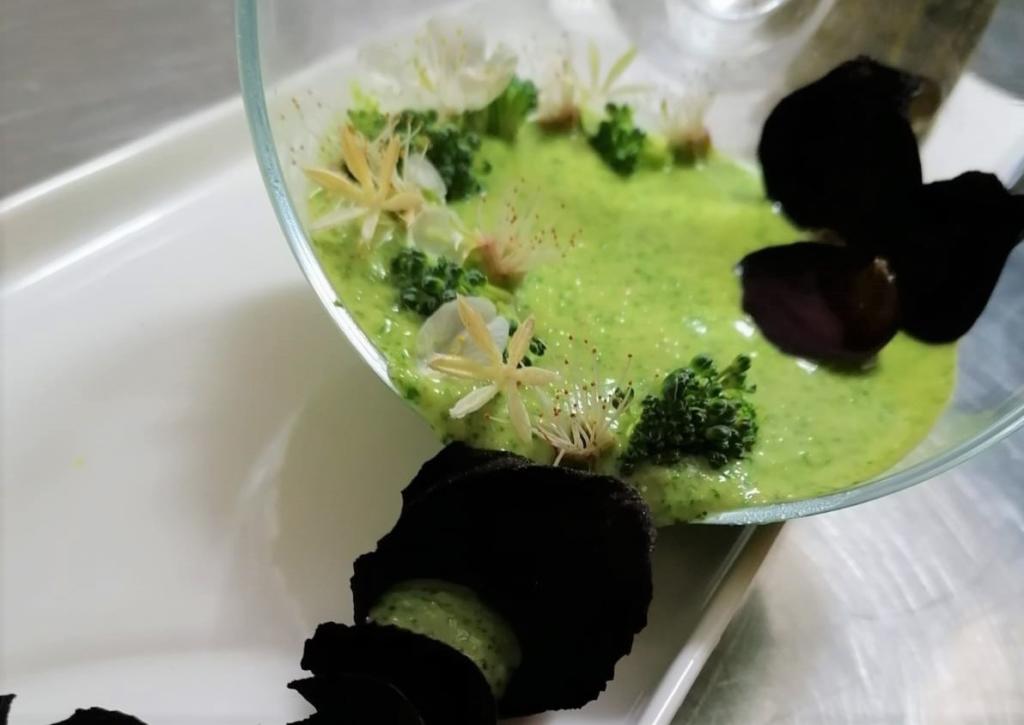
In the preparation of the herb cream I decided instead to use only spontaneous herbs dosed differently according to their characteristics, in order to balance the final result. It is important to maintain the doses to achieve the perfect balance.
I then used the stracciata, a fresh pasta filata cheese obtained from cow's milk that has the shape of 4.5 cm strips and 1 cm thick. The flavour is savoury, delicate, especially in the freshly packaged product, and recalls the taste of milk and live probiotics as a result from its slight fermentation.
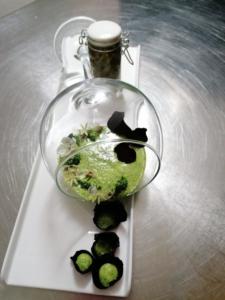
My recipe for this dish (as you can see from the photo) is also to give the possibility to a hypothetical customer to taste the traditional soup in a little jar sterilized and hermetically sealed, which the customer can decide to take home.

This is the idea of the dish I invented.
Wild herb cream soup recipe with stracciata, broccoli tops and dried rose petals
Ingredients:
170 gr of dandelion
250 gr borage
100 gr of watercress
100 gr of water celery
1 shallot
Vegetable broth to taste
80 gr stracciata
80 gr of Apulian broccoli tops
1 clove of garlic
EVO oil
2 potatoes
Salt
Thoroughly wash the herbs and blanch the borage and dandelion separately for 5 minutes in boiling water. Then immediately cool them with cold water and ice to keep the colour.
Proceed with watercress and celery for one minute. Finally blanch the broccoli tops for 4 minutes, always cooling them at the end, and set them aside.
Brown a shallot for five minutes, add two diced potatoes and about two litres of vegetable broth. Cook for 15 minutes and add the various herbs, leaving to cook for another 10 minutes.
At the end blend everything with an immersion mixer adding the stracciata, olive oil, salt and a pinch of pepper.
Serve the herb cream and add the broccoli tops sautéed in a pan with a clove of garlic, or with croutons. The dried rose petals can be found in herbalist's shops if you cannot make your own with a food dryer. The petals are completely edible, a great source of vitamins and minerals.



Follow us