


In 2016, the ministry published the full Atlas of Italian autochthonous (indigenous) fruit trees where it catalogued in detail the heritage of biodiversity (natural and cultivated) that characterizes our country.
As far as I was concerned, Abruzzo has 13 different native apple "cultivars" with at least 5 varieties of apples (gelata, limoncella, panaia, paradisa and spinster) that play a historical-cultural role in our regional territory.
The indigenous term derives from the late Latin "autochton" and means originating from the place where it lives, in which it develops and in our case refers to a plant that originated and evolved in the territory in which it is located.
The atlas also enhances our Valle del Giovenco by describing it as "an area in which the fruit-growing of the region has always had and preserved considerable importance".
In addition, it reminds us that "until the 1960s, given the proximity to Rome, a thriving trade of winter apples and pears had developed which supplied the capital".
In particular, "the fruit purchased by Roman traders was stored in the cellars in the towns and the testimonies are still alive, especially of the women who looked afterthem during the winter, they turned them it to verify their ripening, eliminating the dead fruit, packaging and the preparation of loads for the shipment of those fruits ready for consumption".
[caption id="attachment_115263" align="center-block" width="886"]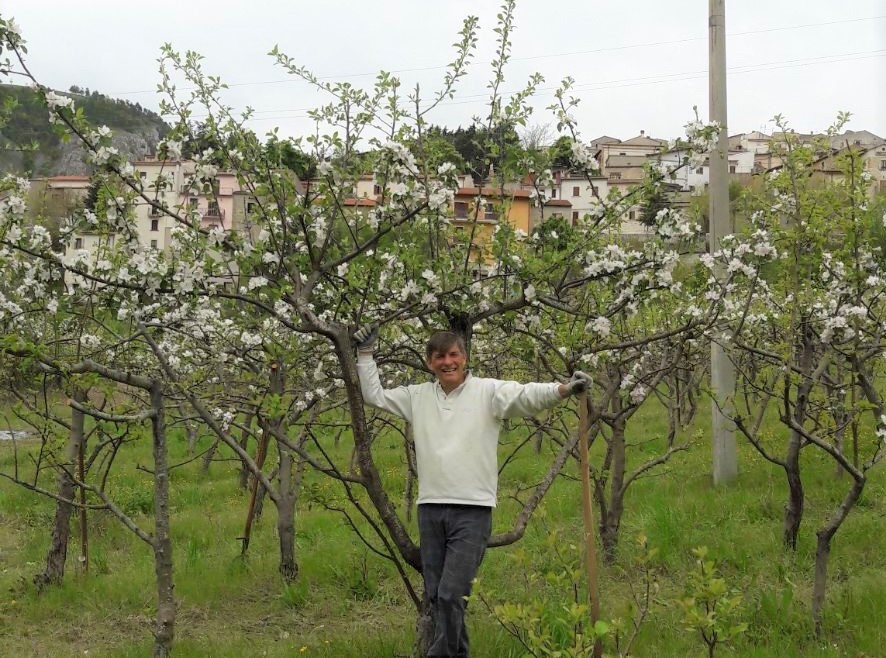 Maurizio in his Apple Orchard[/caption]
I must confess that I was very proud of the photographic image chosen by the authors of the atlas to describe the valley in which our apple orchard is represented with the profile of the town of Ortona in the background.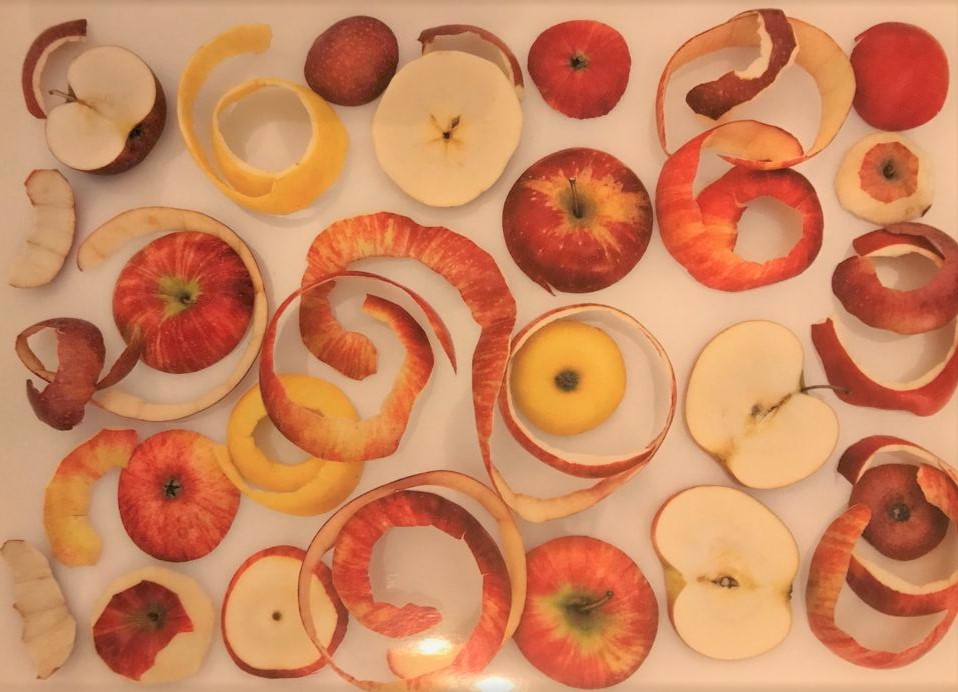
The limoncella apple (the most famous of the Ortona apples, with a characteristic sour taste), the cerina apple (also called ‘spinster’, due to its late ripening but extremely long-lasting), the appia (very tasty and with anti-inflammatory properties), the pianuccia apple (flattened at the ends), the onion apple (large in size with an aftertaste similar to the flavour of the onion) and the granettona apple (similar to renetta but larger in size), are just some of the varieties that characterize the Ortona area and qualify the product of the country.
In 2017, the Higher Institute for Environmental Protection and Research (ISPRA) published the volume "Forgotten fruits and recovered biodiversity: the fruit and viticulture germplasm of traditional Italian agriculture. Case studies: Lazio and Abruzzo ", where there is a specific and detailed form concerning the limoncella of the Valle del Giovenco.
Limoncella apple is a medium to medium-small, elongated, cylindrical-conical or truncated-conical fruit, almost always asymmetrical, with a medium-short, thick peduncle (stalk bearing the fruit), inserted in a deep and narrow cavity, almost acute and a semi-open calycine cavity, shallow and pleated.
The skin of the limoncella has a yellow colour when ripe, slightly rough, with few lenticels emerged. The fruit is harvested in October, is easy to conserve, it is consumed from November to March even if stored at room temperature (however in a cool environment).
Characteristic is its progressive drying during the winter which makes it gradually more acidic, without becoming floury.
In his book "Ortona dei Marsi, fragments ...", Giancarlo Antonangeli reminds us of the well-known healing properties of apples:
“In Ortona dei Marsi until a few years ago the officinal (used in medicine) properties of apples were used essentially for the treatment of bronchial affections that afflicted children and old people.
For example, a decoction of Appie, Pianucce and ènnas' apples (anise - Pimpinella asinum - for its sedative and expectorant properties) sweetened with abundant horehound honey was rubbed on feverish young children to cool them.
And they were put to sleep with - ‘n matnij call’ ‘n bepp’ - a clay brick heated on the embers, wrapped in a woollen cloth, and placed directly on the breast of the patient. In the morning the symptoms of constipation had almost disappeared".
Finally, I like to remember that the birth and development of Renaissance cities had to follow precise rules: one third of the surface had to be cities, a third garden and a third field in order to achieve food self-sufficiency and, therefore, peace of people.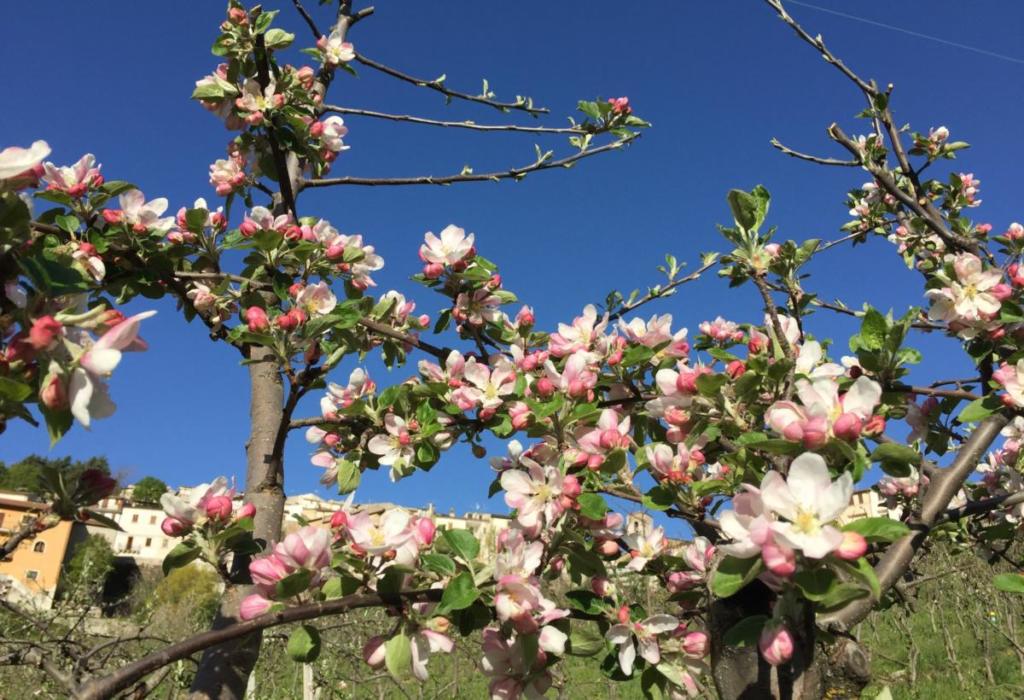
The fact that our apple orchard in Ortona is an extension of the garden and the home puts me in a condition of coherence with this planning approach to places for humans to live.
I like this harmony.
In 1305, Piero de 'Crescenzi wrote a treatise on agriculture and described what he thought was an ornamental garden that "gave the soul pleasure" and which "retains health of the body" because "the body complexion always approaches and conforms to the desire of the soul".
Here, then, are his instructions:
"The garden next to the house needs to have free flowing air, while too much shadow generates infirmity. The aforementioned harmful trees must not include walnut and some others. But they must be sweet and fragrant in flowers, and cheerful in the shade, as are the vines, the apple trees, the pear trees, the laurels, the pomegranates, the cypresses and the like ”.
Ortona, I'm coming ...


Follow us