


Who remembers those brushstrokes of oleanders along the Autostrada del Sole?
The colorful oleander hedges that from June to September provided a light of colorful joy, a splash of color amidst the gray asphalt, still fill my heart, and every time I take the highway I wonder why they're gone.
The hedges were cut almost to the ground in winter, but undaunted, they regrown every spring, marking the time of summer and vacation.
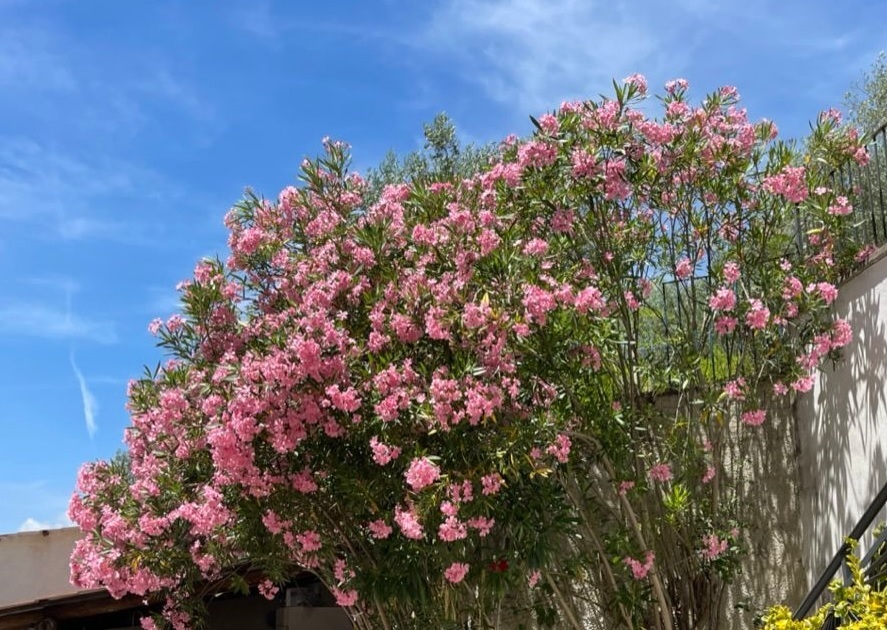
For me, the oleander is pure joy and symbolizes warm summer days, the dry ones accompanied by the song of cicadas, and I would put it anywhere.
It represents our countryside and southern Italy, because I never found them in my cousins' gardens in the north. Its original Greek name, "nerion," means water, and indeed they reveal the presence of underground streams and when oleanders grow wild. The plant is said to be native to Greece, to the magical region of Colchis.
The oleander has a strange history because its beauty is matched by its dangerous flowers and leaves. They're poisonous: but why would anyone eat oleander leaves?
Perhaps someone could take inspiration from the movie White Oleander to kill their mother-in-law!
Many stories serve precisely to remind people not to eat flowers and leaves, such as the story by Apuleius in his novel The Metamorphoses. The story is about a young boy transformed into a donkey who had to eat roses to become a man again. But the donkey was about to eat the oleander flowers and realized his mistake just in time, hence the name "donkey killer."
Another urban legend tells of a group of hunters who died from cooking meat on charcoal made from oleander branches.
What is certain is the power of its beauty, which is depicted in many paintings, such as Raphael's Marriage of the Virgin. St. Joseph's staff was made from a dried oleander, but when St. Joseph stuck it into the ground, the branch bloomed again. From this story comes another name for the oleander, which is also called St. Joseph's staff.


Follow us