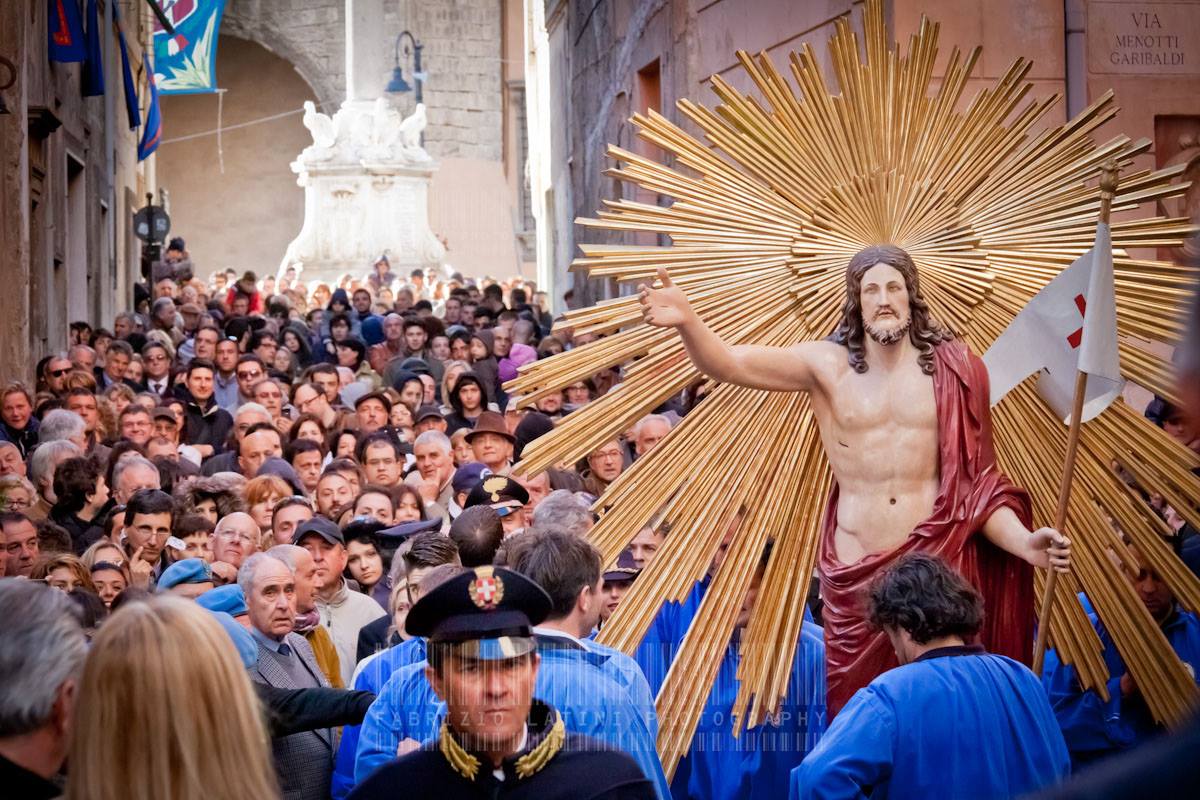
Tarquinia - Processione del Cristo Risorto by Fabrizio Latini

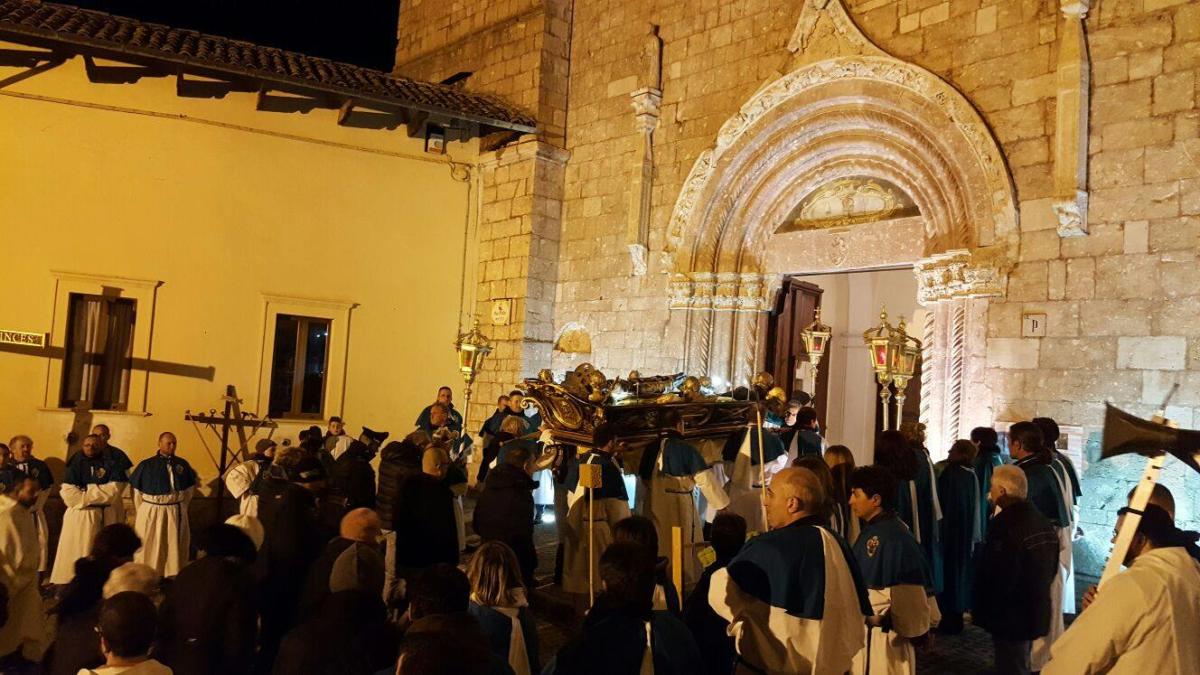
Tarquinia has chosen to celebrate Easter on the day of the Resurrection instead of the day of the Passion and therefore the feast takes on a joyful character with a procession of a great Risen Christ.

The Procession of the Risen Christ in Tarquinia celebrated on Easter Sunday is one of the most heartfelt festivals in the city and one of the traditional events of Tuscia.

It is also called the Procession of the Christ who Runs because, unlike the slow processions of the days of the Passion, it moves forward quickly and the music is a cheerful march.

The procession starts from the church of the Trinity (shaded Dante Alighieri) and runs along the streets of the historic centre to return to the church of the Trinity.

The large wooden statue of the Blessing Christ with its burial garments dates back to 1832 and a legend says that it was made by a person serving a life sentence. The sculptor would then be blinded by God to prevent him from making another equally beautiful one.

The statue is placed on a large procession carriage and carried on the shoulders by a confraternity between festive wings of people and with the music of the Band of Setaccioli.

The procession team opens with the riflemen with their guns loaded with blanks.

An original component of this procession is the cross bearers (one for each church in Tarquinia), the same as in the Friday procession (like the other extras), but now adorned with splendid garlands.

The bearers of the statue, as well as their colleagues with the trunks, must respect the pitch and beat of the musical march sung by the band.

The procession ends with the blessing of the crowd in Piazza Matteotti and finally with the deposition of the Christ inside the Church of San Giuseppe where he remains on display for the next forty days.
powered by social2s
Sutri. Easter Holy Week among events and processions

The celebrations of Easter in Sutri, a splendid village of Tuscia with a spectacular Roman archaeological park, begin on Holy Wednesday with a representation of the Passion of Jesus with ‘living pictures’.

The streets of the ancient medieval centre are transformed and come to life with the scenes of the Gospel interpreted by the citizens.

It begins with the accusations against Jesus and Roman soldiers lead him into the stage tying him to a column for scourging.

The next living picture is the scene with the priests who accuse him and the crowd selecting between Jesus and Barabbas.

Then Pilate definitively condemns Jesus and from this moment the scenes represent the journey and the Via Crucis up to the dramatic crucifixion.

Then follow a series of scenes on the pain of Mary and the pious women until that of the deposition of the body of the dead Christ and the last scene is that of the Pietà.

The whole town of Sutri is involved and the sets, the veracity of the scenes and a skillful soundtrack contribute to making this representation particularly impressive.

On Good Friday evening, the celebrations continue with a solemn procession attended by all the brotherhoods of the city to the sound of the musical band.

It ends with the solemn mass in which the coffin of the veiled Dead Christ and of Our Lady of Sorrows meet at Easter Resurrection.

powered by social2s
Easter Holy Week in Cittaducale: performance in the village

In the province of Rieti, one of the most noteworthy performances of the Passion of Christ is that of Cittaducale, one of the most impressive villages on the border with Abruzzo.

The event has very ancient roots and took place during the sixteenth century when these territories were ruled by the Madama, Margaret of Austria. The tradition was then interrupted only to resume a few years ago.

The performance of the final scenes of the life of Christ is staged thanks to the work of the citizens and is one of the most anticipated events by the faithful for its religious and historical characteristics.

The traditional procession over time has taken on the appearance of a traveling theatre show.

In various areas of the town scenes are set up that tell the most significant moments of the Passion of Christ: the last supper, the olive grove, the arrest, the flagellation, the crucifixion, up to the procession with the Dead Christ and Our Lady of Sorrows.

The scenes are both recited and sometimes narrated to increase the emotional involvement of the spectators.

The episodes and dialogues are closely linked to the evangelical narrative. The characters represented wear traditional vintage clothes, cared for down to the smallest detail.

powered by social2s
12440736_842001719242853_6712197042204657839_o-1024x576.jpg

Holy Week is a special period of worship in Leonessa, one of the most beautiful villages of Lazio lying on a plain at a thousand meters of altitude just below the Terminillo massif.

For three days there are sacred rites, processions and acts of faith with an ancient traditional flavour. From sadness to joy.

There are three processions: on Holy Friday the procession of the Dead Christ takes place, on Saturday is the procession with the statue of the Madonna della Pietà and on Easter Sunday that of the Risen Christ followed by the traditional Easter breakfast.

The nocturnal procession of the Dead Christ is the most heartfelt and spectacular and begins with the sound of the 'tanavelle' to recall the faithful to the religious celebration of the Adoration of the Cross.

The ‘tanavelle’ are typical Leonessa musical instruments and were used when bells were tied as a sign of mourning and could not be played.

It is a wooden table with a handle and on the table metal objects are tied with a thread. Shaking the table these objects hit the wood and make a sound.

At this point the statue of the Dead Christ, a work of the XVI century of the Umbrian school, is placed in a finely worked wood and gold coffin of late Baroque style and is ready to be carried in procession on shoulders by bearers of the Brotherhood who change along the way.

The procession goes through the streets of Leonessa, lit only by torches, and begins with a large cross carried by the Confraternity of Santa Croce followed by the coffin of the dead Christ and by the Three Marys and Veronica, barefoot, dressed in black and covered with veils.

The three Marys are young girls who belong to the Pietà and Grazie brotherhood with headquarters in the Church of St Peter, while Veronica is part of the Confraternity of Santa Croce.

Then the faithful follow and all sing the songs of tradition that tell the pain of the Madonna, such as the Stabat Mater.

The procession goes to all the churches of Leonessa in what is considered the "visit to the sepulchres" until it meets the Madonna in the likeness of the Pietà.

The procession of Holy Saturday takes place in the afternoon and is organized by the Confraternity of the Madonna delle Grazie.

During the event the wooden statuette of the Pietà, a good copy of the Michelangelo Pietà which is located in Saint Peter’s in Rome, is carried in procession along the streets of the ancient village.

The procession is always accompanied by the Three Marys.

The third procession is that of the Risen Christ on Easter Day and takes place early in the morning before the celebration of Holy Mass.

The tradition of Leonessa requires this to be followed by a rich Easter breakfast based on omelette, Easter pizza, salami and a blessed hard-boiled egg.

powered by social2s
Ladispoli. Feast of Saint Joseph Artigiano

In March in Ladispoli an opportunity to taste the first artichokes of the season, and a few cream puffs of San Giuseppe.

Ladispoli celebrates its patron saint on March 19th with great celebrations.

A feast in honor of San Giuseppe Artigiano, which begins in the morning with the solemn mass in honor of the saint and continues with the procession of his statue through the streets of the town.

powered by social2s
Santa Marinella. Feast of San Giuseppe Artigiano

The patron Saint Joseph Artigiano of Santa Marinella is celebrated with great celebrations on 19 March between sacred and profane.

The day begins with the solemn Mass in honor of the saint and follows the procession of the latter's statue through the streets of the village.

Throughout the day the town in the province of Rome comes alive with performances by street artists, shows and street food stands within the reach of all visitors.

powered by social2s

Subscribe to Newsletter

Discover a territory through the emotions of the people that have lived it.