Militello in Val di Catania. Feast of the Madonna della Stella

The feast of the Madonna della Stella, the main patron saint of Militello in Val di Catania, is the most important religious festival in the city and is celebrated on 8 September.

The feast of the patron saint: the Madonna della Stella
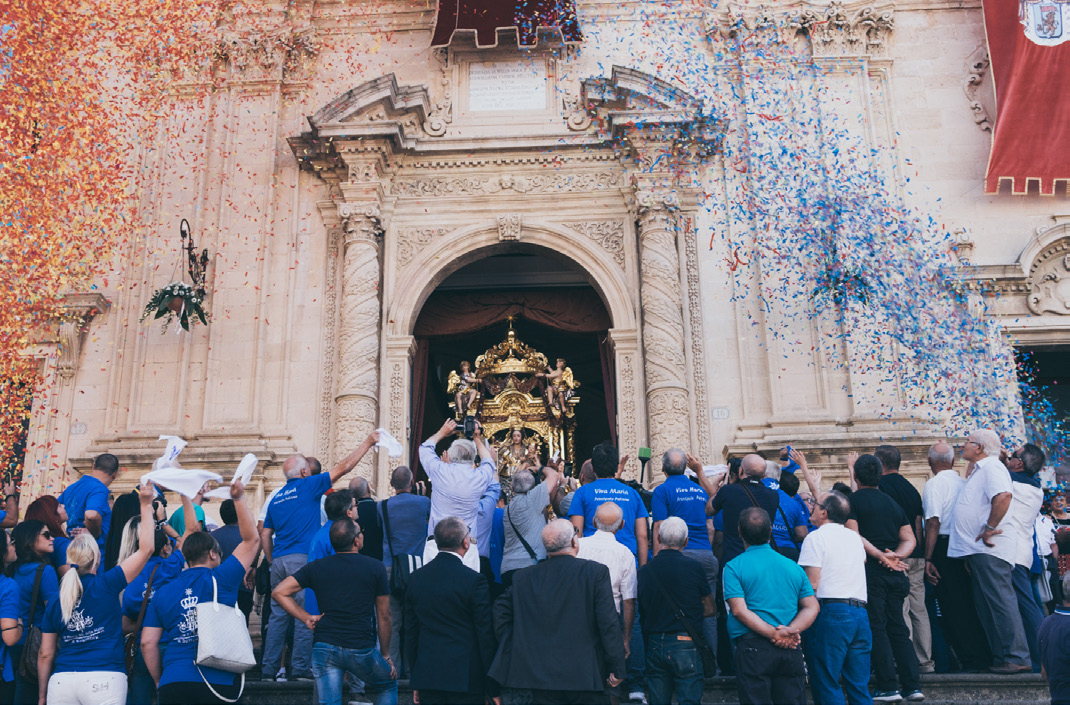
The celebrations in honor of the Madonna della Stella begin on August 29th with the traditional procession of the "Cantata" for the main streets of the city, accompanied by fireworks.

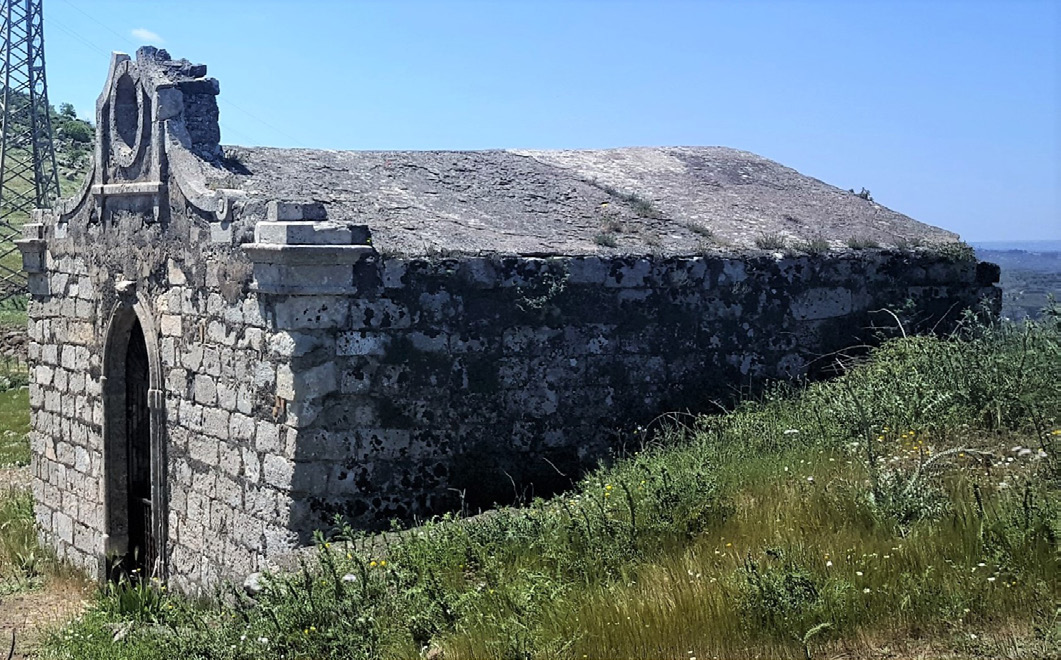
Followed by nine days of preparation for the festival, until vigilia, on 7 September, when the doors of the chapel are opened, which house the precious simulacrum of Maria Santissima della Stella.

It is a precious statue in golden wood and hemp of 1618, restored after the earthquake in 1693 by the sculptor Camillo Confalone.

The statue, on the occasion of the celebrations and after the offering of the votive candle by the Mayor, is placed on a throne within a rich eighteenth-century wooden fercolo, preparing it for the procession the following day.

On 8 September, in fact, the Madonna is taken around the streets of the city, surrounded by great emotion and popular devotion.

The program of religious and recreational events of the days of the Christmas Eve also includes the parade of flag-wavers, the musical band, fireworks, concerts and musical performances.

Mariani and Nicolesi
The religious, social and civil history of the militellesi is characterized by a strenuous opposition between nicolesi, the parishioners of the church of San Nicola, and Marians, supporters of Santa Maria della Stella.

The two cults are born in medieval times but the dispute is more recent. It was caused by the decrees of the Council of Trent which, from the second half of the 1500s, distinguished the master churches and the parish churches.

From that moment on a terrible competition on maturity started (not always played correctly on the interpretation and / or interpolation of ancient archival documents), to claim for one or the other parish the greatest antiquity in the exercise of matrix rights.

This explains the "competition" among the supporters to those who shoot the most beautiful fires or decorate the city with the most splendid lights.
powered by social2s
Militello in Val di Catania. Festival of the Santissimo Salvatore 

A patron saint of Militello since 1788, the Most Holy Savior is celebrated on August 18th, but the festive atmosphere resounds in the streets already in the preceding seven days.

The feast of the patron: the SS. Savior
The feast of the SS. Salvatore begins 10 days before August 18, with the "Cantata" of songs and prayers, the bells that ring to party and the cannons that shoot to blanks.

In the evening, along the main streets, a canvas is carried in procession, depicting the face of Christ the Savior, the work of an unknown artist of the early 1800s. a refrain to announce the approach of the holiday.

It is preceded by numerous recreational events and by the celebrations of the "Novenario", the following 9 days, until the 17th, "Vigilia" of the festival, in which some traditional rituals take place.

In the morning, the local marching band body roams the city for the traditional begging; in the evening, the Mayor and the religious and civil Authorities, escorted by the delegation of the Committee for the celebrations, go to the Mother Church.

Everyone brings with him his silver key with which to open the bronze door of the sacellum (the Mayor key "Vrbis Praefe - Patron Svo", the President of the festivities the "Vniversitas Militelli - Patron Svo", the Parish Priest the "Archipresbyter - Patron Svo").

The offering of the votive candle and flowers to the patron is followed by the unveiling of the canvas with the effigy of the Holy Savior. On the morning of the 18th, one hundred and one cannon shots and bells announce the feast day.

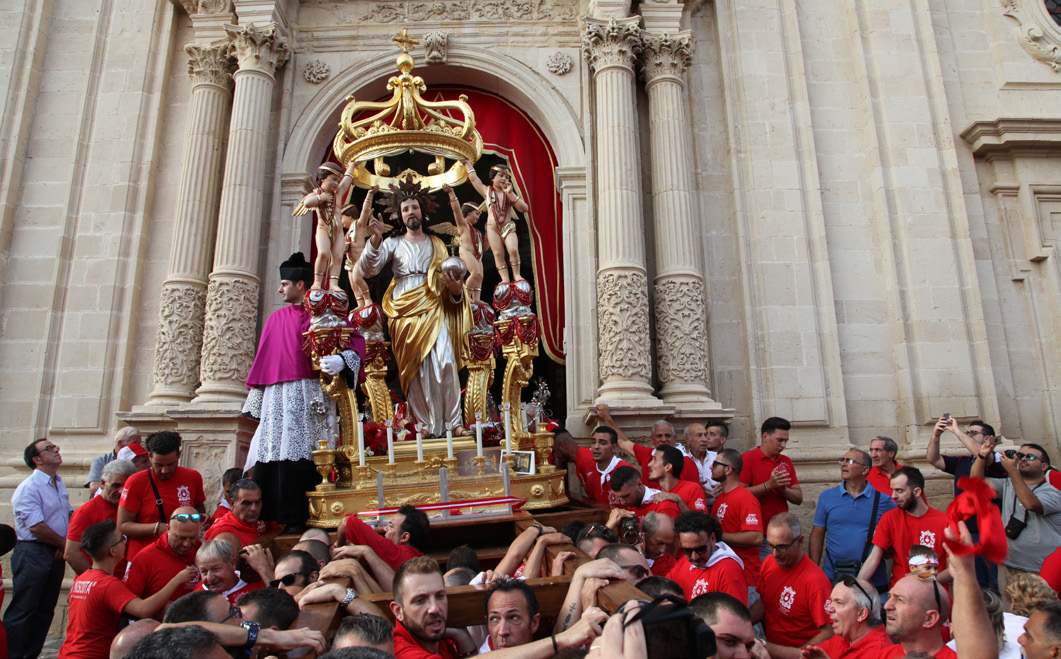
The solemn Pontifical in the morning opens the afternoon celebrations, with the exit of the fercolo from the Mother Church.

On the occasion of the procession, the parents entrust their still newborn children to the Patron, dressed only in the traditional red dress, a symbol of faith and devotion to Christ.

The procession ends, among colorful fireworks, with the ascent to Mount Calvary.

The celebrations conclude with the "Prayer Vigil" on the 24th and a last brief procession up to the "four songs" on the 25th.

powered by social2s
Militello in Val di Catania. Feast of the Santa Croce 

On May 1st of each year (the first was celebrated on the 3rd) a holy mass is celebrated at the Church of the Holy Cross, attended by hundreds of faithful.

A "double" party
This festival was born in memory of the discovery of the Cross of Jesus by St. Helena, mother of the emperor Constantine, which, according to tradition, took place on September 14th of 320 AD

Starting in the 7th century AD, according to the Welsh custom, the feast of the Cross was held on 3 May.

When the Roman and Welsh traditions joined, the September date remained, assuming in 1963 the official name of Triumph of the Cross (to commemorate the conquest of the Cross by the Persians in 628 AD by the emperor Heraclius), while the date in May it was maintained as a Discovery (or Invention) of the Holy Cross.

powered by social2s
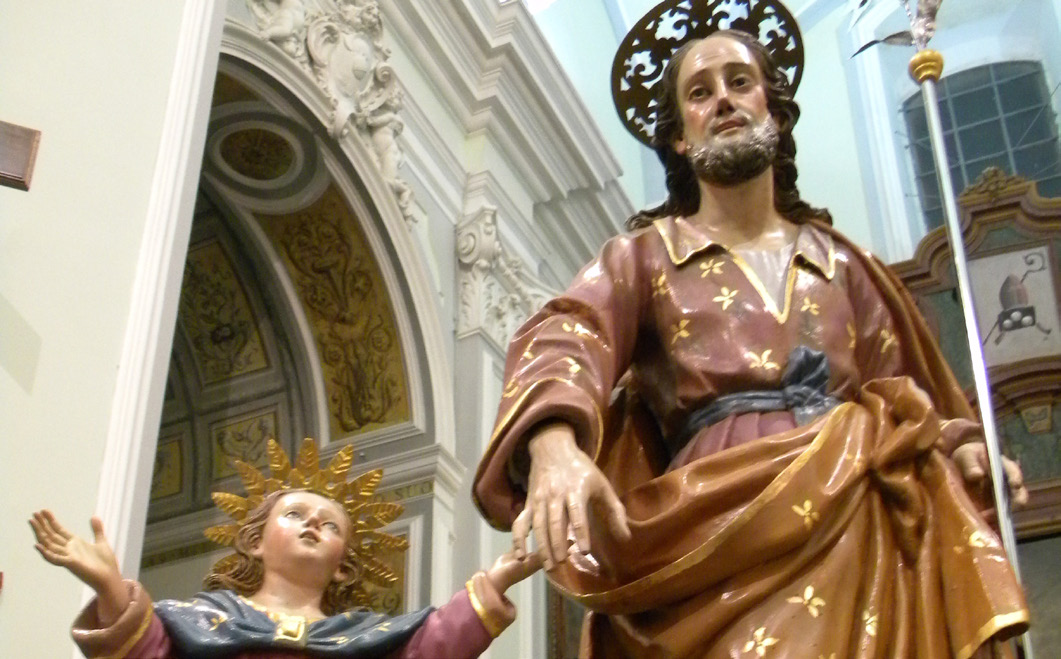
Militello in Val di Catania. Feast of St Joseph 

The feast of St Joseph is particularly felt in Militello in Val di Catania and is preceded by the celebrations of the septenary from 13 to 18 March.

The solemn celebrations follow on March 19 at the Mother Church of San Nicolò and then the procession with the simulacrum of San Giuseppe follows.

An auction for the poor

On the occasion of the feast of St. Joseph, in the afternoon of March 19 before the final holy mass, the traditional "auction of St. Joseph" takes place in Piazza Vittorio Emanuele.

It is a charity auction, with the sale of typical products of the local gastronomy (rows of dried figs, sweets, biscuits, etc.), the proceeds of which are donated to three poor people of the country. They emblematically represent St. Joseph, Mary and Jesus.

powered by social2s
Militello in Val di Catania. Holy Week

In Militello in Val di Catania, the festivities of the Holy Week begin on Ash Wednesday in the Church of Santa Maria della Stella and, after the procession at the Church of the Holy Cross on Calvary, end on Friday in the Church of San Nicolò.

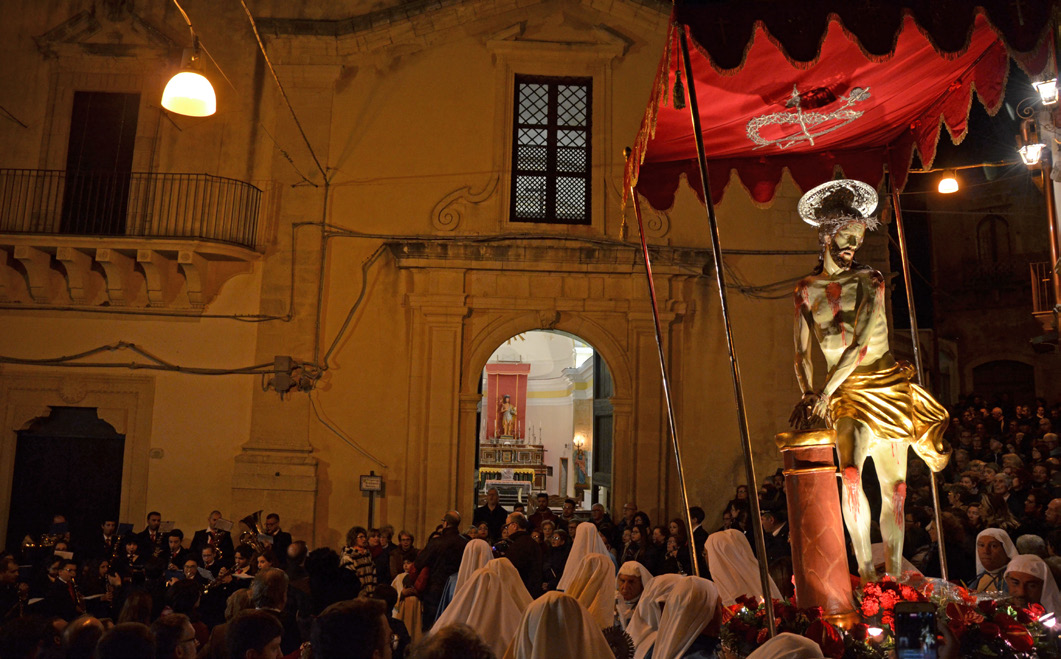
The procession of Christ to the column

On the Ash Wednesday the procession of the seventeenth-century Christ to the column begins whose simulacrum, taken from the Church of Santa Maria della Stella, is carried in procession on the shoulder through the streets of the town until late evening.

On Good Friday at the Church of Calvary a moving procession takes place, on the occasion of the historical reconstruction of the Passion of the Savior. Starting from the morning, the Via Crucis Vivente, from Piazza Vittorio Emanuele to Calvario, is staged.

Here the statue of Christ is brought under the portico and the scene of the Crucifixion begins: the statue is hoisted on the ancient cross (passing a white cloth under the armpits) and the friars proceed to nail it.

A bomb, called miana, explodes with every hammer blow.

At sunset, Christ is laid dead on a funeral bed (which the brothers brought so far from the Istituto delle Orfanelle) to be buried in the Church of San Nicolò.

Accompanied by themarching  band that plays in mourning, the fercolo is carried on the shoulder by young men dressed in white, while the Virgin wrapped in a black cloak follows him along with women and girls also dressed in black.

The complaints that the women offer along the sad procession are ancient screams that make the event even more dramatic. After the ceremony, the statue is hidden behind the Calvary Church.

powered by social2s

In the splendid setting of the Moutan Botanical Garden, just outside the village of Vitorchiano, nature is celebrated with an event dedicated to plants and gardening.

A market exhibition in which horticulturalists and enthusiasts from all over the province participate every year, takes place within one of the most beautiful parks and botanical centers in Lazio.

A park famous for its extensive collection of peonies from all over the world, which every year with their spring bloom give a sight to be seen at least once in a lifetime.

powered by social2s

In Vitorchiano, a village in the Province of Viterbo, one of the most popular types of traditional pasta, the Cavatello Vitorchianese, is celebrated with a festival.

Different in shape compared to the Apulian / Molisana counterpart, the cavatelli of Vitorchiano are a poor dish of the tradition of this village, they are still prepared today on festive occasions by local housewives.

The dough is simple, water and flour, and once kneaded and left to rest, it is cut into spaghetti-like strips, and stretched at the ends. This operation gives it the appearance of a rustic "spaghetti".

They are traditionally seasoned with a sauce of wild fennel flowers, which are fried in oil to flavor it, finally adding the tomato puree.

A relaxing weekend in one of the most beautiful villages in Tuscia, to savor a typical dish that tastes of tradition, immersing yourself in fun and happiness.

powered by social2s

The Ciociaro village of Arpino celebrates the beloved Saint Ann with a weekend of religious celebrations that involve the whole town in an atmosphere of joyful devotion.

The feast of Saint Ann begins with the traditional mass in honor of the Saint and continues with the procession through the streets of the ancient village. Throughout the event there are stands and craft stalls offering typical local products, and tastings open to all curious gastronauts.

powered by social2s

Recommended

Subscribe to Newsletter

Discover a territory through the emotions of the people that have lived it.