


When in Sciacca and you want to express the fact that someone is working for personal interest, you say "e finou a pasta cui saddi" (it all ends in pasta with sardines).
These are popular sayings that reflect feelings better than any other word and are often typically dialectal expressions. For me the most beautiful and folkloric take their cue from the table and combine the values of gastronomic traditions with those of everyday life.
Sciacca, my town, is a seaside town and smells of sea and salt. It has always tasted of minerality and has grown with the sea in these three millennia of history.
Blue and white fish and pink shellfish from the sea and olives, almond trees, wine and citrus fruits from the land. All united at the table in a mixture of olfactory and taste sensations that are our richness and food and wine culture.
The sardines of Sciacca have always been a driving force for the growth of my town and with its industries they have "fed" the economy of the people of the port.
And the "sciacchitana" pasta with sardines (from Sciacca) is the dish that unites the sea with the countryside, represents Sciacca and differs from the Palermo version with tomato preserves.
The sardines taken in the months with the "R" are tastier, as they say, but in truth they are good and available all year round, especially from spring to autumn when wild fennel is also rich in fragrance and flavours.
The pasta with Sciacca sardines draws inspiration and variation from the so-called "Pasta a Milanisa", where Milan was understood as "u continents".
It is said that due to the first large migratory flows from south to north in the late 1700s the "southerners from Agrigento" tried to find their original flavours by preparing pasta with sardines and / or salted anchovies (cui saddi a mari (salted sardines), because fresh sardines were not available), sautéed onion, tomato sauce and, when they were also found in the Po countryside, wild fennel.
To these ingredients often carried in cardboard suitcases, others were added such as raisins and pine nuts that recreated in the mouth that proximity to their land of origin and that gastronomic game of sweet and sour, reminiscent of the culture of Arab origin.
When they returned to Sciacca from the "continent", the emigrants brought back the "Pasta a Milanisa" which over time became the name with which pasta with sardines alla saccense (from Sciacca) is generally still used.
"And ended up with pasta with sardines".
The epilogue of this story is my version of "Pasta con le sarde alla saccense" = ‘pasta with sardines from Sciacca’, reinterpreted and enriched by another excellence of the Sciacca sea: the pink shrimp. Its sweetness and the play of textures pleasantly grace the strong flavour of fresh sardines and desalted anchovies.
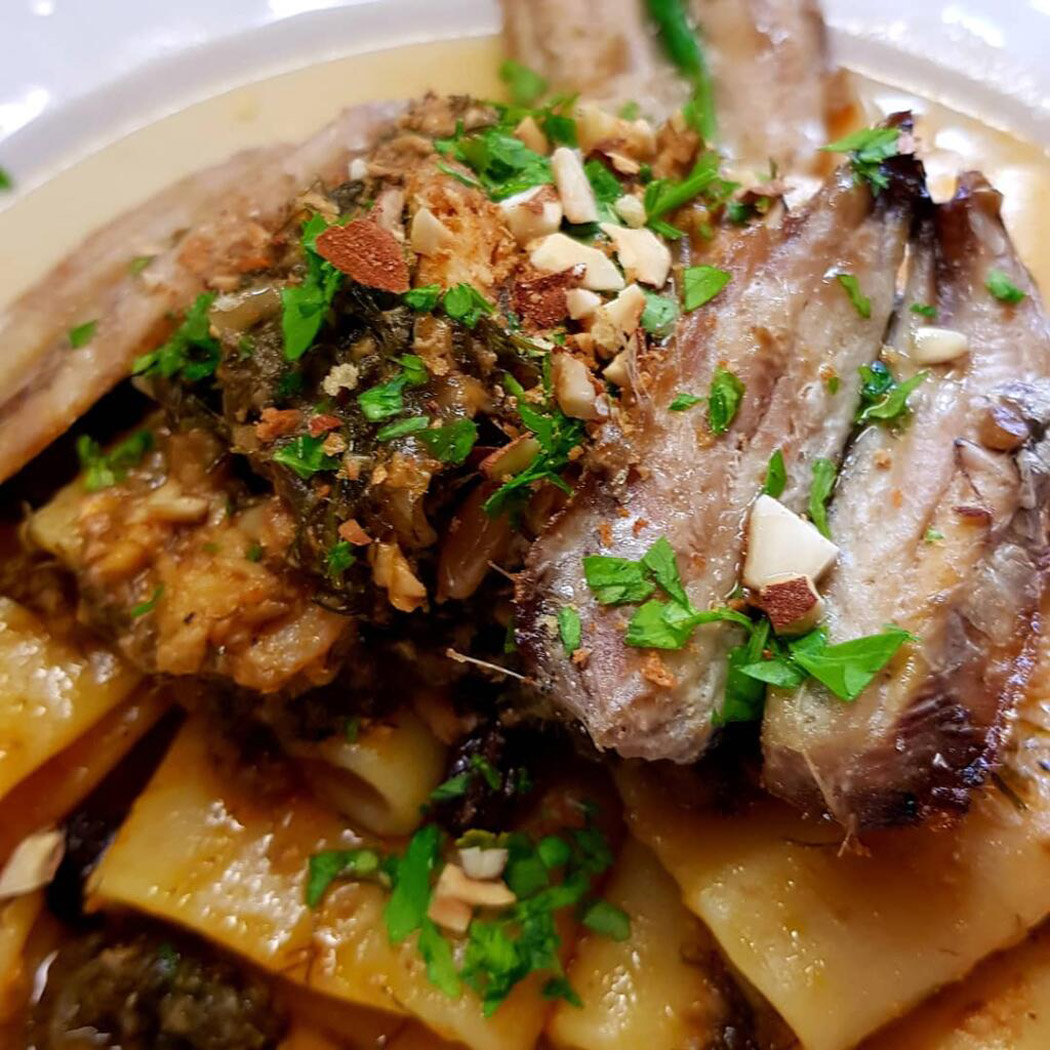
Recipe of "Pasta with sardines from Sciacca and pink shrimp from Sciacca"
Ingredients for 4/5 servings (depends on the belly)
- durum wheat pasta 400 gr
- fresh sardines cleaned (weighed clean) 500/600 gr
- whole pink shrimp 1 kg
- wild fennel 500 gr
- double concentrated tomato paste 70 gr
- 5 netted and boned desalinated anchovies (otherwise 10 desalted anchovy fillets in oil; or, for a more decisive and salty flavour, 5 desalinated sardine fillets or fillets in oil)
- 2 white or golden onions (otherwise 1 onion, 2 small shallots and 1 clove of garlic)
- 1 glass of white wine (Catarrato, Trebbiamo, Grillo and Insolia)
- 20 g of pine nuts and 30 g of raisins found in white wine, 1 tablespoon of white wine vinegar
- 1 sprig of parsley
- 1 bay leaf
- extra virgin olive oil
- salt and black pepper
- peel of one lemon
- lightly toasted breadcrumbs with chopped almonds 50 gr
Wash and de-bone the sardines and peel the pink shrimp. With the heads and shells, make a broth by combining the parsley stalks, a bay leaf and a pinch of salt.
Wash well and select the most tender parts of the wild fennel, both the stems and the most aromatic and green leaves.
Bring plenty of freshly salted water to a boil, add all the selected fennel and cook for about 5 minutes. Leave the fennel still al dente and drain it well from its water. Keep the cooking water of the fennel: we will need it to cook the pasta.
In a saucepan, fry the julienne the onion (or the other combination) and fry on a base of EVO oil and then add a ladle of the shrimp soup. Let the onion simmer and brown for a few minutes.
Add the desalted anchovies (or alternatives), the soaked raisins, the pine nuts and, shortly after, just over half of the clean fresh sardines.
A few more minutes and pour the glass of white wine and the spoonful of vinegar.
Let it evaporate over high heat and add the previously blanched fennel that you have coarsely chopped. Pour a ladle of the fish broth and let it simmer again.
When everything is still liquid enough, add and disperse the tomato paste. The mixture should be soft and already coloured red. If too dry, add another ladle of shrimp broth.
Let it simmer, with the lid half open, for about 20 minutes and taste to season with salt and black pepper.
In the meantime, drain and filter all the shrimp scraps from their soup. Reduce the broth over high heat, adjusting it with salt and adding a drizzle of extra virgin olive oil. It will need to reach a slightly denser consistency.
Bring the cooking water of the fennel back to the boil, season with salt if necessary, and lower the pasta to taste.
Heat the sardine and fennel sauce, add the fresh peeled shrimp and the fresh grated lemon peel. Combine all the ingredients well.
For the other half of the fresh sardines, put them into a pan with a drizzle of extra virgin olive oil and cook until roasted.
Drain the pasta while still al dente, add it and stir it in the sardine and fennel sauce, then let it rest, covered, for about 5 minutes. Just enough time to cut the parsley finely and to toast the breadcrumbs with a drizzle of extra virgin olive oil and chopped almonds.
Now we compose the dish
Serve a light stock of reduced shrimp broth, then arrange the pasta by pouring over part of the sardine and fennel sauce. Garnish the sardines cooked in a pan on top of the pasta.
Then add a sprinkling of parsley and breadcrumbs flavoured with almonds and finally, a drizzle of extra virgin olive oil and a sprig of fresh wild fennel for decoration.
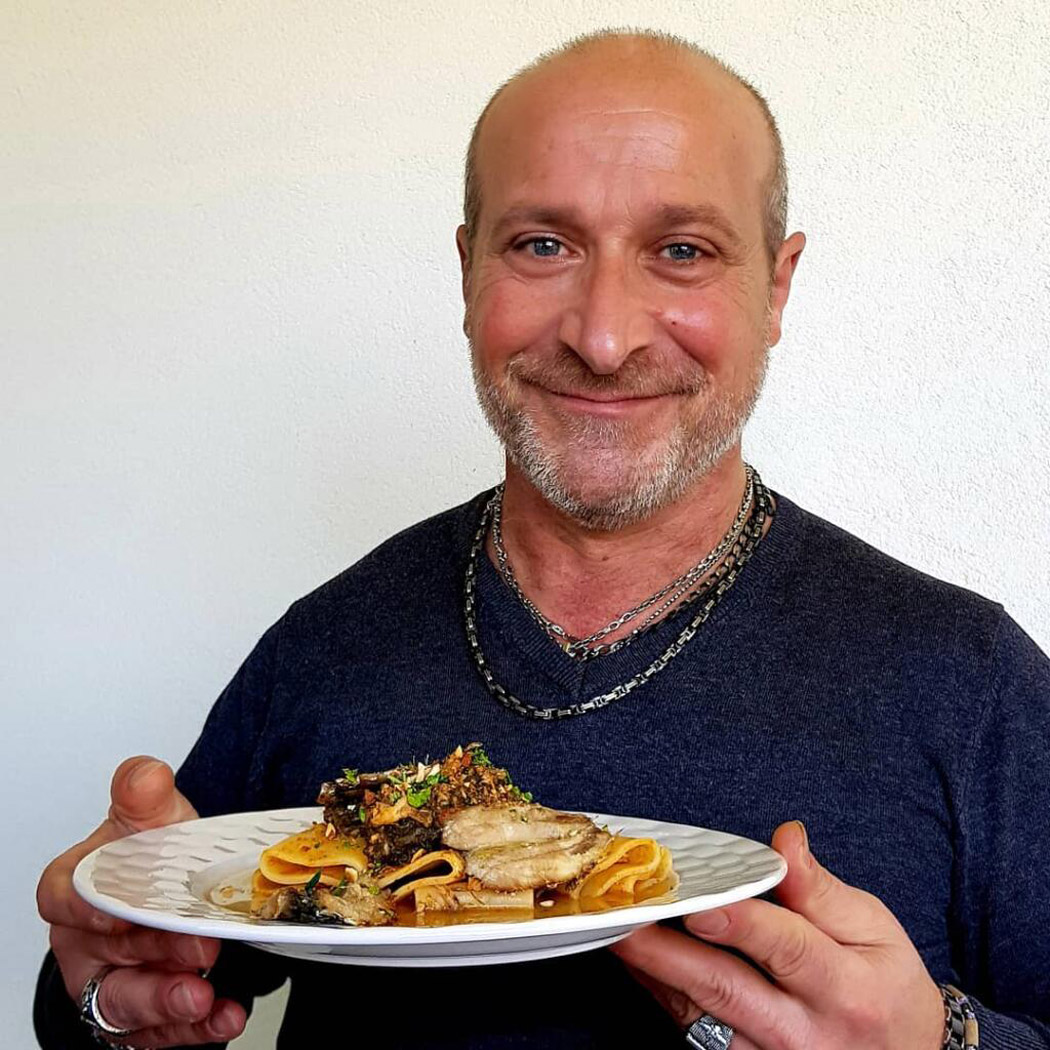
Here is my very personal interpretation of the “Pasta con le sarde alla saccense with pink shrimp from Sciacca”.
Comu finished? (how did it end?) Obviously: "we ended up with pasta cui saddi!".




Follow us