Davinci Experience
The enjoyment in Florence of the multimedia exhibition "The Da Vinci Experience and his real machines"

500 years of Leonardo da Vinci but still we can't get enough!

We visited the multimedia exhibition "The Da Vinci Experience and his realmachines" in Florence that is being held from May 23rd to November 3rd 2019 on the occasion of the 500th anniversary of Leonardo's death, and we were awestruck once again.

Leonardo Da Vinci, one of the most eclectic and brilliant men this world has seen.

It is a multimedia exhibition. With a small surcharge you can start the visit from the “Oculus VR” stations that in virtual reality show Leonardo's main inventions such as the tank, the cannon, and other war machines all visible in real life dimensions. With your eyes focusing on a machine, you can penetrate inside and see the details and the mechanisms of its action.

This first part is already an incredibly engaging, stimulating and fascinating experience, it gives the impression that you are able to shrink at will and penetrate into the machines.

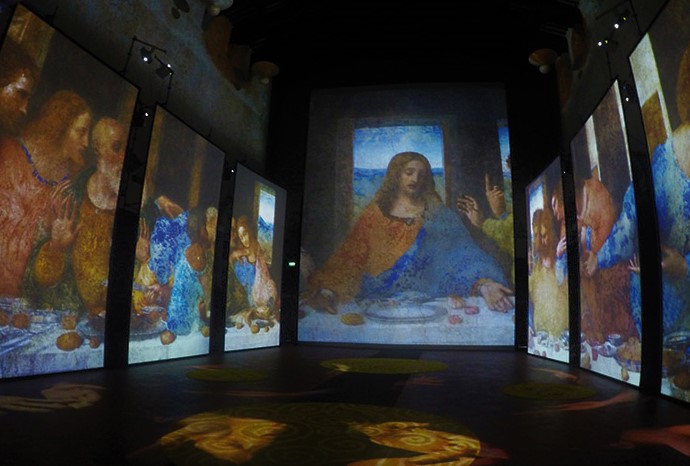
We then move on to the multimedia exhibition of the paintings, which is presented in this deconsecrated church, where you can see full images and details of each image continuously projected on all 4 walls of the church (and also on the floor) for a duration of 35 minutes.

The atmosphere is really special, the feeling is an immersion in a reality of other times and the expertly selected background music, diffused at 360° in "Dolby surround", increases the charm of the projected images.

The space is large so it feels like you are a grain of sand in infinity.

You can stand or sit and watch the projected images of which you can appreciate different details by moving to various spots. You listen to the background music in semi-darkness and in an extremely pleasant and relaxing atmosphere, so pleasant that you can stay there for hours and hear and see the projection several times because every time you notice different details and each time you appreciate different sections of the music tracks.

The images projected are taken from paintings or preparatory drawings with religious figures, women, men, animals, images of the machines he invented and their preparatory sketches. Also striking is the three-dimensionality of the figures that seem to come out of the paintings: the faces of the children are much more mature than their age (almost old) but all very expressive.

Another thing that excites is that Leonardo merges his anatomical and medical knowledge into those faces and some become even more intense and fascinating due to the physical imperfections that Leonardo's compulsive genius puts into it.

For example, experts say that the slight defect of the lips of the Mona Lisa is almost certainly due to Bell’s palsy, which consists of a dysfunction of the VII cranial nerve (facial nerve) that causes the lowering or raising of the angle of the mouth. Yet this makes that smile even more fascinating. Even the clothes and drapes are very neat and enveloping in these paintings.

But we must not stop and let ourselves be hypnotized by the projections. We advise everyone to take a tour of the entire church to observe the beauty of the details and to discover other interesting things that no one tells you about at the entrance nor are they indicated on the brochure because a multimedia exhibition also invites us to "do it yourself" and that is, to explore spaces in search of "hidden treasures".

If you do, you will discover something beautiful and exciting.

The exhibition highlights not only the eclectic nature of this 'brilliant man', much more than what can be seen in the exhibition itself, but also its vast knowledge, such as that of anatomy found in all the preparatory drawings for the final painting.

Leonardo, born in Anchiano April 15, 1452 and died May 2, 1519 in Amboise (at the age of 67 years very advanced for those times), had multiple interests ranging from the human sciences (he was anatomist and botanist) to the arts (draftsman, writer, set designer, painter architect, musician, sculptor), to technologist (civil and military engineer, designer). The depth of his knowledge and the genius of his observations, discoveries and applications is impressive.

The artistic beauty, the music, the arts in general represent a therapy of the soul and the body, and the multimedia presentations set up by teams of multidisciplinary experts have strengthened this positivity of art that we have been able to experience.

It is an exhibition we can share in three-dimensions and in dynamism where art becomes all-enveloping, surrounding us, we feel it, we breathe it, we touch it. It penetrates us and this gives strong sensations and emotions.

Time stands still, we are no longer in Florence in 2019 and not even at the time of Leonardo.

We are in a space of time in which the body vibrates, listens, rejoices. Every viewer becomes, whether he wants it or not, an integral and interacting part with the virtual images that envelop. Images that with their virtuality, their immateriality, envelop and pierce you, appear unexpected, fragmented, in movement, in fusion, peculiarly.

To us the synthesis, to us the active listening to Leonardo's unspoken message: exploring without setting boundaries, overcoming material obstacles and having the courage, even before the curiosity, to look beyond the visible.

This is an experience that remains well beyond the time spent in the splendid deconsecrated church, an experience that also re-emerges unintentionally during the gestures of everyday life that subsequently returns.

The exhibition was organized in the 1100s era deconsecrated church of Santo Stefano al Ponte in Piazza di Santo Stefano 5, right in the centre of Florence (www.davinciexperience.it).
powered by social2s
2018-nov-mostra-museo-rugby-Artena7-1024x683.jpg

What a birthday!

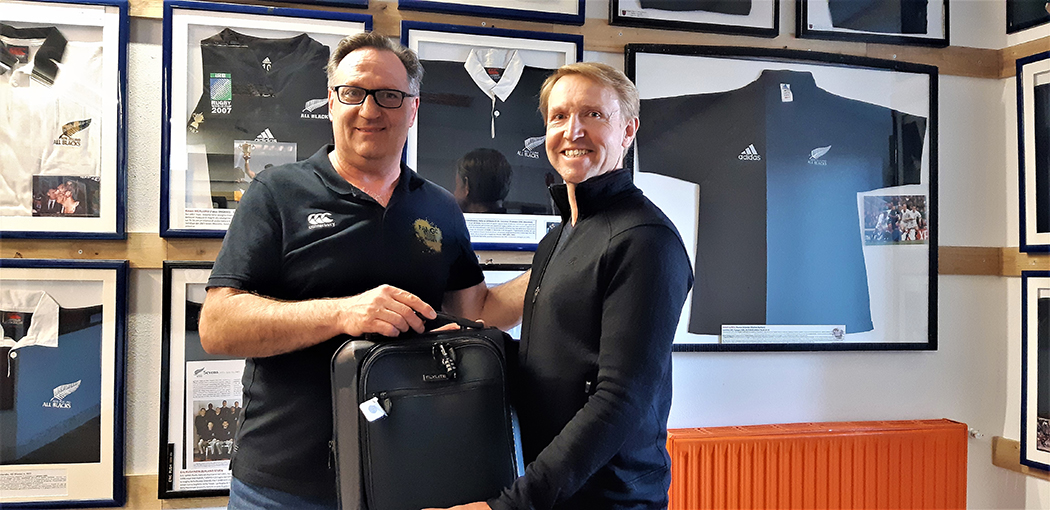
The Museum of Rugby Mud and Sweat in Artena celebrates its tenth anniversary with an exhibition that is unique in the world: an exhibition of the first All Blacks jersey from a game in Europe in 1905.

The jersey that came directly from the Palmerston North Museum (New Zealand) brought by the director of the museum Stephen Berg who inaugurated the exhibition and had to have a special permit from the New Zealand government to bring the jersey to Artena in Europe.

The jersey has a special meaning and was worn in the first tournament of the All Blacks in Europe.

It was 1905 and the New Zealand national team, which at that time was still called by the name 'The Originals', had travelled 40 days on a ship to reach Europe to play in the northern hemisphere.

The debut match had been in England with a selection of Devon and from the moment of their entry into the camp, everyone was amazed. In their black uniforms decorated with one silver fern, players began with the traditional Haka with which they launched their challenge and, yes, they presented as a compact group, with a single spirit.

The result of that match was 55 to 4 for the New Zealanders and that day their name changed to the All Blacks thanks to an article by John Buttery, a journalist of the Daily Mail. It is said that the original title was All Backs, dedicated to their positions in the field, but the printer edited the newspaper's print thought it was a mistake and that the journalist intended make a reference to the colour of the shirt.

From that moment onwards, the New Zealand team has universally been known worldwide as the 'All Blacks'.

The shirt that arrived at the Artena museum belonged to Jimmy Hunter, the shortest player of the team but still able to score 44 goals and with his teammates to win 35 meetings out of 36. Only Wales managed to win against the All Blacks.

This shirt was then purchased by the NZRM - New Zealand Rugby Museum of the All Blacks 15 years ago for 5,000 New Zealand dollars and has since become one of the legends of the nation. The museum is now the guardian of what is perhaps the oldest New Zealand tradition, the one about which the whole world knows and appreciates this country that is far from everyone and everything.

But the story of the arrival of this special All Blacks jersey in Artena starts a long time ago when Corrado Mattoccia, the director of the Artena museum that today is officially recognized by the Italian Rugby Federation, travelled to New Zealand to watch the matches and decided to go and visit the All Blacks museum in person.

With a friend of his, they drove for 14 hours to get to the museum and establish a direct contact and start a collaboration.

As a true collector, with over 1,800 jerseys and 15,000 objects from all over the world in the Artena museum, in the past 10 years Corrado has become one of the world's leading experts in counterfeiting of these products. The Artena collection has become a reference point to know the type of fabric, yarn, stitching that were used for the jerseys of each period and each country and Corrado is now called to verify the fakes.

His skill is such that he earned a letter of thanks from the All Blacks and this exhibition of 10 years of the museum is a thank you for what the museum is doing for this sport.

The exhibition of the Jersey of 1905

On the occasion of the exhibition some requests were made to the museum of Artena on the type of lights and microclimate that the hall had to use but this is not all.

The shirt is exhibited in the room dedicated to the All Blacks and to host it the architect Roberto Felici was called who created a true artistic installation.

The shirt is resting on a globe stylized like a stainless steel cage suspended in the sky, while on the floor was placed a large Cor-ten steel disc, that is covered by a patina (oxidation) that makes it look rusty.

The architect wanted to give different interpretations to his work: on the one hand the All Blacks as the centre of the world of rugby and the jersey placed at the center of this world.

This elegant world that preserves history is then reflected in the common world on earth, where all of us are – the place where there are the games that are played every day in various parts of the world, the sweat of children and adults, the cries of the fans and the beers of the third half.

Another key to understanding is that the world is suspended in space so also recalls the nearby Italian aerospace industry, Avio, which is one of the flagships of this territory. Here some parts of the Ariane are built, the European rocket that carries satellites into space.

'I enjoyed creating something that builds bridges between our countries. I am proud to have been called and for me this museum inside Palazzo Traietti in the historic centre of Artena is one of the best examples of urban regeneration. The historic centre of Artena has returned to flourish and to live", says Roberto Felici.

Now it is no longer unusual to hear foreign languages ​​and have new visitors in the streets of the largest pedestrian centre in Europe, perhaps on the back of a donkey with which you can book visits to the ancient village from the museum.

The Artena Museum of Rugby

But how was this museum born and how does it manage to fill 600 square metres of a historic Artena building?

It all started 10 years ago in Corrado Mattoccia's garage: there is always a 'number one' in every collection. Corrado brought a jersey of Mirco Bergamasco to his son and decided to display it to his friends - particularly passionate friends who gradually become involved in the passion of Corrado and started to follow him in his 'follies'. They are the ones who made the first frames and they started to organize dinners to support the museum.

They have been seen every week and for years they put in their efforts in order to build their dream. Friday dinners have become an appointment for many and the rugby museum's 'third half' stand is practically present at every local event to raise funds for the museum.

A special mention goes to the chef Ubaldo Mattozzi who is also the carpenter who made almost all the furniture. By now he is so good that he has practically become a chef while he involves his wife in the evenings because between his work and the voluntary efforts for the museum he would not be able to see her. But everyone is served at the table: from Corrado to his sons and his wife Simona.

Without this commitment they would not have been able to move from a garage to the world's largest museum dedicated to rugby.

And today about a thousand people a month visit the museum and here have come to visit players from the national teams of New Zealand, Argentina, South Africa, England and Wales.

Major newspapers like Repubblica or glossy magazines like Glamor dedicate inserts to them while on the radio they tell the story of Corrado Mattoccia and his dream.

But it does not end here, and while I'm at the museum he writes to the secretary of the mayor of Tokyo who has already reserved a stand at Toyota and one in Tokyo at the upcoming world rugby in 2019.

Let's celebrate with the whole group of friends of the museum, send him something to keep growing and bring more and more tourists to Artena, and if you have an old shirt of a rugby player you can send it. And if you once played, share your memories with this grand museum.

We will continue to participate in Friday dinners.

powered by social2s
Canepina’s Six-Hour Clock and the History of Italian or Roman Time

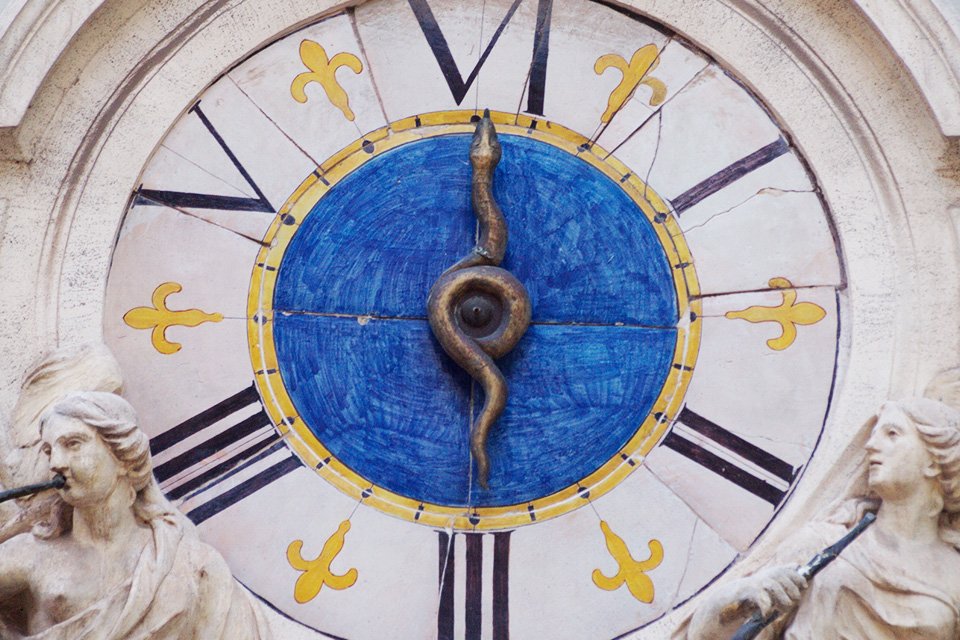
Canepina’s six-hour clock has been on that wall for years, for centuries, without anyone ever having noticed.
Since it stopped working, no one has ever paid it any attention! People have walked by it for years without ever realising it existed! Yet there it is, above the door to the Salone Del Quarto Stato, or “Hall of the Common Folk”, in Canepina’s Museum  of Folk Traditions, which was a Carmelite Convent back in the 1600’s.

I believe the disk of the clock face is made of plaster. Attached to the wall like a rose window, its centre holds a small grotesque mask whose cheeks are puffed out. The mouth, left ajar, most likely provided the point of entry for attaching the clock hands to the mechanism inside (though who has ever seen those clock hands?) while the Roman numerals circling the clock face are interspersed with small crosses.

None of this ever excited anyone’s curiosity, including the numbers, given that the world is full of clocks with numbers done in unusual designs!

At times, mere dots stand in for the numbers, so accustomed are we to telling time by nothing more than how the hands are positioned. So even if someone glanced at it now and then, the clock never drew any attention to itself. It was just part of the decorative scheme.

But then one day a friend took me to where it stood, pointed up and asked: “Do you know what that is?”. A clock!” I told him with the confidence of someone who gives an obvious answer. “No! – he replied – it’s a rose of the winds!”. A claim that left me puzzled, though my friend tried to convince me by adding:

“I was here when they restored the place, including the roof. Behind that wall was the cabinet that held the mechanism, all of it in wood, including the toothed gears, and there was a pipe that went from the mechanism to a point above the roof. Up there, - he added – there must have been a weather vane to show the direction of the wind”. 

And where is the mechanism now?” I asked.

It was all rotted away inside. As soon as they touched it, it went to pieces!” – he answered. Then, still trying to make his point: “Have you looked at the numbers around the clock face? They only go up to six!”

He was right! I’d never noticed it, but if we were talking about a clock, then, at the very least, the numbers had to be in the right places. But the spot where the twelve should have been held the six, while the place of the six had been taken over by the three. What was going on?

I thought for a second. Then I got an idea and said to my friend: “I’d like to believe you, but puzzles me are those numbers. If it was really a rose of the winds, then, as far as I know, the numbers should be multiples of four. You’d never see a six”.

My observation seemed to shake his conviction, and for a while neither of us said a word. Then I broke the silence by saying: “Listen, I’ll look into it. I’ll do my research and let you know what I find”.

I started off by gathering information on roses of the wind, seeing that my mind always tends to give credence to the other person’s arguments before looking into my own. But I soon realised that my friend’s claim was off the mark, so I did what everybody does nowadays, in the privacy of their own home, daring to enter far-fetched possibilities in some search engine, just to see what comes up. First I looked around to make sure no one was looking and then I Googled: “Six-hour clock”.

What do you know! I must have stumbled upon just the right words, because they led me to so many pages, I didn’t know where to begin. Then it all became clear to me.

Our clock was definitely a six-hour model, better known as an Italian or Roman clock: “Roman” because it was used primarily in the Rome area and in religious circles in the larger Lazio region.

The chiming of its bells, which explained why that pipe went up to the roof, was based on the old system of “Italian time” followed mainly by the Church from the 13th century on.

In Italian time (in vogue from 1200 to 1800), the day didn’t start from midnight, as it does now, but from the Ave Maria said in the evening, as dusk was falling, or roughly half an hour after sunset.

Each day began when the Sun went down, while the twenty-fourth and last hour of the day ended at sunset of the next day, all in accordance with a venerable biblical tradition. At sunset, one day ended and the next got underway, with the entire night belonging to the day after.

The lone hand of the six-hour clock did four full laps around the clock face to cover all 24 hours of the day, and so each number marker had to stand for four different numbers. Here’s a quiz for you: what would today’s 10 pm have been? I say four o’clock, what about you? And where did the clock hand point at 3 in the afternoon?

The Italian expression: "Wearing your hat at an eleven pm slant" can be traced to Italian time, seeing that hat brims get pulled low, to keep the setting Sun out of our eyes, at sunset, which meant eleven pm on the Italian clock.

But while such clocks were being used in Italy, the rest of Europe was dividing the hours of the equinox into two groups of 12, the way we do today, with the days starting from midnight. In Italy, this way of keeping time was known as “oltremontana”, or “French” or “German” time, referring to the fact that it was practiced by peoples who lived “beyond the mountains”, on the other side of the Alps.

Towards the end of the 18th century, in the areas of Italy occupied by Napoleon, French Time was officially imposed as the standard.

Once the French had withdrawn, the Papal State tried to restore the old way of telling time, based on the Italian clock, but the Church was eventually forced to fall in line with what had become the universally accepted method of counting the hours, though some Roman clock faces were kept in place, causing further confusion among the public at large.

One of the best known examples is the clock on the tower of Venice’s Piazza San Marco.

And so evidence of the historic six-hour clock (which told “Italian” or “Roman” time) has been discovered in Canepina.

powered by social2s
"Museikè", the museum of musical instruments in Artena

The palace of the Ex Granaio Borghese (former Bourgeois Barn) of Artena has been enriched with a new museum of musical instruments and a place dedicated to musical culture: Museikè.
Artena has a great musical tradition from its poets (A treasure-trove of traditional poetry in Artena) while the nearby Giulianello has one of the most special traditions to learn about: the Songs of Women of Giulianello.
On Good Friday a group of women parades with the procession through the streets of the village singing songs that have been handed down from generation to generation and that probably date back to around 1000. A testimony to the musical, cultural and emotional value of these songs is that one of the records is kept at the Center Pompidou in Paris.
Museikè houses a museum of musical instruments of popular tradition, with particular reference to the Roman Countryside, which instruments come from private collections and include all the organological categories, that is represented all types of musical instruments such as stringed instruments, wind instruments, percussion instruments. Organology is the science of the study of musical instruments.
The instruments are arranged in an exhibition in the order that starts from the "Lazio Arcaico" where philological reconstructions of musical instruments used in ancient Lazio are exhibited.
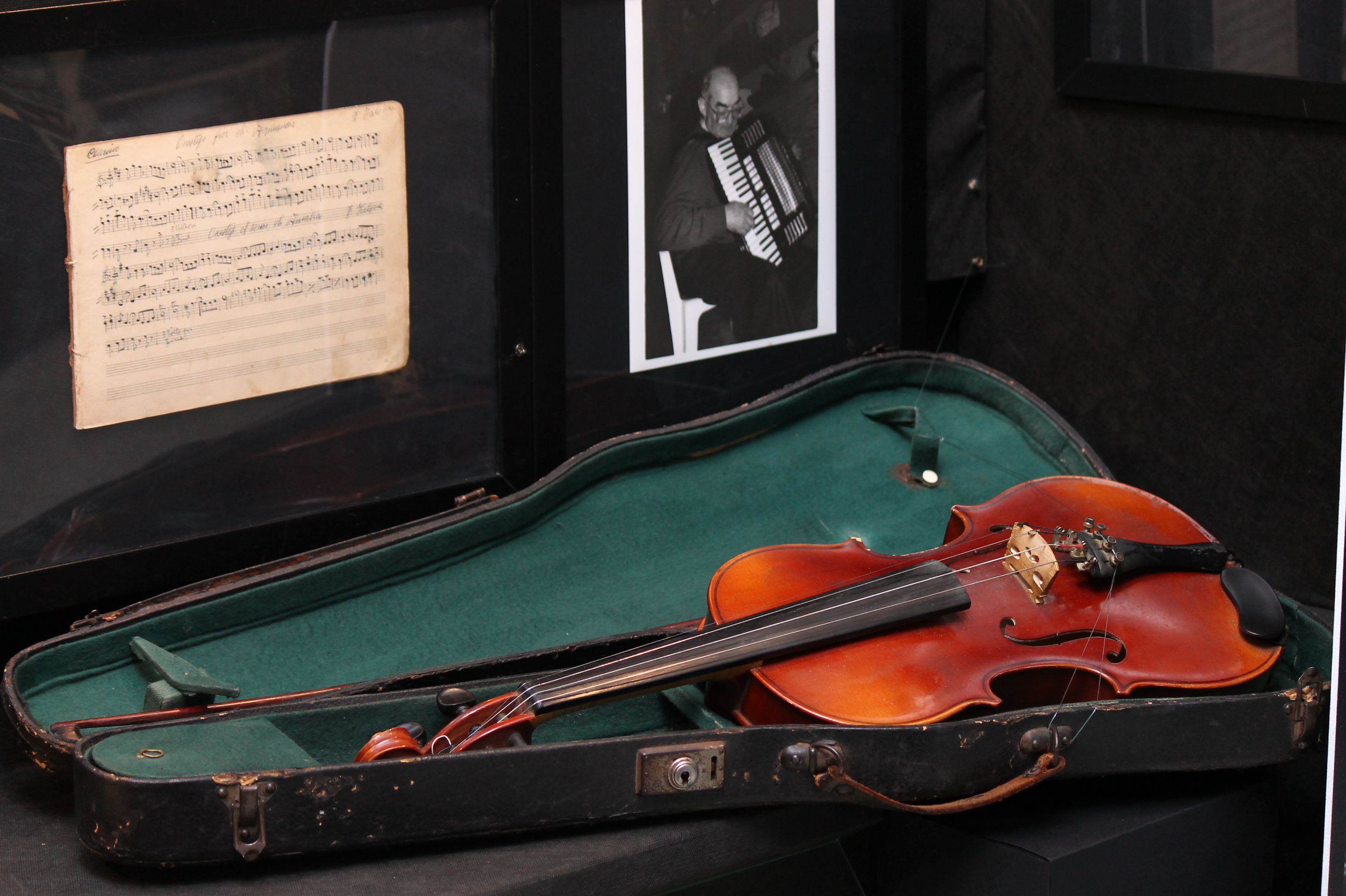
The second section is called "La Campagna Romana" (Roman Countryside) where traditional instruments are displayed that were used in the pastoral, agricultural and artisanal communities of the territory. Among these we can notice the instruments that belonged to 'Federicuccio' Talone and to his son Pasquale, famous musicians of Artena.
In this area there are some instruments from the Aniene Valley area, donated by Ettore De Carolis, an important musician and scholar of Lazio traditions, as wll as band instruments. Among these there are some specimens from the band of Giulianello directed by Maestro Salvatore Marchetti that date back to the first post-world-war period and original scores of the Banda di Artena of the early twentieth century.
Completing this part of the exhibition is a sector dedicated to songs in improvised eight beat rhyme. In the area of ​​Artena you can still listen to these ancient forms of poetry and artists who enter competitions based on the contraposition of parts and on the rhymes of the verses.
The museum has then expanded to include the other territories in the section "Towards the South" dedicated to the music and rituals of Southern Italy, in the section "Between East and West" where a series of musical instruments are displayed that were in use during the Renaissance and Baroque periods.
The visit experience ends with "Music on the road", the area that is dedicated to migrants with an exhibition of instruments from different parts of the world. Un’area caratterizzata da contaminazioni e prestiti, una riflessione sul ruolo della musica come uno dei principali canali di integrazione tra le diverse culture.
This is an area characterized by blending and borrowing of styles, a reflection on the role of music as one of the main channels of integration between different cultures.
Museikè is therefore a multidisciplinary cultural center where symbols, rituals and myth in music are preserved both as protection and also transmission of the traditional musical heritage of this area on the border between Rome and Ciociaria.
It is not just a place of charm linked to the past but a place for all music and poetry lovers, who want to share their experiences with others, to meet and socialize.
The museum is dedicated to the memory of the Artenese musician Pasquale Talone and the scholar Raffaele Marchetti, a profound connoisseur of local popular traditions, a companion to many initiatives for the protection and dissemination of popular songs.
powered by social2s
History through keys, padlocks and locks in antiquity

A visit to the Archaeological Museum of Albano Laziale reveals many small surprises from a careful look at unusual details such as those on ancient keys, padlocks and locks from antiquity.

In ancient Rome there were no banks and money, in gold and silver, was usually kept at home in real safes. These were extremely robust and capacious boxes, which could hold both coins and precious objects.

Usually the boxes were placed in the halls, in full view, in order to promote the economic opulence of the owner of the home.

The inviolability of these forerunners of modern safes was ensured by one or more complex locks with keys, from which the owner was rarely separated except to entrust them to a 'portiarius', charged with carrying them wherever his master was going.

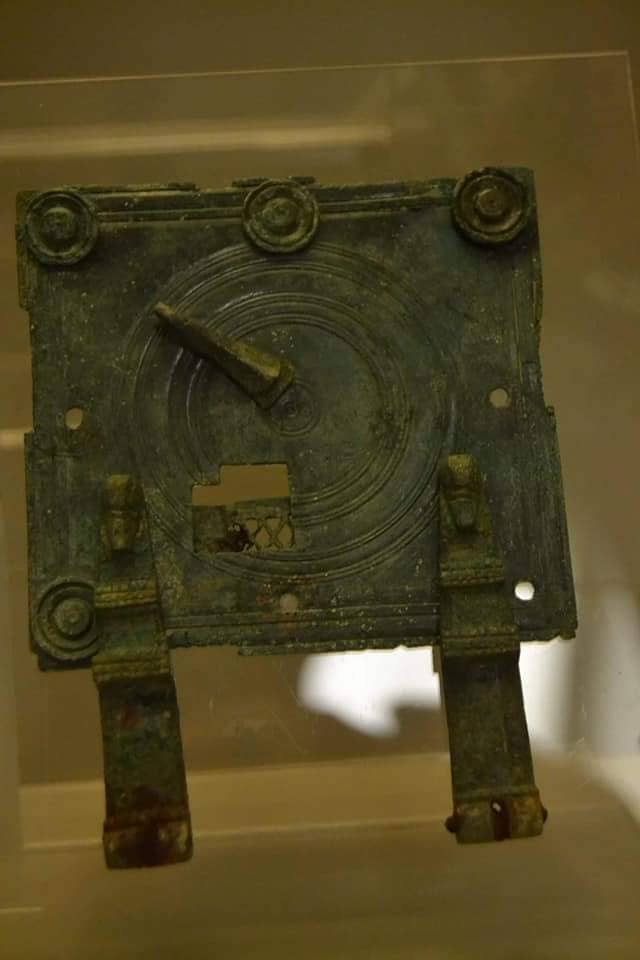
In order to facilitate transport, the keys were made in bronze and shaped in an elaborate manner, and these were also seals used as hot stamps on the wax. They were similar to a ring, with a small shaped protrusion and an engraving that served as the seal and served to authenticate important documents.

In the most important and richest families, at the time of the wedding the husband invited the bride to share both the keys and the seal. This gesture represented a symbol of trust that the spouse placed in the administrative abilities of his wife.

The locking devices, in reality, were born in Mesopotamia in the 2nd millennium BC, as evidenced by the findings in this sense in the temple of Sargon in Khorsabad. In the same period this lock appeared in Egypt and from there spread throughout the Mediterranean.

This lock was composed of two parts, one fixed to the cuff and the other to the door. When the latter was fastened, the two parts interlocked with each other and the vertical pins prevented reopening. Release was obtained by inserting into a slot in the lock a lever provided with fixed pins with the same arrangement of the calipers.

This lock was perfected, a millennium later, in Greece. A device made entirely of metal was created with a movable bolt which had numerous holes in the center which followed a precise geometry. Above the bolt were falling pins arranged with the same geometry.
When the bolt, shifting, made the first pin coincide with the others, these descended into their holes locking it. To open the lock, a key similar to a comb was used, with the pins pointing upwards, equal to the previous ones in number and geometry.

The Roman lock, instead, began to spread a few centuries before our era and the key that opened and closed it was similar to that of the old houses. Like this, it worked by rotation thanks to an antagonist spring of highly elastic steel.

This lock was made by a real specialist: the 'magister clavarius'.

Perhaps it was the one of these masters who ultimately invented the spring that defined the double-thrust key and that released the locks from the need for vertical assembly, and so they could also be adapted to coffers and safes, true forerunners of our padlocks.

The Roman lock of the Imperial age is quintessentially the one known to have a translation key, with a "gamma" letter shaped patch. Numerous specimens have been found of this lock, both in Pompeii and in Herculaneum.

But the Romans, who traveled often, also used a large number of tiny portable locks, known as padlocks, whose production survived to this day. Even the lock was operated - as of today - by a key with the help of a spring.

The bronze keys were extremely beautiful. Bronze was used for the casting in the composition of 85 percent of copper and 15 percent of tin. The technology used was that of lost wax casting.

The handles were usually geometric, zoomorphic or volute-shaped. The combs were often more elaborate than those of the iron keys and were composed of many teeth with the addition, often, of one or two lateral complications.

It must be remembered that the internal rooms of the Roman houses had no doors. There was a sturdy iron door that protected the safe, but nothing else.

powered by social2s
Atina, Ciociaria, and Paris linked by the story of Académie Vitti Museum

At Atina, in the province of Frosinone, Italy, the small museum, Academie Vitti, traces the story of three innovative sisters who opened in Paris the first drawing and painting school dedicated for women.
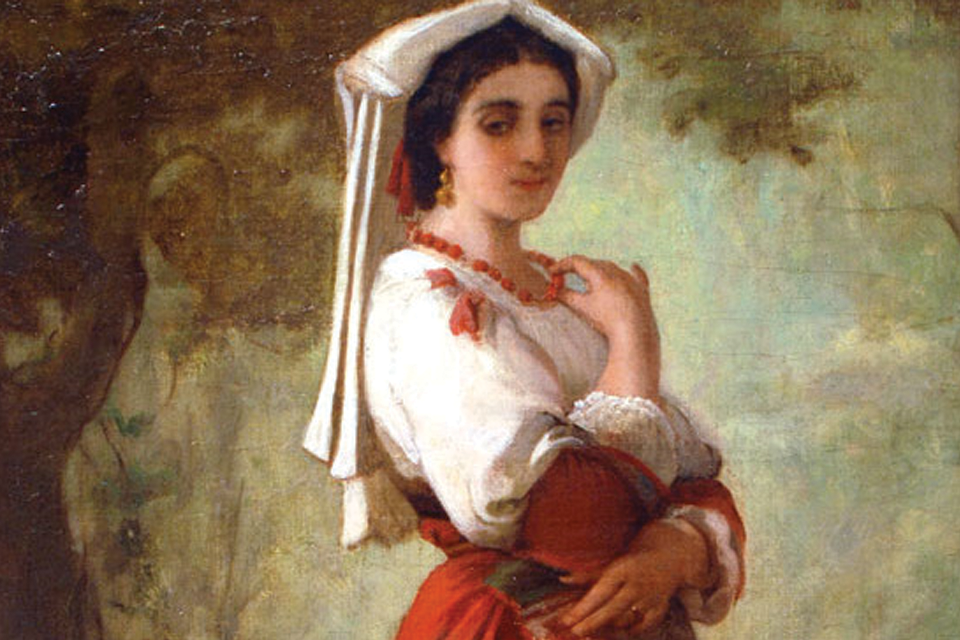
The story begins with the first emigration into France from southern Italy towards the end of the nineteenth century at which time the male and female models from Ciociaria were very much sought after by painters, photographers and sculptors. It was the Grand Tour period and these models with their traditional dress were so fashionable that many of the portraits by famous painters in the most important museums in the world were inspired by Ciociarian models.
Cesare Vitti di Casalvieri was one of these models with his wife Maria Caira who encouraged the other two sisters Jacinta and Anna da Gallinaro to go to Paris. Many of the emigrants came from Val di Comino in which, after unity of Italy, they had found themselves in unfavorable conditions.
Although these models were nude for the most famous artists, there was a limitation: women painters could not portray naked men.
The sisters then had an idea that became reality thanks to their capriciousness and courage: to open a women's art school where artists could have male models available plus all that they needed to be able to exercise their creativity.
The school was located in Montparnasse in the heart of the artistic district and was opened until 1914 when, upon World War I, the sisters decided to return to Comino Valley and settle in Atina.
Shortly after its inception, the school also admitted male artists and in its 25 years of activity many artists passed through its doors including the father of Sylvia Beach, the first publisher of Joyce's Ulysses and the illustrator of Belle Epoque in Paris in the twenties. Sylvia also posed as a model in the school for Cesare Vitti, who was also a good sculptor.
Academie Vitti became so important and a point of reference for artists that it had among its teachers great names such as Paul Gaugain and Jacques-Émile Blanche, Proust's portraitist.
When the sisters moved to Atina, they brought back all their belongings, works of art and sketches, furniture and objects of common use. Over the years many things have gone missing, but one of their heirs has gathered all that he has found and has set up a charming museum-house, the Académie Vitti Museum, in the building where the family had lived.
Entering catapults one into a world of the past with the walls covered with large sketches of naked poses executed by pupils of the school where sometimes masters' corrections can still be noticed.
powered by social2s
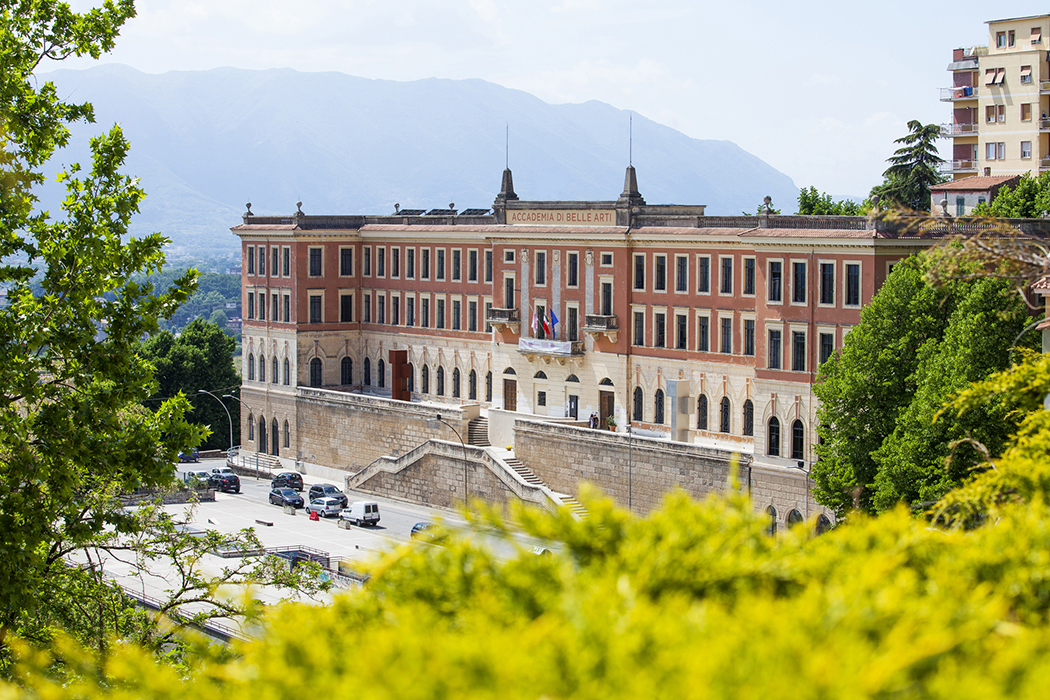
MACA Fine Arts Academy linked to Frosinone
MACA Fine Arts Academy linked to FrosinoneMACA Fine Arts Academy linked to Frosinone

MACA is the Museum of Contemporary Art within the Fine Arts Academy in Frosinone.

It is the first example of integration between museums and institutes, and now all the academies of Italy follow this example by opening museums and becoming more and more integrated with the area where they are located. The academy becomes a pulsating place for students and citizens, a cultural centre.

But how did this simple and revolutionary idea arise at this time?

Three years ago, the academy moved to a new venue, a huge unification era schoolhouse that dominates a whole hill of Frosinone. Palazzo Tiravanti is impressive and bright and regular spaces make you want to break regularity with creative concepts.

Thus fantasy can be freed and on two of the long hallways an art gallery with almost 80 works was set up. Works interrupt regularity with provocative designs, shapes and colours. All have been donated by artists who have collaborated or had relationships with the Academy in its over 43 years of activity.

It will be the light of the valley that is reflected in the white walls of the institute, it may be the historical position or perhaps only the influence of the spirit of art, but since they moved to this palace, the academy appears as if it were integrated (or maybe 'befriended') by the city.

Cultural symbiosis began with subways of the railway station, where light games were built with an installation of panels called 'Dark in colour' and it is continued on the surface. After the construction of the new football stadium, students at the Academy have won the contest for the construction of the new Matusa Park.
Meanwhile, 'Thursday Get-Togethers' with characters and artists, are open to the more and more numerous people who hear stories or lessons about contemporary art.

The real 'engagement ceremony' with the city of Frosinone took place last June with the Open Day event, which will be repeated every year, transforming it into a Festival of Academies.

The palace has been the scene of a fashion show, exhibitions and concerts. In the evening, then, the facade became a large screen for a work of Mapping, the art of playing with the lights creating works with the power of suggestion and images accompanied by sounds. A giant installation that left people agape concerning the technical quality of the performance and the emotional intensity of the work.

With this Open Day, the academy has come to its most fulsome involvement in the life of the city, and not just by the students, as it makes Frosinone ever more alive and present. It is a city much loved by its citizens who enthusiastically participate in every cultural initiative.

And this is also a sign of re-opening of an entire territory where art has played a key role in the past and can once again be a force to attract tourists, especially youth.

The experience of visiting a place where ancient art is a cornerstone for today's creativity has a particular charm and the Frosinone Academy already has active collaborations with other academies in the world.

powered by social2s
Trivigliano- Stemma by Bettiol

At a time when organic food produced according to traditional methods, which were often naturally biodynamic, is very sought after, do we know how they used to produce it?

The Trivigliano Museum of Peasant Life is one of the places where you can see the tools of the past and learn the ancient methods of cultivating the land and preparing food.

Set in a stately palace right at the entrance to the historic centre of Trivigliano overlooking the Piazza del Belvedere, the museum's content and layout is designed to strike the visitor's heart.

Along with the tools and utensils, portraits and tales by famous writers are displayed about the history of life in the fields. These poets and writers have underlined in their works the profound bond between man and the earth, between the life cycles of man and those of nature.

The tools are arranged according to the different seasons and different processes: from ploughing and sowing to harvesting. Finally, one part is devoted to the preservation and processing of products: production of flour, oil, jams and production of dried bread and biscuits.

The equipment and utensils for cooking, both for immediate consumption and preservation, are displayed in a kitchen setting and some names will bring back memories from stories told by your grandmothers.

Preserving vegetable and orchard products meant having food during the winter that could be long in Trivigliano, as in the snowfall of 2012 when the population was isolated for 4 days with 2 metres of snow.

Yet in the past, the cycles of nature and the rotations of crops were respected, and they knew what the plants were for fighting fungus and, for example, those that protected orchards and vineyards from parasites.

Getting closer to nature with respect and knowledge, with care and professionalism, is one of the new lifestyle paths that define the Italian approach to experiential tourism. In addition, the variety of garden fruit and vegetable species that Italy has thanks both to its microclimates and the rediscovery by agronomists and ‘new age peasants’ have reinforced ‘made in Italy’ among world famous food.

A small museum like this one in Trivigliano that combines stories of the peasant past and tools and utensils of that lifestyle is perfect for bringing to new generations of youth the love for cultivating fields in a natural and respectful environment.

For further information, please contact the Mayor, municipal administration or the Pro Loco.

powered by social2s

Subscribe to Newsletter

Discover a territory through the emotions of the people that have lived it.