Churches & Places of Worship

The church of the Colloquium inn Villa Santa Lucia  dates back to the eighth century and is considered a "Venerable Cassinese Sanctuary".

According to reports by St. Gregory the Great, its name comes from the fact that the two siblings, St. Scholastica and St. Benedict met here to talk.

It was destroyed and rebuilt several times.

powered by social2s

The church of Saint Lucia dates back to the Middle Ages in Villa Santa Lucia. 

It had the role of a place of prayer and burial of the dead.

The Romanesque style church was partially destroyed by the war.

Outside there is a bell tower with a mullioned window: two Romanesque arches are separated by a column with a Corinthian capital.

powered by social2s
Veroli. Abbey of Casamari

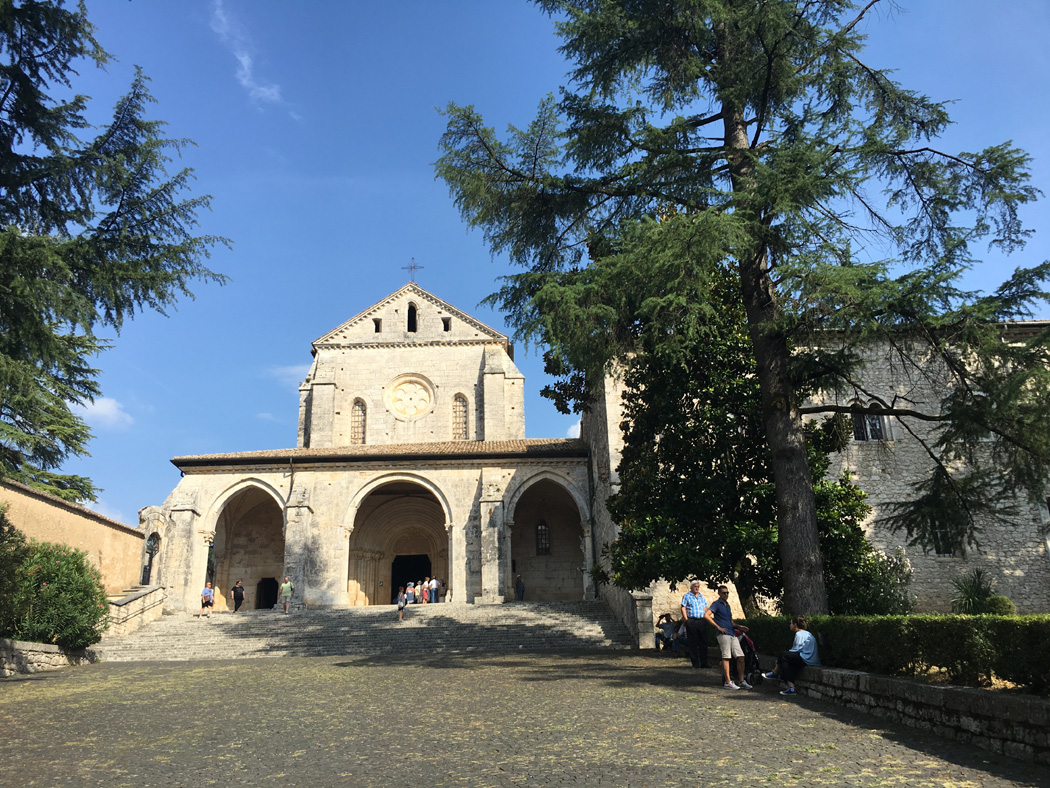
The Abbey of Casamari in Veroli owes its name to Caio Mario, from the Latin House of Marii, the famous Roman consul born right here and it is built on the ancient Roman city of Cereatae.

It is a jewel of Cistercian architecture and National Monument.

Probably everything stared with hermits who went to live in the ruins of the Roman city around one thousand, when the barbarian invasions had destroyed the socio-economic system, especially the areas in the plains and close to the connecting roads. The inhabitants of the plains had in fact all taken refuge in the hills inside castrum, fortresses or castles.

Probably this was one of the centres founded by San Benedetto and was established by San Domenico da Sora.

The current complex was largely built, thanks to Pope Eugene III , after the arrival of the Cistercian monks in 1140 who were already present in the area, precisely in the Abbey of Fossanova. The Cistercian order was founded in Burgundy in 1098 by St. Robert of Molesme, a Benedictine not understood for his desire to renounce riches and he was killed by his brothers. After his death his dream was realized by Englishman Saint Stephem Harding and Saint Bernard from Chiaravalle.

The abbey church was built between 1204 and 1217 according to the mystical style of the order and was consecrated by Pope Honorius III of the Savelli family of Albano with a major event in which the counts of Ceccano also took part. Frederick II of Swabia had passed here several times and his chancellor was appointed abbot.

Over the centuries the life of the abbey has seen history flow throughit, including the looting of the Napoleonic troops in 1799 and the fire of the Piedmontese in 1861.

For a period, it was managed by the Trappist friars.

To the abbey is annexed the State Library, founded on that of the monks, a school, the archaeological museum, and the pharmacy for the sale of liqueurs and medicines produced by the monks.

Much of the complex can be visited and in the summer it hosts concerts and operas.

You enter the abbey complex through a guest house, with a large portico with gothic arches closed by gate,s leading to a garden with an uphill path at the end of which is the church. Part of the monastery buildings also overlooks the garden. Concerts and cultural events take place in this space.

You enter the church through a large portico with three arches, a round arch and two lateral gothic arches, corresponding to the three access doors to the three naves. The main door has a rich medieval decoration and a finely worked stone bezel of particular beauty created by the Canonica. The rear facade is decorated with an important alabaster rosette.

The church has the classic Gothic style of the Cistercian churches and dominates the light stone of the pillars and the ribs of the ceiling. Stone and white plaster are the essence of this abbey. The altar is housed in an elegant eighteenth-century canopy donated by Pope Clement XI.

Next to the church is the monastery built around a cloister where the four corridors that surround it have 4 arched openings and mullioned windows towards the garden with the central well. Each column of the mullioned windows ends with a capital carved in an original way. The chapter house and the refectory are perfect examples of Cistercian architecture.

In the other buildings there is a precious library and the archaeological museum with all that has been found in the area starting from two fossil tusks of a prehistoric elephant.

Here are also paintings of the school of Raphael, of Annibale Carracci, of the Serodine, of the Sassoferrato, of the Solimena, of the Siciolante.
 

powered by social2s
Veroli. Basilica of Santa Maria Salome

The basilica of Santa Maria Salome in Veroli is the most important church of Veroli because it was built where the body of Santa Salome was buried and houses the relics of the patron saint of the city and mother of the apostles James the Greater and John, which arrived here from Palestine.

Maria Salome was under the cross at the crucifixion, assisted with the burial of Jesus and finally was one of the witnesses of the resurrection. The story tells that Maria Salome and her son Saint John went to Ephesus in Turkey where the governor was found to be from Veroli.

The church began as a small place of worship to keep the body of the saint in 1209, and which today is the crypt of the church. A story tells how the tomb was found thanks to a dream in which St. Peter had indicated to a Verolano the place of burial.

The initial oratory was gradually enlarged until it was rebuilt after the earthquake of 1350 and re-consecrated in 1492. In the 1700s it was then completely rebuilt and only some frescoes and small portions remain from the previous Gothic church.

In the eighteenth century two Tuscan bishops brought numerous painters to Veroli to paint the interior walls of the church.

The interior is divided into three naves and a large image of Santa Salome created by Cavalier d'Arpino (Caravaggio's master) is immediately apparent on the central apse.

Under the high altar there is a 'confession', that is a marble staircase leading to a small room on a lower level where in an urn is the heart of Santa Maria Salome and there are urns with the relics of Saint Blaise and Saint Demetrius, companions of the saint.

Next to the altar on the left aisle there are 13th century frescoes and on the right an incredible triptych from 1561.

The church houses a 12 steps saint stairway and in the eleventh step there is a fragment of the holy cross in a small case in the step. The staircase was built by Bishop Tartagni with the permission of Pope Benedict XIV and offers the same privileges as that of Rome: the believer who climbs the stairs on his knees obtains the plenary indulgence if he complies with the instructions on a plaque placed near the stairs.

The basilica also has a Holy Door, which is opened on 24 May on the occasion of the feast of the patron saint, and is twinned with the Basilica of San Giovanni in Laterano in Rome.

Next to the triptych there is a large painting, attributed to Francesco Solimena (1657-1747), which depicted the various Franciscan Orders and the Virgin Mary who delivered their 'cincture', symbol of union.

Among other works we must mention frescoes by Frezzi, a Christ and Saints attributed to Giuseppe Passeri, a painting by Solimena, a Christ King of Scacciafoni and a wooden statue of Santa Salome in Baroque style.

The large dome is decorated with frescoes by Giacinto Brandi (1623-1690).

powered by social2s

The church of the Holy Annunciation was a confraternity building adjacent to a hospital in Vallemaio.

The facade is sixteenth century with a beautiful portal dated 1553.

Inside, the altar is a sixteenth-century triptych of the Annunciation of the Virgin Mary.

The floor in front of the main altar is a work made of multicoloured terracotta tiles and octagonal shapes.

It includes half-length human figures (warriors with helmets and armour, women with extravagant hairstyles), friezes, crests, animals, realistic decoration and a long inscription.

powered by social2s

The church of San Martino in Vallecorsa is very old and dates from about the year one thousand.

The cult of the saint dates back to Medieval times, perhaps from the Lombard influence.

The present church has a stone facade in Romanesque style.

It is divided into three interior aisles and altars are made with precious marble.

The organ is supported by fine columns.

A wooden crucifix and large oil paintings are of considerable interest.

In 1412 a picture of the Madonna was found on a wall, perhaps the work of a Benedictine monk.

Then, it has established the cult of Madonna della Sanità (Our Lady of Health).

powered by social2s

Recommended

Subscribe to Newsletter

Discover a territory through the emotions of the people that have lived it.