Picinisco. Atina DOC Wine and Cabernet di Atina DOC Wine

It may seem strange that an international grape such as Cabernet has become famous in Val Comino, in the southern part of the Lazio region, but the cultivation of this grape has now a long history.

It all began in the 19th century when phylloxera destroyed vineyards throughout Europe and a mayor of Atina, who was also an oenologist, began to travel between France and Italy.

From France, Pasquale Visocchi brings back several vines including cabernet which immediately settles perfectly in the micro climate of the Val di Comino.

Pasquale Visocchi also introduces the green manure technique and the cultivation of legumes among the rows of vines (which will then bring recognition to the famous Cannellino di Atina PDO bean).

In reality, the production of wine in the area dates back to Roman times and was later favored by the small monasteries scattered throughout the area that spread agriculture and viticulture.

In 1999 a group of winemakers obtained recognition for the wines of Val Comino with Atina DOC and Cabernet di Atina DOC.

Today they are produced in the Atina Rosso Riserva, Cabernet Riserva and Semillon versions.

Cabernet Atina DOC wine must contain at least 85% of Cabernet Sauvignon and Cabernet Franc grapes while the other 15% can be black berried grapes grown in Lazio.

Atina DOC wine must instead contain at least 50% of Cabernet Sauvignon grapes and the rest of Merlot, Syrah and Cabernet Franc and up to 20% of other black berried grapes grown in Lazio.



 

powered by social2s
Settefrati. Atina DOC Wine and Cabernet di Atina DOC Wine

The history of Cabernet di Atina begins in the 19th century when the agronomist Pasquale Visocchi, then mayor of Atina, imported some varieties of French grapes into Val di Comino.

In those years the phylloxera had destroyed most of the vineyards in Europe and in many areas it was decided to restart production using international vines.

The cabernet of Val Comino has earned acclaim and awards for its quality which has been recognized with the appellation Atina DOC and Cabernet di Atina DOC.

powered by social2s
Grottaferrata. Frascati Wine

Viticulture in the Castelli was born with land allocations to veterans of wars, starting with the battle of Lepanto through to the former combatants of the "Great War" 1915-1918.

Assignees started small vineyards used for their own consumption and more intensive production for the local market.

This was the beginning of what is now a grand tradition that has led to some fine wines such as the Frascati DOC produced in the area of ​​Grottaferrata.


powered by social2s
Zagarolo. Zagarolo DOC Wine

The area of Zagarolo is perfect for white grapes and is the production area of Zagarolo DOC Wines. Zagarolo has a volcanic soil and many cellars are dug into the tuff stone.

The denomination of controlled origin Zagarolo is reserved for white wine, also of the superior type, which meets the conditions and requirements established in the specification for production. The grapes of Zagarolo DOC are Malvasia Bianca di Candia, Malvasia del lazio, Trebbiano toscano Verde e Giallo, Bellone e Bombino Bianco.

The presence of viticulture in Zagarolo dates back to Roman times. The Statutes of the Community of Zagarolo, issued on July 31, 1552, contain numerous chapters that established the areas to be used as vineyards, the methods for determining the harvesting period and regulating trade some wine.

Over the centuries, viticulture has maintained the role of prince culture of the territory, up to current events, as evidenced by the Grape Festival, which takes place every year in Zagarolo.

Thanks to their peculiarities, there are numerous acknowledgments that have received and continue to obtain the Zagarolo DOC wines both locally, nationally and internationally.

powered by social2s
Genazzano. Cesanese of Olevano Romano DOC

Cesanese of Olevano Romano DOC is a ‘big’ red wine, of ancient origin, ruby ​​red with violet hues.

The production area includes the whole territory of Olevano Romano and part of that of Genazzano.

Not less than 85% of the grapes must be Cesanese Affile and / or Cesanese common.

The remaining, other red grape varieties suitable for cultivation in the Region of Lazio (Sangiovese, Montepulciano, Barbera, Tuscan Trebbiano, White Bombino).


powered by social2s
Genazzano- Vinello bianco by Benedicta Lee

The Genazzano DOC is a wine produced in the territories of Genazzano, Cave, Olevano Romano, San Vito Romano and Paliano.

The area was known since Roman times for the Prenestino wine and had been described by Galen, the personal physician of Marco Aurelio, who had devoted a chapter to the wine in his treatise De Rimediis therapies.

In the Middle Ages in 1354 the Statuta Olibani were issued, detailing the castle that dominated the area between Olevano Romano and Genazzano, which describes the areas to be allocated to the vineyard, the ways to harvest and how to adjust the wine trade.

In modern times the first Grape Festival of Genazzano took place soon after World War II.

The white wine has a pale-yellow colour with a lively flavour and is also produced in the sparkling version. It is obtained from Malvasia di Candia (minimum 85%), Bellone, Bombino, Tuscan Trebbiano and Pinot Bianco.

Red wine is similar to the Cesanese and is produced from Ciliegiolo (minimum 85%) along with Sangiovese and common Cesanese.

The Genazzano DOC wines have won numerous accolades and awards both nationally and internationally.

powered by social2s
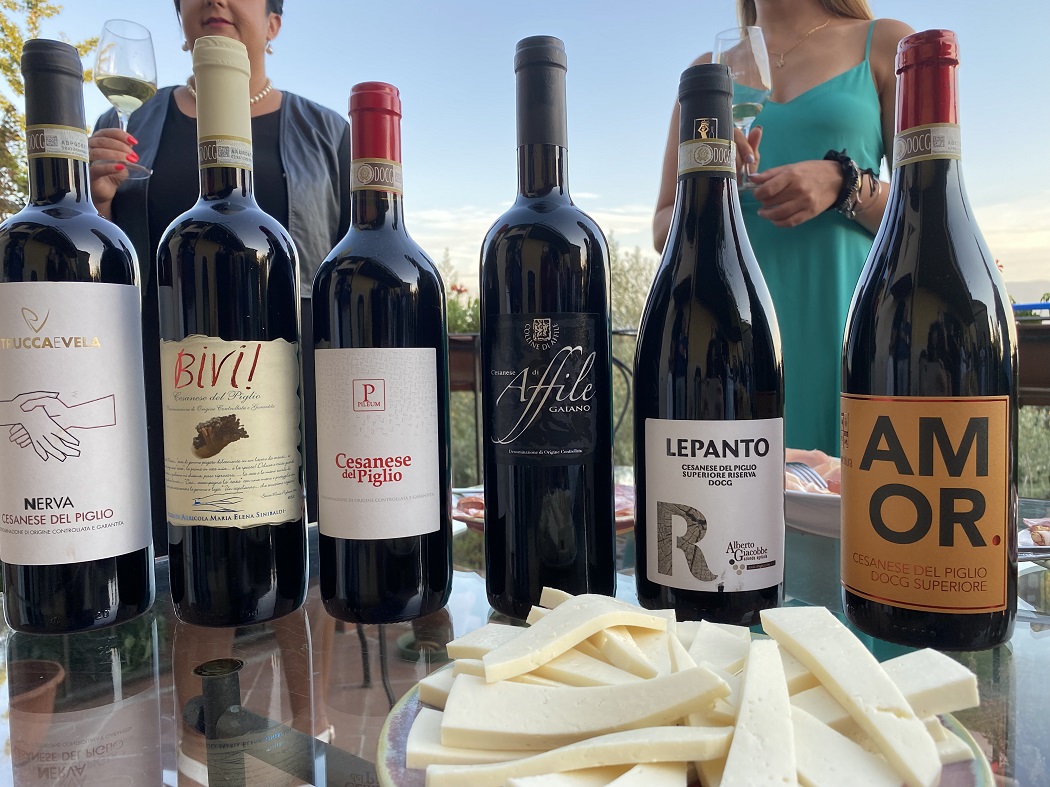
Cesanese del Piglio DOCG Wine

Acuto is home to the Cesanese del Piglio DOCG, an indigenous grape variety of Lazio of ancient tradition, as evidenced by the historical artifacts found in the area.

It has been very much appreciated since the times of the Romans.

The production area includes the towns of Piglio, Serrone, Acuto, Paliano and Anagni.

The Cesanese Wine Route (Strada del Cesanese) winds through these municipalities and passes beside the cellars of several local producers where you can sample the wine and other culinary specialities of the area.

powered by social2s
Sagra del Cesanese
Paliano. Cesanese del Piglio DOCG Wine

Paliano is the production area of ​​Cesanese, a bright red wine with an intense taste and aroma that makes it suitable for important dishes.

At the end of the nineteenth century, the two sub-varieties were distinguished: Cesanese and Cesanese di Affile. According to the specification, 90% of the grapes of the Cesanese d'Affile indigenous vine must be used in the production of DOCG wine.

In the "Book XIV of the Naturalis Historia", Pliny the Younger describes a particular red vine cultivated in Ariccia which is assumed to belong to the Cesanesi grape family.

The Cesanese di Affile vine dates back to Roman times, and its name seems to derive from the deforestation work ("cesae" means "places with cut trees", hence the name of the vine) of the Roman colonists to make room for the vineyards. On the coat of arms of Affile there is a vine shoot with black clusters with an asp twisted on the trunk.

Even if Roman history seems more of a legend, certainly the Cesanese di Affile vine was reintroduced and promoted in the eighteenth century by a Benedictine monk from the Subiaco Monastery.

In 1973 it obtained the DOC recognition, and in 2008 the Cesanese del Piglio DOCG Wine designation was issued for the wines produced in the territory of Piglio, Serrone, Acuto, Anagni and Paliano.


powered by social2s

Subscribe to Newsletter

Discover a territory through the emotions of the people that have lived it.