Churches & Places of Worship

SAMSUNG CSC
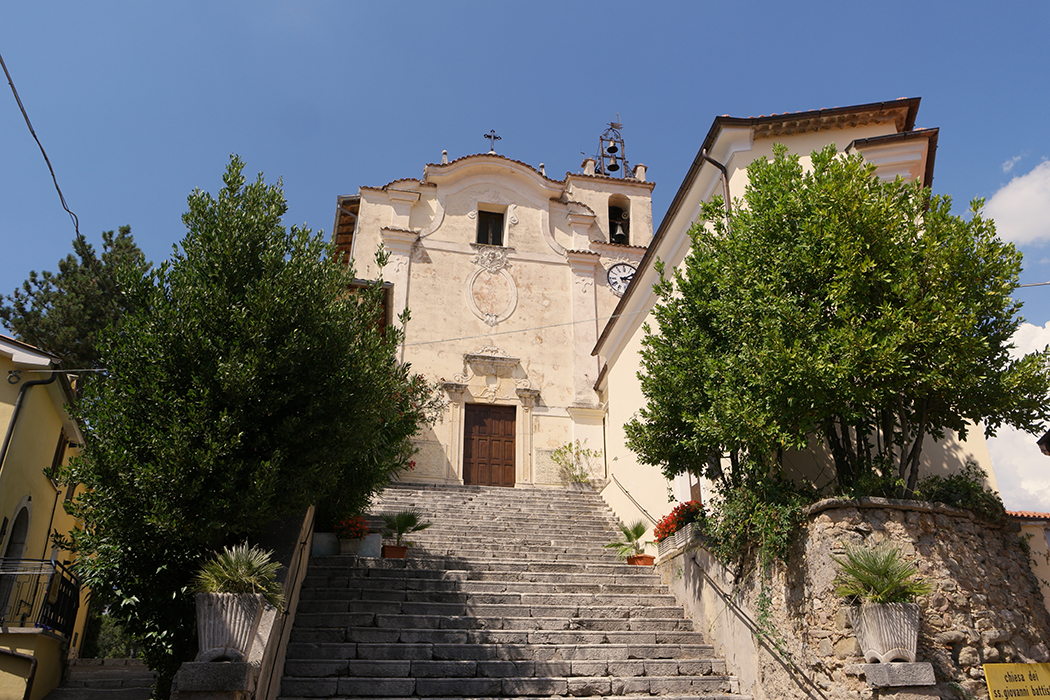
Gallinaro. Church of San Giovanni Battista

The eighteenth-century church of Saint John the Baptist (San Giovanni Battista) was built on the ruins of the medieval castle of Gallinaro.

It is mentioned for the first time in the fourteenth century, as a chapel of the fortress.

In the sixteenth century there is another document relating to the donation by Prince Conca Matteo di Capua, owner of the Duchy of Alvito, who gave the town the castle to build the new church, the inaugurated in 1596.

The church was restored in 1700 and the bell tower with the clock was built.

The facade is decorated with floral motifs, a limestone rosette and a cherub.

The interior has a nave and two side chapels and, in the chapel of the Infant Jesus, a miraculous image is kept.

In the counter-facade is a splendid eighteenth-century organ with wooden choir.

powered by social2s

The shrineof Our Lady of Hope in Giuliano di Roma was built in the eighteenth century.

The church is in baroque style and houses the image of Our Lady of Hope.

The image dates back to the sixteenth century and represents Mary holding Baby Jesus holding the world with St. Anthony of Padua and St. Nicholas of Tolentino.

In this sacred image many miracles are attributed since 1775.

The last miracle dates back to World War II.

An aircraft bomb crashed through the roof of the church full of worshippers, but did not explode.

The bomb is preserved within the presbitery.
 

powered by social2s

The origin of the church of St. Blaise in Giuliano di Roma is early medieval.

A plaque on the front door it reads that in 1091 the church was restored for the first time.

It is at the foot of Mount Siserno and was entrusted by the bishop to one or more hermits who lived in a room near the church until eighteenth century.

In 1692, the interior sacristy was built and restructured with the fresco depicting the martyr San Sosio.

In another restoration in 1863 the stone terrace that you see today was built.

The church has a single nave and the back wall has a recessed niche containing a wooden statue of St. Blaise, now kept in the Santa Maria Maggiore church.

Until a few decades ago the mothers warned their children with the threat that if they went to the church of San Biagio the "monk" (strict Franciscan) would have appeared.

This oral tradition recalls the presence on site of hermit monks.

powered by social2s

The church of San Rocco in Giuliano di Roma was originally dedicated to St. Sebastian.

It dates back at least to the Middle Ages when, near the gates of the city, were built churches dedicated to St. Sebastian to ward off the plague.

From the 1400s this protective function was entrusted to San Rocco and, therefore, the town was also dedicated to this French saint.

The church was enlarged in the 1600s and the entrance wall was changed.

In place of the original entrance door (visible from outside) the altar of St. Sebastian was erected in front of one of San Rocco, with the statues of the saints.

In 1855, the population was hit by the epidemic of cholera after which the church was restored for Thanksgiving.

powered by social2s

The eighteenth-century church of Santa Maria Maggiore was built on the site of the original medieval castle of Giuliano di Roma in the highest part of the historic town centre.

The primitive church of Santa Maria already existed around 1000 and located next to the castle of the Colonna.

In 1766, it was decided to demolish the old church to construct a more spacious church.

The church was consecrated on 25 May 1784.

In 1846, it was restored with the addition of the gilding and the cleaning of the walls.

Inside it has three naves and six side chapels, and there are copies of works by famous painters such as Solimena, Conca and Saracens.

There is a beautiful wooden choir and an eighteenth-century organ.

The massive bell tower was built on the ‘male’ of the castle and dominates the town.

powered by social2s

The sanctuary of the Madonna di Loreto dates back to 1565 in Fontana Liri.

It was built as a small chapel dedicated to the Virgin.

In 1698 it was expanded after miraculous incidents such as the appearance of three drops of blood on the face of the Child Jesus in a picture.

The statue of Our Lady of Loreto dates back to 1842.
 

powered by social2s

The church of St. Stephen is located near the walls of the castle of Fontana Liri and dates back to the fourteenth century.

It was remodeled in the eighteenth century in baroque style.

The interior has three naves and there are paintings dedicated to St Stephen and San Francesco di Paola, and a wooden statue of St. Stephen.

In July, for 15 days, it hosts the statue from the shrine of Our Lady of Loreto.

Here Marcello Mastroianni was baptized.

powered by social2s

The church of St. Andrew and Holy Cross in Fontana Liri dates back to the sixteenth century.

It was built by merging with the existing church of Saint Andrew and it maintains two entry gates.

The bell tower is square and is housed in a tower.

Inside the church there is an old crucifix on the main altar, an organ in the choir loft, the statues of St. Rocco and St. Anthony of Padua and the busts of Santa Barbara and Saint Lucia.

In 1971 there were some scenes filmed here of the Nino Manfredi film "For Grace Received" (Per grazia ricevuta).

Today the church is the seat of the museum "The new primitives" by Vincenzo Bianchi dedicated to Michelangelo Buonarroti.

powered by social2s

Recommended

Subscribe to Newsletter

Discover a territory through the emotions of the people that have lived it.