Churches & Places of Worship

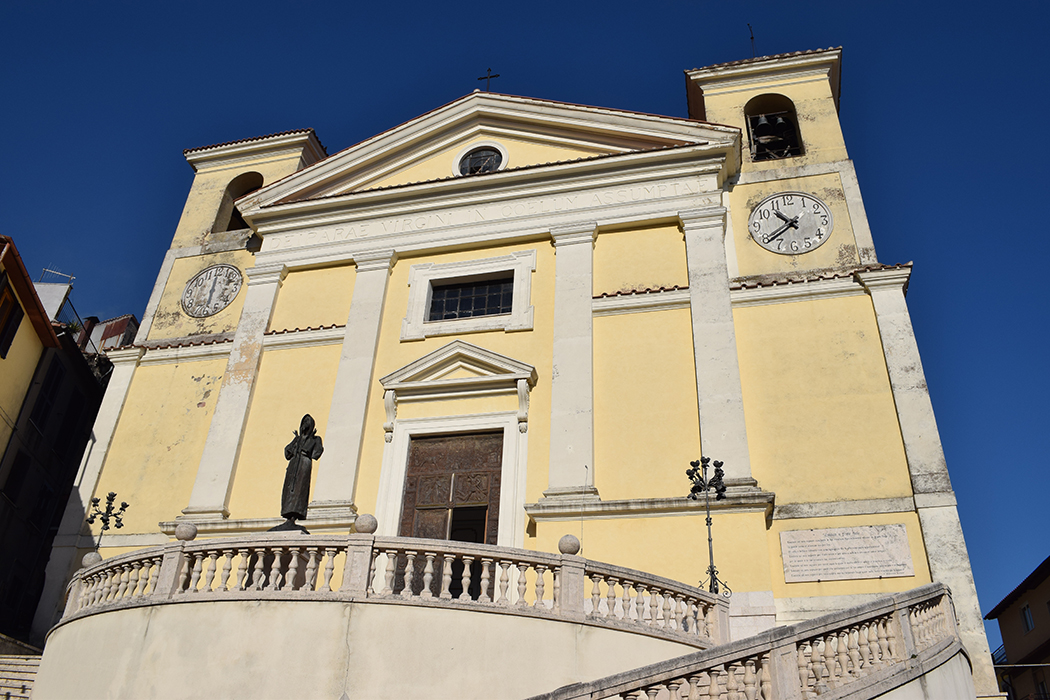
This is ancient church of Saints John the Baptist and the Evangelist in Pescosolido damaged and rebuilt several times.

It now looks like a late Baroque building, and inside there are frescoes and mosaics by contemporary artists that depict scenes from the life of the two saints.

You can admire some valuable paintings such as the Baptism of Christ of 1778 attributed to Gaspare Capricci and the Madonna of the Rosary by Marco Mazzaroppi in the late sixteenth century.

A distinctive architectural feature is the large staircase in front, also rebuilt several times.
powered by social2s

In the church of Our Lady of the Regiment in Monte San Giovanni Campano is preserved a sacred image found in 1796 and being the object of popular devotion.

The church has a border with Veroli about 500 meters from the Abbey of Casamari.

Its name may derive from the fact that the direction of the work for the construction of the Abbey of Casamari was based here, or that in this place convalescing sick monks spent time.

In 1731 the church was destroyed as it had become a place of refuge for Brigands, typical of border areas between the Papal State and the Kingdom of Two Sicilies.

Around 1790, refurbishment work was initiated on the premises and there were brought to light frescoes depicting the Madonna and Child with the lives of saints such as St. Thomas Becket, St. Thomas, St. Benedict and St. Leonard.

These frescoes were detached and are now kept at the Museum of Casamari.

Since 1797 there has been an important goods and livestock fair in this location.

powered by social2s

The church of Saints James Battista and Evangelista in Monte San Giovanni Campano is in the Capuchin monastery and was rebuilt in the sixteenth century.

The previous church was much larger and was reduced when it became part of the Capuchin monastery.

The convent has an interesting cloister with a garden in the center.

Currently, the monastery is a house for prayer and meetings.

powered by social2s

The church of San Pietro de Areaula in Monte San Giovanni Campano is very old and it is mentioned in 1028 as a 'canonical foundation', a form of church life previous to the Gregorian reform.

The church became part of the possessions of the Abbey of Trisulti.

In 1379 Urban VI obliged the Carthusians of Trisulti to enlarge the church, which remained tied until 1870.

The monastery appointed the parish priest, maintained the church, and in 1725, it oversaw the restructuring .

The building has a unique shape and is different to the architecture of the area: the plan is a Greek cross and the church ends up with an octagonal (tiburio) lantern topped by a lantern.

The bell tower has an original cover that recalls oriental stylistic elements while the façade is from the eighteenth-century.

Inside there are three altars, one for each aisle, and several paintings, including a Virgin and Child with St. Peter and St. Bruno of 1682 by Caci.

powered by social2s

The church of Santa Maria della Arendola (or Arenula) in Monte San Giovanni Campano is of medieval origin and dates from the eleventh century and has been remodeled over the centuries.

The interior has a nave with four altars, a ciborium (canopy over the altar supported by columns) from the 1700s and an apse.

There are two valuable paintings: the first depicts the Nativity of Our Lady from the eighteenth century Neapolitan school, and the second represents the Madonna with St. Francis and St. Emidio, attributed to Sansovino.
 

powered by social2s

The church of Santa Maria della Valle in Monte San Giovanni Campano is of medieval origin and was mentioned for the first time in a document of 1186.

The church has undergone a renovation in the sixteenth century and the facade is of late Renaissance style with two rows of columns, crowned by a pediment and a large stained glass window.

The majestic bronze door was sculpted by Tommaso Gismondi, with themes of devotion to Our Lady of Suffrage and the patrons.

The interior has a nave with six chapels, a higher altar and an eighteenth-century carved choir loft from the German Veser.

The apse is nineteenth-century by architect Virginio Vespignani, and there are paintings of Sarra, Balbi and Cavalier d'Arpino school.

Inside the church is a wooden statue of Our Lady of the Suffrage of the Lucchese school of the XVI century and the Grand Cross which is carried in processions.

The decoration of the church is recent by craftsman Mauti who frescoed on the vault three episodes of the Old Testament.
 

powered by social2s
Morolo. Church of Santa Maria

The church of Santa Maria is of medieval origin but was rebuilt in 1642.

It is located in a central position but elevated from the rest of the town of Morolo.

The church is accessed via a sinuous staircase that starts from the square floor.

It is separated by an elegant bronze gate made by the sculptor Tommaso Gismondi in 1973.

A sculpture of a bird distinguishes the entrance.

Above the stairs, on a terrace before the church, you can see a sculpture of St. Francis which is a copy of a work by the artist Ernesto Biondi, originally from Morolo.

You then enter the church through a bronze door, also made by Tommaso Gismondi, in whose tiles the story of Morolo is represented.

The facade of the church has a classic style with a central part characterized by a large tympanum.

On the sides of this tympanum there are two small symmetrical bell towers, with the three bells merged in 1638 and 1697.

The clock was originally placed in 1697.

The interior has a single nave with a frescoed and decorated barrel vaulted roof.

Behind the main altar are the seats dedicated to the 12 canons when the church was elevated to the rank of collegiate in 1782 by Pope Clement XIII.

On its sides there are six chapels that house works of art by Sebastiano Conca, Eugenio Cisterna and from the seventeenth-century school.

powered by social2s

Sanctuary of St. Gerard in Gallinaro dates back to the twelfth century and was built, in 1102.

Here were buried Gerardo and his fellow companions Stephen and Peter on a pilgrimage to the Holy Land.

According to the "Gothic Book", a pilgrim who lay ill in the country had a vision of Gerardo and was healed after having implored.

In 1127 Gerardo was sanctified. The oldest records of the church date back to 1259.

In 1608 the Jesuit John Gerard, the last member of the Saint’s family, donated the silver arm which the Sanctuary still holds the relic.

The sanctuary was enlarged and rearranged in the eighteenth century in Baroque style.

The interior has three naves with bright decorations consisting of paintings and frescoes.

The last were painted from 1970 to 1972 by the painter Secondo Raggi-Karuz.

Of artistic interest is the fresco on the dome dedicated to the "four pilgrims” and built in the eighteenth century by an artist of the Neapolitan school.

powered by social2s

Recommended

Subscribe to Newsletter

Discover a territory through the emotions of the people that have lived it.