Churches & Places of Worship

The convent of San Sosio in Falvaterra was founded by St. Paul of the Cross on April 2, 1751.

It was initially a small building for a hermit who kept a small church dedicated to St. Sosio, martyred in 305 along with San Gennaro during the persecution by Diocletian.

In 1772 he began the construction of a new church and expanded the convent to accommodate 12 religious devotees initially. The monastery was rebuilt in the eighteenth and nineteenth centuries.

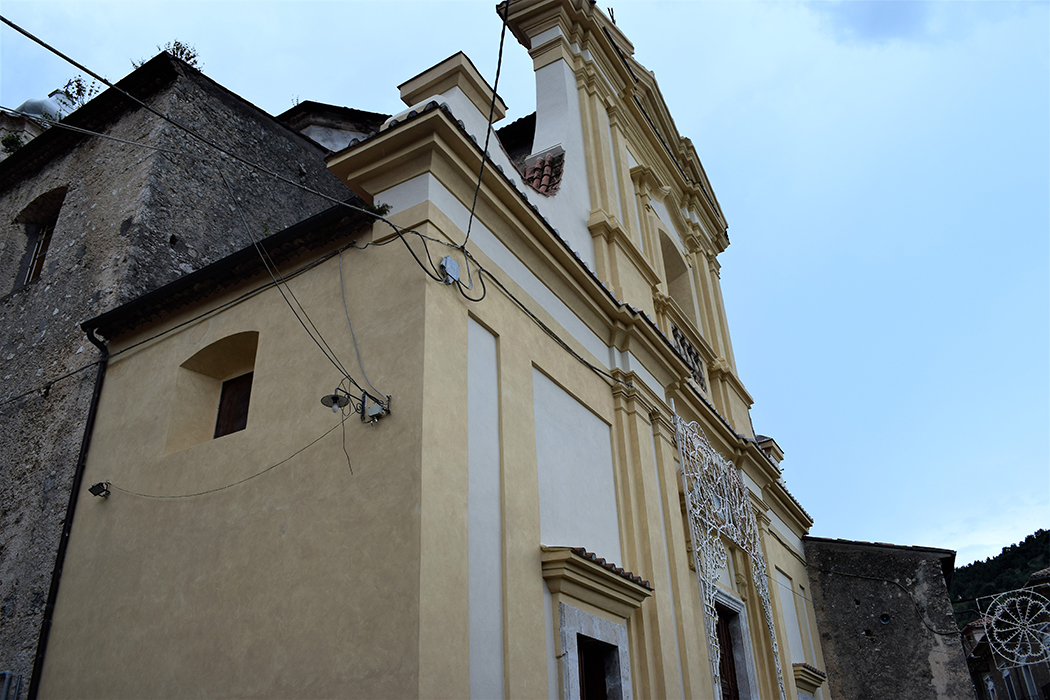
The church has a single nave with side chapels and shows baroque decorations. Today the complex is also used as a convention center.
powered by social2s
Colle San Magno. Church of San Magno

The parish church of San Magno was built in 1750 on the design of the architect Vanvitelli and is today heavily remodelled.

It is dedicated to San Magno, protector of the village of Colle San Magno.

The imposing church is in neoclassical style and marks the whole profile of the village from a distance.

The façade is characterized by three openings: a monumental entrance and two lateral ones from which you access the three naves of the church.

The aisles have chapels rich in decorations and frescos in which are found the statues of San Rocco and San Magno and the church ends with an apse and a magnificent dome.

Above the entrance there is a choir with an old organ.

The stone bell tower is located at the back of the building.

Saint Magno lived in the III century AD and, after his conversion, he gave all his goods to the poor and was elected bishop of Trani.

He healed cripples and the sick and, to escape persecution, he began to wander between Rome and Ciociaria, where he was witness to the Gospel and performed miracles.

He was led to martyrdom by order of Emperor Decio. He is buried in the cathedral of Anagni.

powered by social2s

The church of the Annunciation was founded in Cervaro in 1415.

It had a hospital-hospice to house pilgrims and poor strangers who often passed in this area at the base of the mountain on the path between Monte Cassino and Rome.

The church is a beautiful building in Baroque style, restored after the war.

The facade is adorned with columns and a pediment top with bas-reliefs.

On the entablature (frieze) are the words of the Annunciation: ‘Ave gratia plena’.

Inside the church are paintings including a Via Crucis and sculptures of Giovanni De Marco.

On the great altar is a painting by Vincenzo Tarallo from1898 depicting the Annunciation.
 

powered by social2s

The church of Santa Maria Maggiore was the first one of Cervaro that subsequently had two main churches: Santa Maria Maggiore and San Paolo.

The church dates from the twelfth century but has undergone several transformations and appears now as mainly Baroque.

The church is incorporated with other buildings that were part of the complex of the ancient castle.

The front is covered with square stones up to a gable decorated with stucco and the entrance features a bifurcated staircase, protected by walls and an artistic wrought iron balustrade.

On the wall of the side entrance is the date of a restoration, 1742, and an inscription carved in stone: 'Lapis testimoniis'. This was the place where in the Middle Ages offenders were invited to confession, before undergoing their sentence. The bell tower has four levels and ends with a spire with a clock.

Inside, the dome in conformity with the altar has bas-reliefs depicting the four cardinal virtues: Prudence, Justice, Fortitude, Temperance.

Among the works of an art are a wooden crucifix of 1600, mlticoloured marble baroque altar, the balustrade of the presbytery, the multicoloured marble floors, an intricately carved choir and an original pulpit.

The church also has valuable paintings of the eighteenth century and a wooden statue of St. Sebastian from 1500s.

The bell tower has four elevations and ends with a spire with a clock.
 

powered by social2s

The sanctuary of the Madonna in Piternis is located at the entrance of a gorge at the foot of Mount Aquilone in Cervaro.

The name "in piternis" is an expression in dialect transformation of “in sempiternis grati” (eternally grateful).

The sanctuary was consecrated in 1408 but had been operating as a chapel that was built before 1000.

The place where the Madonna appeared to a shepherdesswas chosen.

In the sanctuary there are frescoes of the sixteenth and seventeenth centuries.

powered by social2s

The church of St. Anthony is located in Le Fornaci, along the ancient Via Latina, and is the only ancient monument of Ceprano.

The church and the cloister of the adjacent Franciscan monastery dates from the thirteenth century and then have been repaired in the fifteenth century.

The property is private and has recently been refurbished by its inhabitants who are devoted to Sant'Antonio Abate (St Anthony).

The cloister is used for concerts and events.

St. Anthony is the patron of Le Fornaci and on 16 and 17 January, the feast days of the saint, the area around the church has hosted a big fair every year since about 1400

powered by social2s

Recommended

Subscribe to Newsletter

Discover a territory through the emotions of the people that have lived it.