Churches & Places of Worship
The church of Torano (or Turano) was built on the ruins of an ancient Etruscan temple in San Lorenzo Nuovo
It is dedicated to the virgin Turan depicted in a fresco of the second half of the 1400s with the Child blessing the people.
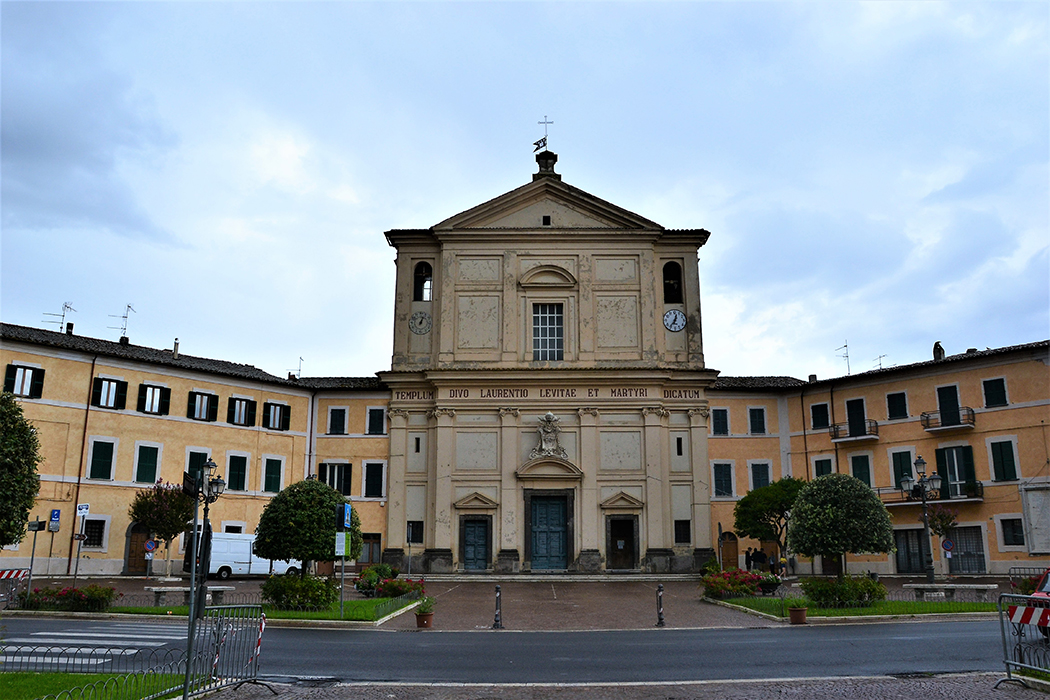
The church of San Lorenzo Martyr dates back to the eighteenth century.
It is part of the Navone design of the new city of San Lorenzo Nuovo and the square with its particular octagonal shape.
The church has a nave with side chapels.
Inside there are many works of earlier periods including two important paintings by Jacopo Zucchi, an altarpiece with the Martyrdom of San Lorenzo and a marble bust of Pope Pius VI attributed to Canova.
The polychrome wooden crucifix of the twelfth century was an object of deep veneration by the inhabitants.
On the main entrance is visible the coat of arms of Pope Pius VI who had sought the realization of the church.
Devotion to St. Bernardino of Siena came to Piansano with the Tuscan settlers in the sixteenth century who immediately wanted to build a church on the site of a previous religious building.
This church was then completely demolished and rebuilt around 1750 in the most impressive form and it was embellished with beautiful frescoes of the Viterbo school.
The present church has a single nave with six side chapels, in one of which is preserved the ancient canopy of gilded wood with the statue of the saint that is carried in procession on the day of the patron saint.
The sanctuary of SS. Trinità was born from a group of caves in front of the city of Orte which were used by hermits during the fourteenth century.
The hill in front of the city called the 'Collis Hortanus' in the 11th century is a sanctified place which was then called Civita Deserta in the 15th century.
In the past it has hosted several hermits including San Bernardino who lived there in 1426.
The church was partially excavated in the tuff thanks to the will of the hermit Nicolò Cappa di Vigne.
Inside there are frescoes that date back to the fourteenth and fifteenth centuries.
In the seventeenth century the church was entrusted to the congregation of the Annunciation.
In 1944 it was damaged by a train explosion and was then rearranged by all the congregations of Orte.
The shrine of Santa Maria delle Grazie in Orte dates back to 1521.
It was built on a small chapel of 1159.
The monastery was built in 1579 by the Gerolimini fathers.
In 1957 it switched to the Benedictine Nuns and is famous for the production of herbal products.
The church of Saint Francis was built in Orte at the end of 1695 by demolishing part of a previous Romanesque church of Sant'Angelo.
Next to the church is the convent of the Franciscans who settled at Orte in the thirteenth century.
The monastery has a beautiful cloister around which was the life of the brothers.
In the nineteenth century the church had another development when it became the seat of the Compagnia della Misericordia - Brotherhood of Misericordy.
The building has a single aisle and inside is a beautiful altar with an altarpiece representing the 'Madonna della Misericordia' in 1614 by the artist Otto Pratello of Città della Pieve.
The painting is surmounted by a lunette with the image of St. Francis in the act of receiving the stigmata.
The church has a crypt that documents the earlier Romanesque structure.
The church of Santa Maria Assunta in Orte was founded in the ninth century and was rebuilt several times.
In the first half of the fourteenth century and in the second half of the sixteenth century it was enlarged.
ùThen in 1721 it was rebuilt in Baroque style of the architects Castrachini and Bizzacchero.
Inside there is a wooden choir loft, a seventeenth-century monumental altar under which the relics of the Holy Martyrs Joint Patrons are preserved, and an altarpiece by Giuseppe Bottani of 1752 depicting the Madonna in Glory with the eight Holy Martyrs.
The church has an eighteenth century organ built from a previous sixteenth century instrument.
The original single-nave church of Saint George was built in 1671 in the period of Giorgio Santacroce.
In the eighteenth century the building was widened with three naves and a Latin cross design.
The modified building was completed in 1756 by the architect Giuseppe Barbieri.
The valuable baptismal font dates back to the early church and inside you can admire a painting above the altar depicting St. George on horseback slaying the dragon.




Follow us