Oriolo Romano. Convent of St. Anthony
- Benedicta Lee
- Category: Churches & Places of Worship
- LAZIO • VITERBO • Oriolo Romano
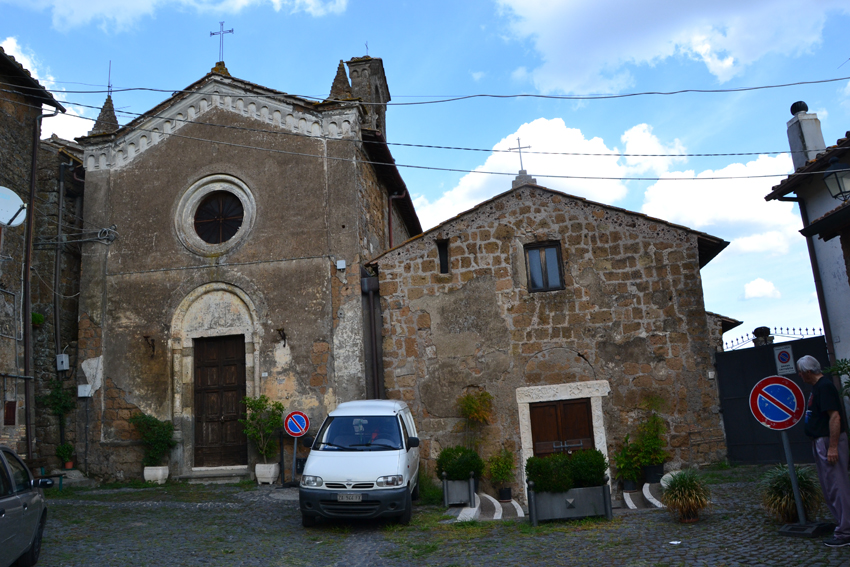
The church of St. Anthony in Oriolo Romano was built in 1675 on the occasion of the jubilee proclaimed by Pope Clement X.


The church of St. Anthony in Oriolo Romano was built in 1675 on the occasion of the jubilee proclaimed by Pope Clement X.
The church of Our Lady of Grace is the oldest in Onano and was built in the Romanesque period and decorated with frescoes of the Sienese school around 1400.
The coat of arms of the Monaldeschi family was affixed on the facade but was later replaced by a deer during the renovation.
The church was modified several times with additions and renovations.
The desire to enrich the church, led to completion of the fresco of the Madonna with the addition of a number of faces of cherubs.
The church of San Biagio is one of the oldest buildings in the city of Nepi and already existed in 950.
The church has a single hall with a raised presbytery above the crypt.
A chapel on the right is covered with a cross vault with late Gothic decorations.
To the left is the remarkable votive temple dedicated to San Biagio that made Nepi the ''University of breeders of pigs” in the late fifteenth century.
The facade of the church is very simple and is enriched by an access portal composed from Roman ruins reworked in medieval times.
The jambs have phytomorphic (plant) decorations and the lintel is extracted from a late Imperial era sarcophagus.
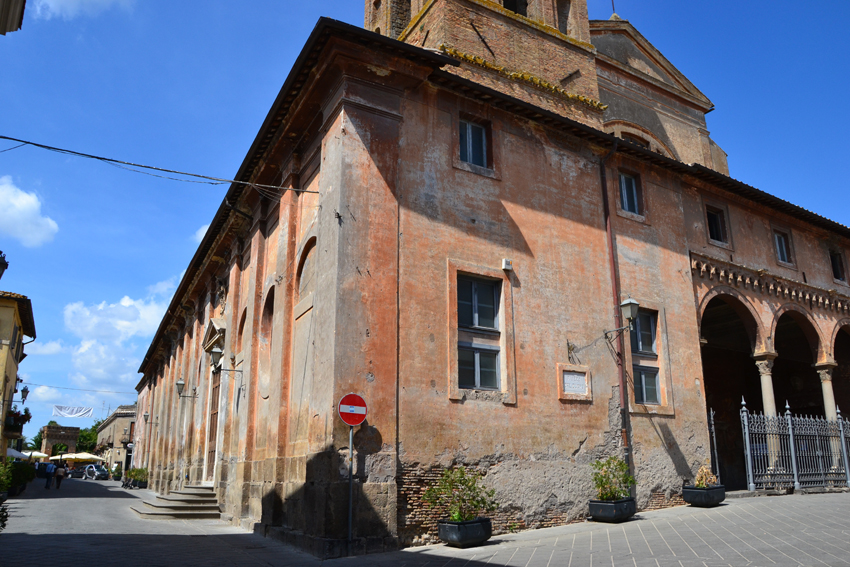
The church of Santa Maria Assunta in Nepi was built in the twelfth century on a Roman temple on which had been built in the fifth century AD the early Christian church.
In the sixth century it was demolished by the Lombards and in the ninth century the church was rebuilt by Bishop Innocenzo Pegatesco.
It was later enlarged and embellished with numerous works but in 1798 it was burned down by French soldiers.
It was reconstructed again by the bishop Basilici in the nineteenth century.
The church has a Romanesque portico and five naves.
Inside is the beautiful sarcophagus of San Romano by the Bernini school and a triptych attributed to Giulio Romano.
In the crypt you can admire the most ancient phases of the building.

The church of St. Joseph in Monterosi was built in the seventeenth century in baroque style.
It has two bell towers topped by domes characteristics of oriental forms.
Inside it houses the relics of Saints Vincent and Anastasius, the protectors of Monterosi.
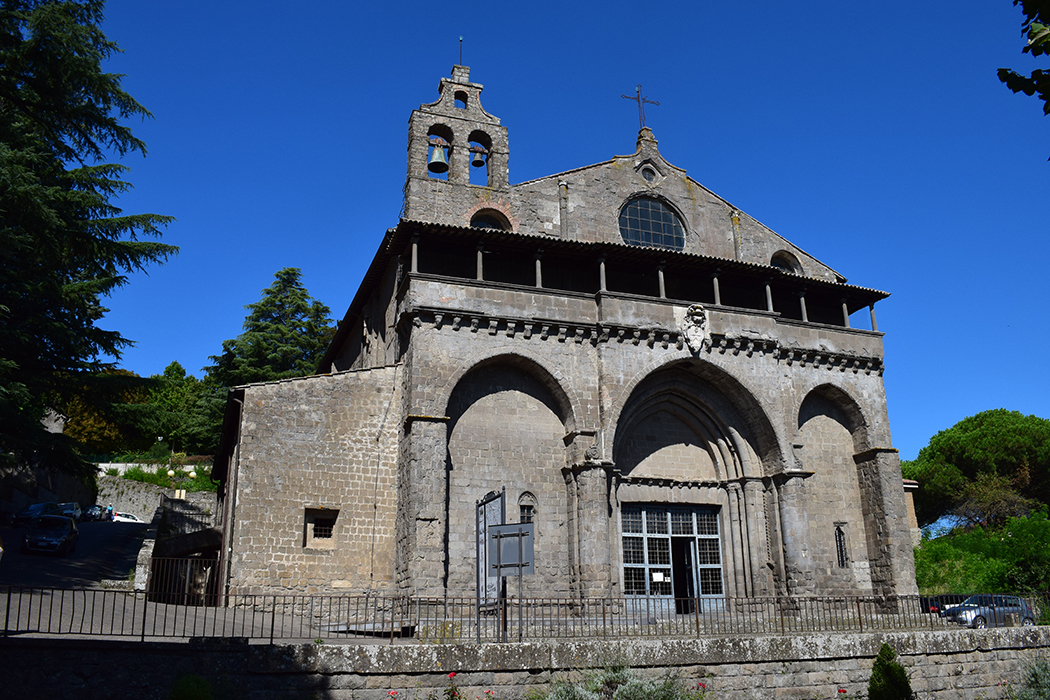
The splendid church of Saint Flavian (San Flaviano) is located outside the town of Montefiscone along the ancient route of the Via Francigena and takes its name from a Christian martyr who lived at the time of Emperor Julian the Apostate and who was the husband of Santa Dafrosa and father of the saints Bibiana and Demetria.
Flavian had been a Roman aristocrat and a prefect under Constantine and was then enslaved after his conversion to Christianity.
Probably Flavian had arrived as a slave in this area to work on the construction of a temple.
The church is very old and there is a trace of a first building already existing in 850 because it is mentioned in a document by Pope Leo IV.
The church is very special because today it is composed of the superimposition of two different buildings, both with three naves but with opposite orientation that exploit the difference in height of the ground. The lower church is the oldest and dates back to 1032 and was built by Lombard masters in Romanesque-Gothic style.
In reality, even the oldest church was based on a central Romanic nucleus that somehow recalled the architecture of the Holy Sepulchre of Jerusalem. In the past, Montefiascone had been very important because it was the point where the different pilgrim routes met that were leading to Rome.
On one side Via Francigena and on the other the Via Roma that came from the Adriatic and the Baltics, and the road that arrived from Bologna.
In the fourteenth century the church was enlarged and the current façade was completed, characterized by a final platform with three large arches, in the central one 0f which there is the coat of arms of Cardinal Aldovrandi and the glass door leading to the church.
Above these arches there is a small loggia that partially hides the final part of the church. The façade ends with three circular openings at the aisles and a bell gable with two bells.
The interior of the church has a local square stone cladding that is frescoed in many parts with works from the fourteenth and sixteenth centuries.
The columns that divide the three naves have capitals very different from each other, some in Romanesque and other Byzantine according to the period in which they were made, and the church ends with three apses of which the central one has a fresco of the fifteenth century that represents Christ enthroned between Saint Peter and Saint Paul.
Immediately below this fresco of the apse stands an image of St. Flavian on horseback and the altar that houses his relics.
At the centre of the church a large ceiling opening connects the two religious buildings and from the top you can have a view of the lower one as on a balcony.
The upper church can be reached through an internal staircase that is at the end of the right aisle, or from the upper road that connects with the centre of Montefiascone. In the upper church is the throne of Pope Urban IV who had consecrated the altar in 1262.
The exterior facade of this church is totally different and has a style of early baroque with a large rose window with 4 lobes and two side doors with an oval window above.
The Frescoes of Saint Flavian
The lower church presents an incredible cycle of frescoes of refined beauty executed between the fifteenth and sixteenth centuries.
They narrate biblical events of the New Testament such as the Cradle, the Epiphany and the Annunciation and stories of the life of saints such as Saint Catherine of Alexandria and Saint Nicholas of Bari.
Particular attention is deserving of the encounter between "Three Alive and Three Dead" which is located above the arch of the first chapel in the left aisle. In an ornate frame is the phrase "Think about what you are and what you can not avoid becoming".
Among other images of saints we recognize Santa Barbara, Saint Sebastian.
Defuk's tomb
Among the chapels of the church of Saint Flavian one deserves particular attention: it is that of the bishop Johannes Defuk (Giovanni Fugger) who died in 1113 but who in a certain sense still influences the history of Montefiascone.
A legend tells that the bishop was in the team of Emperor Henry V who went to Rome to be crowned by Pope Pasquale II. The bishop loved wine a lot and told one of his servants to precede him and taste the wine in the various taverns.
In order to communicate with the bishop, the servant Martin had to write the Latin word EST! On the door of the taverns that served a good wine.
Arrived in Montefiascone, delighted by the local wine called moscatello, the servant wrote three times the word Est! Est!! Est!!!
It is then said that the bishop decided to stop in Montefiascone on his return journey and to have enjoyed so much wine and company to stay here until his death.
The bishop also left an inheritance to be able to celebrate every year a festival dedicated to wine.
Johannes Defuk is buried in the church of San Firmino under a beautiful inlaid slab and a plaque recalls his story with the words: "East est est pr nim est hic Jo De Fuk do meus mortuus est" which stands for "Est est est propter nimium est hic Johannes De Fuk dominus meus mortuus est" (For too much EST! here lies my lord Johannes Defuk).
A legend tells us that Defuk left a legacy to the 24,000 Roman shields to organize a large wine party on his grave on August 24, the day of San Bartolomeo, patron of the seminary.
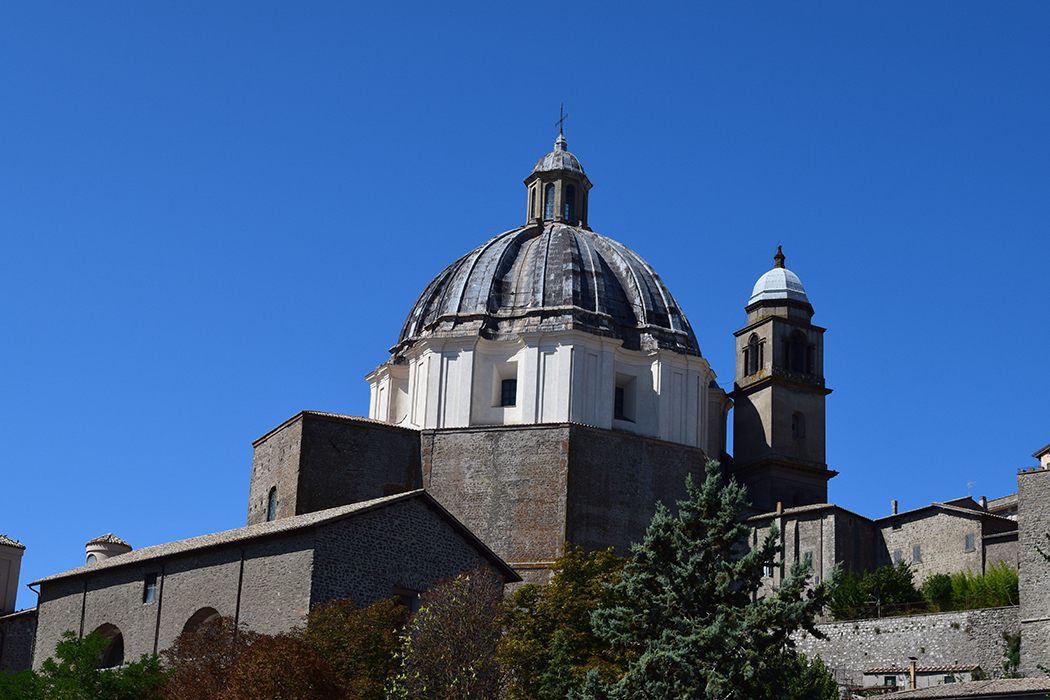
The cathedral is named after Santa Margherita, the patron saint of Montefiascone, and has one of the largest domes on a national level. With its 27 meters in diameter it is recognizable from almost all the places in Tuscia.
The cathedral was built between the fifteenth and the sixteenth century on two levels that had two different functions: the lower church housed the relics of Saint Lucia Filippini and the upper church, used for daily celebrations, was where there are the relics of Santa Margherita, a martyr originally from Syria and protector of pregnant women.
In 1483 the cardinal Domenico della Rovere started the enlargement of a previous church and also seems to have involved Bramante and Antonio Sangallo the Younger in a truly original design of an octagonal church. For a time, the works were suspended because of the plague and construction went slowly, but the current form is due to an accident.
The construction of the dome and of the current church, in fact, were made after Good Friday of 1670 when a fire caused by an organist had destroyed the roof of the cathedral and part of its interior.
The new 'ribbed' dome with its evident grooves was designed by Carlo Fontana and dates back to 1674. It characterizes the landscape of the village in a decisive manner and dominates the simple bell towers and the simple facade embellished by the entrance door and two side niches with the statues of the patrons San Flaviano and Santa Margherita.
The façade dates back to the 19th century and is the work of the architect Paolo Gazola.
Inside the baroque style of the church has an octagonal plan with side chapels and on one of the sides there is the main altar with the statue of Santa Margherita and a precious wooden choir.
Among the many artworks present is an ancient wooden crucifix that was saved from the fire of 1670 and for this reason it is considered miraculous, a painting of the 1600s of the bishop St. Martin, a painting of the Madonna with Child between the empress St. Elena, St. Vincent and Saints.
In the chapel of the Madonna del Rosario there is a splendid Renaissance terracotta made by Benedetto Buglioni, of the Della Robbia school, which represents the Madonna enthroned between San Benedetto and Santa Bibiana.
The dome is frescoed with scenes of the patrons of the city. Above the entrance is the choir with an organ.
In the cathedral is buried Cardinal Marco Antonio Barbarigo who created the seminary in Montefiascone and transformed the local economy during the second half of the seventeenth century.
Crypt of Saint Lucia Filippini
The crypt is the oldest part of the church and includes the remains of Saint Lucia Filippini, disciple of the cardinal and founder of the order of the nuns Pie Filippini, who was born in Tarquinia and died in Montefiascone in 1732.
The crypt is accessed through a fourteenth-century portal in the shape of an ogive and the simplicity of the environment seems to contrast with the baroque splendour of the church above. The octagonal shaped space is marked by a central nucleus containing the remains of Saint Lucia in an artistic altar and a ring composed of eight Gothic arches.
The crypt was designed by the architect Michele Sammichele di Verona with the involvement of Antonio Sangallo the Younger.

The church of the Holy Spirit was built in the eighteenth century in Monte Romano.
Page 87 of 140


Follow us