Churches & Places of Worship

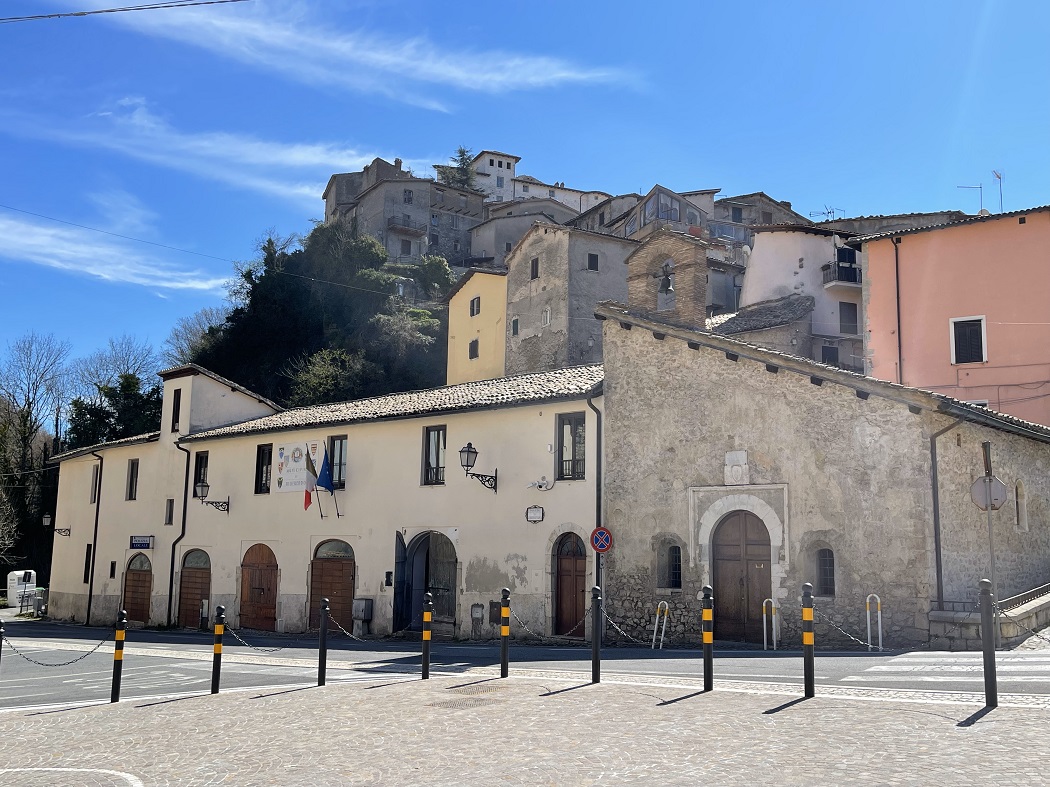
Church and oratory of the Santissima Annunziata

The church and oratory of the Santissima Annunziata (Most Holy Announcement) is the most important monumental building in Riofreddo and is located right at the entrance to the town along the ancient Via Tiburtina Valeria.

The simple oratory is incredibly decorated with frescoes representing the story of Jesus and fake tapestries with a style that recalls Giotto and international gothic. The name of the authors of the works is not well known, among which there is also an artist called Master of Riofreddo.

The decoration was carried out by order of the Colonna family during the pontificate of Pope Martin V Colonna di Genazzano to announce to the faithful the end of the Western Schism in 1420. For the definition of the subjects and themes to be treated, Antonio Colonna availed himself the assistance of philosophers and theologians expert in Eastern doctrine.

Once this church was the chapel of the medieval hospital which performed these functions for many centuries with ups and downs. The last period of splendor was when the last son of Giuseppe Garibaldi came to live in Riofreddo with his wife Costanza who was a nurse and decided to set up an emergency room to serve the residents of the village and neighboring towns.

Today the Riofreddo hospital has been transformed into the town hall.


powered by social2s

The church of Santi Abbondio and Abbondanzio in Rignano Flaminio began at the time of Otto III (980-1002).

Probably as compensation for shifting of the bodies of the martyred saints to Rome, and underwent changes until the fourteenth century.

The church is made of brick interposed with early medieval marble while the apse is tuff.

The bell tower has three floors with mullioned windows and was built using the buttress of the church.

The interior is divided into bays by pointed arches and  in the elevated presbytery are a table and a stone seat.

In the trapezoidal crypt a particularly beautiful fresco can be found: St. Michael with his face very realistic.

The painting suggests the idea of ​​the third dimension, and with shining white wings that make the idea of ​​an angel as "hierarchically" closer to God.

The apse is painted with a scene of the Apocalypse, the Holy Family and the Day of Judgement,.

A typical medieval scene with educational purposes for the faithful to bring them closer to God, but also to control them.

These scenes were the Bible of the poor and illiterate.

powered by social2s

The church of Saints Vincent and Anastasius in Rignano Flaminio dates back to the Middle Ages, at the behest of the Savelli family,.

It has a simple façade of tuff blocks in the shape of a hut.

The interior has a Latin cross with three naves divided by pillars.

The emblem of the Savelli family is found on a special water font together with two golden lions rampant with red tongues and a rose.

powered by social2s

The church of Immaculate Conception in Riano dates from 1490.

It was built by the Benedictine monks of St. Paul Outside the Walls.

It was then renovated and expanded in 1738 by Francesco Maria Ruspoli.

It is a simple construction with a fifteenth-century door framed by marble.

The church has a nave and the altar in the apse with a painting of Madonna and Child.
 

powered by social2s

The abbey of St. Andrew in Flumine in Ponzano Romano was mentioned for the first time in documents of the Carolingian period, in 762 on a preceeding Roman installation of the fifth century. It is attributed to a certain Gallae, told by a monk of the community of San Silvestro on nearby Mount Soratte.

History has it then that this abbey was sought by a brother of 'Pepin the Short', who retired in contemplation in this area, and it was built by Benedictine monks.

After 1000, the abbey remained among the possessions of the monastery of St. Paul Outside the Walls in Rome, and then passed under the administration of the Farnese.

The Romanesque style dates back to the twelfth century and was originally a fortified church with control towers like all centres located in a strategic location along the trade routes.

The only surviving tower is the bell tower. The interior has three naves with granite columns and Ionic and Corinthian capitals, and the floor is covered with cosmatesque (cosmati) mosaics.

powered by social2s

The church of St. Nicholas of Bari is located in the centre of the town of Ponzano Romano.

Iits origins certainly precede the first official document, a deed of 1494.

The bell tower is built in the corner of the façade dates back to the late thirteenth century.

The church was remodelled in the eighteenth century.

Inside it houses many works from the abbey of St. Andrew in Flumine.

powered by social2s

The church of Mary of vineyard - Maria delle Vigne - in Pomezia is called "the Madonella" is a private church of the Borghese family in a deserted agricultural area.

The style dates from the seventeenth century, even if the real story is not known. It is believed that as with many churches, it may have been built on an earlier Roman building, probably a thermal plant.

The church is an octagonal central plan covered by a pavilion vault internally decorated with frescoes dating from the seventeenth century.

powered by social2s

Recommended

Subscribe to Newsletter

Discover a territory through the emotions of the people that have lived it.