Churches & Places of Worship

Sant'Angelo Romano. Church of Saint Liberata

The church of Saint Liberata is the oldest in Sant'Angelo Romano and with its convent dates back to the 14th century. The story goes that it was built by the citizens to have saved them from the plague.

The church has been renovated several times and inside you can observe the various interventions. In 1737 the convent was enlarged thanks to the intervention of Giovanni da Evora.

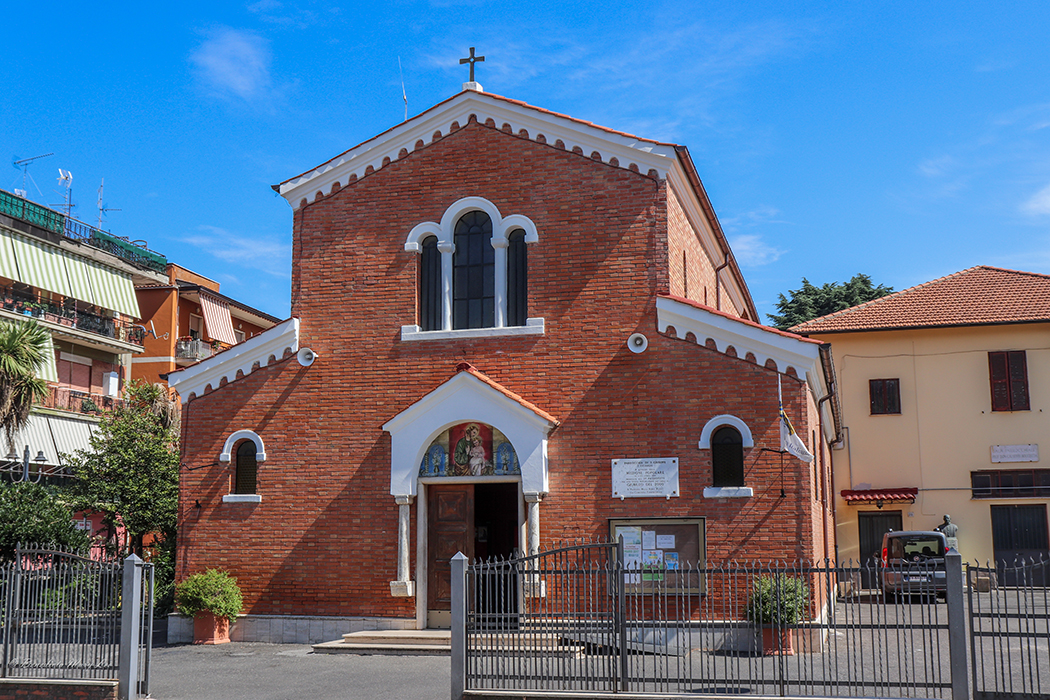
From the outside it appears as a neoclassical building, with a facade divided into three sections corresponding to the three internal naves. It has only one entrance door but three large windows that illuminate the interior and the central part of the facade ends with a tympanum.

The church has three naves with 2 chapels on each side. The interior is rich in works of art such as the altar area under a cross vault and which once housed the choir. Behind the altar is a small temple that displays a 15th-century altarpiece representing Santa Liberata in a large cloak as she addresses God.

Above the entrance door is the choir loft.
powered by social2s
Sant'Angelo Romano. Church of St Michael Archangel

The church of St Michael Archangel has a long history and it seems that it was part of the first fortress of Sant'Angelo Romano. According to tradition, it was Pope Eugene III, a cultured pope of monastic origin, who inaugurated this church after the year one thousand.

The church is raised above street level and is accessed via two side stairways. The facade is in simple plaster and ends with a gabled roof. The bell tower was built in 1677 by the bishop of Tivoli.

The interior has three naves and the central one ends with an altar area under a cross vault and is framed by a 16th century fresco. Above the entrance there is a choir loft.

The church was used as a burial place before Napoleon's cemetery reform.

It was used by the Garibaldians as their headquarters and lodgings before the fall of Rome.

powered by social2s

The original church of St. Nicholas of Bari was built between the thirteenth and fourteenth century in San Polo dei Cavalieri.

It was later rebuilt in 1587 by changing completely the original building.

The interior has a single nave.

To the right of the main entrance you can see a fresco of the late sixteenth century depicting the baptism of Jesus.

On the background scenery is just the castrum of San Polo, with its defence towers and the original city walls.

The altar painting depicting St. Nicholas is instead of the fifteenth century.

The bell tower was built on an old tower of the city wall.

powered by social2s

The church of Saint Lucia, in the old village near the castle of San Polo dei Cavalieri, is the oldest in the are.

It dates back to the fifteenth century.

The plan has a Greek cross, a nave with two chapels.

You can admire the 'processional apparatus’ that allows bringing into the annual procession.

An oil painting on wood representing 'The Assumption', and that goes back to the 1600.
 

powered by social2s

The name of the church of of Our Lady of Cavata in San Gregorio da Sassola takes its name from a legend.

It is said that the image of the Madonna and Child from the thirteenth century, depicted in the act of blessing St. Gregory the Great kneeling, was 'cavata' (removed) from the soil in which she was buried.

The building dates back to the fifteenth century and in 1700 the facade was transformed.

The church has a single nave with walls completely covered with undated frescoes.

Probably they are the work of several painters and created at different times.

powered by social2s

The present church of St. Gregory the Great was founded in 1485 in San Gregorio da Sassola.

It was an extension of a place of worship dedicated to the community of the saint.

His consecration was in 1537 and the statue of the saint dates back to 1567.

In 1621 the masonry presbytery and the main altar with the monumental tabernacle with two beautiful alabaster columns were created.

In 1720 the local painter Tancredi Maschietti painted the canvas of the Saint in the act of writing the apocalypse, as he looks inspired by the Madonna.

Is referred to on the 1774 banner of the procession of the patron.

In 1867 the church was modified by the construction of the vault and the aisles.

powered by social2s
San Cesareo. Church of Saint Joseph

Initially the small wooden church of Saint Joseph was built in San Cesareo by the National Opera for Combatants.

In 1928, it was transformed into a Romanesque masonry building.

In 1944 the church was damaged by bombing and rebuilt in 1951.

The interior has three naves with a chapel.

It has a beautiful quadrangular bell tower decorated with mullioned windows.

powered by social2s
Convent and church of Holy Mary of Grace

The church of Holy Mary of Grace (Santa Maria delle Grazie) is located at the entrance to the village of Sambuci and is annexed to the Franciscan convent. It is also called the church of SS. Virgin of the Nativity and was built on a previous medieval building. Its renovation dates back to the end of the seventeenth century, under the government of the Astalli family, and continued in the following centuries.

The church has an imposing brick facade built in neoclassical style with a bell tower on the right side. The wooden portal is original and the interior has a single nave with two small side chapels and has a Baroque style with faux marble on the walls.

The convent has a beautiful internal cloister with cross vaults frescoed with the story of Saint Francis.

Today the convent is owned by the municipality and intended for recreational activities.

powered by social2s

Recommended

Subscribe to Newsletter

Discover a territory through the emotions of the people that have lived it.