Sperlonga-museo-Archeologico-Bettiol-12-1-1024x683.jpg

The Roman emperor Tiberius, famous as the first successor of Augustus, chose Sperlonga to build a very special villa in a cave, one that still amazes the visitor.

For years the villa had been forgotten and for this reason it has kept some of its treasures that can be seen today in the museum. The discovery of the villa is almost accidental: it was 1957 and the engineer Erno Bellante was undertaking construction of the Via Flacca near Sperlonga.

A treasure was extracted from the sand of the Antro di Tiberio (Caveof Tiberius). A large circular basin was filled with thousands of marble fragments. The find was renamed "Odissea del Marmo".

A memorable moment, news that went around the world and that brought to Sperlonga numerous illuminati. Essays and articles were written. The discovery involved all the local inhabitants, who did not only participate in the discovery but also organized surveillance groups to avoid that the findings would be taken to Rome.

So, there was a popular rebellion that stopped transfer the sculptures, and endeavoured to leave them on the site. Thanks to this revolt today there is the National Archaeological Museum based in Sperlonga.

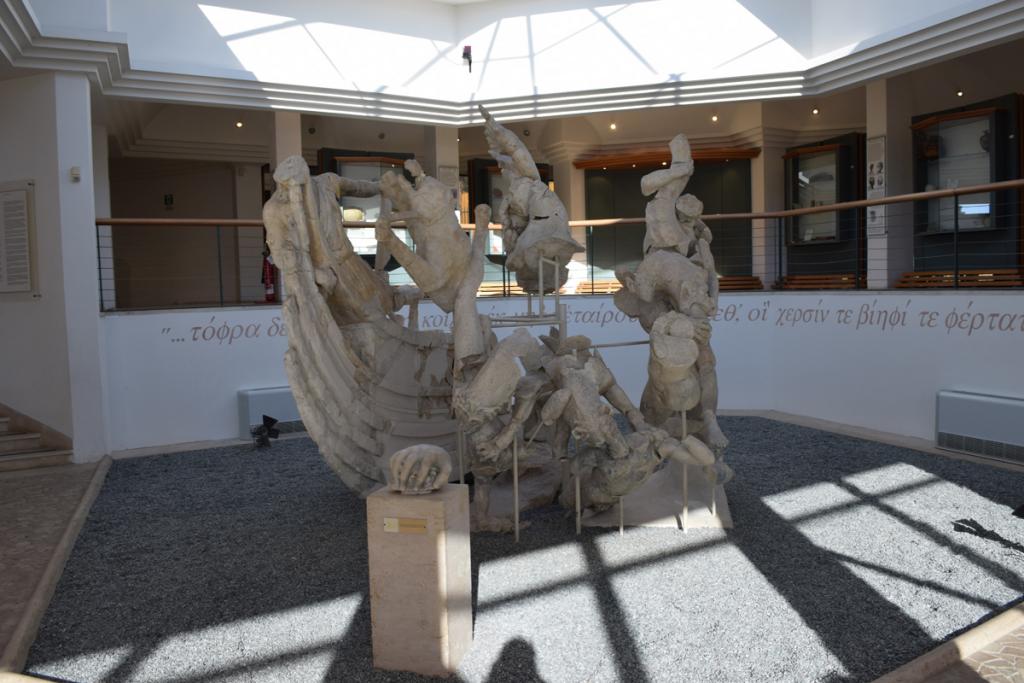
After a long and difficult restoration, four main sculptural compositions representing the exploits of Ulysses and the return of the wanderers are now recognizable. The sculptural groups include the assault of the Scylla monster on Ulysses' ship in the centre of the circular basin; then the "Pasquino" (recently identified with Ulysses carrying the corpse of Achilles) and the abduction of Palladio by Ulysses and Diomedes.

These were placed respectively on the left and right appendages that separate the circular pool from the front quadrangular basin. Finally, at the bottom of the cave, there was the large sculpture that represents the blinding of Polyphemus by Ulysses and his companions, at first known as Laocoon ".
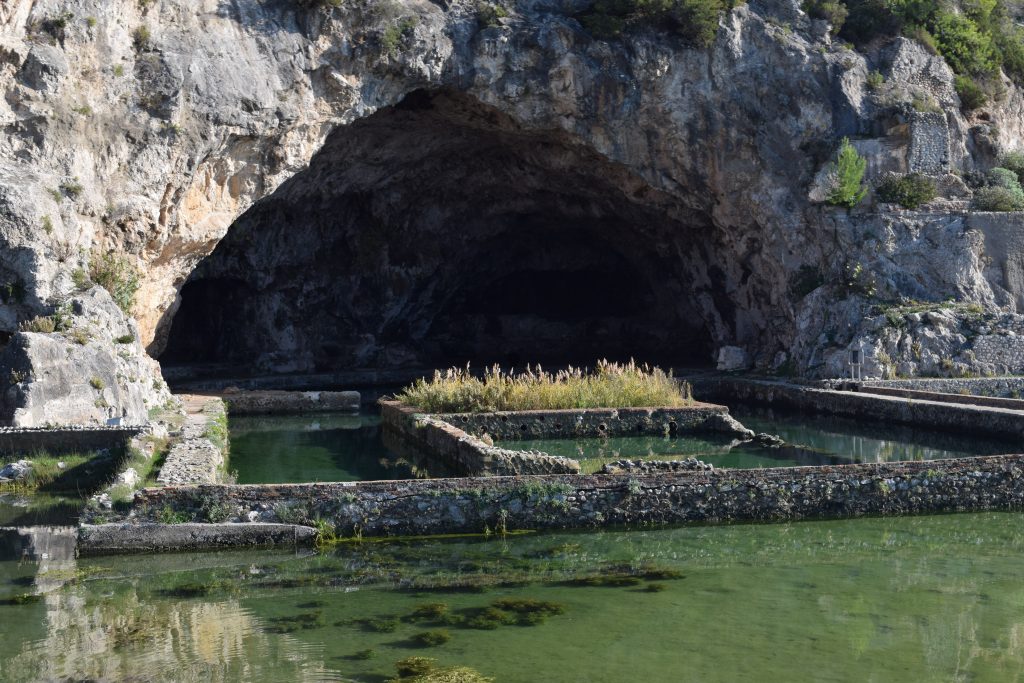
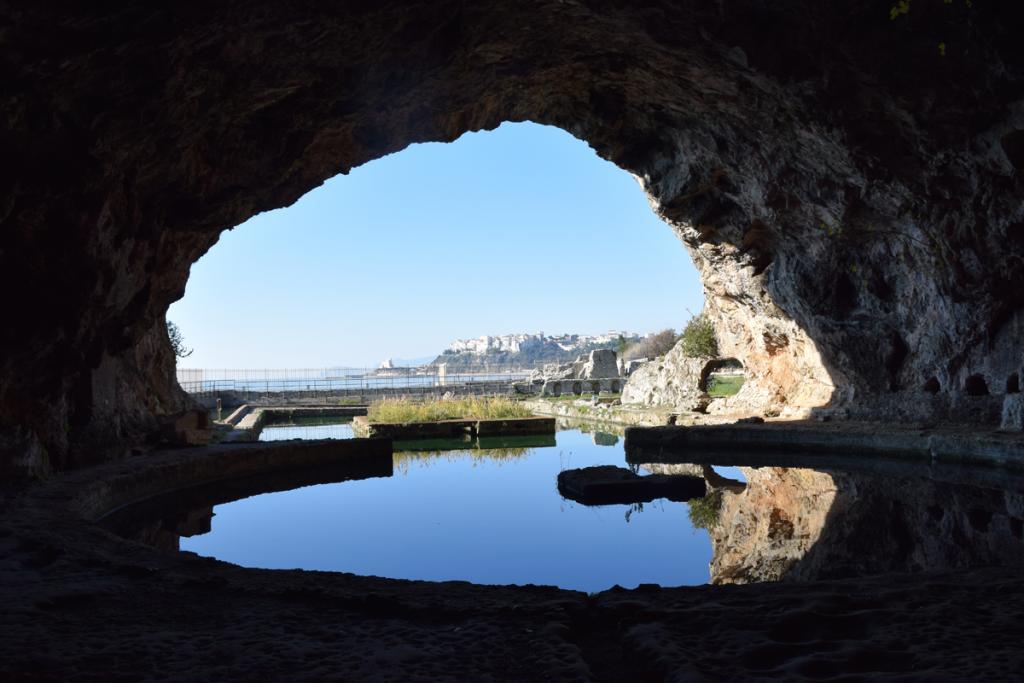
The cave of Tiberius is open to the sea and is a section of a large villa dedicated to festivals.

Many times doubts have been raised concerning whether the belonging of the villa-cave were of the emperor Tiberius. There are, however, elements that prove the validity. The term praetorium (generally used to indicate the residence of the emperor) is cited by Suetonius, in the aforementioned passage. Another element is the presence of a vast barracks to collect the Praetorians, imperial guard.

The historians Svetonio (Tiberius, 39) and Tacito (Annali IV, 59) tell of a fortuitous event occurred in 26 AD in this cave when a collapse occurred during a banquet inside the cave praetorium cui Speluncae nomen -  near Terracina.

The collapse caused numerous deaths and the emperor Tiberius was saved thanks to the immediate advent of Seiano who protected him with his body by acting as a shield. For this gesture of great faithfulness he was granted the position of the governor of Rome, while he eventually retired to Capri.

The most recent discovery took place on March 9, 2018 when two fishermen found a capital of Greek origin, which testifies even more the commercial link between Italy and Greece. The capital of 1 meter in diameter, perhaps dated around 80-90 BC. or in the first century AD, may have belonged to the villa of Tiberius.
The proof that the capital does not come from under the sea and had fell from a ship, is testified by the top having been in contact with the light many times before this find. This very recent recovery testifies even more the historical importance of this site and gives it even more charm.
powered by social2s
Canaletto, greatest of the vedutisti

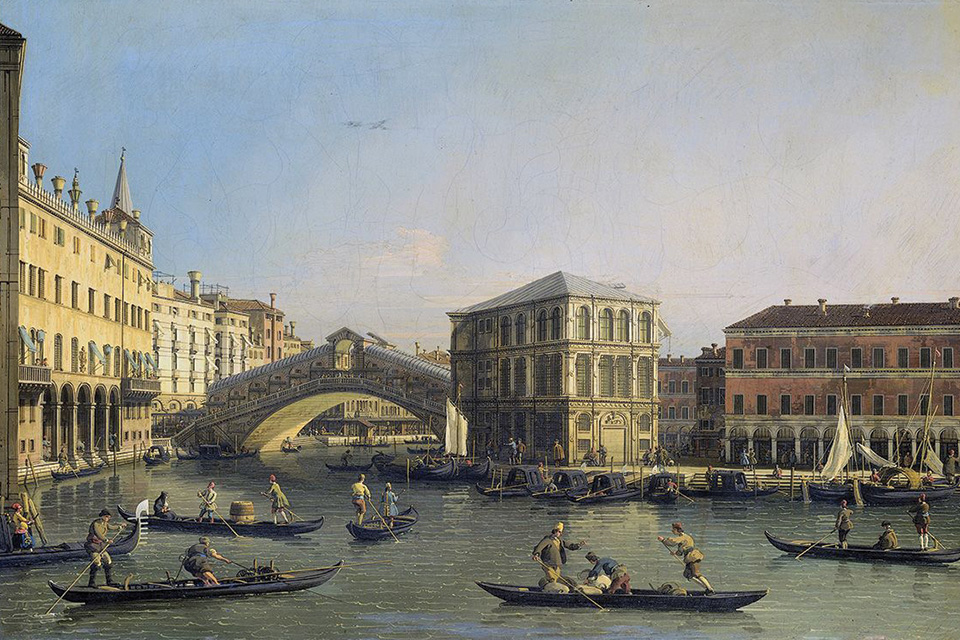
The greatest of the vedutisti, the apex of vedutism, the most well-known painter of vedute (views), was Canaletto, the ‘Little Canal’.

Named Giovanni Antonio by his father Bernardo Canal, the world knew him by his ‘nickname’ of Canaletto. Born in Venice in October 1697, he expired in his hometown some 70 and a half years later having filled the world with an amazing collection of art something more than 170 works.

While not combatting Picasso in quantity, he certainly provided the world with a more accurate study into pictorial realism.

Canaletto, from an early age, was taught by his father the family trade of being a theatrical scene painter, a craft that required a good eye, a sure hand and a fast arm.

In his early twenties he ventured off to Rome, not stopping to admire renowned art on the way and was enchanted by the city of Rome and the realistic painting of Giovanni Pannini, to the extent that the Little Canal set about painting the eternal city and its people.

His style was later termed ‘topographical’, but to the humble observer whose awareness of art is somewhat ordinary, it may be better referred to as ‘photographical’. In fact, if only Canaletto had been able to produce his works at a more rapid pace, he may have delayed the onset of colour photography for generations.

The first work of Canaletto that is recorded is Architectural Capriccio from 1723. And why ‘capriccio’? It reminds us that the scene so presented is a fantasy, an image from the mind, a story of realism that escapes reality. How Canaletto became the master, supplanting the recognized Luca Carlevarijs as a painter of city scenes was, to my eye, his mastery of colour and light – creating realistic scenes with brilliant colour of which even God may be a little jealous.

A Venetian by blood, love and technique, he was the favoured source of artworks for the English travelers on the Grand Tour in the 18th century, who purchased his commercial output through his entrepreneurial agent, Joseph Smith, who later became British Consul to Venice.

The passion by the British for the images of Venice, as a memorial for their real or dreamed tours, and the intervention of war, resulted in Canaletto spending some 10 years in England painting time and again scenes such as Windsor Castle - though these were not so well received as his Venetian art and he had to resort to painting demonstrations to prove that his works were really from his brush.

Of course, much of his output throughout his life was capricci, or at least pictorial ‘capricciosi’, the result of a blending of true imagery with possible scenery. The tricks of his trade mostly learned in his youth, whether or not he used camera obscura as an aid, enabled him to reproduce and heighten reality in his finished works.

The master had at least one famous pupil, one Bernardo Bellotto, his nephew, and it was often surmised that there were two Canaletti, so similar were their works of the same scene. View: ‘Piazza San Marco, verso est, Venezia’ and decide who painted which.

Finally, Canaletto waited till his last years, following his return from London, to accept election to the Venetian Academy and it was not till his 68th year that he presented his work for admission, ‘Prospettiva con portico’- amazing perspective.

For those who, like me, have become enthralled by the story of Canaletto, the time to appreciate his great art is now, at the 250th anniversary of his departure to a distant celestial scene.

See about 40 of his works at Museo di Roma, Palazzo Braschi in Piazza Navona in the heart of the palace district of Rome, until 19 August 2018.

Enjoy the art and the descriptions and stories in both English and Italian. And maybe send a comment or two, adding a little literal capriccio.


powered by social2s
The good life around the Lake of Nemi and its pleasures

Spend a different kind of Sunday in Nemi and its fascinating lake hidden inside the Castelli Romani Park, a small oasis of peace so close to the capital.

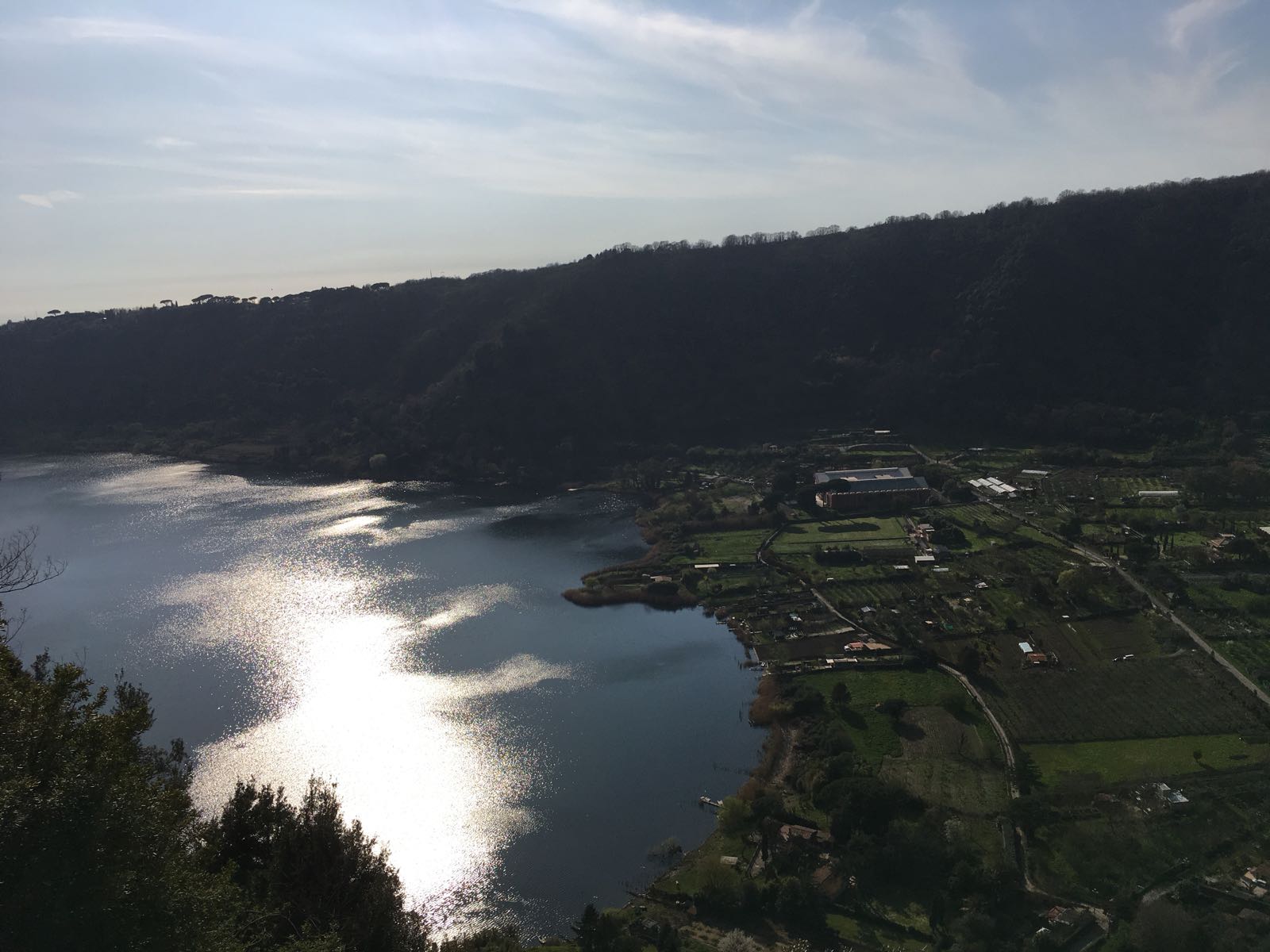
This enchanted village is one of those places where the hands of time seem to have stopped. Above the clear waters of the lake of Nemi surrounded by the nature of the sacred wood of the goddess Diana, the village emerges on a spur at a height of a bit over 300 meters above sea level.

The lake of Nemi and its forests have always inspired man to respect nature and its link with it. But the beauty and sacred nature of the place are not the only elements that characterize its fame.

Good food and the genuineness of local products have their social relevance and, to frame this pleasant scenario with local pleasures, check out a good glass of the renowned Fragolino wine, accompanied by a cup of strawberries with cream, from the local crops. In this way life around the lake of Nemi can take on a truly invaluable value.

Living in Nemi becomes a 'choice', as well as an excellent investment to rediscover the well-being and a more human dimension, alone, with friends or with the whole family.

In particular, the microclimate should be noticed, which with its moderate temperatures has always favoured cultivation in the area. The pleasant climate encourages local agriculture and, not least, the presence of some sources of drinking water, which make Nemi a coveted place to live and visit.

Over time, the constancy of the locals has certainly been essential for the growth of this small town. For centuries, in fact, the local populations have collected the seedlings of the strawberries in the undergrowth and have transplanted them in the terraced farms of the slopes of the lake, thus allowing a lush cultivation of the fruit, and the development of this activity. (This is the reason why the wild strawberry is the typical product of excellence in Nemi).

Nemi has been chosen since ancient times by the major Roman families as a summer residence, so it has become the hub of good life, good food and contact with nature. Today, it is still chosen for the same reasons.

Lovers of the 'green lifestyle' can choose to take a trip out of town or have a short escape from the chaos of the city metropolis or even just to go in a desperate search for a breath of magic in timeless Nemi

Her beauties, therefore, continue to enchant and fascinate young and old, with its aroma of lavender that emanates through the streets of the village.

Nemi still allows us to dream compared to those who, too often, have forgotten the formula for doing so.

powered by social2s
Canepina’s Six-Hour Clock and the History of Italian or Roman Time

Canepina’s six-hour clock has been on that wall for years, for centuries, without anyone ever having noticed.
Since it stopped working, no one has ever paid it any attention! People have walked by it for years without ever realising it existed! Yet there it is, above the door to the Salone Del Quarto Stato, or “Hall of the Common Folk”, in Canepina’s Museum  of Folk Traditions, which was a Carmelite Convent back in the 1600’s.

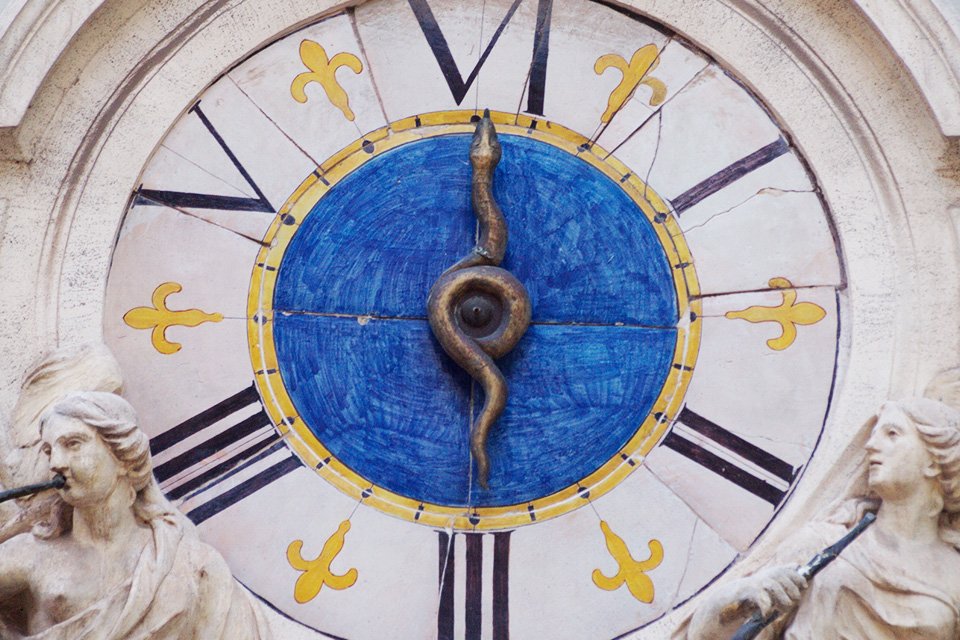
I believe the disk of the clock face is made of plaster. Attached to the wall like a rose window, its centre holds a small grotesque mask whose cheeks are puffed out. The mouth, left ajar, most likely provided the point of entry for attaching the clock hands to the mechanism inside (though who has ever seen those clock hands?) while the Roman numerals circling the clock face are interspersed with small crosses.

None of this ever excited anyone’s curiosity, including the numbers, given that the world is full of clocks with numbers done in unusual designs!

At times, mere dots stand in for the numbers, so accustomed are we to telling time by nothing more than how the hands are positioned. So even if someone glanced at it now and then, the clock never drew any attention to itself. It was just part of the decorative scheme.

But then one day a friend took me to where it stood, pointed up and asked: “Do you know what that is?”. A clock!” I told him with the confidence of someone who gives an obvious answer. “No! – he replied – it’s a rose of the winds!”. A claim that left me puzzled, though my friend tried to convince me by adding:

“I was here when they restored the place, including the roof. Behind that wall was the cabinet that held the mechanism, all of it in wood, including the toothed gears, and there was a pipe that went from the mechanism to a point above the roof. Up there, - he added – there must have been a weather vane to show the direction of the wind”. 

And where is the mechanism now?” I asked.

It was all rotted away inside. As soon as they touched it, it went to pieces!” – he answered. Then, still trying to make his point: “Have you looked at the numbers around the clock face? They only go up to six!”

He was right! I’d never noticed it, but if we were talking about a clock, then, at the very least, the numbers had to be in the right places. But the spot where the twelve should have been held the six, while the place of the six had been taken over by the three. What was going on?

I thought for a second. Then I got an idea and said to my friend: “I’d like to believe you, but puzzles me are those numbers. If it was really a rose of the winds, then, as far as I know, the numbers should be multiples of four. You’d never see a six”.

My observation seemed to shake his conviction, and for a while neither of us said a word. Then I broke the silence by saying: “Listen, I’ll look into it. I’ll do my research and let you know what I find”.

I started off by gathering information on roses of the wind, seeing that my mind always tends to give credence to the other person’s arguments before looking into my own. But I soon realised that my friend’s claim was off the mark, so I did what everybody does nowadays, in the privacy of their own home, daring to enter far-fetched possibilities in some search engine, just to see what comes up. First I looked around to make sure no one was looking and then I Googled: “Six-hour clock”.

What do you know! I must have stumbled upon just the right words, because they led me to so many pages, I didn’t know where to begin. Then it all became clear to me.

Our clock was definitely a six-hour model, better known as an Italian or Roman clock: “Roman” because it was used primarily in the Rome area and in religious circles in the larger Lazio region.

The chiming of its bells, which explained why that pipe went up to the roof, was based on the old system of “Italian time” followed mainly by the Church from the 13th century on.

In Italian time (in vogue from 1200 to 1800), the day didn’t start from midnight, as it does now, but from the Ave Maria said in the evening, as dusk was falling, or roughly half an hour after sunset.

Each day began when the Sun went down, while the twenty-fourth and last hour of the day ended at sunset of the next day, all in accordance with a venerable biblical tradition. At sunset, one day ended and the next got underway, with the entire night belonging to the day after.

The lone hand of the six-hour clock did four full laps around the clock face to cover all 24 hours of the day, and so each number marker had to stand for four different numbers. Here’s a quiz for you: what would today’s 10 pm have been? I say four o’clock, what about you? And where did the clock hand point at 3 in the afternoon?

The Italian expression: "Wearing your hat at an eleven pm slant" can be traced to Italian time, seeing that hat brims get pulled low, to keep the setting Sun out of our eyes, at sunset, which meant eleven pm on the Italian clock.

But while such clocks were being used in Italy, the rest of Europe was dividing the hours of the equinox into two groups of 12, the way we do today, with the days starting from midnight. In Italy, this way of keeping time was known as “oltremontana”, or “French” or “German” time, referring to the fact that it was practiced by peoples who lived “beyond the mountains”, on the other side of the Alps.

Towards the end of the 18th century, in the areas of Italy occupied by Napoleon, French Time was officially imposed as the standard.

Once the French had withdrawn, the Papal State tried to restore the old way of telling time, based on the Italian clock, but the Church was eventually forced to fall in line with what had become the universally accepted method of counting the hours, though some Roman clock faces were kept in place, causing further confusion among the public at large.

One of the best known examples is the clock on the tower of Venice’s Piazza San Marco.

And so evidence of the historic six-hour clock (which told “Italian” or “Roman” time) has been discovered in Canepina.

powered by social2s
The imperial villa of Trajan in the woods of Arcinazzo Romano

The area of ​​the high plains of Arcinazzo Romano has been a destination for tourists since the imperial age and, perhaps, the most famous character who chose it as a hunting lodge was the emperor Trajan (98-117 AD), the emperor universally known for the Trajan's Column in Rome following the conquest of Dacia, and the Trajan markets (which are considered as the first commercial centre).

The villa had an area of about 5 hectares and is located at the foot of Mount Altuino, surrounded by woods and fields of the Altipiani di Arcinazzo and can be visited together with the nearby museum of Arcinazzo Romano.

This area near Rome is special for its natural beauties and there are other imperial villas such as that of Nero in Subiaco. It was crossed by the Via Sublacense that led to springs of the Aniene and to one of the valleys rich in water and called the aqueducts because it was one of the water supply areas of Rome.

Today in the highlands you can practice Nordic skiing, horseback riding and trekking in nature while once they were hunting and refreshment areas from the oppressive summer heat of Rome. These were probably the reasons that convinced the emperor Trajan to put one of his dwellings there.

The complex, which today is also used to host cultural events, spread over an area of ​​about 5 hectares and was organized on two levels, of which the upper one was used as a dwelling, while the lower one was composed of rooms for the reception of guests .

It was not a villa of extreme luxury like that of the ships of Caligula on Lake Nemi or Nero's Domus Aurea, but a hunting lodge with elegant and surprising architectural details. It is suggestive of a nymphaeum, inside which jets of water started from some sources and bathed the statues creating amazing games of lights and colours. This room overlooked the long garden inside which there were two fountains and various structures.

When accessed from the side of the garden, you can imagine the amazement of the guest, catapulted into a real paradise!

Today it can be imagined and, thanks to the reconstruction of part of the building, it is possible to enjoy a magical play of lights that, originally, had been carefully researched.

To enrich this dream scenario, the villa had rich decorations, found during the excavations and partly kept in the Archaeological Museum of Arcinazzo Romano, where it is possible to admire the splendid reliefs, the stuccos and the marble decorations of the floors and walls.

The marble came from Italy and the Orient and in the construction technique combined different geometric and natural colours and patterns.

Between the 18th and 19th centuries, many of these marbles and decorations, were taken from the villa and used to decorate the church of Sant'Andrea in Subiaco and Santa Maria Assunta in Arcinazzo. The archaeological excavations were done at the end of the last century but much is yet to be discovered. Part of the villa is today protected by an elegant wooden architectural structure that allows one to visit at any time of the year.

A trip to the Altipiani di Arcinazzo for pleasure or sport should always be enriched by a visit to this incredible imperial villa where you can breathe the air of the power of Rome at its full splendour.

Trajan was one of the greatest emperors, one of the five "adoptive emperors" and with him Rome reached its maximum splendour. Tread the places where he passed, discover the waterfalls of this park and imagine being a Roman engineer who built the aqueducts ... these and other views and dreams will create emotions to warrant a stay in this area.

powered by social2s
The tradition of painting eggs painted at Easter and the Tarquinia egg

The painted egg has been present since ancient times in almost all Eastern and Western cultures. In mythology painting eggs is associated with the universal symbolism metaphorically traceable to life, prosperity, resurrection, fertility and wisdom.
Among the archaic and pagan civilizations in which we find decorated eggs we remember in particular the Chinese mythology: the sublime universal principles of the yin and the yang are perfectly balanced and from that complete equilibrium emerged the creator god, born of the egg, which in iconography recalls the Greek god Pan.
For the Saxons, the Etruscans and the Mesopotamian kingdom, the Egyptians and the Mycenaeans, the egg was conceived as a symbol of rebirth and resurrection, of transition, as the guardian in itself of a new life.
This is the cosmic egg, which has the vision of the whole universe as a single living being. Man in antiquity knew that he was an integral part of this eternal cosmos, immersed in the continuous cycle of birth and death.
The painted egg, according to various sources, was present in the ancient pagan rites, in which the goddess of fertility was worshiped in the spring.
Even the ancient Persians were painting eggs for the "Nowruz", the Persian New Year which coincides with the spring equinox. The peasants of ancient Rome used to bury an egg painted red in the fields, a symbol of fertility and therefore favourable for the harvest.
From the tenth century to 1749, the Republic of Pisa set the beginning of the Pisan Year, with the Annunciation and the spring equinox: with a sort of solar clock. At noon on every 25th March, a ray of sunlight penetrates the Cathedral from a round window in the central nave and hits a marble egg.
Precisely because of these propitiatory features some art historians link the portrayal of the ostrich egg of the famous "Pala di Brera", or "Pala Montefeltro" by Piero della Francesca, datable to 1472, commissioned by the Duke of Montefeltro for the birth of the heir of the Duke Federico.
In the history of recent art, the theme of the egg as a metaphor of hope, love and life is recurrent in Fontana's pictorial research, culminating in the famous cut of the canvas, and in particular in the famous painter Salvador Dali.
He often took inspiration from the concept of the symbolic egg, up to celebrating it in a striking way even in his home in Figueres, Spain, whose roof is surrounded by giant reproductions of eggs.
Ostrich eggs
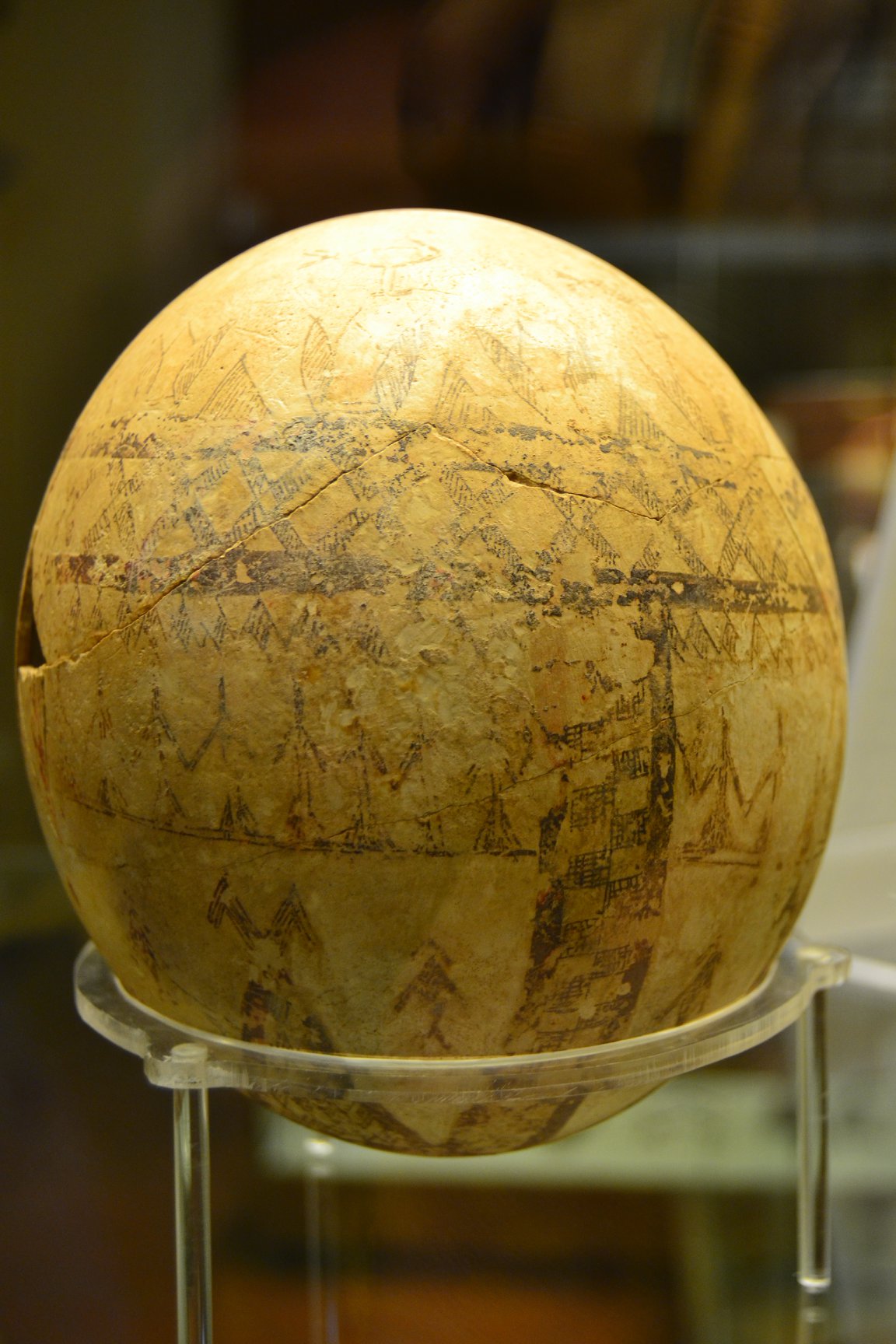
A special few words for painted ostrich eggs, precious objects that boast an ancient tradition. The ostrich egg is sixteen centimeters tall on average: with its perfect shape it is itself a discreet and elegant object, light, smooth to the touch.
In Italy the oldest decorated ostrich egg is kept in the museum of Tarquinia (Guide of Tarquinia ) and was found in an Etruscan tomb from the oriental period, in the middle of the seventh century B.C.
powered by social2s
The Abbot Desiderio and the 'golden age' of Montecassino

Work of the intellect has always been highly valued by the Benedictine Rule and in the copying of the texts of the past, each amanuensis decorated the texts with refined miniatures. St. Benedict claimed that the monks should read and write to understand the word of God and to help the community in its growth.

Over the centuries this activity became a true art and the abbey of Montecassino was one of the major centres for the dissemination of manuscripts and new initial letters and new miniatures were created.

But the artistic apex took place shortly after a thousand with the arrival of Abbot Desiderio and the appointment of Leone Marsicano as head of the scriptorium.

Desiderio was of noble Lombard origins, his father was the Duke of Benevento, and his knowledge of many different cultures would open his horizons and guide him in choices that were always considered wise.

He fled from his house at the age of 20 taking refuge with the princes of Salerno and lived for a long time as a hermit between the Tremiti islands and the Maiella mountain in Abruzzo. In 1055 he met Pope Victor II who made him enter the Abbey of Montecassino and appointed him a cardinal in Rome.

About 1058 he was elected Abbot and remained in office until his death in 1087 after he had been elected Pope in 1086 with the name of Victor III. With his time we have the so-called "golden age" with the growth of the church and the flourishing of the arts.

In his role he always tried to promote peace with the Normans and to maintain ties with Constantinople even during the schism. Precisely because of these ties, he brought from Constantinople the artists who would work on the construction of the new church of Montecassino.

In fact, Desiderio decided to pull down the previous construction and to make a larger one adorned with paintings, mosaics and decorated floors.

He was directly interested in the work and told the stories of how he went to Rome to collect marbles and columns for its construction. At that time the remains of the imperial buildings were like quarries from which to take works and in a certain sense it was a great privilege to have stones that came from the 'sacred city', that of the tomb of the apostle Peter.

The modernity of Desiderio was also that of having created a kind of arts school in which the Byzantine artists taught the monks and assisted their art. In a sense, the artists who were the heirs of the post-Roman and early Christian arts continued in the Eastern Roman Empire and returned to Rome to teach their children what they had lost.

Thanks to this school and the great influence of the Abbey of Montecassino in the history of the whole of Southern Italy, Byzantine art spread rapidly, giving rise to an important artistic period.

The consecration of the church took place in 1071 with one of the most spectacular events of the eleventh century in which bishops, royal Normans, archbishops and obviously monks participated. The church was then destroyed by the earthquake of 1349.

In 1086 Desiderio found himself pope almost by chance, he had been nominated by Pope Gregory VII, for whom he was an advisor, on his deathbed. He took a long time to accept and was consecrated only in 1087 under the name of Victor III and immediately retired to Montecassino.

At the request of Matilde di Canossa, he returned to Rome where he had to oppose the antipope Clement III, who he excommunicated with a synod he held in Benevento. During the synod he fell ill and chose to die in Montecassino where he was buried after only 16 months of his pontificate.
 

powered by social2s
The wooden crucifix in San Bartolomeo Church, Sora

In the church of San Bartolomeo in the city of Sora, there is one of the most important historical and artistic works of the area: the wooden crucifix of Sora.
The crucifix of Sora (Guide of Sora) was carved in Rome and donated by Cardinal Cesare Baronio, originally from Sora, to a local confraternity in 1564. 1564 is a sadly important date for the history of world art, because that year the world lost a man considered among the greatest artists of all time: Michelangelo Buonarroti.
The crucifix of Sora is a work strongly linked to the studio of ​​Michelangelo, and was realized just before Buonarroti died, probably by one of his closest collaborators. Among the various names proposed for the attribution, two in particular have been taken into consideration by recent historical and artistic studies: the students Daniele da Volterra and, to a lesser extent, Tiberio Calcagni.
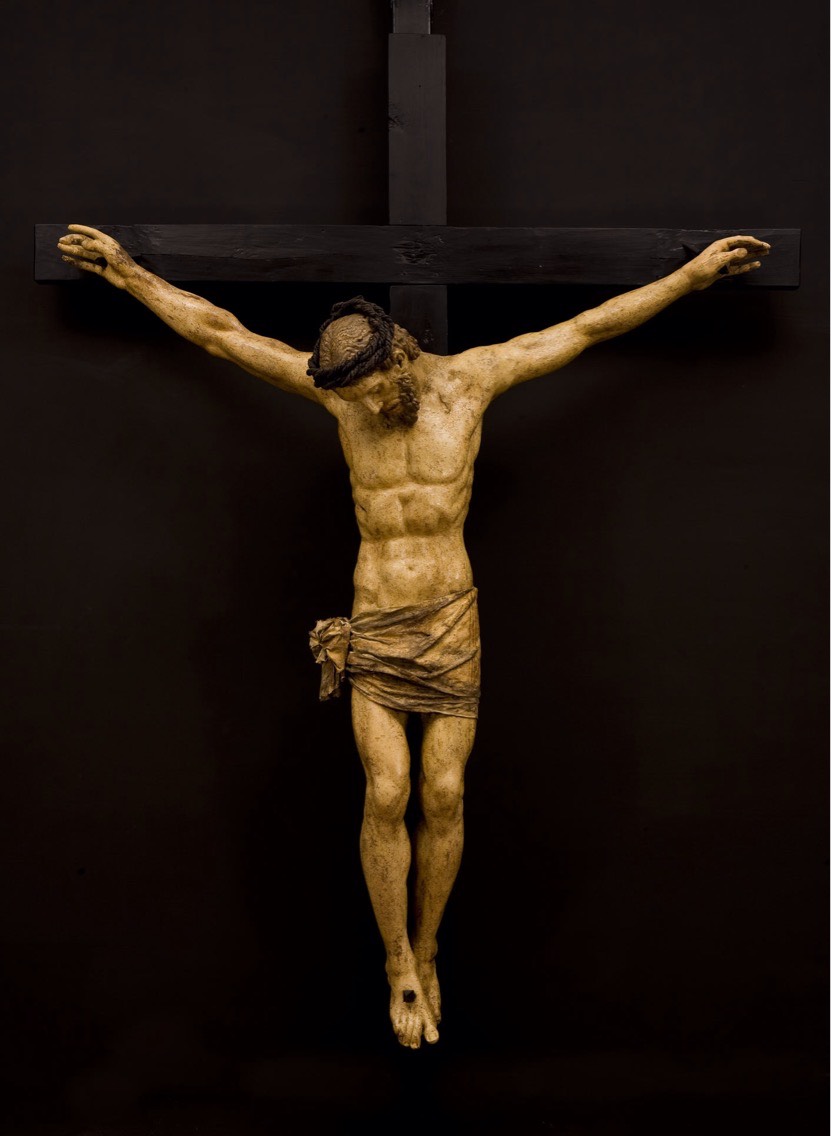
The work depicts Christ crucified just having died on the cross. The face bent on the chest has lost all expression of human pain, the body and the turned arms form an almost perfect "Y". The sculpture is an image of great realism, has dimensions equal to reality and seems to be in effect a body of a man in flesh and blood.
The accurate anatomical rendering of the musculature of the abdomen, thorax and legs, associated with dryness and slight angularity, make the crucifix of Sora a work of great value that time had damaged and that has now been returned to its splendour thanks to a careful restoration.
The particular feature of this restoration, performed by Chiara Munzi in 2009 (www.keorestauro.com), is that it has undone the damage done by a previous intervention that had compromised the work.
In fact, the crucifix had been cleaned with aggressive paint strippers and coarse abrasive tools that had caused the loss of the original painted surface of which few traces remained. A thick layer of a plastic material also covered what remained of the complexion, darkening the surface.
To understand how to intervene, radiographic investigations were carried out on the crucifix aimed at understanding the technique for execution. From these investigations it emerged that the sculpture was made with a single trunk of linden that also included the head of Christ made by carrying out a bifurcation of the trunk. To the main body were then added the protruding parts: the arms, buttocks, calves and feet.
The restoration work consisted in the removal from the surface of the plastic material (polybutyl methacrylate) using compresses soaked with different mixed solvents followed by anti-woodworm treatment.
At the same time, wood was used to reinforce the statue, old stucco was removed and new surface material was applied with specially formulated materials used for the restoration of works of art. The work ended with a reintegration of the painting that led to the enhancement of the original appearance of the Sora crucifix.
The restoration was also performed on the non-wood part of the loincloth of Christ, which was made of plastered and painted linen fabric. The loincloth was disassembled and after being cleaned and repaired, it was placed in the correct position, following the archive images prior to the earlier intervention of 2007.
If you go to Sora do not miss the chance to let yourself be moved by the expressiveness of this wooden sculpture of the Crucified Christ.
powered by social2s

Subscribe to Newsletter

Discover a territory through the emotions of the people that have lived it.