Maria Greca Surprising Special Jewelry

We are in Piazza di Pietra near the Pantheon. Yes, ancient Rome still alive in modern Rome. Dominating the square are the ten columns and façade of the Temple of Hadrian (Emperor) (Tempio di Adriano). We are seeking Maria Greca.

Each column of the temple consists of ten perfectly squared cylindrical marble stones, carved to create a Corinthian temple, yet now no longer perfect as Hadrian would have demanded. The façade has seen 2000 years of corrosion, erosion and tooling that makes one wonder when the old adage of ‘the straw that breaks the camel’s back’ will come to pass. Yet, if the Colosseum can stand and the Pantheon still present its perfection, it seems that safety in engineering design was a feature of Roman architecture.

But we are here for a different reason – to share in a Rinascimento, to find some of the most excellent examples of Roman artisanal technology of the 21st century. There are 28 Roman artisans displaying the joys of their talent and creativity. Let us meet one, Maria Greca. But let us not rush.

There is an unusual table, grey black with striations in the smooth surface and bamboo legs. Its creator, Roberto Baffigo, deigns to discuss it with me, and in so doing he informs me that this is but a sideshow of the main act, and introduces me to Maria Greca, his mother. A good man admires his mother and certainly Roberto does, but not just because a man should always respect his mother, it is also because she is the artistic genesis of the family business in jewellery and objets d’art.

There may be thousands of Italian mothers like Maria (and not just in Napoli) who have been the artisans for the world name brands. All the great fashion houses are built on the hands, needles and thread, sewing machines, leather and metal working tools of families, the old and the young, devoting their whole days to creating magnificence for the rich and receiving just pennies into their pockets.

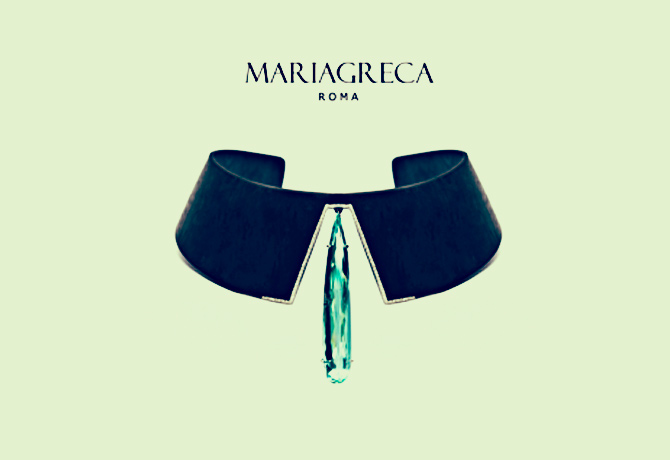
So what is special about Maria Greca (http://www.mariagreca.com). Her jewellery, created for the great fashion houses, utilises hi-tech materials such as titanium and carbon fibre combined with native materials and fashioned with technology that any scientist with a doctorate in the field would be proud to be able to replicate. Carbon fibre bangles melded with golden ovoid shapes, designed at home, and brought to reality by 3D printing. Just a few years ago, Roberto convinced his mother to come out of hiding and present her great artistic and materials engineering talents to the world in her name.

Yes, we are thrilled by these high technology jewellery pieces that would certainly excite the market places of Houston, LA, London and Milan.

Yet, Maria Greca also shows us an off-white snake shaped necklace covered by nodules.

“Where does this material come from?”

“The waters between Thailand and Indonesia”

“Please tell me what it is?”

“Stingray skin”!!!

I am befuddled, we must talk again. How did a jeweller in Rome come to be creating magical pieces from stingray skin and carbon fibre?

Maybe you should ask her. Find Maria Greca at Via dei Quattro Cantoni 39a (or contact Energitismo). If you are really brave, buy a piece of absolutely unique jewellery and tell the world your own story.
(This article is reproduced under licence from Energitismo Limited)
powered by social2s
Poetry in a wedding dress

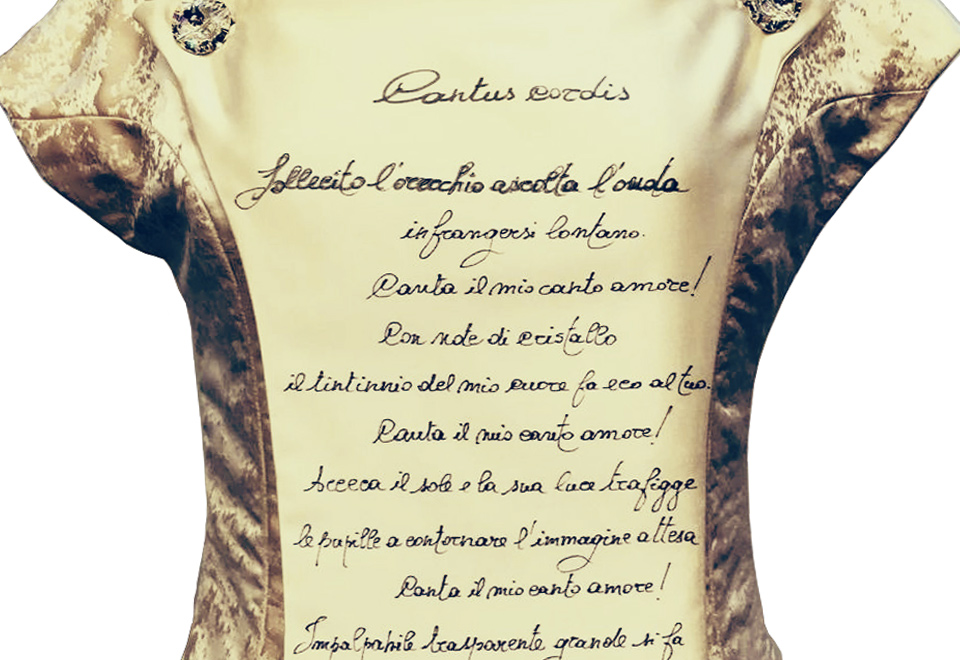
On display at the Spanish Steps in Rome is a wedding dress, one of the most beautiful and romantic that has ever been created, a jacquard silk dress with a handwritten love poem in 129 verses.
The poem is written by hand by Antonella Pagano, one of the most incisive Italian poets who donated one of her performances for all of us who went to look and wander around the exhibition.
I had already worn one of the stoles, "Embrace of poetry", created by this poet but this wedding dress that Antonella called "Thinking of Love" is much more. It is a hymn to life and you would imagine to those who want to wear it for the wedding. The wedding dress is refined elegance, simple shapes that follow the contours of the female body.
The front panel, in satin, on which is handwritten poetry can be removed and used as a form of furnishing in the house or on an imaginative woman. In this way, the dress can be used for other situations. The original jacket "Thought", in silk organza, completes the garment. Both the gown and the jacket have in plain view a precious gold label coined with the signature of Antonella.
Silk and words "marriage" appear in a poetic message that is a hymn to love and to the magic of the wedding day in which the couple crowns the dream and the promise of eternal happiness. The poem that Antonella has chosen for this dress best represents her spirit, her wonder at life and the enchantment and admiration for the magic in store. The text can be customized for a couple telling their love story and what is represented by that day, all of which will help increase the emotional impact.
I was also amazed by the elegance of calligraphy with which she wrote the words on the silk. Perfect writing in which the warmth of the text, handwritten, gives more depth to the words. She adds poetry to poetry. Love to love. It must not be a coincidence that Japanese culture elevates the art of calligraphy and gives it great space in their history.
During the exhibition, Antonella recited some of her poems and the performance included the story of two Lucanian women "robbers" in the period of the unification of Italy. A performance that left everyone breathless in its crescendo, in a whirlwind of emotions that arose from the history of women, but go directly to the heart of each of us, inviting us to reflect on our lives and on the meaning of our period on this planet.
There must be a link between the Lucania, Matera and the poem that goes beyond conventions and modern practice and rekindles the emotions of people by the words written and recited. Matera was named European Capital of Culture of 2019 perhaps because, in addition to the poetry of the stones of the old town there are even more profound poems, albeit less obvious.
The association "Matera Poetry 1995" celebrates 20 years of activity and the Antonella Pagano speech in the evening of celebration is a true hymn to her homeland from which she says she learned almost everything. Matera and Lucania inspire all her creativity and her concepts. It is a place that was founded by a succession of men, products and thoughts but maintains a distinct identity truly recognizable still in the stones and poems.
"My suggestion is provocative: we need a new generation of giants. There are too many pygmies on the shoulders of giants who have preceded us. Poetry is a powerful yeast. It is important that scholars, writers, poets and intellectuals make a generous gesture of humility toward it. We have to stop believing we can control our destiny and demanding arrogantly, presuming to know all of our lives up to, at times, even to the extreme gesture of, not having the need to live life. "

Antonella invites us to make the transition from virtual to real, from rationality to emotionality and stimulates us to not be afraid to face real life because it is the only way you can get to experience happiness.
"... At the base of life it can be hard, difficult, unsuccessful, worse than you think, but sooner or later it gives us a meeting with a flower that has petals on which you can read that fate was not sealed. We can then realize that often our unhappiness comes in looking for it in the wrong direction."

The full speech by Antonella, from the twentieth anniversary of Matera poetry, was published entirely by several newspapers, among others "Sassilive" on the culture page. The Committee of the UNESCO Club of Matera has done the right thing and is spreading this genuine manifesto of poetry with Ministry for Education support, for its educational power.
I am more convinced each time we can not go wrong with the guidance and positive emotions that arise whenever you hear (or read) the poems of this little woman from heart overflowing with life. It must produce a very unusual emotion to wear a dress with words of love, even to the partner, and ... will affect your life while you are living the day that, for many, is still the most beautiful.
 
(This article is reproduced under licence from Energitismo Limited)
powered by social2s
MATERIA, museum of art and dyeing with sustainability

The MATERIA Museum, the Museum of Art and Dyeing, Renewable Energy and Environment was founded in Val di Bisenzio, Cantagallo (Tosco-Emiliano), to study and bring understanding of the environmental sensitivity of this vast territory with its spectacular natural heritage.

The Prato area has been famous since the Middle Ages for textile processing, the creation of any type of coloured fabric and for this you need creativity, energy and continuous innovation in the chemical dyes. Many textile companies, therefore, were born near one of the oldest forms of energy available: the hydraulic paddlewheels along canals, a clean, renewable energy.

Some several years ago sustainability has come back into the foreground in Prato and the textile industries have created an eco-textile district. This has led both companies, Gruppo Colle expert in dyes and Andritz Group, leader in turbine manufacturing, to give birth to this very original museum of art and dyeing, tracing two stories, seemingly distant but strongly interconnected: in textile and energy.

MATERIA is also the source of information on what the activities of the textile industries are today, more related to the chemicals, dyeing, and the developments which have resulted in it having increasingly less impact on the environment. The Prato and other Italian textile industries have invested heavily in this area and the companies must publicise the achievements to recover competitive advantage.

The museum of art and dyeing was installed in a mill of the late sixteenth century and you can see the old mill-stream with the dam and the water turbine, restored early last century, and the horizontal wheel with spoon blades, called a ‘ritrecine’. Looking ahead, to the present but starting from the past. There are centuries of work and engineering that they read concerning the industrial architecture highlighted with passion on your way through the MATERIA museum.

What many termed a visionary project is now a center to learn the history of textile production in Prato valley, the importance of the force of the water, as well as the environment and the sustainable and renewable energies. The project was designed by architect Giuseppe Guanci one of the best Italian 'industrial archaeologists'.

An original note: inside the museum of art and dyeing there is a "confessional", a red room with an armchair and video station where a visitor will be invited to declare his guilt in relation to the environment and to explain his intentions to rectify.

I am guided to the discovery of the office of Elisa Fabbri, head of the museum of art and dyeing, and we move from the visit to the turbine, and to the so-called "hell", a suggestive underground cavity for water control from 1450. Nearby there are turbines and other ancient gear that show well the evolution of hydraulic technology. MATERIA is energetically autonomous: the electricity comes from a photovoltaic plant and a hydroelectric turbine, while the heating is provided by the offtake from the neighboring dyeing plants.

Inside, meanwhile, one feels the clean air with panels showing the textile processes and the industry of Val di Bisenzio. Elisa tells me that just starting from the importance of colour, MATERIA will host art exhibitions highlighting the relationship that binds all that is beautiful: art, fashion and environment.

MATERIA is more a tool to shape environmental sensitivity than a traditional museum and it is a worthwhile experience for all tourists in search of something unique. From the traditions of the Middle Ages to the largest Italian district for today's fabrics, it sits in a picturesque setting where from here also starts our Third Industrial Revolution by Cetri.

powered by social2s
Claudio Brunello: Words of Art

Until February 4, there is an experience in Vicenza that will slowly captivate you. On the upper level of the bibliophile’s friend, Libreria Galla, in the Caffe’ Galla, stands an exhibition by Claudio Brunello of a selection of his operas - words of art - from the last several years.

He chose the title ‘HAPPY’, not ‘FELICE’. To understand why, you must visit this expressive artistic scripture and sit with a coffee, reading his guide ‘The fascination for the word in the picture’.

Understanding Claudio Brunello as an artist is for most of us a challenging learning curve. His previous exhibition in Bassano del Grappa highlighted his Identity Containers, transparent plastic boxes containing letters, words, musical notes, which we tagged with names such as letter box, music box, colouring box. Yet at that stage, even though we were interested, Claudio had not grabbed our attention. We did not understand the relationship he has with the written word in art - in his words of art.

In this exhibition he has once again drawn on the written word, for instance, as a follow on from the Identity Container, one work contains a visual shelf with a pile of written words, each a colour, each in black on a transparent square of colourless plastic.

The work is, of course, titled ‘Colore’ (Colours). Nearby a work containing pieces of different materials tells us ‘STEEL’ – its title ‘Elementi’. But we are not doing justice to the mind and output of Claudio Brunello.

Words of Art according to Claudio Brunello

We attempted to interpret other works but each time needed the guiding voice and hand of the master of ‘Words of Art’. Gradually as I toured the exhibition for maybe the fourth time, I started to understand that Claudio Brunello has a love affair with the intellectual description. He sees a scene as we do and then apparently deconstructs it into descriptive words, phrases and letters. The challenge for the viewer is to travel back up the tracks of his mind to appreciate the ‘beauty’ in the artistic acronym.

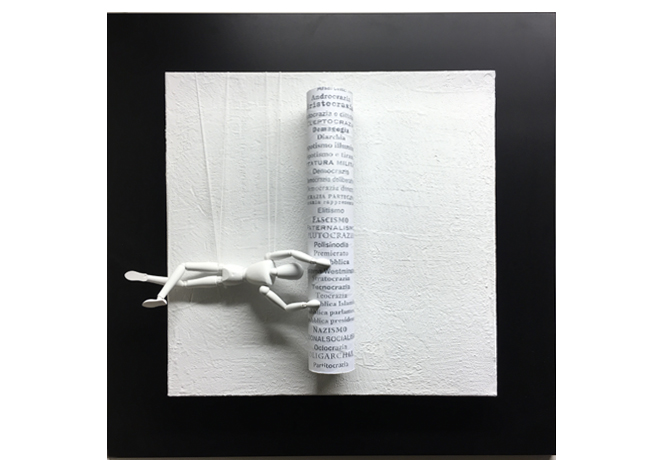
The work that represented the title of the exhibition consisted of a plain background with a white cylinder on which were written many ideologies and forms of ‘government’. Sliding up and down the side of the cylinder is a representation of a man, one hand on ‘Republicanism’ the other on ‘Islamic Republic’. Claudio explains that mankind lives in whichever ideology is current and man seeks to be ‘HAPPY’ in his existence. Maybe Claudio is giving us a cynical view of the reality of human life.

The work of an artist is by definition something that prioritises images. My way of doing art is often intermingled, occupied, shared with the written words that - in addition to their semantic meaning - appropriate something that gives them visual form and expressive power. 

A pleasant way to spend a coffee break in the old town of Vicenza, challenging yourself to learn the scripted tunes that Claudio Brunello plays with his words of art.

powered by social2s
Sirin: From Mythological Beauty to Bejewelled Magnificence

Those of us who love elegant luxury and who seek the ultimate in artistic creations, live in a world filled with the creatures of mythology, a world where ultimate beauty combines the best of the elements of nature to create magical powers.

Our lives include the search for these unique creatures, unicorns, mermaids and fairies, and the joy that they can deliver. At the Dubai Jewellery Exhibition, I discovered one, a Sirin, the legendary female creature with the body of a paradise bird that sang wonderful songs of joy yet to come, and the head and chest of a beautiful woman. This Sirin found its life in Russian legends and was reborn in 1990 by the master artisans of the Moscow experimental jewellery factory when they sought an image to challenge and represent their art.

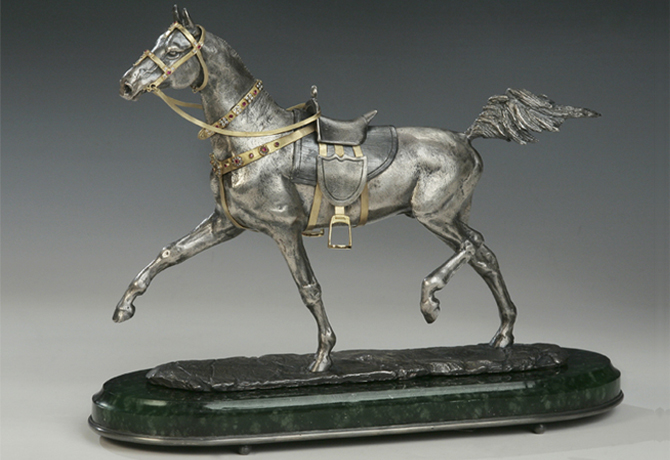
The first image I had of the beauty from Sirin was a silver horse (the name of this statue - Le Allure), possibly an Arab stallion created for this Dubai exhibition, standing on a serpentine base. The bridle and straps were 18 carat gold and decorated with diamonds, and rubies.

Yet what struck me was the pose, an extended trot of dressage, the horse in perfect balance. Above this magnificent bejewelled sculpture was a similar dark silver prancing stallion (named Akhal-Teke: the Turkmenistan national horse). This one is decorated with diamonds and turquoise. In the two stalls below were Arab camels, one ridden by a Bedouin reminding me of the arrival of Sherif Ali (Omar Sharif) in Lawrence of Arabia. Captivated by these sculptures that create such wonderful images, I sought to learn more about the mastery of the team known as Sirin.

I was immediately drawn to two enamelled boxes and a gold and transparent enamel dragon-fly. It was while listening to the explanation of the multistage manufacture and the selection of gold purity, that I started to understand the depth of science, technology and years of artisanal expertise that are necessary to produce these apparently perfect works of art. For the technical specialist as I am, the demonstration of transparency in the enamels - of enamel glass, plus the pure colours in settings reminiscent of a miniature stained glass window, formed a lasting impression.

Sirin consists of artists and artisans with vast experience whose works have won recognition in Russia and internationally. Sirin, as its name suggests, draws on tradition, yet is proud of Russian style at the boundary of the 20th and 21st century. Sirin has provided a renaissance of Russian art particularly from the imperial period – linking to the great Easter Egg creations of Faberge and his team. In fact, this team that became Sirin was contracted to create a gold support for a 1908 Faberge Imperial Easter Egg.

Much of the creativity of Sirin consists of fantastic ‘objets d’art’, this French term spoken as ‘obzhedar’ in Russia, and I thought back to the creations of Cellini in Italy and France in the 1500’s and to the earlier periods in Russia that inspired Faberge, and I could feel the importance of tradition that underpins use of modern technologies alongside expert craftsmanship.

The works of Sirin combine the ancient and the modern. A Nautilus shell, yet 5 million years old, is mounted with delicately perforated silver through which the secret can be found, a single pearl. Words are insufficient. Search and admire with some jealousy this ‘business card holder’ that only one person can acquire.

Of course, the joy for a team of great craftsmen is the creation of Easter Eggs, each with a different surprise. Sirin has won the Gran-Prix in Russia with its ‘Solemnity of Mary, Mother of God’ Easter Egg. The connection of the egg to the ancients is a carved mammoth’s tusk framed in gold and encrusted with diamonds.

The works of Sirin you may find in Embassies and palaces around the world and in private collections of the most famous collectors.

To find Sirin at an international fair and to share in the joy of becoming a member of the family of Sirin collectors contact Anastasiia (This email address is being protected from spambots. You need JavaScript enabled to view it.) or chat with Gavin (This email address is being protected from spambots. You need JavaScript enabled to view it.) about both the creations that have no practical application except the joy of admiring their great artistic wonder and some of the beautiful Sirin items that still have practical application, such as their glorious enamelled jewel boxes.

powered by social2s
Toni Venzo’s Wooden Sculpture in Mexico

From the Dolomites to Mexico, from Bassano del Grappa in Guadalajara, a wooden sculpture by Toni Venzofinds itself a star in the main courtyard of the University of Michoacan. The occasion is an international symposium of sculpture of wood.

Perhaps because the mountain of Guadalajara recalls the view of Monte Grappa above Pove, perhaps because the valley of the Rio Santiago (Barranca de Oblatos) resembles the valley of the Brenta, or perhaps for the large urban forest of Colomos.

Maybe because it was the capital of American culture in 2005, or perhaps because it is a growing city, Guadalajara invests in art and its streets and houses are adorned with valuable works. The art galleries host symposiums, exhibitions and attract artists from around the world.

This is what happened when Toni Venzo was invited to a sculpture symposium (Symposium Internacional de Escultura en Madeira) organized in Colomos Bosque in Guadalajara where internationally renowned sculptors of wood and Mexican artists were called upon to sculpt some woods of the local forest.

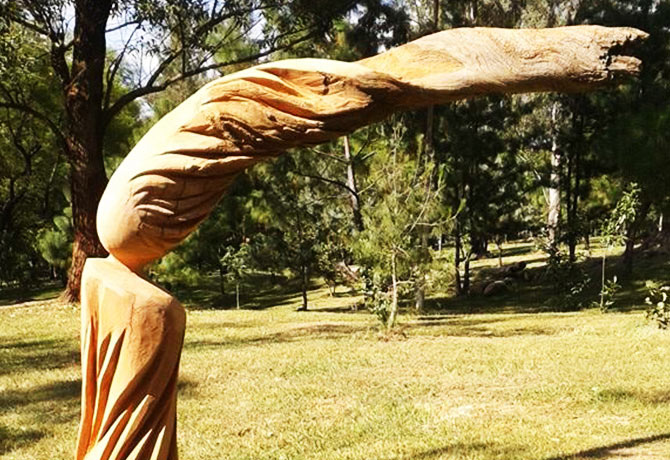
"Lifting its roots to the sky. This Eucalyptus was laying in the park waiting for me for twenty years!!! "says Toni Venzo about the trunk that they were granted to sculpt.

The symposium was organized by Colomos Bosque Cultural to bring to life the excitement of artistic creation asking sculptors worked in the middle of the park under the eyes of visitors. An opportunity to appreciate their art in a relaxed environment while the eight artists worked on several local species, including eucalyptus, mango and Giacaranda, Morada rose tree or palo de rosa.

"The idea is to make the public see the process of creation of several sculptors so that people are as close to the artists and talk to them about the work they are doing," says Ana Paula Luna, sculptor and organizer of the symposium.

Toni Venzo was also honoured to speak at the University of Michoacan during the presentation of his sculpture to the institution, and the experience left him with a wonderful memory. His sculpted figures that seem to be flowing naturally shaped by wind or water, as if not by the hands of the sculptor, have enchanted Guadalajara and have enhanced Toni’s international reputation.

Art is the best investment that a city can do for the welfare of its citizens. From the time of Rome, through the Medici renaissance to the baroque, Italy was made great by hundreds of years of investment in art and architecture, and today its art is a major international tourist destination.

 
powered by social2s
Benvenuto Glass Technology with Soul

The discovery of glass thousands of years ago opened a revolution in products and beauty that is maintained to this day in the centres of glass art and technology. Benvenuto glass is one of those centres.

Glass is an enigma – a supercooled liquid that softens directly and then flows when you heat it. But if you cool it too quickly it may shatter and you must not bend it far or it will break. Then again, if you just cool the surface quickly from a special temperature it becomes immensely tough. Maybe not the best of friends for an artisan, it is a demanding bride, and can ‘cut you to the quick’, but when shaped with joy it sings a pure melody.

That’s why to be a master of this material one needs excellence in technology, fine artisanal skills, artistic flair and soul – a feeling for the behaviour.

Vittorio Benvenuto has spent his life achieving understanding of glass and finding the way to “let it sing” such that today he is a master of glass and he welcomes all to Benvenuto Glass. We met him and have visited his atelier and he told us a few of the many tools he uses to create his works of art; meanwhile we were dreaming of new wonders.

Stained Glass and ‘Tubage’ Technology

The most common technology for production of stained glass windows, that has been in use for over 1000 years, utilises lead to connect the pieces of glass. Less than 100 years ago another technique was invented that involved dispensing a non-lead containing paste from a syringe to connect the pieces of glass, coating it with a coloured enamel and melting the paste to seal the glass pieces. This has been referred to as ‘tubage’ technology.

Tubage technology possibly was similar to some of the early cermets (a composite material composed of ceramic or glass – ‘cer’ - and metallic elements – ‘met’ - materials) that consisted of micron sized precious metal particles mixed with a small percentage of fine glass powder.

This technology became core to vacuum sealing of electronic valves and electrodes for ceramic capacitors. Yet, for the stained glass industry it was lost and the challenge for Vittorio Benvenuto and other glass technologists come 1990 was to rediscover the materials and methods. The challenge was accepted and conquered and Vittorio added this to his long list of glass technologies that he offers to share with other artisans.

Since the early years of use of stained glass in cathedrals, glass painting using glazes has been a technique for providing detail to a stained glass window. Benvenuto glass collaborates with artists who create their works using glasses and glazes developed by Benvenuto Mastri Vetrai. Vittorio invites artists to work alongside his team to achieve their most challenging scenes and dreams.

Glass enamelling and fusion

For hundreds of years enamelling of metal shapes has been the technology of choice for coating the metal with a corrosive protecting coloured glass. The technology involves normally three layers, the first to bond the glass to the metal to minimise thermal expansion mismatch. The second layer seals the glaze and provides a chemical barrier. The third layer is the colour coat enamel glass that gives the decorative effect. The challenge is to prevent crazing and pealing of the enamel.

In glass fusion the challenges of melting one glass onto another are multiplied as the glass shapes have significant thickness and are non-continuous. The artist must understand thermal shock resistance, different flow conditions for each glass, and chemical compatibility.

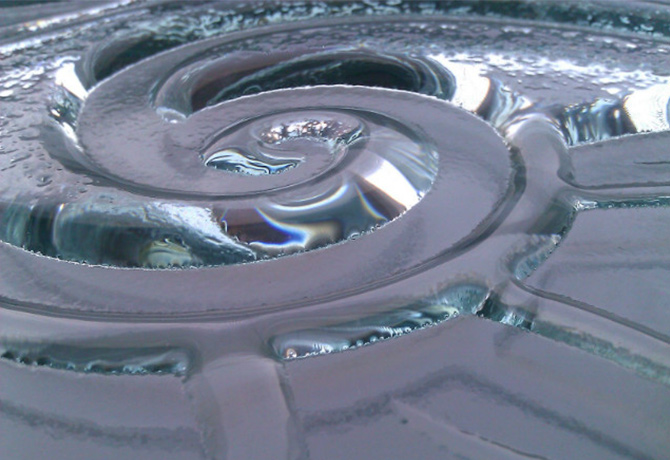
Examples of these technologies used by Vittorio Benvenuto can be experienced by visiting TINAS (This is Not A Showroom) at his works in Treviso. It is a sort of labyrinth in the dark where you are guided by special music and lights on each piece of glass art.

There are 6 different works of art that correspond to 6 different glass technologies. It opens your eyes and your soul to the joys of the creations of a glass master.

powered by social2s
energitismo

A work of art becomes garbage at the Museion Bozen Bolzano where it has been trashed.

This situation where art becomes garbage, for some tragic and for others fun, happened Friday, October 23, yet for all it has reopened a sensitive debate on the definition of a work of art.

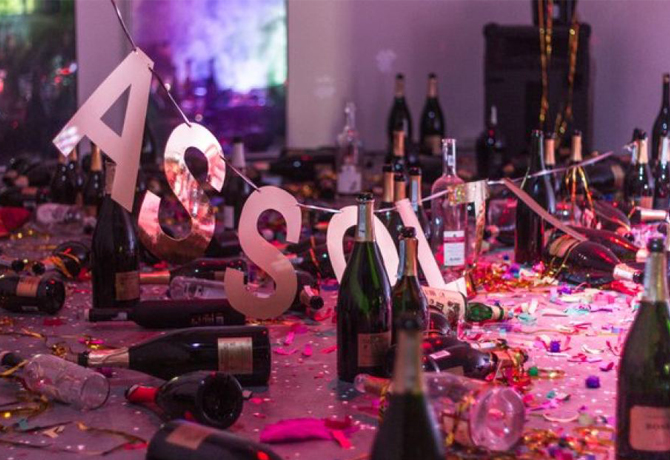
Ladies cleaning the Museum in Bolzano have literally cleaned up the exhibition space containing the installation "Where do we go to dance tonight?" The artists Goldschmied & Chiari, had created their work by throwing into a black garbage bag empty bottles of champagne, glasses, streamers and confetti and then spreading these party leftovers around the space. Under the brooms of the ladies the art becomes garbage.

It is a work of "environmental" art that is part of an exhibition, curated by art critic Achille Bonito, and involving several museums. The artists wanted to create an image of the spirit of the '80s:

"The eighties are for us the stage of childhood, it was the era of consumerism, hedonism, financial speculation, of mass television, politics and socialist parties. During the research we found a 1988 guide to nightclubs of the peninsula written by political (and foreign minister at the time) Gianni De Michelis, ‘Where do we go to dance tonight?’ with a foreword by Gerry Scotti, who inspired us with the title of the work.”

The party then became a state of existence, a widespread practice that lasted a decade, the eighties, and marks a piece of Italian history : this is what the two artists wanted to express - to show the sad remains. Garbage becomes art - but not art becomes garbage.

Goldschmied (1975 ) and Chiari (1971 ) have been working since 2001 in Milan and have attracted significant international fame with appearances at the Venice Biennale , the Dublin Contemporary , Berlin , Tel Aviv and Rome . In short, from the way these women are doing it!

After the incident, as expected, the social media went on the rampage .

In the majority of comments (on Facebook, as well as on areas of online media ) users have sided in favour of the cleaning ladies . To exonerate them, not for their apparent naivety (which, if they were careless in their work, they would be equally defensible?) But rather the judgment spread to the works of the two artists defined by experts and non-experts, "garbage, not art." Sgarbi included - herein art becomes garbage.

The contemporary art scene unleashed daily debates of this kind involving both expert critics and common public opinion.

I do not think you can find an absolute truth, there can be no rule or law that would define what is art . Every artist, as well as every person is free to make his path, finding art in his own time and at his own pace, the answers he needs (and it is possible that the roads he travels have already been covered by others) .

A question, finally, arises : but if the director of the Museum cared so much for the work why was it not possible to prevent the situation by giving the right instructions?

Or was it all a question of advertising ... ?

We think, maybe, as the story even made the mainline Australian press. And now the 'work' has been reconstructed – but is it the same art or trash?

 
powered by social2s

Subscribe to Newsletter

Discover a territory through the emotions of the people that have lived it.