Life inlaid in stone mosaic jewellery

A stone can tell the oldest and most incredible stories. Stories which have been locked and hidden inside it. The new mosaic jewellery sculpture by Antonis Karakonstantakis reveal even more: they are jewels. Small, unique works of art, destined to adorn, as he says, " breasts of women".

Some stones are protected in the bowels of the earth, others are lost in high mountains, in inaccessible places, under the deepest sea, while others are near us.

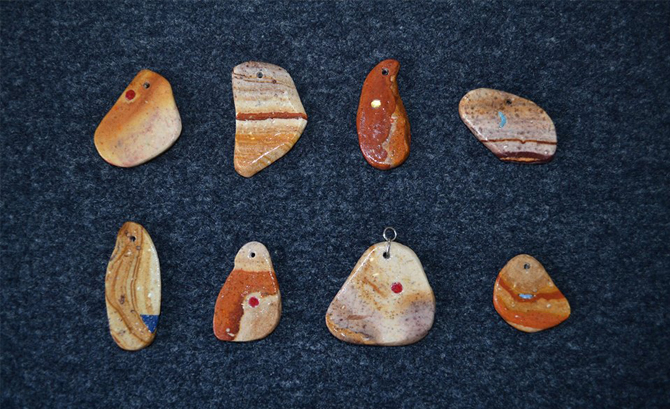
Each one of them is unique, carrying its own memory and its own secrets. Antonis Karakonstantakis seeks to learn these secrets and he completes the story and transfers the message to us with his own unique way, by inlaying the tesserae to create stone mosaic jewellery.

How lucky he is when, while cutting the stone, he is the first who reads the story and feels its impatience - and perhaps the expectation - of being heard. I do not know if the artist himself has realized it, but he is a co-creator of the nature. Simple, subtractive, he operates as much as he should on the stone, which is a coloured canvas with harmony and combinations that only nature can give.

Every single stone is unique, each tessera is unique, each work of mosaic jewellery unique, the inspiration of the artist inexhaustible and the result is a piece of art that cannot be copied, something that did not exist in the past and will not exist in the future.

His work is difficult and demanding. From finding the right stones, which is not so simple, as the outside surface differs from the inside texture of the stone, to visualising the work to create the mosaic jewellery, the precise cutting and the inlaying for the final finishing, bringing out the texture and the colours for the mosaic jewellery.

The stone is a hard material, it demands careful workmanship. At the same time it is so hard, but so fragile, and a wrong move can destroy it.

What is required is a precise work on a unique canvas. The result however more than compensates. Because, as cold a stone is as a raw material in nature, so warm can it be once worked. And when this vision is unique, from people like Karakonstantakis, it is made into a unique piece of art of mosaic jewellery.

Karakonstantakis, with his hands and his vision, mixes places, time, stories, because the tesserae are also made of stone. His themes are unlimited, just as nature is endless, without limits.

His pieces of art always come with inspirational poems, which when you read them, let you understands how charismatic he is and how in a few lines he translates emotion into speech.
powered by social2s
gioielli in corallo

All fine jewelry have something special, but coral jewelry has something extra as it incorporates craftsmanship, history and some curiosity due to its ‘living’ nature, created by marine microorganisms.

Many stories have been woven around coral and it is always fascinating to think that maybe some of them might be true. Deepwater coral is said to have been born from the blood of Medusa's head thrown into the sea or is it merely the result of a combination of biological reactions. What is certain is magnetism. Exquisite coral jewelry pieces have adorned all the queens of the world.

Visiting the Ascione Museum and atelier in Naples you find many examples of the beauty of these jewels made by the skill of the master coral jewelers of Torre del Greco, with expertise in the manufacture of coral jewelry dating from the early 1800s.

The Bourbons were to open the first schools in Naples area for working and sculpture of coral that was originally found in the local waters and sold as raw pieces to France. Since then, the imagination and the skill of the craftsmen have created coral jewelry personalised to the needs and dreams of many elegant women.

The Ascione atelier is in the historic center of Naples, just in front of the Teatro San Carlo. Here you can find coral jewelry of many different styles. From ‘liberty’ designs that recalls the sinuous forms of nature to the most modern linear forms perhaps with different shades of magenta and rose, from traditional floral sculptures to perfect spheres of matched colour.

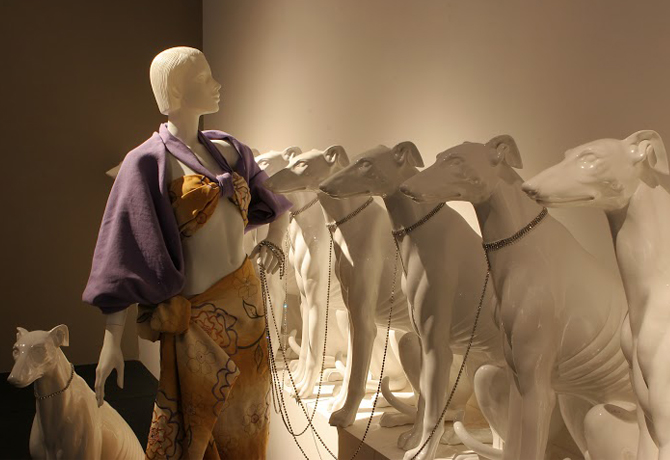
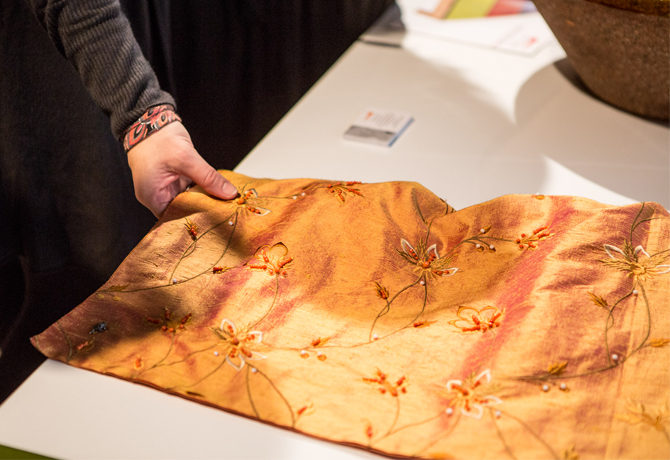
Some years ago the Ascione family resumed the tradition of making the finest silk and cashmere woven garments with beads or carved coral of a variety of colours interwoven.

The museum has on display the wedding dress of the grandmother of the current proprietors. It is handmade lace embellished with a fine set of coral jewelry. Meanwhile, the atelier has replicated these designs and created modern designs for shawls, accessories and personalised clothing for the elegant and extraordinary lady.
Immerse yourself in the history and enjoy the opportunities offered by the Ascione family, who continue the family tradition of coral jewelry and the mastery in the art of adorning women.

powered by social2s
Bronze Sculpture from Apostol

A few drops of rain on a late autumn evening in Plaka at the foot of the Acropolis, and we sit with Apostol and his surreal bronze sculpture in his showroom, The Athens Gallery.

It is three months since our last ‘full summer’ visit and we hastened here to share an aperitif and listen to more of the dreams behind his works of art.

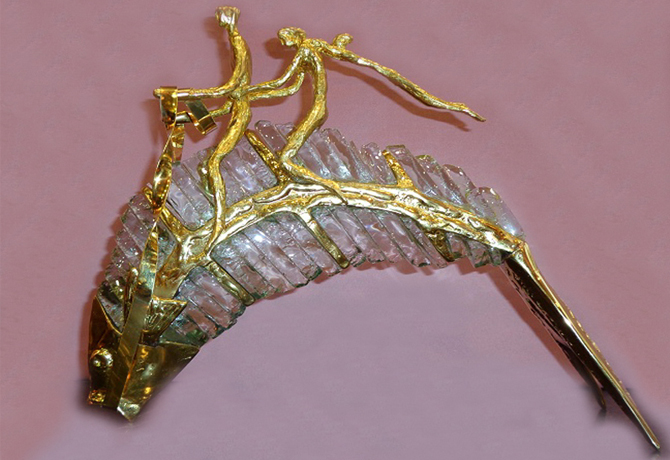
A repeating image of his bronze sculpture is the combination of crystal glass and bronze in sea creatures of all sizes.

A particular theme has a large fish with a family riding on its back. Inevitably, the fish is grand, transparent and often arched, able to travel the seas without boundaries. The miniature family - father, mother and child are ‘riding the waves’ on its back one behind the other.

In one design, the father is searching ahead holding the reins of the fish. His wife holds his waist and their child, holding onto his mother, is being drawn along in flight. Apostol’s dream of freedom in the seas, of a Mediterranean that touches many countries, but of peoples not countries.

So many of Apostol’s large works draw on a musical theme, always surrealistic, with a surprising accuracy in details. These are works for the true collector, they are works that continue to inspire, each time we visit, much more than bronze sculpture.

The grand ’melting’ cello – titled by Apostol as Nature’s Melody, stands near the front door of the gallery capturing all who dare to view it. It is a particular favourite and, secretly, I hope that it does not sell as, just like the grand Icarus standing on the upper landing, the great Balls of Fire Piano, and the Shostakovich concerto, it carries the magic of coming through the Looking Glass into Apostol’s world.

Apostol’s world is far away, in his studio where his hands do the talking and there are more dimensions of reality than in this showcase of surrealist bronze sculpture to the world, a necessary extension of reality to serve the gods of commerce.

Soon Apostol will retreat to his haven and, we trust, another dream will evolve through the back of the surrealist Looking Glass into the world that we occupy.

powered by social2s
The Glazing Zookeeper - creator of fine ceramic art for the Ahura Zoo

Ezio Zanardello is ‘the glazing zookeeper’ the creator, designer and manufacturer of the Ahura zoo of wild and tame animals whose common element is that they have immortality.

In Ezio’s Ahura Zoo, we find creatures great and small living in a land of giants or in lilliputia, but all sharing in peace and tranquility their shining visages, without fear of death or destruction from their fellow zoo members. Some sit, stand or lay side by side without fences or guards, while others swim, prance, leap or fly-but always within the safe confines of the zoo.

This zoo is not artificial, its Animalia are true representatives of their cousins who exercise movement in daily life. These animals will find a place with any collector attuned to the soul of the animal.

We stroll around the Ahura zoo, admiring its residents. The most powerful in the Ahura zoo may be the shining black panthers, mouths agape bearing their fang-like teeth and snarling at their prey. Beside them the bulldog, peacefully alert and tame, yet of similar size to the panther, quietly guards his master’s family and possessions from the preying cats.

Glorious peacocks in royal blue livery, stand erect with plumage spread calling their mates, while others rest. Two flamingos stand proud on a rock in their pool and a single giant crane stands to attention. White swans sail peacefully by with bright flowers in their backs, and ducks preen themselves beside a crocodile ready to pounce.

Among the plethora of farm dogs, a proud cockerel stands atop the stalls while goats and pigs sit quietly. Golden horses prance in their yard.

The most exotic Ahura zoo specimens are the golden white tigers and lions sharing pride of place at the entrance. A wide variety of other feline life includes leopards and jaguars, lynx and pumas, and household cats with even a puss-in-boots.

From the mountains come stags and mountain goats with eagles and hawks on the crags. From the savannah come elephants, rhinoceros, zebras and giraffes.

Finally in the aquarium we spy Japanese tropical fish and unaccustomed penguins.

Find the Ahura Zoo and start collecting the finest glazed art ceramic animals.

powered by social2s
Surrealistic Pottery - Ceramic Art of Castelli

Surrealistic pottery, what is it,where is it? We went to Castelli because we had learned about a young ceramic artist who loves tradition yet creates surrealistic pottery.

These seemed concepts a bit 'distant’ from each other and so we decided to learn about the tradition and try to better understand what he meant by surrealistic pottery. Where does the work of the artisan stop and that of the artist begin? It is difficult to define a border, especially in the world of art ceramics, where the techniques of preparation of the clay, the sintering and painting can greatly affect the final work. So how can we understand surrealistic pottery?

Anyone lucky enough to arrive in Castelli, Abruzzo, in the mountainous heart of central Italy, can immediately perceive the meaning and spirit of tradition. A mountain town where for centuries people have spent long winters in isolation baking and painting the local clay. They were warmed with the same furnace in which they realized their unique and recognizable pottery.

The close-knit community is known by its communal achievements. Between 1615-17 the majolica community realized over 800 painted tiles each different and by individual craftsmen, to decorate the roof of the local church, San Donato. Later they proudly created a pottery school to pass on the knowledge from one generation to another.

The flip side of this coin is that the people of this area were suspicious and not receptive to the effects of the news. The war had caused the majority of an entire generation to migrate. Thus, creating in the same style that had made Castelli world-famous was no longer a viable strategy.

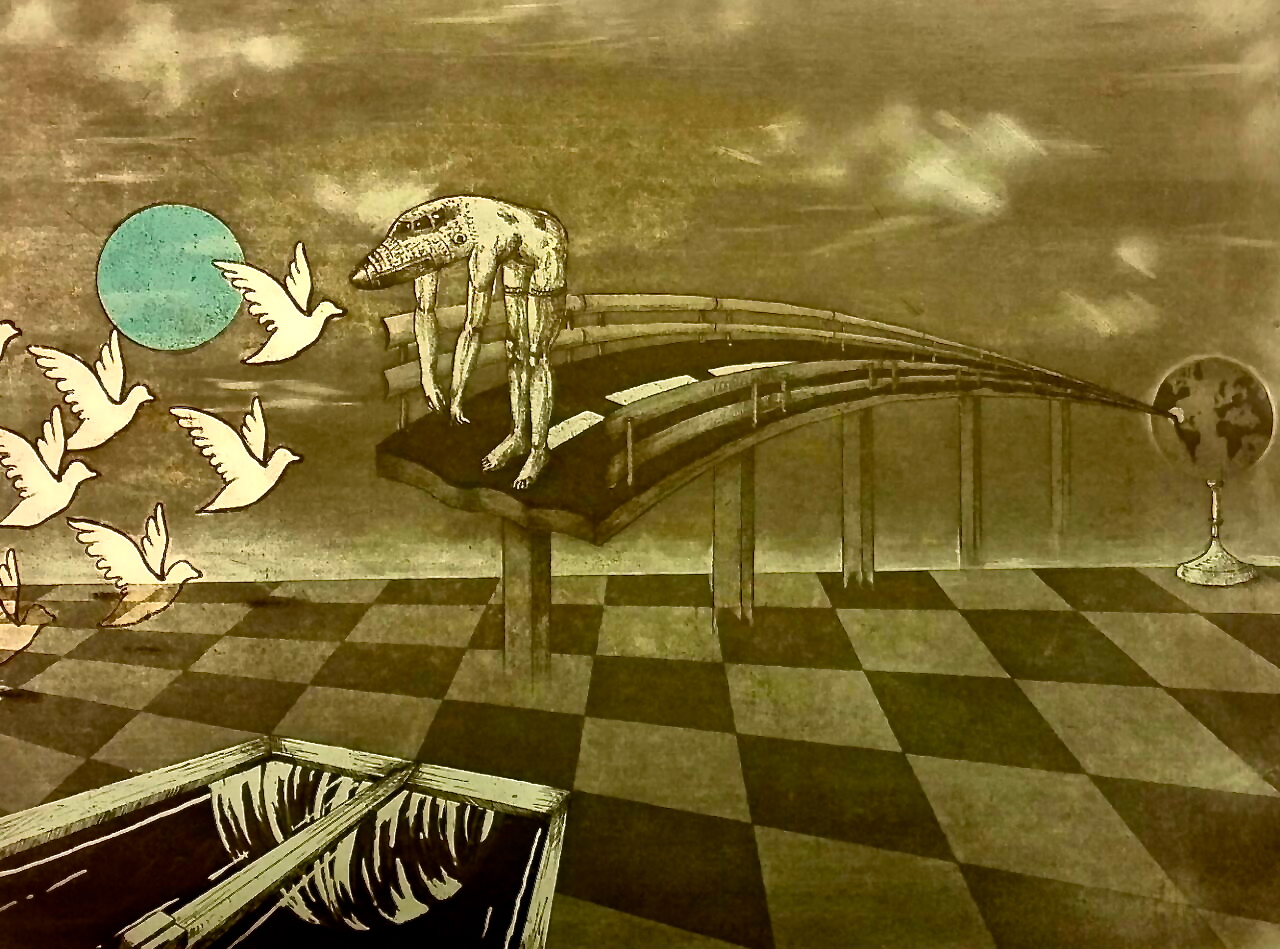
Then came the generation of Marco Carbone, who grew up with television and cartoons. This opened the door to an innovation within the community. Marco learned painting with his mother and his uncle but his spirit is joyful and he was immediately attracted to Dali, Magritte and the surrealist movement.

At the same time, however, he did not leave the mountain and did not emigrate in search of his fortune elsewhere. He could see the country waning and he started his own path to revive traditional elements in a new way and with a personal language - surrealistic pottery.

He knows the art and craft techniques and blends them into a personal style in which the weight of tradition is rendered "light" from strokes and unusual landscapes. The colors in the palette are traditional and also the shapes of the artifacts can be found in the history of castles, but the subjects are new. 

The scope of the drawings belongs more to the techniques of intaglio, the definition of the edges of the subject and the characters are accurate and precise. However, the scenes are not typically coming from Abruzzo and fantasy mixes with the most joyous surrealism to create surrealistic pottery.

He calls himself a "humble craftsman," but we have seen that in his works we can define an artist who could mark an important step in the history of ceramics of Castelli and create a bridge between the past and the future - through surrealistic pottery.

powered by social2s
Handwriting, the rhythm of thought

According to a survey appearing in the DailyMail, an adult can spend, on average, six weeks without writing anything by hand. It seems impossible … Is it a good thing or a bad thing?

Handwriting, especially ‘running writing’, is the first artistic expression of each of us and reveals traits of our being. It is no coincidence calligraphers and psychologists were also involved in the past in very important roles in police searches.

And today: a nostalgic art to be discovered?

Letters linked together reproduce the rhythm of thought and reveal the psychological state while the motor activity of the hand activates specific areas of the brain that help the visual recognition of written concepts. Writing by hand helps keep the brain active and encourages creativity.

One of the first to describe a modern role for calligraphy was Steve Jobs. In his biography he reports that his life had changed thanks to a calligraphy class where he came in contact with the different ways of graphic expression of words. There is a language of graphic signs, selected typographies and fonts underlining this message.

But handwriting is something more: it is a craft. And as you look at exclusivity in objects made by hand, so it gives pleasure from communicating something special in a unique and personalized way.

Now calligraphy is experiencing a new era of glory and with it the choice to select just the right paper, the right ink and the right pencil.

Going back to writing a letter by hand, or starting to write by hand, means in the first case to communicate something special. The first message is just the means of communication!

powered by social2s
‘Magical’ Ceramic Art: Dal Pra

On via Munari, one of the four main roads leading to the cathedral piazza in Nove, the traditional centre of ceramics in north east Italy, there is an elegant set of timber framed glass doors in the face an oldish town house.

On the left hand door is a sign ’Ceramiche Aperto’ (Ceramics Open). Ring the bell and you will probably be greeted and invited to enter by a smiling lady, the proprietor of Ceramiche Dal Prà, Rita Dal Prà, or her daughter, Valentina Meneghini.

Entering you come from a street world of ordinariness to a veritable personal museum of art ceramic ware of wonderful forms and colours from the most modern concepts back to the traditional painted urns of 100 and more years ago. The widest range you could conceive, so that many objects are missed on the first scan; beautiful deep water corals on shining black stands, wonderfully hand-painted vases and lamps, dinosaurs in gold, shaped green bushes and trees – every leaf hand created, and some enchanting miniature Italian Gardens.

These model garden masterpieces were first created by the grandfather and founder (in 1897) of this traditional ceramic art house and these sets are collected by lovers of fine ceramic models around the world as centerpiece to adorn elegant dinner.

When your gaze shifts to the left there stands an old refractory brick furnace housing more pieces of the collection. We are told there are two more furnaces standing on top of this one, all were ‘fired’ at the same time, one assumes with some fuel savings for the upper two. It is then that we are invited to visit the upper two levels of this fine ceramic house, the building just as it was in 1900, the top level of the furnace ’stack’ carrying a beam that supports the roof.

While we talk, I gaze around the large open space, filled with ceramic art from four generations and I count over twenty soup tureens on one set of shelves, every one different, even one white tureen with three platinum frogs as the handle on the lid – something for every possible taste. There are many thousands of items to create joy for the collector, home décor at the table for an elegant dinner, or to enhance a fine lounge room.

Every two years a new catalogue is produced with the latest designs to add to the plethora of unique designs from the past. For the buyer from far away, this catalogue may be enough, others may visit Ceramiche Dal Prà at one of the fine living exhibitions such as Maison et Objet, but for the lover of ceramic art and pottery, a visit to the showroom and family museum is an essential part of your tour of the Venice area.

On bidding farewell and stepping back though the door to re-enter the street, I feel that I have come from a ‘magic’ ceramic land, I had entered through the ‘wardrobe’ into a home and workshop of griffins, lions and ‘which-what’, and witnessed a fantastic history of life through the eyes of designers, ceramic artists and artisans. I trust that it will all still be there just as I saw it when next time I enter the ‘wardrobe’, because this is real ceramic art.

To know more visit: www.ceramichedalpra.com

powered by social2s
Bossa Nove

At the Festa della Ceramiche in Nove on 13 September, the local tradition of Bossa Buffona was reborn as ‘the Bossa Nove - the quaffing jug of love’ – the traditional jug retaining its pre-eminence and giving birth to the Bossa Nove (New Jug).

Energitismo supported the creation and presentation of this infamous quaffing jug. It is designed and fashioned to cause all to laugh at the expense of the drinker. The tradition of Bossa Buffona started in Nove 400 years ago as a joke to be played on the bridal couple.

The core requirement of the jug is that it must be impossible to quaff from it. So another means of obtaining the nectar of Bacchus must be found. Interestingly, it could be a way to limit excess alcohol consumption (it may have been the idea of a Calvanist priest or of a frustrated bride following the excesses of her groom).

But where there’s a will there’s a way and even God deigns making a challenge that is certain of failure. And the way is that of the ‘sucker’ not of the quaffer, but not just any sucker, a sucker with a fine sense of playing the bagpipes, selecting the mouth tube and then placing the fingers adroitly to close off the air holes – and then the nectar flows.

It wasn’t a lack of brides in this famous Alto Veneto town that caused its demise. It was the gradual disappearance from the workshops, and into retirement in the cafes, of the artisans who each devoted about 8 hours to create a jug. Maybe fashions changed with a surfeit of American TV so that brides and grooms no longer accepted the risk of being buffooned, or maybe the desire to quaff proved too strong.

The Bossa Buffona was and is more than a joke, it is a work of ceramic art requiring not just great dexterity of the potter’s hands to create the rustic elements of the jug plus a fine artist’s skill, but also careful plumbing, structural engineering and understanding of the possibilities of two-handed interdigital-agility.

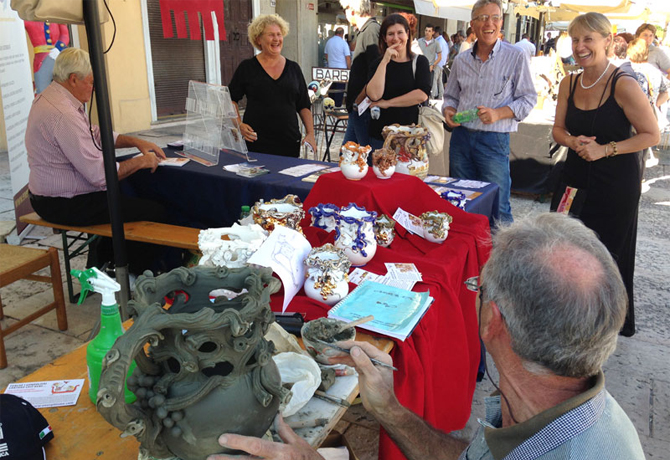
At the Festa, several new designs and sizes of Bossa Nove were shown with gold and platinum glazing thereby connecting the two historical local threads of pottery and goldsmithing. Adriano Spigarolo, as master potter, entertained the crowds for the two days carefully decorating and ’rusticising’ two jugs with the help of dozens of junior potters eager to learn the secrets of grappling with a clay grape.

Meanwhile, Claudia, Giampietro Zonta and Daniela Raccanello regaled visitors with histories, some even partly true, of the exploits of Bossa Buffona and now the Bossa Nove throughout the years.

Keep tuned, Bossa Nove will soon be released for sale through Energitismo. Contact us for more information or to arrange a visit to the workshops and showroom in Nove.

powered by social2s

Subscribe to Newsletter

Discover a territory through the emotions of the people that have lived it.