The colour blue in life and in ceramics

Reading and studying in different areas, not only art in ceramics, I came to understand that the colour of sky blue has a special meaning and value. A subjective value, which we attribute to men, and an objective value, visual and real.

Our life is filled with sky blue: you can see it everywhere, even where you never expect it, right there on the corner. So it is said in amazement:

"Indeed, even here there is blue! I cannot believe, I did not expect! "

Well, what about for my ceramics? The sky blue "friend", so I like to call this colour, is always about, but is not seen. It hides among the other colors, but it is no less important. Maybe it's a bit ''shy” for some, for others it is unimportant, too 'soft' and not very consistent.

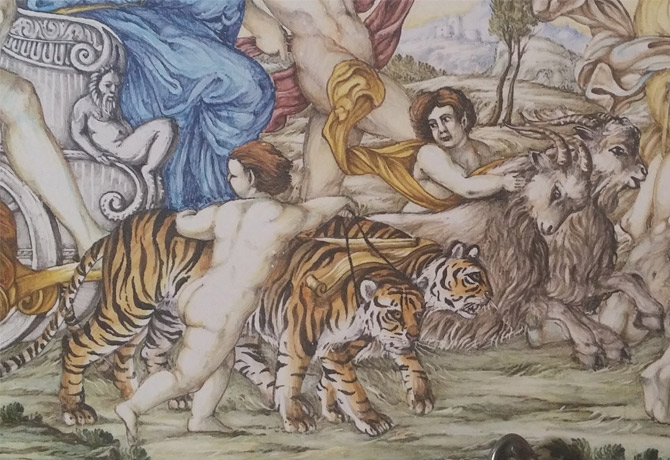
For me, however, this sky blue is a colour of great value, 'soft' yes, but also noble and by no means trivial. Thinking about my work, from the landscapes of castles, to faces, to scenes with mythological figures, to flowers, to modern images, I state that the sky blue of heaven is a support that I cannot do without.

I find it difficult to set a work on ceramics, without this backdrop. Sky blue to me is the beginning of a job: it can be everywhere, in traces, definition, outline, shadow, volume, texture.

It is essential, it guides me, and allows me to understand and imagine, well in advance, even the finished work. It facilitates the definition of the image painted on the glazed surface. Its nobility is to offer itself as a basis for all the other colours, which usually will be superimposed. Everything takes its true place only if there is sky blue behind.

But this is not just my impression! Looking at the works of the ancient potters of Castelli, but also those of more recent artists, I cannot help but notice how the blue is a constant imperative.

A friend pointed out to me as that sky blue is used as the background in many film and television special effects with a technique called "blue screen". The studio walls and ceilings are painted sky blue and in post-production the desired background is added. Whatever the weather or scenes of special effects in Matrix, surrealist pictures, what changes is the context, but the value of the sky blue will always be universal, as in the past so in the future.

powered by social2s
Didgeridoo and Art - Interpretation and Improvisation

Life is simple in its beauty and ever so complex in its analysis, for example music and art- didgeridoo and art. The essence of life, the double helix, is an element of natural beauty, the intertwining of the infinite helices that contain in details the story of mankind, rhythm and rhyme.

We sat at the birthplace of cybernetics in Italy, the study of the machine that is man, the villa of Silvio Ceccato in Montecchio Maggiore, just below the castles of Romeo and Juliet, and we ponder objective reality as we gazed over central Veneto, spread out below on the plain. We are in the generous and kind hands of Silvio’s granddaughter Riccarda Silicani Ceccato to experience a realisation of this paradox of simplicity of beauty and the complexity of its study - to combine didgeridoo and art.

The occasion is the opening of an exhibition of the late so-called schizophrenic artist of the school of Art Brut, Carlo Zinelli. All the works were painted while he was institutionalized following experiences in the Spanish Civil War, his multitude of works represent his desperate means of communication with the world, his vision of its complexity and beauty recaptured virtually every day for over 10 years, once he was freed from his psychological gaol by the possibility to paint – to draw as aborigines and other ancients did – creating their own hieroglyphic languages.

‘Parole, parole, parole’, meaningless alone and only understood if you can see and feel the whole picture. This is not the task for an analyst alone, there are 3000 images and audio records that do not tell the emotion of this human machine or what linkages were activated.

Some may not call this expression of a mind, this language, art? But, since impressionism took away the need for photographic reality and even more for those who appreciate the “art” of Pollack, this art of Zinelli is an intellectual masterpiece. If we try to analyse, we lose its dimensional impact by applying crude mathematical formulae, fourier transforms, similar to attempts to convert a fractal to a possibly measurable form.

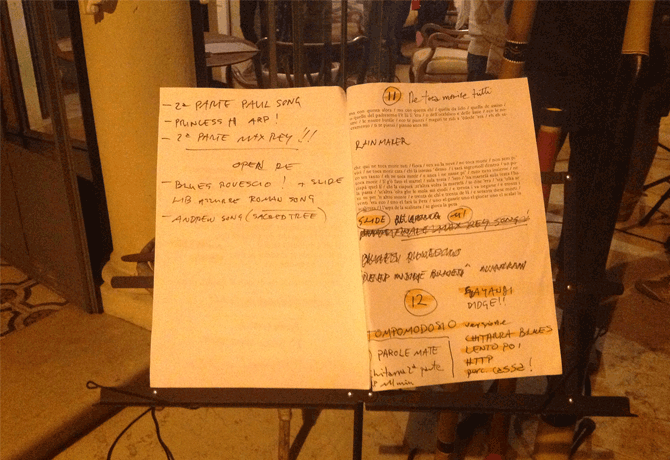
Having abandoned my engineering analysis of Zinelli and concluded that it is not my judgment that matters but that of each free mind, it was an inspirational experience to listen to a musical interpretation of the art of Carlo Zinelli, his literary pronouncements interpreted in improvisations by Florio Pozza on the guitar, and hieroglyphically, on the didgeridoo and from the incredible and sensitive voice performing of the actor Nicola Brugnolo. As the evening cooled, and the ladies wrapped their shawls for preservation, the performance of didgeridoo and art captured the emotions of the audience who sat enthralled on their garden seats in the courtyard of the villa.

Bravo! This for me was art, musical creation with emotional intensity coupled with freedom - didgeridoo and art.

It was a unique experience, a surrealistic word and music jam session, never to be repeated and not subject to objective analysis. I now understand a little more of Zinelli, and I promise not to try to measure this experience of didgeridoo and art.

Be free enough to visit Villa Ceccato in summer and seek an experience and find Florio toexperience his didgeridoo and art.

powered by social2s
A sculptor of the Heart of Stone

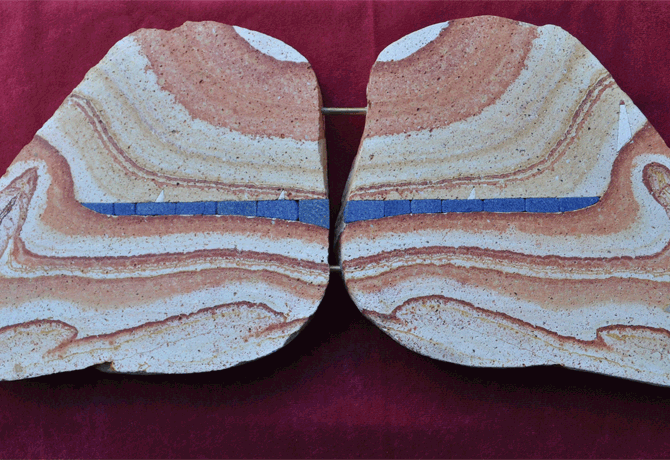
The new heart of stone creations of Antonis Karakonstandakis were presented in May at the Archeological Museum of Larissa (Geni Mosque) with the title "Scouting". The exposition included three modules (Horizons – Candles – Landscapes) created with the artist's original technique of inlays applied on natural rocks.

Antonis Karakonstandakis uses poetry to create word pictures of his heart of stone mosaic sculptures. For his latest exhibition in Larissa, the capital of central Greece, his verses describe the influence of the art form of mosaics.

Art Form,
that initiates us
to the obvious and to the self-evident,
approaches harmony,
transposing circumspection in parallel,
with Doric austerity
that defines it,
composes and endorses,
the anticipated,
while at the same time,
recalls and releases memories,
that remain vivid
activating the senses,
to a continual and transparent Rearrangement.
Apocalypse.

For Antonis, as for any sculptor, the heart of stone, the rock they work with, has life. Stone has history. From Minoan art to the Parthenon, to the masterly work of the Byzantine period, stone has existed and always will, as long as there is civilization. Because it withstands and bears time within, the memory and experience, and encloses life within its heart of stone.

Because stone does have a heart! It constitutes the "canvas" on which Antonis Karakonstandakis expresses himself. The heart of stone is the heart of his creations.

Antonis says: "There's great anxiety when cutting into a stone. There is the danger of wounding or even destroying it. But the climax is the moment of apocalypse. In every stone you open, you see its heart! It's unique"

On this primeval heart of the stone, Antonis makes his pictorial representation, with colored tessera, "stone into stone, a mosaic in the heart of the stone, on which civilizations were based". However, the base rock is what defines the artist's canvas. For Antonis "the tessera by itself is meaningless. It's a living cell, part of a whole. By taking its appropriate place in the composition, it brings out the whole and together with the stone it brings to life what was hiding within".

"The artist must try to expand his art. Through this activity, his ‘apprenticeship’ with the material and study of his previous creations, the artist will arrive at his own new concept. Whether this concept is worthwhile, time will tell".

“Open Horizon
A provocatively Unknown,
Open Horizon,
calls us to transcend,
the melancholic smugness of the settlement,
the grind of olive trees,
the sureness a lighthouse emanates,
as a place safe to sail,
the surface journeys and
to follow the flight of birds,
flying free,
opposite a new moon,
and an escape to areas and places,
where our inmost being was trapped,
unfulfilled desires.”

powered by social2s
Learning by Art and learning by Heart - leaves carved from their wood

The classification of plants goes back to Aristotle and the Greeks and the early herbal texts with the first systematic collections of leaves started in about 1500 AD. These prints and paintings are important works, preserved in libraries or museums and rarely exposed for appreciation as works of art, but they miss the real life of the leaf.

We would like our children to at least recognize the different trees, but the truth is that too many of us are uncertain and unable to transmit the essential knowledge.

We know that learning is made easier by involving the senses and emotion. We also know that to create art requires emotion and technique coming together in shapes, colours and scents, then perceived by others. Without that combination of emotion and technique, such art is not possible, and learning from it less facile.

For the emotion to arise the artist must be free from the disturbances of ordinary life; there must be no identification or negative emotions. Then the positive emotion can arise from deep in the soul of the artist, from memories of relationships with the surrounding world, often initiated in childhood, with family, friends, pets and nature.

These feelings can be revived when the artist’s senses are awake to recognise those sensations that had stimulated the positive emotions years ago. Now the artist is free to create, to transmit learning with emotion.

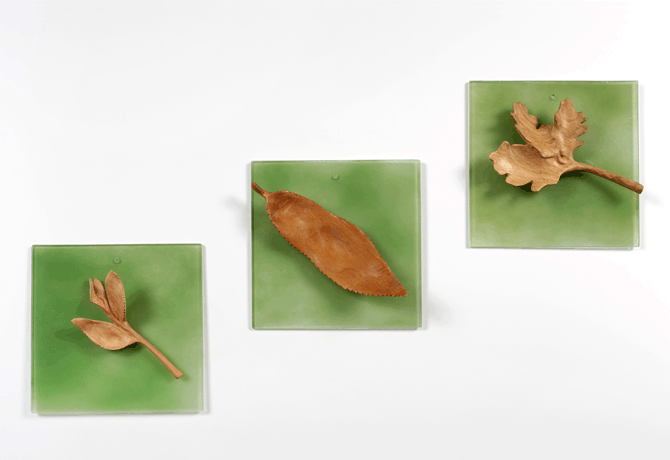
For Toni Venzo, we can imagine that the awakening comes when he strolls among the trees, seeing the dappled light through the rustling leaves and treading softly on the carpet of leaves beneath his feet.

Possibly a leaf flutters to ground near him, a leaf that inspires him to recreate its beauty from the timber of its parent tree. Whatever the inspiration is, the outcome is a work of art driven by inspiration, a leaf with the scent of the tree.

The pieces of work that result from this process are not just excellent examples of the wood carver’s art, but also form an open book to teach children, family and friends the nature of forests and trees, and their innate value.

To know more visit: www.opere.tonivenzo.it

powered by social2s
Coral Jewellery by Ascione - fit for a Queen

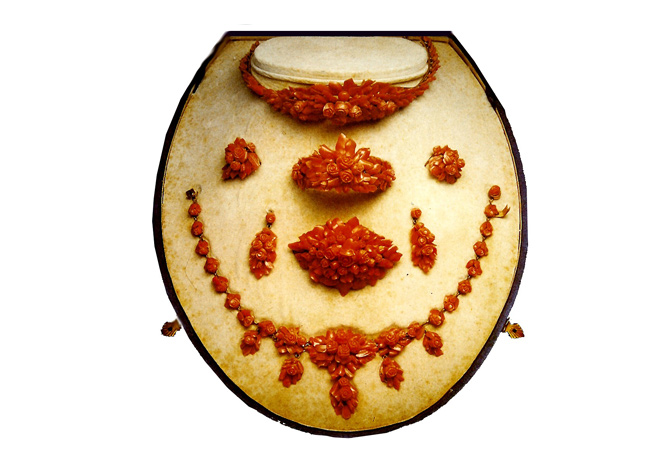
Following on from the French heritage of creating the finest fashion coral jewellery from coral sourced at Torre del Greco, and from the creations for ladies such as Napoleon’s sister, empresses, princesses and queens of Europe, the Ascione family has produced fine fashion accessories, integrating deep water coral, for over 150 years.

Ascione has been the official supplier of coral jewellery to the Italian royal house. The Ascione family history is intertwined with that of Italy and they feel honoured to have been part of what is written in the history books.

In their showroom in Naples, opposite the grand opera of Teatro San Carlo, one of the brothers will guide you through the museum showing the farsightedness of the various royal families: from the Bourbons who invited the introduction of the working of coral into Naples to the Savoy royal family's decision to choose Ascione as official suppliers of coral jewellery.

The museum inside the Ascione showroom shows a painting of Napoleon’s sister adorned in coral jewellery, the coral jewellery of the Queen of Italy, plus marvellous coral carvings.

The wedding dress and coral jewellery of the grandmother of the current family are proudly displayed, the lace as resplendent as the coral.

The living colour of the coral brings back to life the years gone by and entraps you in a desire to share a piece of the living history and to bring coral jewellery back to its rightful place as part of grand fashion.

The new Ascione collection features garments embroidered with beads of coral to match coral jewellery or to wear individually. Beautiful shawls in fine silk are decorated with beautiful designs of white, pink and rose coral.

powered by social2s
Perziano Jewellery: ‘Rinascimento’ of Murano Glass with Soul

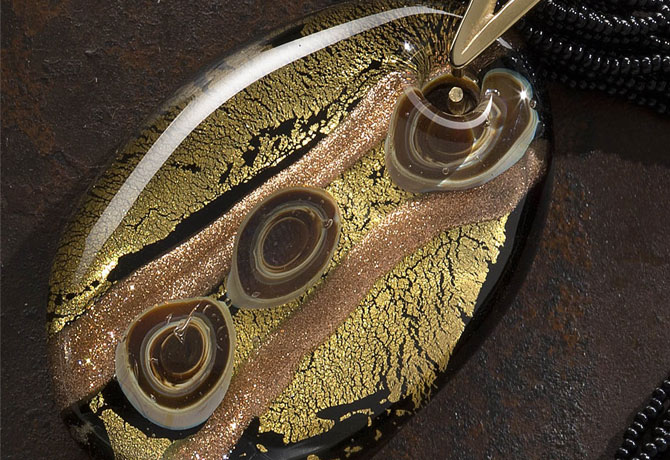
True artists and artisans have one thing in common, while they work with different media - marble, ceramic, wood, stone, precious metals, glass. They all feel the life in the material -in Murano Glass with Soul.

They can ‘see’ and feel the body of their work shining through the raw material in their hands. Each artist is giving rebirth to the soul of the material and, for Roberto Perziano, this is a Rinascimento of glass.

With roots firmly embedded in the Murano silt – Venice, where his father Ugo fired up his glass furnace as a welcomed Murano artisan, Roberto was raised with the burning heat of the glass furnace on one side and the great creations of a master Murano artisan on the other - those pieces of Murano Glass with Soul.

All it takes is to feel the soul of the glass in your hands. Roberto escaped from his destiny some 6 years ago when the family sold the glass business, then located on terra firma, but not long after the life of the fire and the sensations of working with glass drew him back.

His passion for glass needed to be expressed in a new way, not in the ’classical’ Murano tradition, and he was compelled in his Rinascimento to choose artistic jewellery to condense his talent and artisanal skill. Culture, style, elegance were all swirling in his mind as he sought to express himself on how to realise Murano Glass with Soul.

His travels had taken him to Kenya and an appreciation of the Maasai people, their beliefs and art. In Murano during his regular weekly visits, he met an old friend of his father, a now famous glass artist, Livio Seguso, who saw the pent-up talent being released in the Perziano emblematic jewellery.

“Overcoming the limits and unknowns of this material, he managed to give his best at all times in the desire to bring the expectations in his emotional world to fruition. Roberto Perziano's rigour and mastery of technique lend his work a perfect symbiosis of compositional harmony and formal elegance.”

All art forms that become a Rinascimento combine art and technology, traditional and modern. For Roberto’s designs that realise and emulate the shields, masks and adornments of the Maasai, embedded for life in the crystal clear glass, he chose for some the most challenging of Murano’s 500 year old traditional technologies, Chalcedony glass and for others the famous reds of Murano.

Yet his tools and fuels are those of today, just as the secret glass formulations of today no longer use the poisons and heavy metals that brought a short life to many glass blowers.

All the jewellery bearing the Perziano name is hand signed by the master, a guarantee that despite the encroachment of copyists into the Venetian traditions, this studio is truly authentic and in every piece of art you find the soul of the artist and of the glass.

To know more visit: www.robertoperziano.it

powered by social2s
The Patch - EsaltaBuchi by Nani

Near Pesaro in Marche lives a fine entrepreneur, poet, humourist, gentleman and enigmatic genius, Nani, il Conte Alessandro-Ferruccio Marcucci Pinoli di Valfesina and his enchanting wife Paola.

Nani is master of The Hotel Alexander on the beach in Pesaro. This hotel is the epitome of the Energitismo philosophy. It is a living work of contemporary art and a museum reflecting the soul of a different artist in every room and space.

Nani displays his artistic creations and poetry with great pleasure. Each morning at breakfast, another small gem of his poetic talent greets the guest as one gazes out over the sands to the Adriatic Sea. Some mornings a message of love or beauty, others ironic or enigmatic, but always with a special touch of a man of distinction.

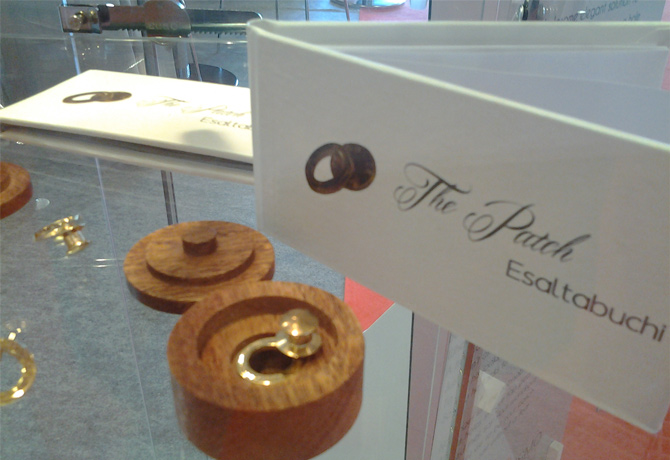
One of his creations is a small circular gold accessory, a gem that he patented known as EsaltaBuchi, The Patch. Nani told us his tale of the story behind The Patch.

When a child he was taught to never throw anything away just because it may be old or no longer perfect. He was also brought up with the view that repairs can make for ugliness. The third pillar of his learning was to find how to convert a failure into a success.

So when, shortly after receiving a valuable sweater from his family, he found a moth hole in the front, he was faced with a personal conundrum – how to preserve the garment as a keepsake without spoiling it with a repair.

His inspiration was that it would be much better to emphasise the defect rather than to repair the garment or secretly throw it away.

EsaltaBuchi, a small pure gold engraved ring, is the phoenix that rose from the ashes of that hole. It is the wholly elegant solution to a holey inelegant problem. EsaltaBuchi is jewellery that converts a hole into the whole. It reflects Nani’s philosophy on elegance and true Italian Style.

EsaltaBuchi is the ultimate representation of sustainability- nothing is lost while beauty is increased. Finally, it is an attention getting piece of jewellery that produces a smile and some fun.

powered by social2s
On the Trail of Alvar Aalto : Nature, Snow, Light, Dark  Part 2

"Finland, a land rooted in its history and its fairy tales."

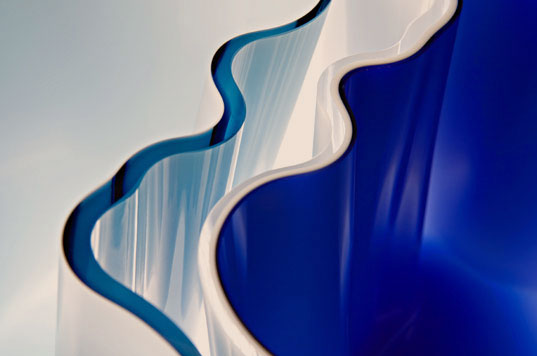
Iittala is a small village in Nuunajärvi where, on the hill, is the oldest glass factory in Finland. The glass has legendary shapes. The Savoy vase created in Iittala, won the competition in 1936. Critics attribute the inspiration of this collection to the Finnish landscape and its lakes.

Here  Alvar Aalto chose not to decide what use to make of the vessels, and left people to use them as they saw fit. Fluid forms, organic, made with three layers of hand-blown glass. Glass is melted snow, running water, thick air, light work, the film transpires. Glass that is Finland, landscape, lake, birch, wood, bark: everything is inside.

I feel that these vessels will melt with the first hint of heat and become wind on the lakes and then freeze again at the end of the short summer. Finland, the people are reserved but know how to welcome.

The journey takes me now in the south-east of the country, near Turku. Here is Paimio sanatorium, designed by Alvar Aalto and his first wife, Aino, in 1926. "The primary purpose of the building is to function as a medical instrument ... ". The design of the rooms is defined based on the limited capability of the patient, lying in bed. The colour of the ceiling gives tranquillity, the sources of light are outside the visual field of the patient.

He himself had been hospitalized and this served to accentuate the point of view of the patient. Ribbon windows were born here. Almost 90 years ago.

The 41 Paimio Armchair, designed for the sanatorium recalls the famous Wassily by Marcel Breuer. Here the wood replaces the iron pipes. The wood is bent, and this is the greatest quality that Aalto wants to emphasize. Because the curves are, deep down, more "acceptable" than right angles. Rationalism has removed the cushions, there is an anatomic bend that is made of birch plywood, the tree no longer present in the local forests. Folded sheets support the weight with their flexibility and elasticity.

"Chair 46", created later, with the bold cantilevered structure, manages to lighten the total form. Aalto, with his invention, no longer bending wood with steam that caused great tension in the material. The wood is cut longitudinally along the length of the curvature and perpendicular to its plane, so that the layers are prevented from slipping on each other during the folding before then being fixed with glue.

Finland, a nation that seems to be icy, but instead knows how to love passionately. Chasing the light of the lakes, I arrive at Imatra in the afternoon, with some flashes of the last light.

The Church of the Three Crosses is sunk in the snow. Inside, the ceiling and walls are one. Broken walls, the space that evolves through niches, skewed, curved, organic, moulded matter, it seems by his hands, the light that falls on the graceful shapes, clean, where every corner is rounded, where the shadows indicate a change of the surface. And on the ground, wood.

For us in Italy it would be impossible to walk on wood in a church. We often pay little attention to the meaning of things, we do not live with wood in its intensity, in her nature, that is Truth. Aalto here seems to knead the forest with the walls, undulated surfaces that know how to create lightness, on which the light plays, illuminating. Two trapezoidal windows illuminate the celebratory space, another hole in the roof diffuses light in the same space. Light that softens and cleanses the soul.

Following the snow, I reach Järvenpää. We are 70 miles north of Helsinki, obviously in the middle of a forest. The villa is barely seen, as is the integration with the environment. The trees and the garden are disturbed as little as possible. Here, in 1966, Aalto designed and built this home for the most well-known Finnish contemporary musician, Kokkonen.

It is now a museum. Liturgically I take off my shoes and enter, I walk on that part of the floor that is travertine and that leads to the chimney in the living room. Here he lived and worked, the walls are covered in linen and partly with wood panelling. I'm surprised by some small details, such as the profiles that close the wood panelling on the walls, and the frames of doors and windows. Everything seems "normal", but I feel a pleasant sense of well-being.

For months I kept asking myself the reason for this unusual serenity that then was none other than being part of the creation. I think it was due to his ability to assemble, to combine all the elements, shapes, materials, colours, details, even the simplest as well as the most diverse, in one size which means sharing relationships i.e. harmony.

My journey ends. Finland knows wood, birch trees, lakes, water, darkness and light. And Alvar Aalto, artist of authentic sustainability. That you can not but love.

Minus 35° degrees. How cold it is.

powered by social2s

Subscribe to Newsletter

Discover a territory through the emotions of the people that have lived it.