Art and Sustainability of Andrea Gamba

A life dedicated to love, art and sustainability. After many years working in a social cooperative, Andrea Gamba felt the need to "achieve" good outcomes, ones that you can touch; so he devoted himself to his passion: wooden sculpture.

He began to work with wood at a young 12 years and has never ceased to practice fine wood carving. He opened a shop in the center of Turin - a "studio near the Po river park where I love to walk in nature and where I find its unsuspecting creatures just a few meters from downtown streets."

Maybe due to a mild dyslexia that allows him to think in a different way - enhanced imagination, or perhaps arising from the love that pervades his life, Andrea became a renowned sculptor. His two lives came together in the creation of a school of arts and crafts and special courses in support of disadvantaged people.

Andrea, how would you define your work, your art and sustainability?

Sculpting a material as rich in character as wood is primarily a job of "reading". The forms and the natural grain make every piece of wood unique and unrepeatable and one that can be interpreted in different ways. The real limit is the imagination of the interpreter, or the artist.

And each piece of wood "suggests" the final shape to the feelings of those who interpret it. The sculpture is a meeting between art and sustainability, two subjects in a strong dance motion: the artist and wood.

Are your creations very realistic shapes or are they completely abstract. What inspires you?

I am very attracted by both the exaggerated and figurative, where the pursuit of anatomical consistency becomes almost an obsession for detail, both by the search for the emotionality and through the representation of movement.

When I sculpt animals I like to think of the wood as a living organism, going to its death, rather than "rotted" maybe "vanished", assuming a new position in space through its movement. A move dictated by music. My art and sustainability energy.

Has there been some great artist who inspires you?

An artist who inspired by the fact that he attended the meetings and that he as the Maestro Felice Tosalli. The study at the University of Art Nouveau struck me, especially Mucha and the Secession movement although I challenge you to find some form directly attributable to them.

My amorphous works are my own reinterpretation of Art Nouveau passing through a material no longer subservient to the artist, like wood, but the artist takes part with its being and its history in the creation of the work.

Andrea, how do you see your future?

This is a craft that can be declined in terms of design, art, and craft all the way to jewelry. Technological advances have made exponential advances for crafting and these will alter many professions, just think of the 3D printers that in a few years will be in every home.

But the quality of a work of ‘art’ does not consist of only the "technical" and, in my opinion, there will always be an important space for the understanding of the material and the sensitivity towards its unique exclusivity. So I think the crafts will be socially important for a long time yet- art and sustainability will share the stage.

powered by social2s
Caresse, charm and resourcefulness in the history of the bra

The history of bra is incredibly connected with Rocca Sinibalda, near Rome.

Rocca Sinibalda, a place of sumptuous and pure shapes, stands towering to the sky as an indefatigable noblewoman. And as a woman of the past she hides her secrets. In fact, only by watching it from above, can you discover the form of an eagle. But among much else, digging into its history you will discover that Rocca Sinibalda is related to the genesis of the brassiere – the bra.

Among those rooms full of events of great history, full of beauty, there stayed for many a year the rich American woman who designed the most intriguing and seductive female undergarment, to be precise: the bra.

Caresse Cosby, a woman of charm and resourcefulness. Dressed always in vanguard, legs elegantly and expertly put on display in 1914 patented the progenitor of the bra, triangles of fabric, lace, organza and silk that make men and women dream and go crazy.

The intuition came while she was preparing for her debutante ball, she was 19 years old. She thought of two triangles of cloth that could cover, hold up, hold tight, but not "choke" the breasts of a woman that, until then, had been forced into corsets that repressed their breath, female armour.

Mary Phelps Jacob, later to be known as Caresse was the original American eccentric, a wise protagonist of the intellectual life of her time. Travelling always between America and Europe, as the final stop in her story, acquired Rocca Sinibalda, and for twenty years was the "caresser" of those locales, until her death in 1970.

In the magnificent Rocca, Caresse, taking a long and deep breath, realized and founded the "Center of the Citizens of the World" and the Association "Women Against War". She was a magnet inviting and hosting the leading intellectuals of the time: from Gregory Corso to Allen Ginsberg, from Ezra Pound to her extraordinary friend Peggy Guggenheim.

Three years ago, an intriguing historical exhibition was held with a nice illustrated catalogue. Many photos were included documenting the thousands of international famous people from around the planet that this lady attracted to her incredible artifact of Architecture and Italian Beauty.

Walking through the alleys, Lilliputian compared to the Cyclopean measures of the Castle, I was able to try out the delicious courtesy of the inhabitants of the village. One lady offered me coffee, another a freshly baked donut... the third, still sitting in front of her house, to even stay for lunch ... we shared a baked pasta for which I have inadequate adjectives!

I am not going to tell more so that everyone remains intrigued by the mystery or mysteries ... unrevealed!

powered by social2s
Fabio Fornasier: candles in the wind

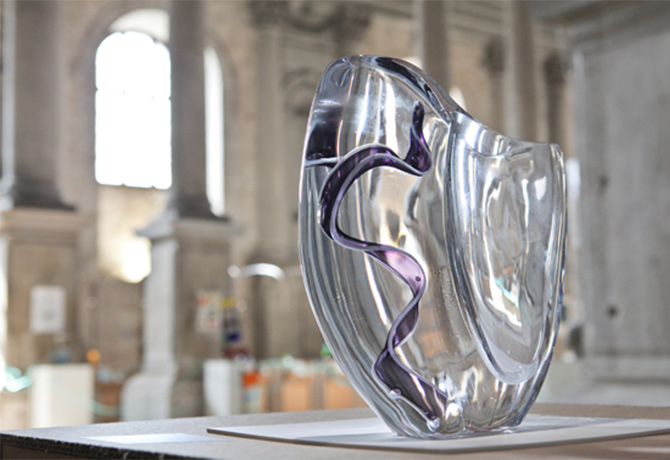
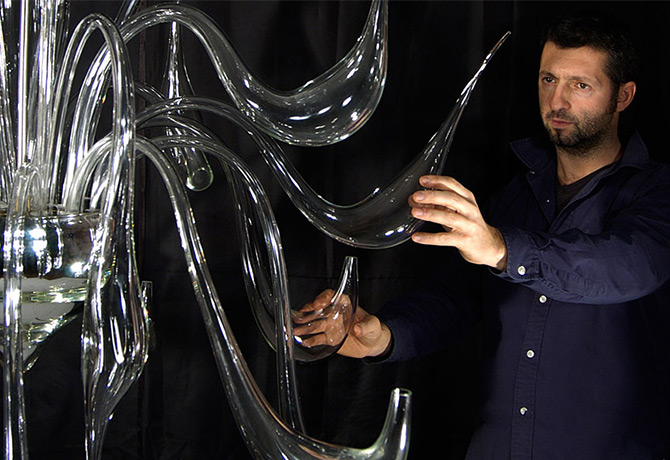
Fabio Fornasier is a master of Murano glass who has transformed the traditional Venetian chandelier into a futuristic element of elegance intended for classic and modern interiors.

Through his desire to go 'against' banality and mediocrity, Fabio has created the LU-Murano chandelier that has bewitched important clients around the world. One line in the latest catalogue has novel technological features, incorporating an excellent sound system.
In his furnace in Murano, surrounded by his creations where modernity joins with tradition, we met Fabio who told us of his tireless challenge with glass.

Fabio, you consider yourself an artist or an artisan?

Absolutely a craftsman who has a basic artistic interpretation! As a child I watched the hands of my father as he created works in glass and I was amazed. I recognized in him a talent that I wanted to discover in myself and, for this, I left school at 14 years. Since then I have devoted myself entirely to glass: my inner torment.

I started as an apprentice at the furnace, according to an internal hierarchy that is no longer so rigid. The fire rested only when I approached my father rested. I remember that I got angry, because my hands did not create anything beautiful until one day I realized my first piece: a dolphin riding a wave of the sea. I still like it now.

Then you become a master of Murano glass and your chandeliers talk for you throughout the world!

There was so much work, so much effort but also so much love in my career as a craftsman. Love wanted to experience new frontiers, to prove to myself and my clients creating chandeliers that they were a symbol of modernity and class.

The chandelier, LU Murano, was born from a sketch of a cruet with oil inside drawn on a napkin. And so it came to life 'Air and Fire', a lamp whose light is supplied from the oil in the vials, as is tradition.

Later I added low voltage bulbs and I started playing with the artistic part using all the different colours of Murano.

So far an artistic experimentation in excellence, but what about the marriage with technology?

My desire to experiment does not stop and I wanted to try giving other functions to the chandelier. I thought that its central location in large environments is optimal for transmitting good sound through 360 degrees, eliminating reverberations and giving beauty to the speakers.

I worked a lot to perfect the combination of glass and technology to achieve a purity of sound that would satisfy the most refined ears.

My creations are now in the Museum of Glass and they are an integral part of the cultural heritage of Venice and Murano.

Meanwhile your creativity is evidenced in a chandelier of bottles, sustainability and Venetian tradition together.

With bottles of wine from Franciacorta, for wineries and collectors, I have created a chandelier reusing bottlenecks. The style recalls a historical form of the Venetian tradition, but the use of glass bottles is intended as a message of sustainability and love of wine.

And now, Fabio, where are you going?

My most recent work is a chandelier cut in two: one half a Venetian chandelier and the other is a chandelier-LU Murano. It represents the past and the present of my life in the furnace.

I'll go ahead! I am guided by stubbornness and a desire to emerge. I have received important awards, I teach around the world and show my works in exhibitions in Paris, London, Frankfurt and Milan, but I still try daring challenges for the future.

I'm used to that!

powered by social2s
Cenedese, master of Murano glass

Being born in Murano marked the life of a young man and the destiny of Simone Cenedese to become a master of Murano glass. His words flow clear as he tells us about his love for the Murano glass.

He was only 7 years old when he went to play in the furnace room with the night watchman, 15 when he started working as an apprentice, and today he is one of the younger masters of Murano glass. From his first glass sculptures, Simon still has very strong emotion to work this material in this special place just steps from the center of Venice.

Simone, what do you feel when thinking about your work?

The everyday magic of being "Hic et Nunc" (here and now). Belonging to the tradition of Murano, and then Venice, makes me happy every day. Breathing in the beauty and history knowing that today we are integral part makes me proud and also responsible for how to continue to build and pass on this beauty.

And Murano changed since you were little? What is your vision?

Murano has been for centuries a center of industrial glass. Here, after the war, were realized many consumer products such as light bulbs, reflectors or vials for medicines. Slowly these industries have moved on shore and Murano has assumed more and more an artistic flavor.

I can say that we have grown through "breathing" industrial culture and learning many techniques which then allowed us to unleash the creativity and experience of original artistic languages. Today we sought more for our art and the furnaces are also increasingly becoming "cultural centers."

What is your vision of the role of Murano glass?

Murano has evolved naturally and progressively towards artistic more than industrial glass and we must accompany this passage describing it to people who want to surround themselves with fine glassware. We cannot compete on price, so we must learn to value our traditions using new languages.

The new tourists who come to Venice, especially those from Asia and the Far East, do not know the details of our history and we must establish a kind of relationship that takes into account their characteristics and interests. Simple language and media to convey the importance and meaning of what we do.

We are an important part in the history of mankind, and we are everyone's heritage. If we know how to do this, then Murano glass will live forever.

powered by social2s
Animated Art

Graziano Vivian is part of the family of animated art that is Nove in central Veneto, on the banks of the Brenta, not far from Bassano del Grappa.
His young years were spent among art, his sister is a fine ceramic artist in this blood line that also includes the next generation in which his nephew is the expressionist ceramic artist, Giuseppe Facchinello. Scholastic life was not part of Graziano’s agenda and even as life took him away from the brush and palette, he was eventually drawn back to paint, not for his livelihood, but for his life.
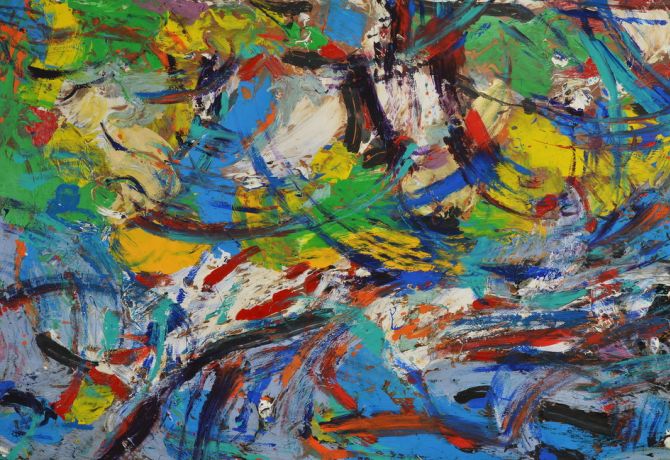
The expressionsim of Graziano Vivian is not figurative, but purely abstract, art of the spirit, art of the soul, art of the ’anima’, animated art. His brush strokes come from the heart without eye interference. His choice of colour comes from inside, or maybe outside. The panel for his work may be plastic, old wood panels, glass, ceramic tile.
He adds life to these inanimate surfaces with texture maybe plaster, maybe earth or sand – and colour. And what is the absence of colour or the fullness of colour with texture? What is the role of shade? Some works live as you pass them, telling a different story as you come and then go - texture, colour, brilliance and shade.
If one were to approach this animated art with an analytical mind, disappointment would result. In a few of his works displayed throughout the three levels of the family’s house - and his extensive studio, we were struck by an approach to colour that reminded one of Pollack, a more famous artist for whom analysis seems futile (though many try). Yet Graziano is not limited by style.
He paints always with emotional music, sometimes Puccini, as his partner in creation, and as a friend who helps him find the channel for the art to flow through his transparent body. Words that flow in poetry also accompany him along the road.
Graziano does not seek to sell his works and a commission for animated art seems unsuited to his soul. He relates that in every work he leaves a little of his life, so the concept of sale would be prostitution of his being. His house is filled in rooms and stairways on the wall, roofs and some floors with the life of Graziano Vivian. Do not come to stare as at an exhibition, just come and let one or many of his works of animated art talk to your being.
His next challenge is to create art and music together, in the summer evening among the lawns and gardens – maybe there will be room for a poet or two. The challenge – for the souls of the artists to communicate in harmony not cacophony.
powered by social2s
Silvia Logi has "blossomed"

The art of Silvia Logi has not gone unnoticed and it has over 60,000 fans on FB and an American director who has dedicated to it a documentary, "Blossoming", which has received many important awards on the festival circuit of independent cinema in the United States.

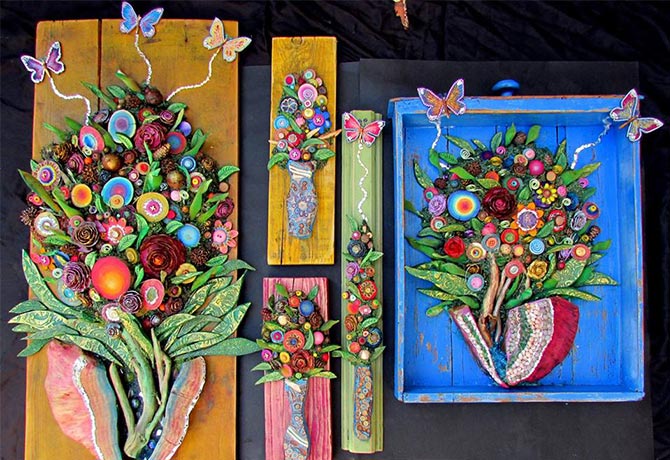
It is not easy to describe what Silvia does, her technique arises as a crossing of mosaic, collage and assemblage of different materials that then come together in a single ‘language’. And it is as if it were drawing with the materials instead of brushes. The result is imaginary shapes, almost fairy-tale, but with some connection with reality, immersed in a harmonious color scheme.

An art that speaks of freedom, but uses fresh bold experimentation to come to unexpected solutions.

Silvia, who inspired you to create your own style?

I do not think I've ever been inspired directly or deliberately by anyone, but definitely a trip to Barcelona in 2005 where I came across the revolutionary architecture of Gaudi was the first spark to get close to my "art" within.

Then I would mention Klimt and Niki de Saint Phalle with her amazing Tarot Garden in Capalbio (in Tuscany), a place where fantasy blends with reality.

You're a self-taught and how did you start? How you decide to become an artist?

Like many women, after my second maternity I had to find a new job. I had the feeling that times were changing, it was the end of 2005 and I was returning from the trip to Barcelona. I felt it was the right time and during all those months I seemed to be encouraged to continue this new way: my small mosaic artifacts were liked very much by friends and acquaintances.

My mother, who has a shop in Florence, began to sell them and to encourage me to continue. My whole family supported me and my workshop is a part of my house, in my beautiful garden overlooking Florence. This allows me the time to work in the garden surrounded by nature.

You speak with pride of Florence, what is special about the country you live in?

For more than 20 years the great Michelangelo lived most of his childhood in Settignano (near Florence), to name the most important of our fellow citizens. This means we breathe, even unknowingly, beauty, art and history in every street corner.

Where I live and work cannot be separated from my art and inspiration. I feel much more appreciated in the area where I live, I know the people in my local country who have lived with me from the beginning of my artistic career supporting me and encouraging me.

I understand that you never stop working ..

It's true: when not busy creating I dedicate myself to the collection of materials to use in my work. I find them both near home and in the trips I make. The materials we use are largely recovered (old boards, windows, doors thrown out, reclaimed wood from prunings, pine cones, seeds and beside those, old metal, pencils collected in schools ..).

Sustainability maximum!

You can see here the documentary

powered by social2s
Elegant satire in the art of Fabio Taramasco

Watching the artistic creations of FabioTaramasco is a sensual pleasure. Immediately you are struck by the comic idea of the work and the skills of its realization. Then you smile with the title. And finally you may understand in depth the meaning and conceptual links.

Fabio Taramasco defines himself as a "pop-conceptual" artist and in these words we understand the love of irony and satire and the desire to reach the general public by being understandable to all.

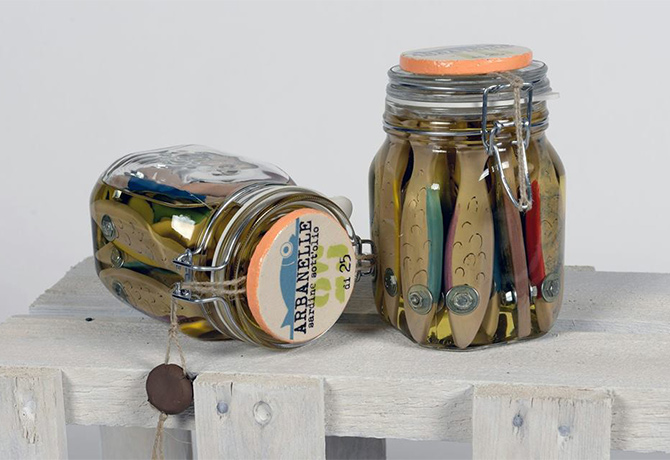
We meet his latest artistic creation "Arbanelle, sardines in oil," almost a construction: ceramic sardines in oil in a series of glass jars that recall the Mediterranean tradition of his land.

Fabio Taramasco, what inspired you to create this collection of sardines?

It all started from my studies of the past and from Churchill's phrase "the past must be preserved for the future". In my work as a restorer I am driven by the idea that history is part of the present, and so I started to interpret the objects of family history.

Keeping food in oil is part of the traditions of all Italian families, we are on the Ligurian coast, and we bring to home produce of the sea preserving it in fish oil.

It is an assembly in some respects fun, laughing at the audience, what should it arouse in the viewer?

I like to create works that people have the pleasure of owning and looking at, and I like to get in touch with people who understand the work. I would like to give a smile to people.

Sometimes it is risky: the refinement is essential to achieve a real irony. The elegance must be intrinsic to the creation not to slip into vulgarity, while maintaining a certain level of satire.

Even the use of colour is important. The bright colors and contrasts contribute to wellness and exercise a sort of "colour therapy" on those who observe them.

Why the sardines?

The sea is part of my language and I have often tried to represent its energy. The sea is a living being that encloses within its own world: the fish and much more.

Sardines in oil are the evolution of a previous exhibition devoted to fish of the Mediterranean, the "Mute speaking", in which I had created the paintings of fish using different materials (wood, metal and ceramic) combining the visual language with that text. And the sardine knows its fate, so it stares sardonically at its ultimate destiny, to feed its audience.

The testing, in-depth investigation of a theme, is part of my art history just like the sea is part of my personal history.

powered by social2s
‘Perseverance’ the Marble Polar Bear

We returned to the enchanting showroom of Jon Fathom in Whistler to be captured by the ‘stone carvings’ and each Marble Bear, wildlife & contemporary works of this master sculptor and his team at Fathom Stone.

After several hours of sharing life with Jon, our hearts linked to Perseverance, a very special marble polar bear sculpture by Andrew Gable, whose story about this work is summarized here. Andrew was born and raised in in Prince George, interior BC.

He attended the Alberta College of Art and Design in Calgary.

We met Andrew at Jon Fathom’s carving studio and his artistic talents enchanted us. As well as stone sculpture, Andrew also paints, blending both realism and abstraction which complement his expressive en plein air landscapes painted directly from nature.

Andrew, which is your relationship with sculpture?

A visit to Italy and the sculptures of Michelangelo catalyzed my artistic mission. Then, when I started to work in collaboration with Fathom Stone, I discovered the great pleasure of carving in stone particularly wildlife including the marble polar bears. We live next to the Arctic, in a country covered by snow most of the time, and our souls are next to them.

You choose to work with different sources of marble. Tell us the story of “Perseverance”

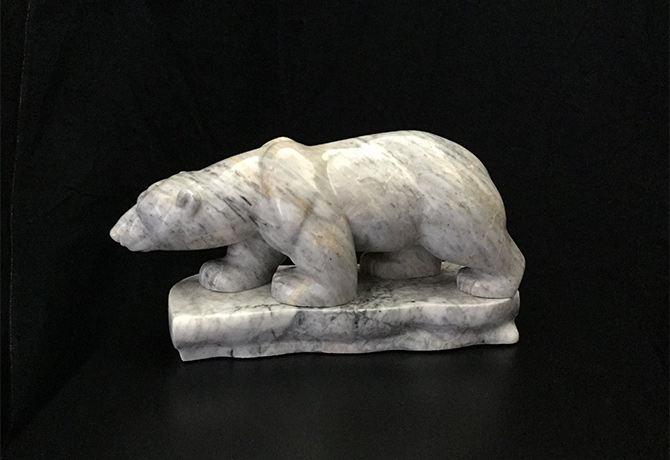
The Stone I chose for ‘Perseverance’ was Canadian marble from British Columbia. I initially thought the coloration was white with very little variation. And that is in part why I decided to model my piece as a marble polar bear.

I chose a simple design because the polar bear expression has a kind of graceful and elegant simplicity to it. The idea was a white bear striding across a great white plane of snow and ice on a bright day.

As I moved into the polishing phases, I started noticing there was in fact quite a variation in the coloration of this marble that brought me to other considerations. Sometimes the intricacies and depth of coloration in a stone doesn’t start revealing itself until the final stages and it was only during the 6 stages of polishing that I noticed the real colour of the stone.

‘Perseverance’ is a marble polar bear walking across the arctic ice though a snowstorm. I based this final concept on the patterning and coloration of the stone.

Why “Perseverance”?

The whitish bluish foundation color with the diagonal streaks of grey and amber specs within this marble gives the idea of a storm. The marble polar bear, head down, represent a powerful animal walking step by step, facing its challenging environment head on. To me this suggested a kind of ‘Perseverance’ embodied in what a creature like the polar bear must face in its day to day life to survive and thrive.

Sometimes I choose names that I can relate to, or even aspire to be!

In this case I see perseverance as a quality that would be beneficial to have. That ability to face our challenges head on, walking through storms one step at a time even though we can’t see what the outcome will be.

And the golden splashes of colour as a warm sun beyond the storm?

Yes, representing that success, if you will, that comes to those who persevere, who take it one step at a time until a project or task is complete.

Next artistic challenge?

I have a number of sculptures in the works at the moment. Everything from polar bears, to grizzly bears, to wolves. Perhaps the most significant project in the works though, is that I will also be working closely with Jon Fathom on the third life size Marble Polar Bear Sculpture.

The challenge is to carve a 15000 pound block of Alaskan Marble to realize the third great masterpiece of FathomStone.

powered by social2s

Subscribe to Newsletter

Discover a territory through the emotions of the people that have lived it.