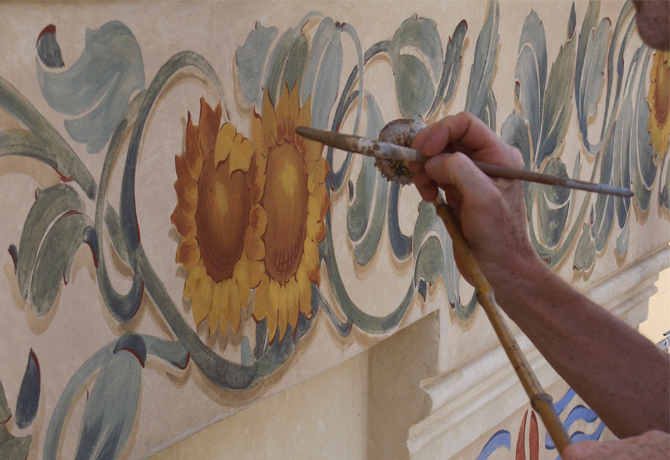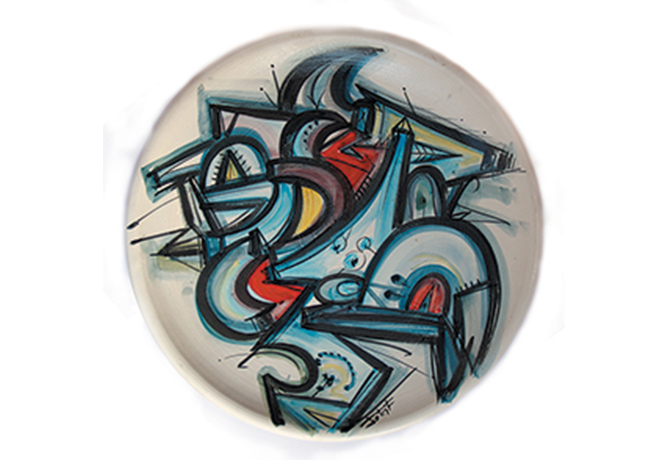
Felix Diaz: creating with music

Music is vibration, art is vibration, life is vibration and in Cuban Feliz Diaz (Jotaf) all these things coincide and collide.

Born in Cuba, where the Caribbean colours blend with musical rhythms, where art is an everyday experience, means artists are of an unusual type. So it happened to Felix Diaz (Jorge Felix Diaz Urquiza) who combined a classical education with a non-classical daily experience.

Felix, how have you reconciled classical university studies with art?

I think there is something in the influence of my mother who was a teacher, maybe I wanted to teach myself and thus why I chose Art Pedagogy. I wanted to let others know about the stories of the great artists and convey their emotions.

But then it is also a fact that from the age of two years I lived with my grandfather who made musical instruments and played in his band. I played with coloured pencils while he was playing with notes. In my life I wanted to follow the teachings of both.

And meanwhile thou didst make thy works ...

Not yet. While I was at the University I became the president of a major artistic association, the "Hermano Saiz", of Santa Clara. In that role I took care of the Gallery and the promotion of concerts of authors, book exhibitions, and I was in radio promotion.

It came naturally to take courses in management of culture and organization of shows: I approached the theater. You must know that, at that time in Santa Clara, contemporary art was very lively and we welcomed artists from various parts of Latin America.

We were selling a lot of art in America and Canada and traveling constantly. Then they changed the laws and we could not move even for cultural reasons. This is why I left Cuba and fate brought me to Italy.

That's where the ability to use many artistic languages became useful, which do you prefer?

I can change from figurative to non-figurative art: it depends on the feelings that cause me certain sounds in me, the music itself, the field recordings, or pictures.

It is important to define the style that the painter uses, through the strategy and the colours, not only the use of images. I prefer more pictorial art.

For me art should aim to improve the human being. The artist must combine ‘man-woman' to express the maximum!
powered by social2s
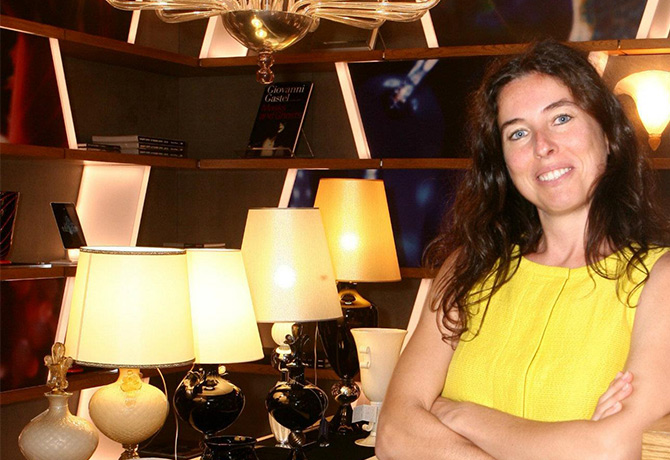
Carlotta Gabbiani - a life in the beauty of Murano glass

Carlotta Gabbiani surprises! Smiling, cheerful and yet a deep thinker and creative in her career as a designer of artistic glass and director of the family business. Already this description should be enough for one life, but then talking to her it turns out that she is also veterinarian and loves animals deeply. Incredible!

Carlotta Gabbiani, as a young designer in a well known Venetian family, the Gabbiani, learned the love for glass and its magic.

Her mother Marina Ravagnan is an artist and has been her teacher: she has learned the wisdom of how to touch and work the glass, so "fragile and delicate like Venice."

We met Carlotta Gabbiani at Palazzo Bragadin, historical residence where Giacomo Canova lived as a refugee when he escaped from Piombi. It is opposite the ancient home of Marco Polo. Part of the artisanal treasures of the Gabbiani family is rooted in the palace, while the other is in Murano where the ovens give life to the creations in glass.

Carlotta Gabbiani, you come from a family with a tradition in glass art and your training is very eclectic ...

Our family has worked glass for over 50 years. While the family of my father were traders, in the spice business from the East, the family of my mother has always been artists. I breathed art as a child growing up with my brother in a ‘museum’ more than in a home for children.

My brother followed the family in the glass business so I became a veterinary in Bologna with a major in acupuncture. Then he moved to Shanghai 15 years ago, and I joined the company to take on various roles.

The job of designer seemed natural to me: from the first jewelry collection in glass, now I dedicate myself to decoration and lighting, which is the hub of the business of the company. I drew part of the chandeliers for last catalog in classic and modern style. But I got my mother's approval and this gave me a great satisfaction!

Carlotta, where do your creations come from?

Inactivity: when we are sitting in the boat and my brain is free to expand. The idea registers, I make the first sketches, I check my ideas with everybody, and then leave my drawings to the master glassmakers so that they can interpret them skillfully.

Venice is a magical place to be an artist in glass. Venice is by definition glass: it is the human being that is reflected in the water! This is a 'transparent' city, a collection of reflections and colours, but fragile as glass.

Connecting my love of animals with that for glass, means I live between the ephemeral and the ground. The open mind that I acquired guides me in creating works that reflect my intuitions. In the end, creation always gives me strong feelings.

What is special in the Gabbiani creations in artistic glass?

For us, Murano glass is above all passion for tradition. And it is complex to carry forward a company like ours in these days, because it is all done by hand!

When customers visit the furnace in Murano they are amazed! Only there do they understand the time and energy needed to create our works, all customized and some timeless in effort! Our achievements I find graceful in their combination of colours. They offer a moment of peace because they combine "Elegance and Beauty".

Here, I wish to sell this to customers: the dream of knowing that a work was made for you and your needs and not in just any factory!

powered by social2s
Paolo Bellò at Salon Lecce 2015

Salon Lecce 2015, the 20th meeting of International Decorative Painters will be held in Lecce from 21 to 24 May. This is where the best fresco artists, emulating the great art of the renaissance, meet the carnival artists, share experiences, challenges, achievements, and techniques.

What about Lecce, why is it so interesting for artists?

Since antiquity, there has been civilisation near Lecce. The original settlement was probably of Cretan origin, but, if not, definitely Greek. About 1,000 years after its founding, Roman emperor Hadrian shifted the centre of Lecce for reasons not explained. Nevertheless, he did add a stadium of 25,000 people capacity and it is used today for performances.

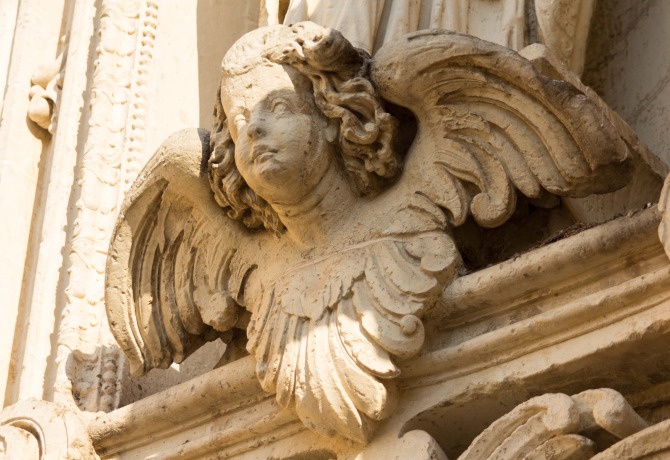
From a modern perspective, Greek and Roman antiquity are not as relevant as the impact of the baroque from the sixteenth to the eighteenth century. Lecce and Baroque are virtually synonymous - but why? Interestingly, Lecce buildings are yellowish - the colour of the local limestone. This limestone is the major building material and export of the Lecce province.

What is so special about the use of this building material? All you have to do is stare wonderingly at the exotic baroque sculpture on most of the buildings of the city to understand. Carving such complex shapes, figures and structures, would require great effort and time, unless, of course there were something to make the job easier. And there is: the limestone, it is strong enough for building but very soft for easy carving and sculpting. So Lecce's architects and artists have taken advantage of the local nature.

Yet, while the sculpturing is highly ornate, Lecce is not renowned for murals and frescos, so common further north and subject of Salon Lecce. Is the reason once again a quirk of nature related to the characteristics of the stone? Or is it simply that the highly ornate baroque architecture needs no further ornamentation, inside or out?

What will the decorative artists at the Salon Lecce learn of the challenges of the local stone, of how to deal with its special texture and porosity? Will they approach it with verve or will they politely decry the challenge allowing the naked stone of Lecce to continue to expose itself.

One such decorative painter who may accept the challenge to embellish Lecce stone is Paolo Bello the mural artist of Veneto whose expertise in a wide range of surface painting techniques have brought him renown among villa and palace owners of the Veneto region. Paolo has a passion for mural art and particularly for defining the beauty of a lady in this format. Meanwhile, he creates paintings on portable canvas to show his artistic skill in oil, tempura or other of several artistic media.

We look forward to the opportunity to admire and compare the works on show at the gathering of decorative painters in Salon Lecce and to interview Paolo at the meeting.

powered by social2s
Antares: modern jewelry from Murano glass

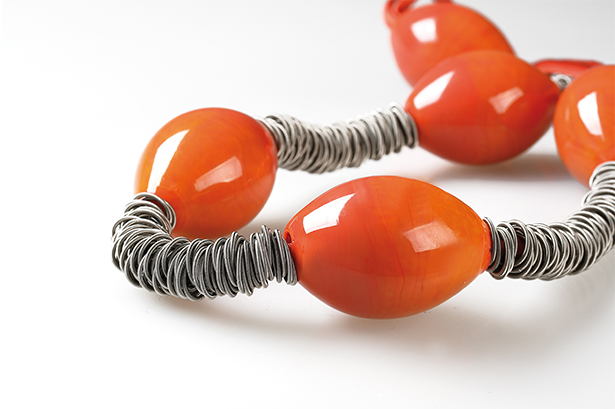
Milanese design and Venetian tradition blend in jewelry of Murano blown glass made by Antares jeweller Fulvia Notari. Twenty six years ago, Fulvia, an architect from Milan, moved to near Venice, fell in love with Murano glass and decided to create "wearable objects".

With love and time she came to know the characteristics of the 'glass material', and in 1995 founded Antares where she began her small artisan business journey creating artistic jewelry. Her architectural training allowed her to grasp innovative aspects of the glass and her jewellery blends the brilliance and opacity of glass in forms that adorn the body of a woman.

Fulvia, what made you decide to create jewels in blown Murano glass?

When I came in the Venice I started working with a glass designer who led me to the furnaces of Murano. Here I became haunted by the process, when a neutral mixture of earth turns into a unified object with beautiful colours, and the glass workers move as in a dance with precise rhythms creating the shapes. The purity and brilliance of coloured Murano glass inspired me to create objects for the person.

Jewelry of blown glass? Not many people create this art.

I liked to investigate the symbolic meaning of jewelry and to communicate, but I did not want something heavy like solid glass.

I wanted something ethereal and I thought about the blown coloured glass. My ambition was to create with opalescent glass that is not transparent and ‘hides’ its true nature, while just touching it you feel its lightness.

At first I struggled to find blowers who understood my creations. For those born and raised in Murano glass 'must' be transparent while, from Milan, I had no such mental limitation and I could see the potential. With time I was shown to be right: more and more women appreciate my pieces jewelry by wearing them with a smile!

Have you tried various materials for your jewelry, where is 'Antares' going today?

'Antares' was born thanks to the thrust of my husband who stood by me in the first years. Now we are three and we do everything: a Murano artisan glass blower, and Dolo, we perform the work of creation and the framing of the jewelry.

In jewelry we combine various materials: metals to fabrics, from steel to satin, from skins to silk. The jewelry is a design project that has the Murano glass as the main theme. We have had collaborations with leading Italian brands such as Alviero Martini, Trussardi, Fendi.

For a Japanese designer, Hiroko Koshino, I made a special collection, of necklaces combined with fabrics from his collection, that was exhibited in Paris.

Fulvia, what feelings you want to convey through your jewelry?

I wish all my Antares jewelry to communicate the 'joy of life' through the colour, the design, the play of "tone on tone" between the matte and glossy, and the combination with transparent glass.

I am happy and satisfied if I can contribute to being the companion of a woman, throughout her days, making her feel unique and important wearing one of my creations – fine blown Murano glass from Antares.

powered by social2s
arte concettuale

Claudio Brunello is a "cross-border" artist and designer: one who likes to cross several borders of art in the ongoing search for new materials, expressive forms and narratives.

His desire for experimentation originated from contact with important teachers and several artists from whom he learned to narrate using different languages. In his eclectic background, Claudio Brunello started his artistic formation in the early 70s in Turin, a very lively city with important cultural ferment, where he received the Cairoli Award and started working as a window dresser.

His move to Bassano del Grappa plunged him into a new world. Here he became ‘consecrated’ as a painter, but he also works organizing exhibitions and promoting cultural events.

Claudio what are the artworks that have most affected your personal development as an artist?

Every artistic period has its own charm and I'm attracted by human beings and all the ways a human finds to communicate emotions. I feel inspired by many different artistic movements of 1900’s: Optical art, the informal period, naive art and finally I came to religious abstractism.

In recent years I have managed to merge my different research in "making art" characterized by abstractism and a conceptual use of different materials.

In your latest creations you trialled plexiglass, how were your “Identity Containers” born?

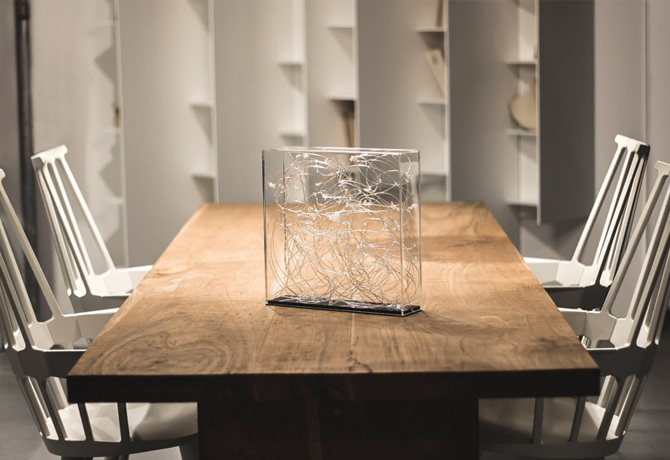
The Plexiglas Containers are a narrative experiment. They were born from prior art installations, including one built in 2014 dedicated to the fall of Berlin Wall.

The "Identity Containers", that’s their name, their language is clear, have immediately gained the favour of visitors. This prompted me to search for union of beauty and concept.

With the Identity Containers I created a solid transparent space, the stands between sculpture and writing, in which I can insert different messages but all aimed at positive emotions, to an inner wellness that should be the perpetual condition of man. It 'a continuous creative becoming.

What feelings do you want to convey with your works?

Beauty, Elegance, Sustainability: in a sense, my works are 'elegant' because they are built on a precise thought circumscribed in a simple geometric construction. I feel like a 'sustainable' artist as I often use discarded materials, always highlighting the traces of their previous life.

Both as a painter and as a designer I celebrate Beauty, the center of my message is positive feelings and I try to stimulate interest in what lies beyond the artwork.

Being an artist gives you the opportunity to get out of the reality of others and to invent your own, where those who want to experience and learn something different are welcome to enter.

powered by social2s
Roberto Lanaro, a philosopher of iron

"Iron is not sculpted, it takes shape. You do not work to remove material but following and releasing its enormous energy ", with these words the sculptor Roberto Lanaro tells of his love for the iron.

Love for metals comes from his family, which has a laboratory in Molvena, his home town, where Roberto began creating functional works, i.e. adding art to everyday objects. He pursued studies at the Academy of Venice and Salzburg. But his life as an artist is steeped in philosophy, from friendship with the philosopher Dino Formaggio has increasingly deepened his reflections between thought and form.

Roberto, how has philosophy influenced you being an artist?

It is enclosed in all my works: their common matrix is the exaltation of opposites, putting together the rational with the irrational. I am attracted to opposites, because their dialogue reflects life.

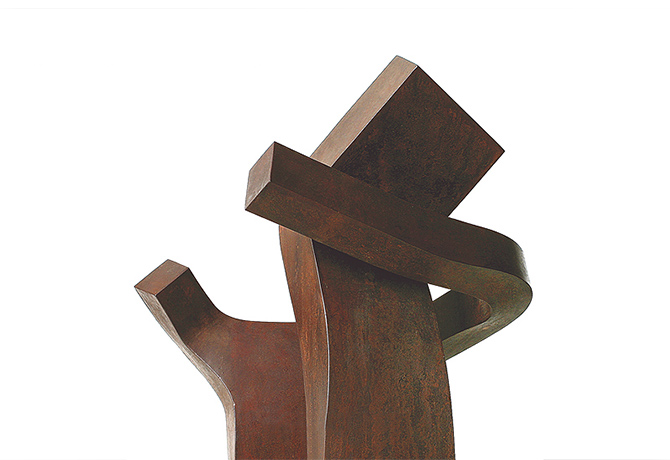
Geometry is the reason, while the curve and the unexpected are emotions. My works are signs suggesting messages, and are open to different interpretation according to the feelings with which a person views them. This is the beauty of contemporary art!

What feelings do you want to convey through your works?

I made functional sculptures and artistic works such as the door of the Basilica of St. Anthony in Padua. In all I try to convey the existing relationships in life, but it is difficult to know 'why' I create. The core is just not to know why: for me to create is a necessity.

Roberto, your works are born in your mind but eventually become a 'great unknown' ...

My creative process followed three phases: the visual arts, the stage interpretation of reality and 'fracture-twisting' that began in the '80s. If at the beginning I created animals, then I started to tear the metal as if to know the soul. With the twists and folds the metal is stabilized in space.

Often out of an initial project will come another work because the metal bends, moves, following instinct. At that moment I realize that what is born is a value, because diversity is a value. If this diversity is imperfection delete it, but if it is wealth accept it.

In life nothing is absolute, and the work is always different from the sketch.

Because iron, what's unique about this metal?

It transmits force, it has the appeal of being able to look unworked. Iron is not shiny but I leave it rough intentionally. I prefer to work with solid than with empty spaces: you do not see inside empty space, while in the solid substance I can convey a message of truth.

I did not think about beauty until I started to sculpt jewellery to be worn by beautify women. With jewellery I have opened a different world. I realize pieces using all materials, especially those of little value and those ennobling with the exaltation of opposites: beauty and baseness.

I think my sculptures are innovative and represent the uniqueness in the time when I create, there is nothing else the same at that point of time.

powered by social2s
The magical art studio of Andrea Zelio

Going up the narrow stairs that lead to the studio of Andrea Zelio, right in the middle of San Donà di Piave, you cannot imagine what you're getting into. When the door opens, your eyes do not know where to rest between installations hanging from the ceiling, theatrical scenes, paintings, prints and books.

Andrea Zelio is an artist with a spirit of "old" in the sense that is not limited to an artistic expression but a curiosity that leads him to experience every means of communication.

Talking to him is pleasant and his "story-telling" about his creations reminds one of the storytellers of the past century that went from village to village telling stories to entertain people. Stories that conceal teachings while always handing down those teachings and traditions.

Andrea Zelio, in your studio I have seen many different forms of art. Which do you prefer? How do you prefer to communicate?

The different forms have the ability to interpenetrate, to achieve completion. There is not a favorite form. I miss each form if I do not practice and this is why I feel the need to experiment always with new solutions and hyperbole.

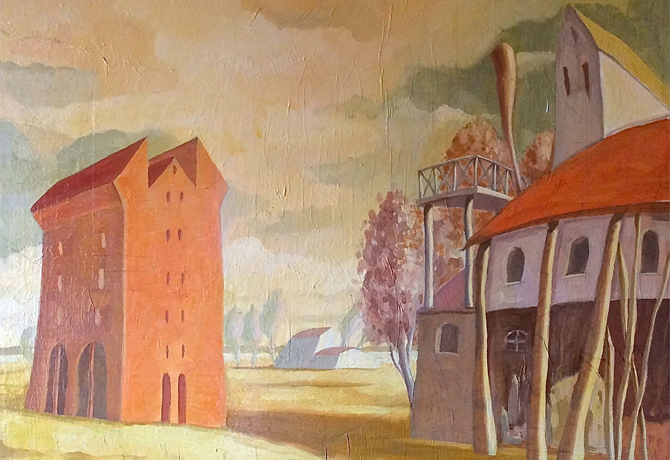
I try to represent something unreal but that might be too real, a fairy story but one that we can also find in life.

Despite this variety of expression Andrea Zelio, your personality comes out well delineated by all your work. How would you define your style?

“Saudade-chic”. I think that my creations convey an elegance that comes directly to me from the place where I was born and I live on the border of the lagoon of Venice, in an area famous for centuries for its refinement. Maybe that's why I love Leonardo and Giorgione.

At the same time I feel a certain melancholy and the subjects I choose also carry a bit of nostalgia: like the little references to medieval jousts that are recognizable in many works or the use of charcoal in the many surreal series of "letters" or "months year ".

What is your next challenge? What are you creating?

The challenges are important and I often come directly from a client who comes to me to find something original. Right now I'm working on a children's book, "The King of Toys" where I take care of texts and illustrations.

I'm interested in these activities to make my life more clear and rounded, I like the feeling of creating resonance with the universe, of harmonizing.

powered by social2s
Mural painting and decorating splendid houses by Paolo Bellò

The area of Venice is famous for its architecture and lavishly decorated villas particularly those with mural decoration. The school of the mural painting had great teachers, from the Renaissance with Paolo Veronese until the late Baroque of Gian Battista Tiepolo. Paulo Bellò is the continuation of this fine tradition, an artist who decorates villas and palaces in a refined and elegant style.

Paulo Bellò began his career "in the workshop" of the maestro Ennio Verenini in Bassano del Grappa and was drawn to the world of decoration that had "bewitched" him. Mural decoration is so specialized in various techniques including the difficult art of fresco, which requires great concentration, preparation, skill and speed to create a work in a very limited time,with techniques the same as those used by the great renaissance masters.

We met Paolo in his workshop in Solagna, where he does all the preliminary studies and research, in order to satisfy the most demanding customers, and where he devoted himself to his passion for figure painting.

Paolo, how did you start painting?

Around 1995, I began to get involved in serious painting. In roof and wall decoration I got to a point that I did not know what was the boundary between the decorative and artistic creativity, so I felt the need to expand my knowledge.

Figure painting was then a function of the decorative world, particularly in the mural painting of villas of the Venetian tradition, and over time has become another form of expression for me. I love to paint the human body because it allows you to depict anything: the brutality, beauty, human feelings and you can do it with different techniques.

You mentioned the Venetian villas, consider your achievements are unique and elegant?

Yes, I think each of my works is 'unique'. I do not like to repeat what I realized as a decorator and painter, and I like to create a work that gives pleasure to others. The artist should not feel himself in schemes, but he must be present his social responsibility. With his works he sends a message to the public and it is right that you ask about what he decides to represent. I always do.

I love the concept of 'shared' beauty because I think that beauty is functional to 'feel good' and should not be an end in itself: it is positivity, warmth, kindness. I become a 'mirror' for the painting and 'practice' for the decoration. I consider my achievements to definitely be elegant and I satisfy my clients by combining elegance and refinement.

What does it mean to carry out the decoration of a villa? What is your relationship with your customers?

When someone commissions a restoration or the decoration of an important house, we begin a journey that can last a couple of years. And within the home, people are very demanding although in different ways. There are three types of customers: those who know what they want, those who do not really know what they want and those who rely on the decorator.

Certainly, I spend a lot of time in their house so I have to "be there but not appear" even if I am still involved in their family life.

powered by social2s

Subscribe to Newsletter

Discover a territory through the emotions of the people that have lived it.