ART TO BE AFRAID OF!

You know that art through the ages has represented death graphically using skeletons and skulls, these also being symbols of the most macabre celebration of the year, Halloween? The most terrifying night is upon us!

Halloween is a holiday related to the Anglo-Saxon Celtic New Year Samhain, a Gaelic word meaning "end of summer", and pointed to the conclusion of the harvest season and the beginning of winter. For the Celts this was a time of celebration mixed, at the same time, with a great fear of death. For this reason, they used to celebrate rites and light bonfires wearing grotesque masks and animal skins to frighten the spirits away.

The theme of death is a big question mark that since prehistoric times involved humanity and which, for various reasons, mankind has wanted to represent in various art forms. From prehistoric times, through the Middle Ages and the Renaissance up to contemporary art, many artists have been fascinated by composing beautiful works full of artistic and cultural significance.

The character of immediacy of Death, its sudden occurrence, and the impotence of man in face of it, drove men to seek answers in religion and worship of the life after death. It is amazing what can be found in Etruscan tombs or the Egyptian Pyramids, or the graphical representation of the deity who accompanied souls in the afterlife.

In the Middle Ages, however, to raise awareness and spread the Christian doctrine to the poor and illiterate masses many frescos were commissioned. What better way to communicate with illiterate people, except through images? By biblical scenes and the images of the Saints they could learn good behavior and to escape the temptations of sin. In preaching, art was a warning well represented by the phrase "remember you must die!" (Memento mori).

First, the theme of the "Triumph of Death" was linked to that of the Last Judgment, related to the representation of Heaven and Hell. In the late Middle Ages instead it takes on a desolate tone, in which Death decimates "freely" the population (the period of the plague) and results in a fanciful vision of a tremendous collective experience.

The symbols include skeletons each armed with a sickle decimating Kings, Popes and ordinary people alike, and skulls, pictures of the physical frailty of man and earthly dimension of existence that ceases with death. Among the notable examples: the "Triumph of Death" of Buffalmacco in Pisa, the same theme at the Palace Abetellis of Palermo, and "The lady of the world" at the Oratory of the Disciplines in Clusone (Bergamo).

For the Renaissance suffice the example of St. Jerome by Caravaggio (painted 1605-1606), commissioned by Cardinal Scipione Borghese and today in the Galleria Borghese in Rome. St. Jerome is portrayed while translating the Bible from Hebrew into Latin, a subject much promoted in the era of the Counter Reformation. There are a few elements, and each has its own symbolic meaning. Among them, the skull resting on the Holy books: it is the symbol of the transience of mankind over knowledge, but Knowledge is eternal. It is the symbol of human trifles that, after death, no longer exist, so is a warning to the faithful to address the really important things, just as St. Jerome does.

And, contemporary art is no exception!

One example is that of Damien Hirst, British artist and group leader of the Young British Artists. He dominated the art scene of the 90s with the theme of death, exactly!

Manifesto of his poetry is "The Physical Impossibility of Death in the Mind of one living", consisting of a tiger shark of more than 4 meters length placed in formaldehyde in a showcase. That work became a symbol of British art of the nineties and its sale in 2004 made Hirst the most expensive living artist after Jasper Johns.

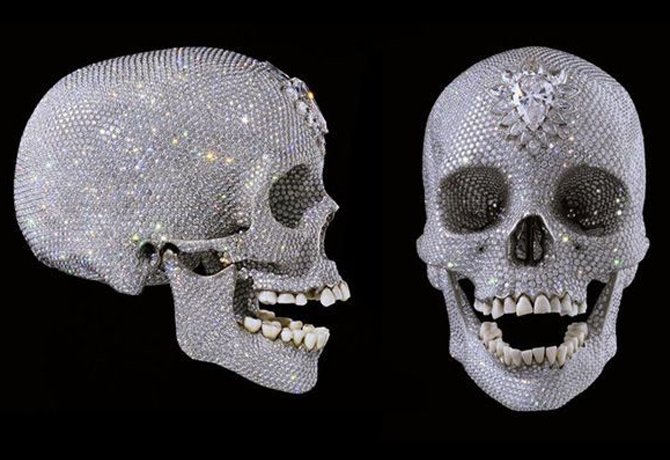
"For the love of God" is a sculpture of 2007 that consists of a human skull cast in platinum enriched with 8,601 diamonds with $100 million market value. Hirst wants to show how the skull, symbol of death, is now abused, is a commodity like any other (on shirts, bags, jewelry ...) so why not make it valuable? At the end for the skull of man what matters? What if you do not want wealth, money, success? These material aspects of daily modern life translated into art.

Happy Halloween, then, it is full of history and symbols of that dark fascination with death that always tickle mankind.
powered by social2s
Bansky e Dismaland
Bansky e Dismaland

If anyone thinks that control systems and "Big Brother" are watching us and we can no longer hide our private lives, then he should learn the story of Banksy and Dismaland.

Who is Banks? Even Prince Charles wanted to know what face (or faces?) lie behind someone who is now considered one of the biggest street artist in the world. He is a graffiti artist, a political activist, a filmmaker and a painter. His works are illegal but are contained in million dollar auctions. Not bad for a revolutionary artist!

And now to tell what happened in the pleasant town of Weston-super-Mare, in Somerset, which had been in steady decline, as had many other towns since Monarch and Ryanair have made available the warm Mediterranean countries for a few pounds. Some say that as a child Banksy was on holiday here beside the Bristol Channel (Bristol his supposed birthplace).

Citizens of Weston-super-Mare had been told that the pool and the area of the Tropicana had been chosen by a Hollywood company, so called Atlas Entertainment, to film the thriller Grey Fox. There were signs all over the town and ongoing work to build what looked like a movie set.

People could see the emergence of a castle from the canvas that hid the work. And they didn’t mind if the castle did not have brilliant colours, the film had to be a thriller and its title already was a bit dark.

Everything was funded by the artist and the first doubts about what was really happening came in early August when his agent was seen in the area. The news was spread in the web and the first curious people came to try to understand what was happening.

With surprise, from 21 August to 27 September, Dismaland opened its doors: an amusement park "anti-Disney". Art critics and spectators from around the world rushed to Weston-super-Mare in Somerset to see the installations of Banksy. His ten new works and works from another 58 artists who parodied consumerism and the schmaltz of the theme parks, a real trap for parents.

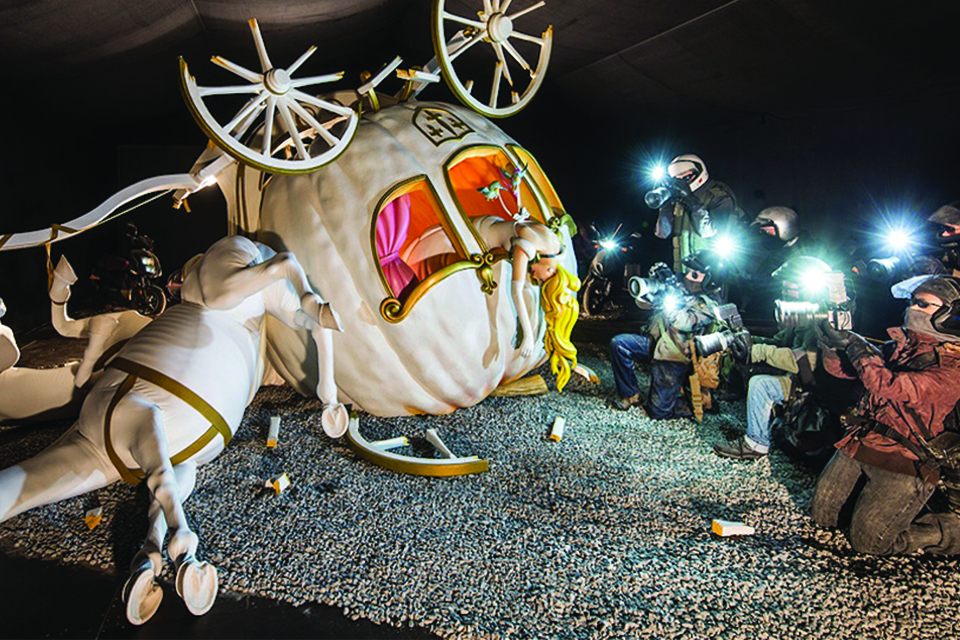
An incredible flow of people who paid for "being treated with contempt and with little grace" from all employees of the park, from Minnie really upset at the arrival, to the Gift Shop without gifts. People pass by Cinderella victims of an accident, to Donald with ISIS, to horse show operated by butchers, recounts just a few.

From the accounts of the BBC, there were 4,500 visitors per day, 300,000 tweets, 86,000 photos on Instagram and the video on Youtube was seen by 2.6 million people. It changed the local community’s economy and has created 20 million pounds of associated business.

For those who follow him, they expected something unique and a strong message against consumerism. Posts by Banksy, who uses stencils, songs or documentaries, always ridicule the capitalist system and wars. His drawings on the wall built by Israel - which separates it from Palestine - express in an elegant denounces all the violence of isolation. Those glimpses of tropical seas, that emerge strongly from grey concrete, are more effective than a thousand texts of useless words of disappointment.

I had heard of Banksy from an article that told how Prince Charles had rushed to see a mural when he was told that he might meet Banksy. Then I realized that his drawings are used in thousands of FB posts where no one quotes the author of the drawings. Now I am part of his followers too. But I hope he does not ever reveal his identity and that he will never fall into the traps of the ‘star’ system.


I will continue to dream that someone can "beat" the system, exit from the controls and be free. Someone who can continue to go to the most important museums in the world and hang his works along with those existing from the past. Days may pass before anyone realizes that in the eighteenth century there were no telephones and gas masks and that perhaps these works are not ‘original’.

For those wishing to see for free some of Dismaland they can go to Calais where the facilities will be installed to build shelters for migrants camped at the border. On his website, the ironic last message from Banksy reads:
"Coming soon ... Dismaland Calais, without tickets online!"

Time for another check-in.

 
powered by social2s
Exhibition "Tombstones on Street"

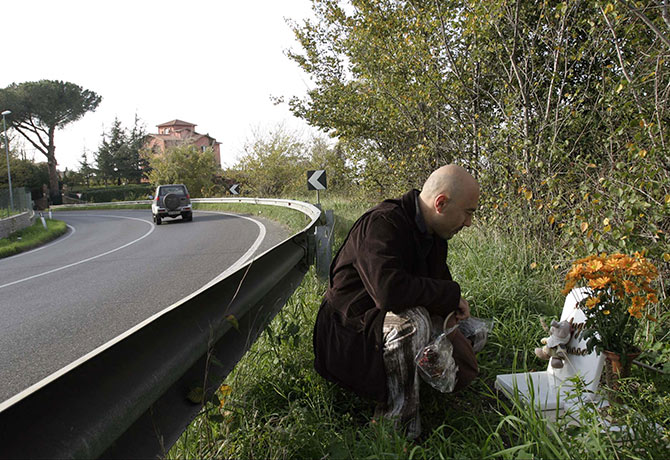
"TombStone on Street - Everyone sleeps on the Hill" is the title of the exhibition of photographs of Simeone Ricci that collects images of epitaphs along the Italian roads.

The exhibition is located in the second edition of "ART KM 0" Corviale (Rome) and is a study of plaques placed along the streets that bear witness to the many Italian road accidents.

Initially this work was born as part of a road safety campaign but the depth of what Simeone Ricci (www.simeonericci.com) found convinced him to further his research. These stones were laid by the families of accident victims in memory of what happened to their loved ones.

"The first time I photographed I thought I would find sentences of death. But, I was dazzled by that tombstone, apparently cold and frosty, an apparent symbol of death and loss of loved ones. Yet behind I sensed an infinite world. The closer I got, the more I realized that there was not only grief and pain, but a desperation to live".

The richness of the verses reminds on the one hand epitaphs left by the ancient Romans along the Via Appia and on the other texts of the Anthology of Spoon River by Edgar Lee Masters. A hug between continents and eras that sums up the life of this Roman photographer who has spent many years in the United States.

"I have lived many years in New York, without having ever owned a car since I resided in Manhattan, where hardly anyone has one. So I began to drive again on my return to Rome. As I drove, I noticed that our streets were littered by these tombstones. Often while I noticed, someone cut the road, did not respect the priorities, did not signal a lane change or was talking on the phone while driving. So out of curiosity but I think more as a form of attraction, one day, after dropping my kids at school, I stopped in front of one of them. I then spent every day in my quest.

A thirst for life.

So not the simple desire to resurrect someone dear, a relative, a brother, a friend, now lost forever. There was a real regret of the past that no longer exists. Yet there was life going on unceasingly. Life tied to that moment precise, subtle, but now part of the past.

There was this, but there was also the future.

However, there were also a tragedy on speaking only when you want something. Forms of fatalism and immortality related to our Catholic culture, of irrationality and challenge of danger, desire to buzz, to overdo. I realized that most of the tombstones were boys or girls under 30.

For this I thought to Spoon River and I have not stopped to photograph. I wanted to express the colours, their explosion of vitality, hidden behind the dull and dreary surfaces. No pain, but the joy that life goes on, regardless and in spite of everything. I wanted to show people, but especially to children, that when we drive a car, a motorcycle, a scooter we can potentially driving a lethal weapon. When instead we should be driving a "machine" of life, but even more one of freedom."

The photographs in the exhibition were projected during theater performances of "The Glass and the Soul", loosely based on the story "120! 140! 160!" from the book, "Send me to say" by Pino Roveredo.

powered by social2s
SAMSUNG DIGITAL CAMERA
The poetess Antonella Pagano as Artist for Peace

My friend Antonella Pagano is a poet who engages you inside her poems. Her recitations touch each listener and positive emotions vibrate in the air. I think for these reasons she has been invited to Assisi as an "Artist for Peace" participating in the Meeting "East meets West".

Antonella, what message are you carrying this time?

Firstly, let me talk about the emotion of being here in Assisi, an area that is a synthesis of a physical place and a place of the soul: overflowing with spirituality and so much energy that I felt regenerated. The seeds of Saint Francis continue to sprout in every season, in every era, in every day that the earth rotates.

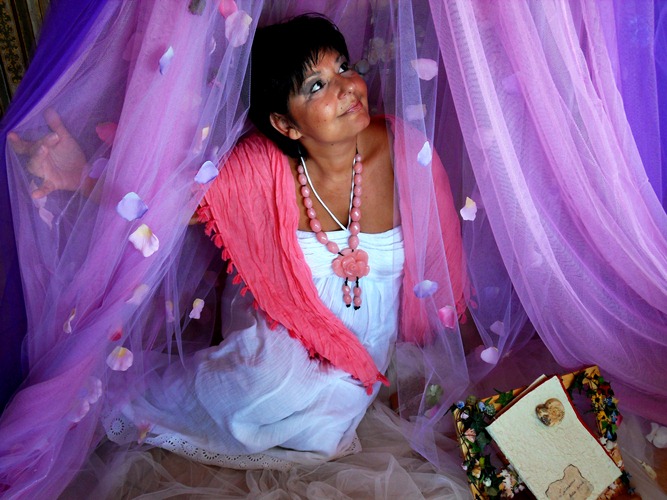
In my past experience I have created about the story of Beauty, that I render visible with the sound of my thousand bells, with the tulle on which I sit, and with the books with pages of silk upon which those stories are handwritten.

This time I will tell of a special flock of "Flamingos of peace", a poem left to the breaths of wind and the heartbeats of each spectator. Here are some lines:

This foreign sun flaunting bizarre anchors
Decked with rainbows of flowers that intrigue madness.
Flight on flamingos of peace.
They have faces of women and children
Fly high over meadows of a brave green.
Volcanoes erupt petals and dandelions here
The fervent lava flow embraces the heart
Suturing all pain.
I hear castanets
bleating of grazing
The moons circle in the sky.
I sense young girls’ voices singing sweet songs of figs
I sense women's with voices of grape
I sense murmuring lands
I sense the winds and the seas and faint swishing
I sense a flutter of wings
Clouds sprinkle sugar on mountains bravely sharp.
I sense souls too stunned to stir
Arms that hold onto other arms
Hands of silk vie with the Wind.

The eighteenth edition of the meeting has the theme "East meets West for a New Civilization of Peace". How did they select you as Artist for Peace?

The foundation "The Mandir of Peace" is a voluntary international cultural, social and humanitarian network, founded by Maria Gabriella Lavorgna. 2015 is a year dedicated by Pope Francis to mercy and my ‘flock’ of "flamingos of peace" is much liked.

Also I have been invested as a Dame of '"Orders Venerabilis Sodalicii Mariae SS. Boni Consilii Mortis et Misericordiae ", an order of chivalry that boasts a thousand years of history.

But we come to the meeting, an appointment with art, ecology, science, ethics, economics because the culture of peace must be more concrete and feasible. Since 1998 Assisi has brought to life and approached apparently antithetical hemispheres, even those of the brain, to show how these can be integrated proactive and ‘cooperattive’ (I spelled incorrectly by intentionally doubling the ‘t’), to explain how the interaction between the two polarities, the rational and the intuitive, can occur.

"The awakening of self-awareness: all is One": life which is travelled to achieve one’s full own identity and awareness of being part of the whole. The contemporary challenges require Mankind to be agile in dealing with diversity, able to experiment with the many aspects of Unity. It is not utopia and still, if it were, I would say that I like to fight for utopias, be at the forefront with a bouquet of flowers in hand to give to each skeptic, annihilated or indifferent one.

This bipolar reality, I speak of the two hemispheres, has created major ideological conflicts, and their integration, instead, has founded the new science in the evolutionary path with Consciousness. The new scientific paradigms help us to fathom the great, fascinating, intriguing mystery of life, mind, and spirit.

The wedding between exact Science / analogical Science celebrates the overcoming of the barrier between Reason and Intuition. The human / nature / physical environment is corresponding to the correlation body / mind / spirit. I recognize that there are other alternative routes, but everyone must sooner or later confront this. It is so that you can experience peace on a personal level and help pave the way for universal peace.

But always, I will not tire to point out to remind all, to be flavoured and coloured with joy.

She speaks of joy and happiness and, very often, and she speaks with joy: it is stunning.

Joy is also the hero in a novel that I seem unable to ever finish. I find so many colours of joy that I think of when I finish, I must add another new chapter. How wonderful!

Even St. Francis was a poet. That his "with all the creatures" is a clear message. In this "cum", or ‘with’ ... weighs tons, while often it is the opposite. It weighs tons that word "all", where I can see all of us humans shake hands and walk together. And then the word "creatures", which in the south of Italy also means children, weighs a lot, at least for believers.

It gives me joy to think about how important the relationship between man / earth, man / sky, man / air, man/water, man / star, man / weight, man / weightlessness, skin colour, manual dexterity, intellectuality, genius, creativity, charity, simplicity, complexity, identity, mystery.

It weighs a lot, but it can also be immensely light, in this the poetry is a teacher, then you can imagine the feel and be really responsible to all around us, animals, plants, nature and our fellow mankind.

I think it may seem trivial, obvious, but in truth we are using the cover of banality to do what we please. The planet we live has been a cozy garden and generous.

powered by social2s
Prefuturism, Futurism and Targa Florio

Welcome to Prefuturism! The twentieth century is presented to the world as an extraordinary century. The first planes and the first cars shocked the imagination of many intellectuals who suddenly found themselves able to imagine a different future world full of cars and imbued with power and speed.

Futurism is the epithet of these emotions and since the release of the first poster of "Le Figaro" in Paris, artists from various disciplines have tried to represent the emotions caused by the interaction with airplanes, trains and vehicles of various shapes. No more static subjects but need to show dynamism, movement and power. Bold colours, energetic and without words!

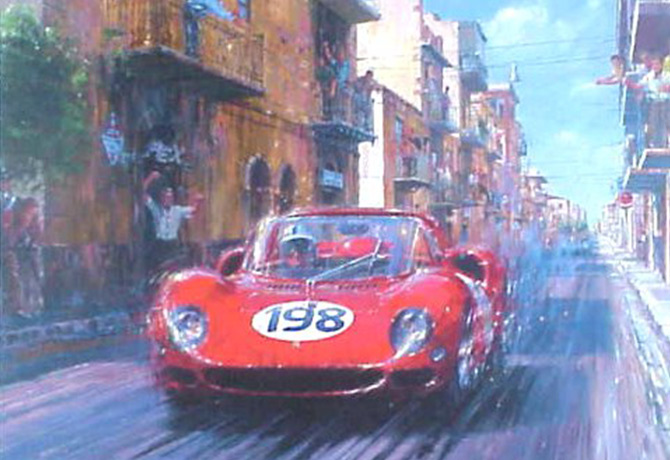
In the early twentieth century the first auto sports competitions were created, where daring drivers were measured trying to beat human boundaries of speed that for millennia, nobody knew how to cross. The history of the Targa Florio  is that of the first and one of the most beautiful and emblematic of this era.

I had the good fortune to years ago meet Antonio Marasco and participate in the first edition of the Eco-Targa Florio, a new version based on electric motors. Together with Leone Martellucci and Fabio Massimo Frattale Mascioli we raced up and down the Madonie nature enveloped in a powerful, amazing and breathtaking scenery. We then gathered in Palermo for a memorable dinner in a Sicilian tuna fishery with the chef there preparing a "cassata" with fresh ricotta, the best dessert in the world.

Antonio Marasco is a founding member of the Foundation Targa Florio and the creator of this race. To say that he is in love with the history and traditions of automakers is to reduce the force of his passion. He is not thrilled by engines alone but by all the cultural context where great ideas have been able to be born and to flourish. His is a mission of sports culture in a sport, motorcycling, which is a synthesis of innovation and competition.

Antonio has founded two museums, the Historical Museum of Motoring and the Sicilian Targa Florio in Termini Imerese (www.fondazionetargaflorio.eu) and at Collesano (www.museotargaflorio.it) of which he was co-founder and collected evidence of the "spirit of the times". In our meeting he overwhelmed me with nothing short of amazing news about the movement of the Futurists and its first seeds planted in Sicily and in some way connected with the Targa Florio.

Pre-Futurists and Prefuturismo in Sicily

"How can the idea of a sporting event be born? Which humus has enabled a number of sports figures and intellectuals to emerge?", These are the questions that have driven the research by Antonio Marasco in Sicily. And the answers are really surprising.

In the early twentieth century Vincenzo Florio was perhaps the most well-known Sicilian entrepreneur and was a very active intellectual figure, so much so that he was dedicated to the airport of Trapani. His family had been known for generations and was among the richest families in Italy, operating a fleet of ninety-nine ships and an industrial empire that ranged from chemistry to wine, from tourism industry to tuna.

They were the protagonists of the European Belle Epoque so that even the German Emperor Wilhelm II stayed with them.

It was natural that other intellectuals gravitated into the orbit of Florio proposing the most daring innovations and new cultural paradigms. Among friends of Vincenzo we find a Genoese journalist, Mario Morasso, who founded auto magazines and wrote memorable articles for L’Ora per Rapiditas of Palermo.

Mario Morasso is the author of the book "The New Weapon" in 1905 dedicated to the car and whose protagonist is Wattman (of the modern man-machine). He was a promoter of the myth of speed and machines and dreamed of a modern and mechanical world. In his book, we can say that he had foreshadowed the rise of robots (although this term was created by Capeck years later in "RUR") with the figures of "metal men, invulnerable automata, monstrous and docile, progenies of real men and maybe his heirs and followers on our frozen planet".

He and Vincenzo met in Palermo and exchanged ideas. At that time Vincenzo often went to Paris (he later married a Frenchwoman) where he met Marinetti at cafes along the boulevard. The connection was immediate and cultural similarities between the writings of Morasso (1905) and those of Marinetti (1909) denote influence of the first on the second.

Futurism and technological innovation

This Sicilian "mechanical" fervor was a perfect humus for technological innovations such as telemetry, which is used in every sporting event, but was first introduced in Targa Florio, and for safety of frames.

But the story told with more passion by Antonio Marasco is of "Ciccio from Cefalù”, a man of 80 who was the first to design and build custom shoes for racing drivers. His creations are on display in every automotive museum in the world: that of the Targa Florio (obviously) to that of the Porsche and Mercedes in Stuttgart.

The task of the Foundation Targa Florio is to investigate the history and to collect stories, mementos and artifacts that can increase the quality of tourist appeal. Tourists who come to Sicily and Italy seek the spirit of our creativity and our stimulating cultural curiosity.

powered by social2s
Andrea Zelio at EXPO Venezia

The narrative painter Andrea Zelio presents two major works, ‘The Ganges’ and ‘The Mother of Rivers’ at the satellite Pavilion of EXPO Venice "AQUAE VENICE 2015" which examines and explores the relationship between man, the environment and water.

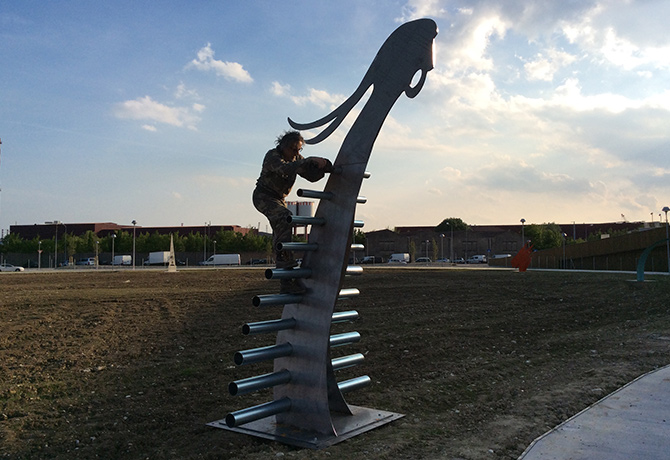
How to represent a river? For EXPO Venice Andrea has created these two works as large installations: The Mother of Rivers stands as a curve to 4 meters in height while The Ganges, the sweeter, unfolds 6 meters horizontally.

With the power and the shininess of zinc plated and polished steel, Andrea Zelio brings out ancestral visions and messages that flow like underground rivers inside every being: the sinuous forms of running water, the sound evoked by the wind blowing through the artworks, the power of water that regenerates but also knows how to destroy, the terrible indifference of Mother Nature.

And indeed the Mother of Rivers collects water from the sky with its hands to feed her children but lets a scream escape from her face to represent the contradiction of being in this world and suffering.

The Ganges instead gives peace, like the river L’Isonzo into which Ungaretti welcomes us by it being recognized as a "docile fiber of the universe".

Indeed, while watching the two installations at EXPO Venice it is recommended to listen to the poet reciting "I Miei Fiumi", the poetry that inspired Andrea Zelio with these works: even those who do not understand Italian will be able to make out the sound of the waters that flow into his soul.

powered by social2s
From Thofothofo the concept of Sustainable lights

We were strolling purposefully through Euroluce at Milan Design Week in April a few years ago, seeking elegant, stylish and totally novel sustainable lights of all forms and we were confronted by a Thofothofo.

Not that we knew it was a Thohotfoho, or even what it was for, until we were introduced to a particularly sustainable gentleman in blue t-shirt with decidedly ruffled hair. Introduced to us as David Trubridge from Hastings, New Zealand, one of a kind, a designer and manufacturer of really sustainable lights. But more of the lights soon.

A picture is worth a thousand words so, for brevity, we won’t endeavour to achieve geometric accuracy in describing this several metre long canoe-like skeletal bamboo structure with a long horn of a unicorn towards each end. The skeleton would obviously need an additional skin for water proofing, but the manufacture of a Thofothofo was not the subject of this meeting. It was the catalyst.

David’s passion is the Melanesian and Polynesian peoples and their homelands - the islands of true paradise, that are progressively becoming part of the Pacific Ocean rather than disturbances in its expanses. His mantra is in our words, ’what have they done wrong?’

Maybe they made the British look a bit foolish in navigational skills as they sailed around the Pacific with unerring accuracy thousands of years ahead of the colonists. They are definitely the world’s minimalist polluters, affected only by rubbish distributed by visitors.

There are more questions than answers about these peoples spread north and east above Papua New Guinea. The one that David is seeking to answer is ‘what can be done to save our islands, when no-one seems to care?’

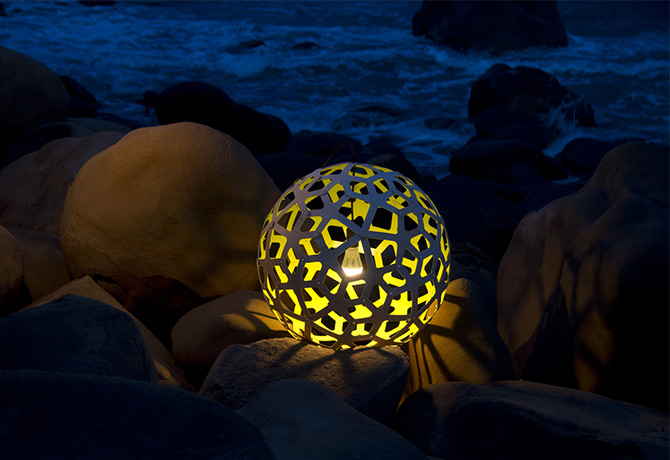
So the light at the end of the tunnel may still be faint, but for David Trubridge and his team it has been switched on. Their latest lamp design to respond to the call for help is named Ripple Light, as David says that it comes from a form of ocean lateen sail found near Vanuatu. The ripples in these triangular lamps are formed from thin bamboo plywood and the lamp behaves like the sea in a soft breeze.

Seek out David Trubridge, not just for the Ripple Light and his friends in the Pacific, but also for his range of sustainable lights and totally different elegant solutions.

powered by social2s
How my new pendant was born ...

As I related during an Energitismo event, every piece of my jewelry holds a story, born of emotions and images experienced during my travels in Africa. Here I describe briefly the story of my pendant, Nascita Beta.

During one of my most recent trips with a group of friends we decided to rent a couple of boats to take us to discover new and unspoiled places, we decided jointly to navigate towards the archipelago of Radama in Madagascar, namely the island of Kalakajoro.

After about 60 miles of sailing we reached our destination and landed on a deserted white beach lapped by clear blue sea with infinite shades of turquoise. In our faces you could see the joy and excitement and we let out a liberating scream that in those moments marked the union and the harmony of the group ...

But there was work to do. We took the fish caught during the voyage to prepare for dinner, prepared the tents and lit the fire before a story or two and then came time for bed.

The morning sensations wake you early. At about 4 am I decided to take a walk and was wrapped in my thoughts. When I chose to turn around to return to the camp, the image I saw caused me great emotion - it was the exact moment of sunrise, coming from behind dense vegetation where lianas and mangroves showed off their silhouette.

The birth of a new day when the night gives way, a moment that is always magical with strong emotional impact. My breath escaped me for a moment, but that moment was so strongly imprinted in my emotions that I had to try to reproduce it through my work.

Born from that experience is this pendant, where thin filaments are woven around a golden disk of Chalcedony that represents the rising sun and the rough cuts mark the transition from night to day .... Just like in that magical moment.

powered by social2s

Subscribe to Newsletter

Discover a territory through the emotions of the people that have lived it.