A Touch of Medici in Veneto: Ivano Costenaro mixes Finance and Art

Ivano Costenaro explains: ’The insurance company is my work, art is my passion.’ This reminds us of the Medici approach to banking – astute and cautious, loyal and personal, characteristics that appear to be at the base of the business philosophy of Ivano Costenaro. For without a stable financial base, how can one be an entrepreneur in art?

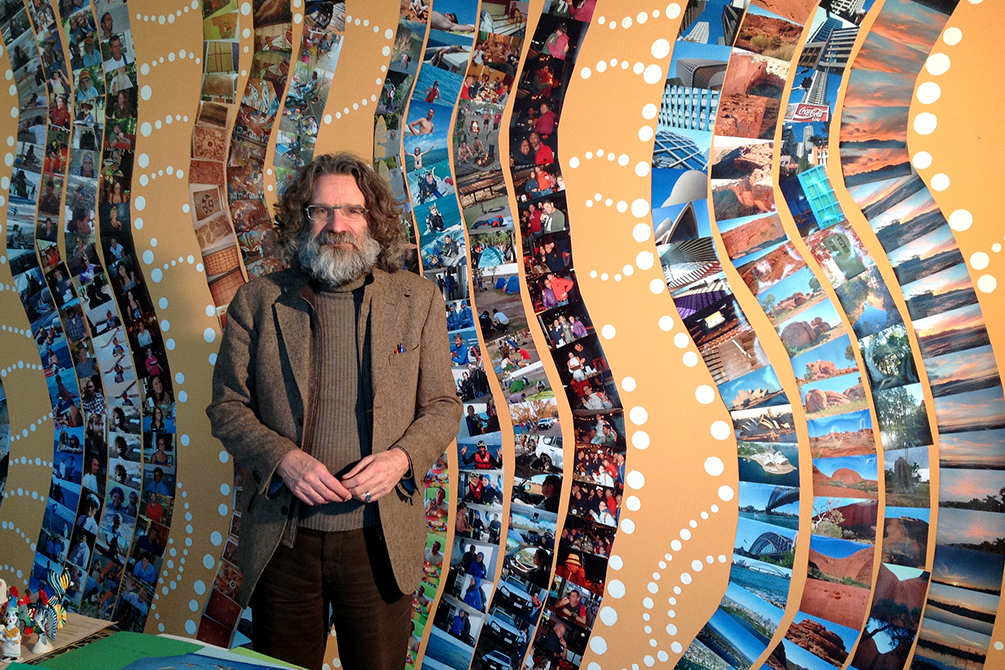
With just a touch of the Medici nose but a head and face of hair of vastly more creative growth, Ivano appears as anything but a traditional insurance businessman. We hear the importance of personal commitment to clients that has built his insurance business over the past few decades. And once again there are memories of the Medici commitment to the “Populo Minuto”, the little people.

Whether all the staff and clients who visit this surprising Bassano office understand why every room is filled with modern art is not so important, because they will, eventually. Art permeates the aura of the offices and one large gallery has been devoted to art exhibitions, the last one having been a personal representation of Ivano’s outback tour of Australia and the likenesses that the aboriginal art inspired with the art of his friend, Federico Bonaldi, who passed away in 2012.

How did Ivano Costenaro come to insurance and art? Certainly not through formal education which he escaped at 15. His interest in collecting local ceramic art and pottery began in his youth. Avoiding discussing his fall into insurance with his brother, Ivano is willing to let us hear about his discovery of art. On top of the shelves in this meeting room is a plate. Close to 30 years ago, before the current forced austerity, the insurance business had a client who, though short of money, owned a plate created by Tono Zancanaro, with which he settled with Ivano.

One rose a summer does not make, but it can make a rose lover, and Ivano Costenaro had become an afficianado of modern art. This shows itself in the wide selection of works, museum pieces and collectibles in the offices, plus the regular exhibitions he hosts and a commitment to supporting cultural and artistic activities. With justifiable pride, he informs that the last exhibition was attended by over 500 people at its opening.

But business calls, and we are granted a gift of books relating to the artists and exhibitions that have inspired Ivano Costenaro and, in leaving, we note the large crucibles from gold refining, possibly awaiting flowers in spring.
To know more visit: www.massimocarboni.it

powered by social2s
Images from Beirut: the art of Raed Yassin

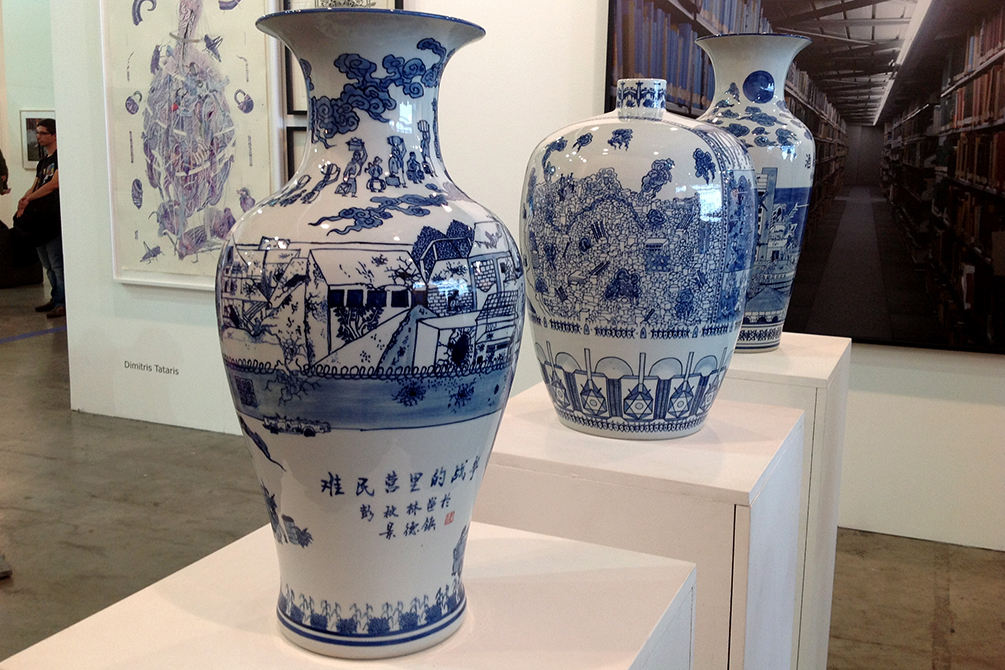
At Artissimma in Torino, last October, we were attracted to a stand of Kalfayan Galleries from Greece that exhibited work, not just of Greek artists but also of artists from around the Mediterranean,including Raed Yassin.  

In the centre of the stand were three apparently Chinese dynasty vases which on closer study revealed scenes of battle from Lebanese civil war, produced when the artist worked in Jingdezhen, capital of Chinese porcelain art production.

The artist is Raed Yassin, and those works formed his ‘Yassin Dynasty’, a project derivative from the work “China” (2012) that was made possible with the support of the Abraaj Group Art Prize.

Quoting Kalfayan:

The “Raed Yassin Dynasty” works are part-beautiful object, part-historical document, and part-mass-produced product. They echo the ancient tradition of recording victories at battle on vases and ceramics for the sake of posterity, and suggest that countless objects painted by different porcelain masters are being reproduced under the same fictional ‘dynasty’. T

he battles detailed on the exhibited works are ones that were instrumental for territorial, demographic and political shifts in Lebanon, and their ramifications are still tangible today. This merging between traditional, historical and artisanal elements creates a conceptually complex and multi-layered work.’

Raed Yassin was born in 1979 in Beirut where he lives and works. He graduated from the Institute of Fine Arts in Beirut. As well as being a multidisciplinary artist, he is also a musician and has released a number of albums.

Raed has exhibited his work in numerous museums, festivals and venues in Lebanon and around the world, including Kalfayan Galleries, Boghossian Foundation – Villa Empain, Brussels; Singapore Art Museum; Mori Art Museum, Tokyo; New Museum, New York; Centre Georges Pompidou, Paris; and Delfina Foundation, London (where he is currently in residence).

Kalfayan launched an exhibition by Raed Yassin at their art gallery in Athens. This solo art exhibition, “Amnesiac Commissions” negotiates themes of personal and collective narrative and memory in an attempt to challenge a common survival tool, that of selective amnesia.

powered by social2s
Luca Tondin tells about a 100% natural door?

We visited the workshop of Luca Tondin near Venezia to understand what are the best techniques to finish wood to maximise natural content. The psycho-physical wellness of a person is given by a number of factors that have be considered together. So, if not finished properly, even a natural material such as wood can cause discomfort to people.

Luca Tondin runs a family business involved in the craft production of doors and windows. In the past few years he also has become a reference point for ecology, particularly related to wood products. We interviewed him to find out his point of view.

Luca Tondin, what are the natural finishes?

The finishes are natural products to treat wood surfaces, they are made from completely natural elements, the finest clean and sustainable raw materials: plants and minerals. These materials are the basis for the realization of the dyes and waxes used to finish our furniture, floors, and even the interior doors and window frames.

Why use 100 % natural finish?

Because they are safe for those who produce them, for those who use them, and for those who live in the house. The natural finishes, in fact, are completely free of solvents; they contain, on the contrary, pigments and binding agents of natural origin and will at all times contribute to health and a clean surrounding environment.

And on floors, windows and doors?

The natural finishes are excellent protection for your valuable interiors – floors, furniture or fixtures – as well as the undisputed choice to maintain the quality of your life.

Wood treated with these finishes does not produce any kind of artificial exhalation, thus reducing domestic pollution and contributing positively to the balance of the natural moisture of the house. In fact, the well-being of an environment is given by a combination of temperature and humidity that comes with breathable materials, essential for the well-being of those who live there.

The natural finish also increases the resistance of the wood surfaces to degradation, maintains excellent colour stability over time and it is easy to maintain. It is available in a wide range of colours and shades, with a wide choice of finishes, from neutral to the most eclectic.

Some finishes can also contain special oils – such as orange oil – ensuring that the treated surfaces will release a pleasant citrus scent. They are not dangerous for children, and are also tested to be resistant to saliva and sweat. The finishes also allow for easy maintenance thanks to a “re- toning” process which can be done easily and quickly.

Luca Tondin, how can we recognise a 100% naturally finished door?

The components used to realize the natural finishes are truly countless. They are vegetables and minerals coming from all over the world but attentively selected on the basis of their origin and sustainability. Most of them come from organic farming. Typical examples of such ingredients are ethereal oils and tree resins, swelling clays, waxes and natural organic colourants, which are then transformed into an abundant variety of raw materials through high quality scientific development. These different primary products are then employed to realize the dyes and waxes, which are used for the finishing of the house.


powered by social2s
Ezio Zanardello - top Ceramic Artist and Technologist

Ceramic Artist - the term for the potter who has been a creative force for thousands of years. In all the museums of the world (those of archeology as well as those of art) are found artifacts of the ceramic artist. Every culture has its own recognizable style and this style is strongly linked to the history of a certain territory in which it has been created. During the periods of the great kingdoms, in the vicinity of major cities and seats of power, there have always been places and regions where ceramics were cast or thrown - where the ceramic artist thrived.

For example, in the Republic of Venice two important centers grew that were home to the ceramic artist: Nove and Bassano del Grappa. During recent years, manufacturers in those areas have had an interesting cultural journey. The Italian industrial boom had transformed the old craft shops into industries with mass production, creating a cultural leveling and pushing aside the ceramic artist who preserved historical traditions and who continued to do research and innovation.

Subsequently, the entry into the retail market of Chinese industries and the resultant price competition has hurt “lazy” businesses and forced the closure of many industrial companies. But a coin always has two sides, and the second side of the coin was the growing success for all those who had continued to try to preserve the historical memory.

One of these people is the founder of Ahura, Ezio Zanardello, whose company stands on the banks of the river Brenta, and is now run by the second generation of his family. Ezio‘s passion for ceramics is overwhelming and shines through in every word he says and in his personal background. In past years, Ezio has collected many traditional moulds either abandoned by companies or put up for sale, and today he preserves the true historical memory of this country of the ceramic artist around Nove.

Having the opportunity to be guided by Ezio among the rooms of his historic warehouse is an unforgettable experience that I wish everyone could be able to appreciate.

Ezio, how do you approach ceramics?

Pottery is part of the traditions of my country, but in my case it was born slowly and started from when I was about 8 years old at my mother’s side while she worked as a ceramic artist painting plates. In my teens I rejected ceramics and I swore not to be involved any more in ceramics. I did everything, from tbeing a postman to working for a gas company, but to increase earnings at night I continued the apprenticeship as a ceramic artist - to paint ceramics as taught by my mother. At one point I passed over my rejection and my wife and I founded our company. And the love of technology has led me to create a plant that is not just home to the ceramic artist but also technologically excellent in terms of energy efficiency.

In these years, you’ve collected in your archive moulds and works of many companies that have closed. We saw the passion in your eyes while you allowed us to visit this collection. Why are you doing this? What drives you to preserve traditions?

I cannot explain exactly. On the one hand I feel a strong push towards innovation and experimentation with new shapes and colors, on the other hand I love beautiful things and I don’t want them to be dispersed. I can see the beauty in the works of the ceramic artist whether in traditional classical forms or in the new design or in the trials of a young artist. I wish that everyone could enjoy these, but then I also think that “anything goes” and that we should not be too stuck in the past.

Being able to enjoy the beauty is a personal journey and requires an openness of spirit. It’s a process and not an end and I show this archive only to those who have trod the path.

Creativity and beauty are a personal journey or may they be shared?

Creativity is generally a personal matter, but when it becomes a shared process it can reach the highest level. If we think of the workshops (which are the ones of the past or that are the laboratories of today’s businesses), the work is a collegiate process. The choice of the ‘dough’, casting clay, firing, painting, and also how to pass this value to the end customer, are an essential part of the creative process and require a wealth of knowledge of different people working together to achieve the masterpiece.

If you miss one element of this knowledge you cannot achieve excellence. Art and technology must go “hand in hand” to fight to reach new heights and transmit new emotions, but without challenging each other. Our staff are the main asset of the company to achieve this.

You appear initially to be ‘detached’ in your love for the traditions of the area and your family. What does this mean?

Maybe it means to continue to live as some of my teachers have in the past and to revive their achievements. But without nostalgia: life is in the future and the past can give us inspiration, can push us towards continued innovation but it cannot return. Time changes the forms of expression and the way we communicate, the possibilities offered by modern technologies increase our chances of expression: and this propels us into the future. But the past provides the sense of taste and gives body to our innovations.

My children are succeeding in business and the generational shift also corresponds to a cultural shift in the way of doing business in Italy. I can give advice to my children but I also have a lot to learn from them and their way of interacting with the world. But it’s my story, and that of all my teachers, who can give meaning to their new business and can help them to be leaders. The great thing about having the new generations is the very freedom that I’m regaining to take care of the philosophy of our company and the creative freedom for me to continue to experiment with my ongoing “search for beauty”.

powered by social2s
Lithography - Reproduction and Art

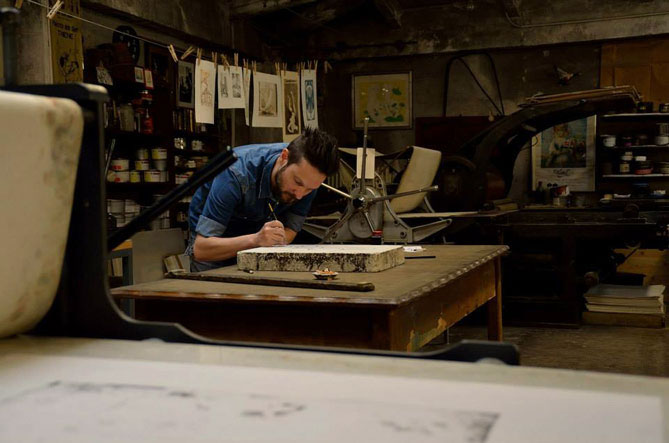
In 1791 Senefelder accidentally invented ‘stone’ lithography as a reproduction technique. The technology was very artisan intensive, even though the materials science was remarkably simple.

Lithography is based on the fact that oil and water do not mix. So a drawing done in wax will reproduce accurately if the background is washed with water and soap and the inks used are oil based.

The challenge of lithography was the use of relatively thick limestone slabs, so often the set up was a two men job. Obviously, the thick stone had less risk of breakage. The top surface was polished with another stone to achieve a smooth flat finish on which the drawing negative master was created.

The elegance of lithography was that the quality of the works depended on quality of the materials and accuracy of the fine waxy pencils and crayons used by the artist to create the mirror image. While, originally, lithography was a black and white printing technique, in 1837 Godefroy Engelmann, in France, introduced a technique to create coloured lithographs. The technique requires multiple stages of production, one for each colour. In lithography, patience is a virtue as up to 40 days may be required to create the works.

Lithography produces high quality artworks without the ‘embossing’ effects of other techniques,so it has remained in the printer’s portfolio till today with several modern variants even for microelectronics masks. The peak of lithography for art was between 1850 and 1950 when many great artists such as Van Gogh, Matisse, Picasso and Salvador Dali produced lithographs, as did Nelson Mandela.

The artist would either create the replica (or original) of a sketch or painting in mirror image on the stone and then authorise the printer to make a certain number of copies which would be signed. Picasso and Dali went so far as to commission others to produce the copies. The availability of up to 100 copies created a lucrative market for the artist, the copiers and the lithographers.

From the 1880’s the technique was used to produce colour advertisements particularly for shows and exhibitions. Each lithograph is, in effect, an original work of art produced with great artistic and artisanal care, and each may have minor variations of resolution discretion and tone as the number of prints increases, creating novel artistic effects, so for the collector, a lithograph may be very valuable while being a small percentage of the cost of the original artwork.

The limitation of stone lithography is the number of prints, so galleries that have high volume print sales have turned to photography. In addition, the public are not educated in the value of stone lithographs. A renaissance is needed so that this wonderful printing technology is maintained by families of lithography printers with traditional printing presses.

Hidden away in the heart of Vicenza is a wonderful lithography artisans’ workshop owned and operated by Giancarlo Busato, a man who is better known out of his home town, in Mexico, Brazil and even Australia. How to find him and thrill to his art? That is another story.

powered by social2s

Subscribe to Newsletter

Discover a territory through the emotions of the people that have lived it.