Promoting Culture and Art from Caltagirone to the World

Caltagirone is close to the geographic centre of Sicily and, in those places where it is well known, it is for its traditional ceramic culture and for pictures of the 142 steps lined with ceramic tiles, different for every step. 

Yet for most it remains a significant drive from the tourist centres of Catania/Etna, Siracusa and just too far from Palermo and Messina.  From afar it is not an obvious site for promoting culture and art to the world.

So what is it that attracts tourists from the Sicilian seaside at Taormina or even Ragusa, the tours of the puzzles of Montalbano, and those of Gattopardo at Donnafugata, and the many traipsing up Etna to watch the fires of hell? For us, it was having met some true Sicilians who were rebuilding and even giving birth to new businesses following the tradition of ceramics from Caltagirone, and particularly to search for a bummulu or two.

Bummulu? It is Sicilian for jug, but not just any jug, a paradox of a jug whereby you pour the wine in one end and then turn it upside down and pour it out of the spout in the other end. It reminds one of the Irish instruction for opening a can of beans.

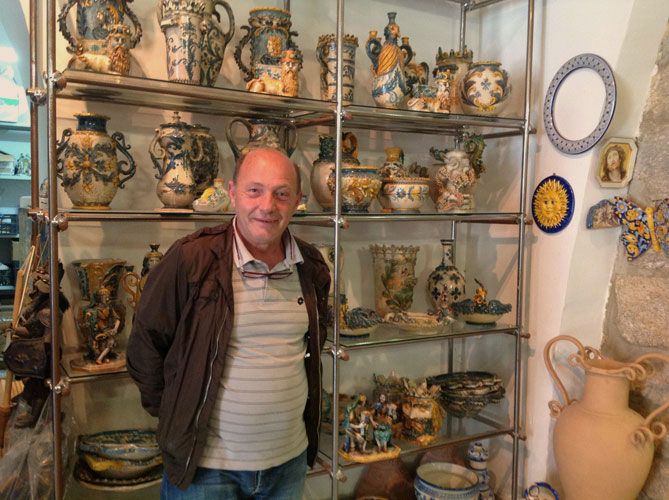
We entered our first ceramic display room, Conci, hidden away in a back street of Caltagirone to be met by Salvatore Di Caudo, husband to the proprietor, who by chance was at an art exhibition in our home town, Rome. He broadened our perspective of pottery from Caltagirone, showing not just the heads and vases we had expected, but also some unique Presepe (Nativity Scenes).

He explained the colours of Caltagirone pottery compared to the more Arabic colours of pottery from Palermo. It seemed that the yellows and greens from Caltagirone reflected the rolling landscape and the blue in the Palermo pottery added the sea.

We noted the small school area in the back of the Conci shop and Salvatore told the tale of their 20 years in creating this family ceramic business, letting slip not unintentionally his story of entrepreneurial promotion of the heart of Caltagirone and Sicily.

Twenty four hours each day does not seem sufficient to have assembled his portfolio of joys of Sicilian tradition. His card reads ‘Sikelia’ and he says that it was born with the intent to collect and promote the culture, traditions and folk art, the colourful folklore of Sicily. He uses the same words as does Energitismo - Human Treasures are of inestimable value.

He also mentions a folk group using traditional instruments, and he pulls a tambourine out from behind a large ceramic vase, and then extracts a small instrument from a shelf, which he plays by strumming it while held between his lips - Jew’s harp or “Scacciapensieri” – apparently originally a Chinese musical instrument brought back by Marco Polo.

His folk group from Caltagirone travels the world to perform traditional Sicilian tunes. For those who seek, he can also arrange a traditional puppet theatre.

Salvatore emanates warmth in his welcome and enjoys portraying the stories of Sicily. He says: “A deep passion for what we do is the spring that pushes us to grow, please visit us."
powered by social2s
Bringing art to the Museum of Rugby

The Museum of Rugby and us have created an initiative to show the role of art in the sport of rugby, with a function at Mauro Bergamasco’s summer school for young rugby players in Cavallino (about an hour either by swimming or driving from Venice!).

A sport can be differentiated when that sport enters the daily lifestyle and sports teachers become teachers of life. In rugby, encroachment of sport into everyday life is palpable from the behaviour of the players as well as from the fans and the supporters. The "third half" is the perfect example of this link between sport and everyday life. It is the time after the game in which the rivalry so palpably expressed on the field turns into light hearted fun and becomes an opportunity to be reminded of the true meaning of games and of life.

And it is perhaps for this reason that, in his summer school, Mauro Bergamasco, the Italian international rugby player, asked the Museum of Rugby in Artena to give a daily one-hour lesson to the young players. Corrado Mattoccia, President of the Museum of Rugby, hung an exhibition of a range of the museum’s over 1000 jerseys, ones specially selected for the occasion, and when we asked him what he spoke about during his lecture, he replied: "History and geography! Each jersey from the Museum of Rugby was worn by a player during an important match somewhere in the world, then I tell the story and ask questions about the specific countries and on relevant historical events."

To give an example of what led to the vision, he explained the "ghost jersey", that of a true legend of the Rugby World, Gareth Edwards. The youngest captain of all time of the Welsh Red Dragons, with 53 consecutive caps of Wales, he scored what is still considered the most beautiful try of all time. In the dark years of apartheid, South African teams were banned from the rest of the world to protest against white racism. No rugby team could agree to play against a South African XV. But in 1978 a team from a South African college asked and got to play a game in Wales, near Neath, home of the oldest Welsh club. The game was played "in secret." Edwards was on the field in the ranks of Neath. He wore the black shirt on that one occasion.

Another example from the Mueseum of Rugby is the importance of rugby in the history of Ireland. Rugby was the only sport in which teams competed from both Ulster and Ireland.

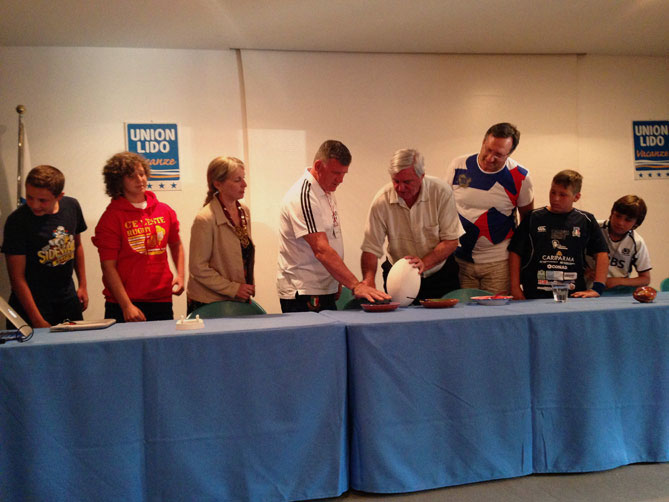
With this background and in adherence to our initiative and the goals of the Museum of Rugby, being rapprochement between culture, life, art and sport, we found ourselves in Cavallino near Jesolo in early summer. Following suggestions by the artist and ceramic artisans, Giuseppe and Alessandro Facchinello, on how to emphasize the link between art and sport through sport trophies and collectibles, we brought ceramic rugby balls they had made, in variegated colours and sizes. In front of all the kids and staff, some players stamped their hands in coloured glaze, leaving their "signature" on the oval ball.

Arturo and Mauro Bergamasco, Andrea de Rossi, Cinzia Cavazzuti, Davide Giazzon, Corrado Mattoccia, Francesco Tognon, Claudia Bettiol, Samuel Piazzolla, Alessio D’Aniello, Emma Stevanin, Edoardo Sommacal and Pietro Casarin have marked this historic ball that was then fired in the pottery oven by Alessandro Facchinello and subsequently donated to the Museum of Rugby.

powered by social2s
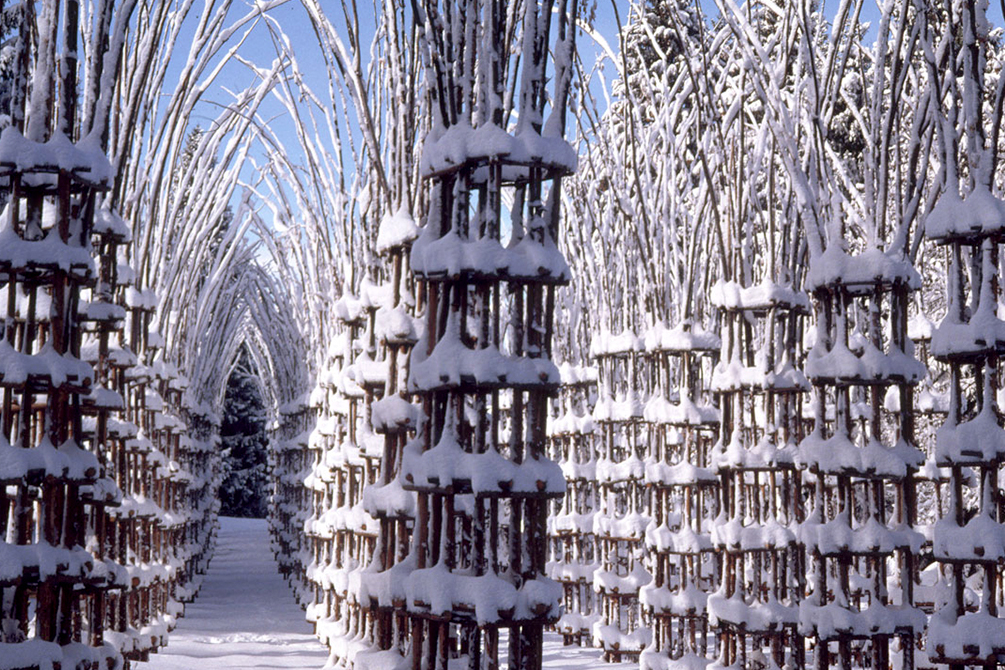
The architecture of the vegetable by Giuliano Mauri

Giuliano Mauri is a ‘poet of the branches’ ​​and generator of the “plant buildings”, defined as “natural architecture“ that lives temporarily and then, inevitably, returns to nature.”

Working with branches and trunks of wood he constructed fantastically real buildings. The assumption, related to the natural transience of the material used, is that nature will fill the gaps left by the decay of the wood, working in a sort of partnership with the artist.

His works live as long as a ‘breath of life’ of the materials used, they are imposing structures but they will rot. They are the symbol of a lofty thought that can disorientate but also move the viewer.

All the art works of Giuliano were based on listening to the spirit of the place, from where was born all of a sudden, the unexpected: ” … It is never a question of inventing, but rather to discover, understand something that is already there, to hear it. And then to give it body.” His attitude recalls that of Michelangelo who thought of the block of marble as a treasure chest that already contained the work that needed to be discovered by removing the “overburden”.

In Val di Sella, in the exhibition Arte Sella, he created an emotional architecture by bending young trees so that they ‘agree’ and can share an idea. Nature will then take over. For him, the trees are wood, sap, leaves, fruit, but they are also the life, death and, above all, rebirth. He bent the branches not to dominate, but to invite them to mould themselves into an idea and a sign that it is a process of invention.

Projects such as the Tree of the Hundred Nests or Wanderer’s Island/Raft of Migrants arouse wonder and reveal the expansiveness of his thought. It is a work about immigration of the future, just like a big floating log, filled with soil, inseminated by the wind, breeding future trees, and once it reaches the bank of the river they become trees, bushes and woods. Not only rafts, but from nature to nature in a hymn to brotherhood.

Giuliano Mauri the author of these works is not self important, he is a stranger who intervenes with his ideas and returns to nature what he has done. This is exactly how the architects of the Chinese gardens centuries ago planned and realized great works, without affixing their signature, and returned from time to time, quietly arranging, tidying up, because the real star was Nature and not man.

How many shapes can you create, how many horizons can be opened with what falls in the woods, even in the incredible spherical scenery ‘Sferisterio’ for Bellini’s Norma directed by Abbado! Is not this the perfect realization of the concept of sustainability in architecture?

powered by social2s
The fabulous world of Friedensreich Stowasser - Hundertwasser

In Austria, in a small town in Styria, Bad Blumau, one can encounter an embodiment of architecture of Hundertwasser where the style of Gaudi, the colours of Matisse, Klee and Kandinsky are merged into one form that its creator defined as “vegetative architecture”. These are the same colours that can be found in Darmstadt, Waldspirale or the incinerator in Wien.

Friedensreich Hundertwasser (born Friedrich Stowasser) was an architect who, in particular between 1994 and 1998, built a microcosm of architectural style around the hot springs of Bad Blumau on whose entrance is written ” …. denn das Paradies ist um die Ecke” (Heaven is around the corner).

Friedensreich started his career as a painter and sculptor: “Painting is dreaming. When I paint, I dream.” He created works such as painted walls, windows that are carved out of their own world, columns covered with ceramics, bricks, and mosaics of different forms. Bold shapes that continued upstairs with trails of other mosaics, colours, columns as if born from the womb of the earth reaching to infinity, almost “to support the sky, as do the trees according to the American Indians.”

To emphasize his joy, he changed his name to Friedensreich Hundertwasser, which means “hundred waters of the Kingdom of Peace.” His dream was to create architecture that is one with nature and brimming with happiness. And his accomplishments reflect this sentiment: I am a world of shapes, colours and vegetation that becomes an integral part of this fabulous architecture. Indescribable. Nature and its relationship with the man was what was most important. Architecture was called “vegetative architecture” because, like a tree, it grows very slowly and quietly.

Lucien Kroll, one of the fathers of Sustainability, shared criticism of the Modern Movement of architecture which had neglected the best part of man: that linked to emotions, sensitivity, memory, and dreams. “Straight lines have no role in our lives” – thundered Friedensreich – nowadays we live in a chaos of straight lines, in a jungle of immoral straight lines. The level and the meter should be banned, they are the symbol of ignorance and the symptom of the disintegration of our civilization. “In fact, the walls are swaying, the roofs are sinuous, the colours are open and brave.”

Since there have been indoctrinated and standardised planners and architects, our homes have become sick. We do not get sick, our houses are already designed and built as sick houses. We tolerate thousands of these buildings, devoid of feeling and emotions, dictatorial, ruthless, aggressive, unholy, flat, sterile, unadorned, cold, unromantic, anonymous, the absolute vacuum. They give the illusion of functionality. They are so depressing that both locals and passers-by get sick.”

In Environmentalist Manifesto he speaks of “the King at home” and “right window”, i.e. the right of a person to recognize his own living space and to paint the walls around openings, with bright colours. “It’s your right to change your home according to your taste, outside the windows of your home, as far as your arm can reach” (1972).

powered by social2s
The unknown and the forgotten: Paolo Soleri, a visionary

Paolo Soleri: enlightenment architect, visionary, creator of ‘important urban experiments of our time’. His motif: Less aesthetics, more ethics.

Near Tucson, Arizona, there is a city/community founded by Paolo Soleri in the ’70s, an architect who challenged the whole world on sustainability and the relationship between man and environment.

Paolo Soleri was born in Turin in 1919, and after a two-year collaboration at the studio of Frank Lloyd Wright at Taliesin West in the United States, he returned to Italy in 1950 with his wife Colly.

He built a mobile home from a small truck that became a camper that could accommodate their family of three. Solar thermal energy was produced in a tank on the roof of the camper and heated the water for cooking and showering. This allowed him to move with minimal cost to adopt a libertarian vision of life, and to acquire a sense of experimentation.

In 1956, back in the U.S. and 70 miles from Phoenix, Arizona – Paradise Valley – he began his urban revolutionary process. The first step was the construction of Cosanti, a residence with a roof shaped like a dome with semi-basement studio, where he taught and designed the city of the future: Arcosanti, a neologism combining the words architecture and ecology (in Italian).

Arcosanti is a prototype of a town for 5000 inhabitants in dense, compact buildings to be developed in the vertical direction so that it did not take up land space, wherein the powerful concept is the vision of a man-environment relationship based on mutual respect and mutual listening. The passageways were designed to avoid the use of cars, thus be used for walking.

Large organic shapes, different from one another, surrounded by many smaller forms, each of which represents the primary activities of man: the towers containing the houses, the place of scientific research, the place of artistic creativity and craftsmanship, the centre of administration and business, the place of worship or religious rites as he called them: the all-in-one form, beauty in design, inspired by natural formations.

Drawn on long sheets of wrapping paper, extraordinary signs and drawings of great artistic and poetic force. The key word for Soleri is frugality, “do more with less”: less energy resources, less waste of space, less pollution. The city of tomorrow is born then with these imperatives: to intensify human relations, to optimize access to common resources, reduce waste, to harmonize the meeting of people with the environment.

Since then, more than seven thousand volunteers have contributed to the building of the city, realizing only 5% of it. To date, 14 buildings, including houses, a foundry, a music centre, swimming pools and a greenhouse have been created. In this community, everyone can still belong: guests, travellers, businessmen, artists, casual workers.

A supervisor, Roger Tomalty, wrote: “It was a community for the sake of the community itself, where you ate tofu and you gave pats on the back. It was the opposite of a hippie scene: a community of builders. If we wanted it to be, you had to work harder than you ever worked in your life.”

“If you are really concerned about the problems of pollution, waste, loss of energy, land, water, air and biological conservation, poverty, segregation, intolerance, containment of the population, fear and disillusionment, join us.” So reads the sign at the entrance of Arcosanti. 

powered by social2s
Bejewelled with Joy - Esaltabuchi

In Pesaro lives a fine entrepreneur, poet, humorist, gentleman and enigmatic genius, Nani, il Conte Alessandro Ferruccio Marcucci Pinoli di Valfesina, inventor of the Esaltabuchi, and his elegant and enchanting wife Paola.

Nani and Energitismo met when the search for elegant sustainable products in the Marche Region was launched through a seminar and function at The Hotel Alexander on the beach in Pesaro. This hotel is the epitome of the Energitismo philosophy. It is a living work of contemporary art and a museum reflecting a different artist in every room and space.

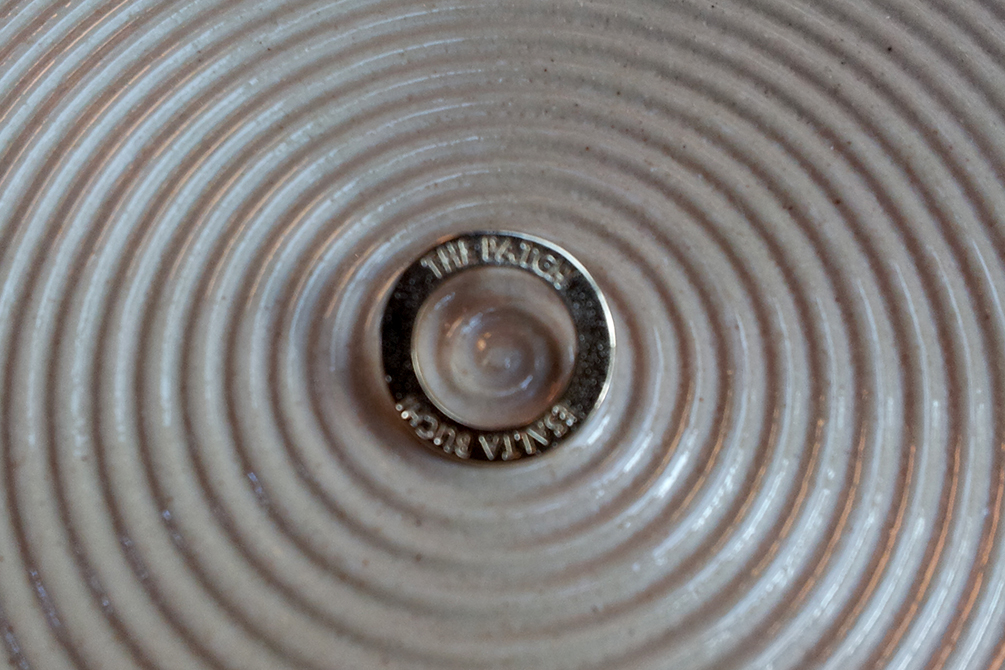
One day over an aperitif, Nani displayed a small circular gold accessory, a gem that he had patented known as Esaltabuchi, THE PATCH. Nani told his tale, the mystery behind THE PATCH:

‘As a child, among other things, I was taught firstly that you should never throw a thing away… until it is totally ‘worn out,’ because there are poor people who do not even have the essentials!  Secondly, darning … mending … remedies and … “patching”, in every sense, are worse than tears and holes!  Thirdly, you must always know how to turn a failure into a success, a negative into a positive!

Well, one July I was given a very expensive cashmere golf sweater. (I would not have ever bought it!) In September, I found that it had a nice moth hole right at the front … So … 2 + 2 = 4! … Or not!

“IT IS MUCH BETTER TO EMPHASISE THAN TO THROW AWAY OR REPAIR! …”

THE PATCH (Esaltabuchi) is the phoenix that rose from the ashes of that hole. It is the wholly elegant solution to a holey inelegant problem. THE PATCH is the renaissance in jewellery that converts a hole into the whole. THE PATCH reflects Nani’s philosophy on elegance and true Italian Style. Esaltabuchi is the ultimate representation of sustainability.

THE PATCH brings life back to your favourite jacket or sweater. It has a soul. THE PATCH without a hole is like an oyster without a pearl. Only through the defect can we see the treasure of the jewel that is Esaltabuchi.

THE PATCH inspires poets and lyricists:

No longer will the hobnob sneer

 At little holes in your top gear

 Amazed they spy your wondrous PATCH

 While ladies vie to be your catch

 And on you sail without a fear

Esaltabuchi, THE PATCH, comes in a special case with a story of its genesis.


powered by social2s
Reincarnation of a Venetian Briccole

How did architect, Maurizio Signorini, fall in love with a briccole? It all starts with the way he looks upon a tree. His eyes are awakened by the colours of the leaves, branches and trunk. He does not see a tree as a simple body of green and brown hues, but as a 4 dimensional creature rooted to the earth, and with every glance he sees a new vista.

The oak tree is native to the Veneto forests. It is a favourite, not just of Maurizio, but also for the Venetian waterways because of its straight trunk and strength. In Veneto, the pylons for the canals are cut from the tree trunks and driven into the sea bed to become ‘Briccole’, canal markers and pier timbers.

Over the years, the water slowly erodes the timber at the boundary between the water and the air. This erosion ‘eats out’ the ‘soft’ cells in the Briccole leaving channels and ‘worm holes’ in the surface of the pylon.

After about 15 years, the Briccole has eroded at the waterline to the point where its strength is lost. Maurizio selects and buys his timbers. The years in the water have aged and ‘dried’ the wood so the trunks that were underwater can be cleaned and cut for use as table legs and other furniture.

The eroded sections of the briccole are cut to create slats that expose the intricate network of holes from the forces of erosion. These slats become the boards of an elegant table on which the glass table top rests.

Overall this reincarnation of the Venetian canal Briccole leaves the fortunate diner dreaming while gazing at the slats with visions of the canals and the sound of the water lapping on the Briccole.


powered by social2s
Design and Craftsmanship: a winning pair for Made in Lava

At a display of the best artisans in Turin we met two young experts who had started a new business - Made in Lava - in the footsteps of an ancient tradition of stonecutting. Luca Scarantino and Sabrina Zibellini are a couple in both life and work and their story takes place in a village on the shores of Lake Vico, north of Rome.  

The territory of Lazio is characterized by its volcanic nature on a vast scale that includes several lakes including Bolsena, which is probably the largest volcanic lake in Europe. That is why since ancient times, the Etruscans and the Romans made in lava from their Basalt and Peperino quarries in this area, some of which are still in operation and from which Luca and Sabrina source their stone. They chose the word Lava for their company as this represents all volcanic stone.

Luca is a ‘stonemason‘, and since 2003 he moved to this area because of its Peperino quarries. He wanted to become an architect, but during his studies in France, in a course of applied arts, in 1998, he learnt the art of “Stereotomy”, the techniques to cut stone - the forerunner of Made in Lava. At that moment he realized that the shaping of stone should be part of his life, and his attraction is renewed every time he is faced with a piece of volcanic rock or a block of marble.

Sabrina is originally from this area and after studying architecture; she decided to return to live here to make her profession in design.

What is ”MadeinLava”?

Luca explains that, since he met Sabrina, his laboratory has become more complete by adding design and innovation to what he was doing as a stonemason to create Made in Lava. Tradition is part of their story: the use of materials such as stone, wood and iron in architecture and design will always be part of man’s consciousness with nature.

Innovation is an interpretation of tradition: stone can put character into our environment by being used with a modern design, in a refined manner, simple and original, to revive the use of natural materials.

How do you relate to the environment?

‘The environment in which we live from birth welcomes us like a mother embraces her son, we are a part of the environment itself. Those who forget this can create irreparable damage for future generations.

We try to use local raw materials, and to create the least impact on the environment as possible in the choice of treatment for the wood, and we make an analysis of the energy balance for each of our products.’

Your company is composed of a stonemason and architect. What does it mean to live and work together?

‘It is madness! And for this reason we like it. The pragmatic nature and practicality of the artisan clashes with the theoretical and academic approach of the other, meeting and clashing constantly, reaching unexpected results.’


powered by social2s

Subscribe to Newsletter

Discover a territory through the emotions of the people that have lived it.