How a masterpiece is born - Living Jewellery

The Living Jewellery documentary tells the story of the first photovoltaic necklace that is based on the life force of nature - photosynthesis. It is an object of beauty and leading edge of energy technology; but even more it is a dream and a challenge from a group of small businesses that wanted to impress the world and enter new markets.

The history of the necklace, Living Jewellery, is the epitome of how, by looking at the world differently, even small companies may be able to emerge and assert themselves internationally.

Three years ago we wrote the Manifesto of Energitismo urging companies to return to work with artists and artisans to create a new Renaissance. We started from the philosophy of collaboration between art and technology to create elegant and sustainable objects. Then our engineers’ minds prevailed and we went to work to put into practice what we envisaged.

Not having yet attracted a portfolio of enterprises ready to take the leap, we decided to ”take action” by going from one enterprise to another presenting the idea of creating a range of the best of the best in sustainable technology products that we could show to the public in a founding event with artists and artisans. But we needed a symbol. We took our cue from a phrase of the manifesto in which it is said that technology had become “jewels for our homes”, so we decided to create a real gem, an item of Living Jewellery.

We went with our poster and business cards to the Gold Fair of Vicenza and sought enterprises that would accept the challenge to create a real gem with mature leading edge Swiss and Australian technology, surprisingly not yet industrialized.

Many laughed or smiled, but D’Orica, an enterprise from Nove responded in the affirmative. The story of Daniela and Gianpietro Zonta is emblematic of the history of thousands of other Italian family-run businesses where the owners have put their heart and passion into what they do. This ‘atmosphere’ is perceived by their employees who share the risks and rewards and are happy to work and to follow the founders in the challenges they attempt.

Daniela and Gianpietro had just built the home of their dreams according to the KlimaHouse classification. Previously they had created their factory as a gem of energy efficiency (they also have a photovoltaic system on the roof) and were ready to compete again.

All of their employees were involved and helped to create this masterpiece of art and technology, LivingJewellery: the picture, reflected in the smiles of the people, evidences the joy of having accepted the challenge and having participated in the creation of something unique.

Energitismo exports this optimism to other companies and to other artists and in our Journal we tell the stories of the web of other great craftsmen who are worth exalting but are still unknown except in their local area. We are ready!

Thanks to all those who dream and thanks to those who still want to put into practice the dreams that small companies can amaze the world.
 

powered by social2s
Traditional Iconography in the modern world

Art has a continuing challenge to express feeling in different ways as communication media and technology evolves,and traditonal iconography is an artform that shares this challenge.

Before the invention of photography, paintings were very close to reality and were the way to record what was going on in other places. With the onset of photos, the need to be close to reality vanished and the artist could start to focus on emotions, colors, feelings. Impressionism and expressionism are just ‘sons’ of technology evolution.

Some art forms such as traditional iconography are different and the technology evolution is less important as they were already at a different level of communication.

Museums such as Palazzo Pitti in Florence are filled with paintings of 1200 or 1300, and people are attracted by them and captured by their beauty. Those paintings have a lot of in common with traditional iconography and they can help us to enter into a relationship with this art which is still so important for millions of people.

What is traditional iconography? Iconography is the art of reproduction with devotion of the great icons that originally were designed in Byzantium and became an art form in Russia about 10 centuries ago.

At a first sight, icons are already an abstract art. They describe angels and god and other religious subject that few people can understand deeply. Nevertheless, traditional iconography communicates great meaning to those who have studied the images in religion or to those who have been introduced to the symbols that they incorporate.

The Tondello sisters create traditional icon paintings of exquisite form. But to really understand these fine icons, it is necessary to connect with the Tondello sisters in their environment. The value of such an icon is much higher when the true meanings of the structure, shapes, detailed design, and colours integrated with it.

The Tondello sisters have broadened their creations from the traditional orthodox church designs to those of the Catholic church, including saints not commonly revered in the Orthodox church in its traditional iconography. As your eyes wander around the studio and the home gallery, one or more particular images will arrest you.

We have been lucky because master Anna Maria Tondello introduced us to the deeper meanings of iconography and the hours we have spent with her in her studio viewing the different icons allowed us to directly experience her inner peace, passion and harmony.

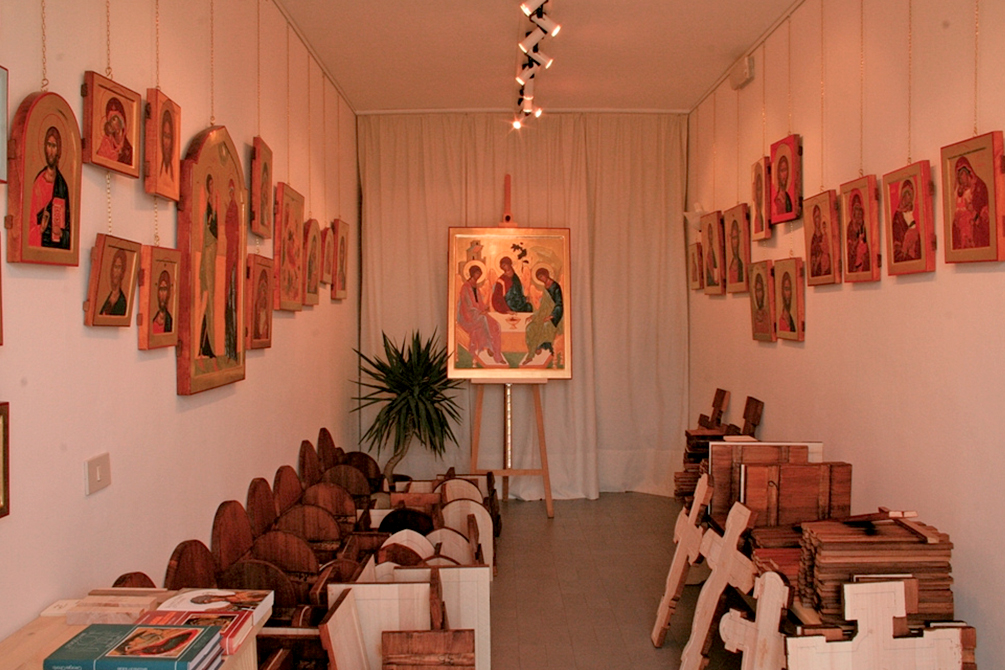
The Tondello sisters have a close bond wherein Mariangela tends the timber, creates the surface, deposits the gold and shines it with agate to achieve radiance. Anna Maria then creates the painted figures and scenes. Each work may require several months to create as each of the many steps needs a specific time to elapse to ensure the highest quality.

The workshop is filled with works at every stage of creation from timber base planes to works receiving their final glaze. For those seeking a unique reproduction for a special event, plan to visit Anna Maria Tondello several months before the event.

powered by social2s
Unknown and forgotten architects - a smile by Giovanni Michelucci

Giovanni Michelucci: the Architect of Happiness

In our first meeting in 1986, when I asked what it was to be an architect, he replied that all we want to hear is: “The architect must work for the happiness of mankind. I will build the church there, but first I have to be with you, see your homes, to understand your land.” So said Giovanni Michelucci, architect from Fiesole to the committee that wanted to commission the design of the church of the new district of Arzignano in the province of Vicenza. This statement, which has remained famous, contains the whole substance of this great man.

Giovanni Michelucci was an architect who has passed through our history for nearly a century. He did not want to be an architect, but in the architecture of churches he was the greatest interpreter of contemporary religious spirit.

His most famous church is certainly the one on the crossroads of the Autostrada del Sole between Florence and Rome, which is viewed by thousands of travellers each year. Hence the idea of the nomads of the desert, so the people of God in the eternal path leading to the design of “some poles with a tent over it.” A temporary shelter.

Was he a man behind the times or one ahead of his time? A man of suffering, he was permeated by the tension of the daily pursuit of a faith that he never accepted with certainty or believe its mysteries. And his design highlights this “nervousness”.

The outcomes are “chaotic filament designs that allow one to see, one within the other, more solutions to the same problem”. The design is not created at the table, but little by little from observation of the things and places, from being among people, from habits and stories heard, from understanding the real needs of men. His architecture is conceived and designed around people, not for the individual but for the community.

His designs were “non-design” meaning that there was no immediate precision and detail. In his search to be ahead of the time, often Michelucci was not understood at once, as in the church of Longarone, a town destroyed by the Vajont dam in northern Italy in the ’60s. The citizens were expecting a faithful reconstruction and a new identity with the tragedy that had struck them.

Instead Michelucci had internalized the pain; he made an elliptical amphitheatre, a new form to help rebuild a sense of the community. The great tragedy that had at the same time destroyed the wonderful natural beauty gave him the idea of a church that could represent life and death.

“Then I began to be born into an idea that would lead to the exaltation of life: the Theatre! I thought of a church designed as a theatre.” 

powered by social2s
A sea of Elegance - Coral Jewellery

We have just toured a very special museum, for entry by invitation, a museum of coral jewellery and artifacts created since 1805, and especially since 1855 when the house of Ascione was created in Torre del Greco. It is still there, one of the proud companies in Italy that have survived the trials of military and economic war through the creation of beauty.

We sit on leather topped square stools at a glass table on the second level of the Galleria Umberto 1st in Napoli. Directly in front, across the road, you read ‘REAL TEATRO’ and then below it ‘DI S. CARLO’ – one of the great Opera theatres of the world from the time of the Bourbon Kings, San Carlo has stood since 1737.

Ascione jewellery is today as it was then nearly 160 years ago, beautifully fashioned deep water coral. Originally, from about 1400, the coral from the waters near Sardinia, Sicily and North Africa, was harvested by men from Torre del Greco, on the road from Napoli to Sorrento. In the renaissance, the coral was shipped from Torre del Greco to Marseilles, Livorno and Genoa where jewellers fashioned the ‘antlers’ of the coral. In 1805, an entrepreneurial Frenchman gained a royal decree to allow him to exclusively produce the coral jewellery in Torre del Greco.

As the years passed, the Italian craftsmen and women developed their own skill base and established jewellery manufacturing studios also importing carving skills from Rome and goldsmithing from Florence. The oldest factory in the town is that of the Ascione family, not just manufacturers and purveyors of beauty from coral, but also proud historians of the art and craft.

The coral represents the ideal that only God can create perfection. Tiny spots and changes of colour denote the authenticity. Different to shallow water coral, these ‘antlers’ retain their color, reds, pinks and whites, over the years. Seeing pieces nearly 200 years old still radiant, gives the assurance that these masters of coral produce ornaments to see the centuries. In the window of the museum, you find black material that is actually not coral but is a black underwater ‘bush’ growing among the coral.

The museum shows a painting of Napoleon’s sister adorned in coral jewellery, as well as marvelous coral carvings. The wedding dress and coral jewels of the grandmother of the current family are proudly displayed, the lace as resplendent as the coral. The living colour of the coral brings back to life the years gone by and entraps you in a desire to share a piece of the living history.

powered by social2s
Ceramic Expressionist - bold ceramic art

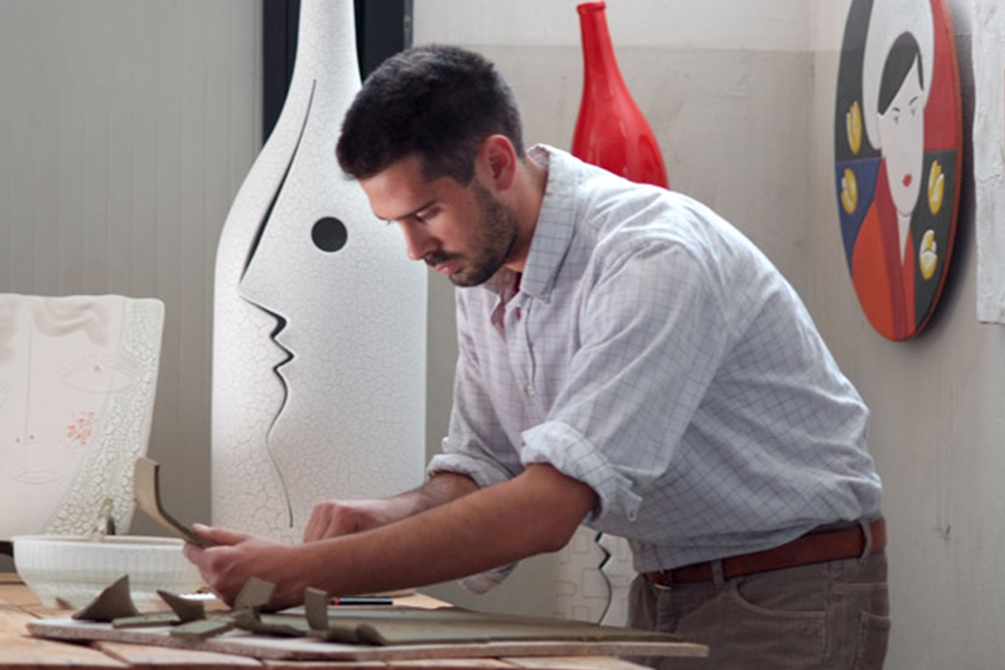
Giuseppe Facchinello is a ceramic expressionist artist. The story of an artist is so often foretold in the early years when the order and discipline of schooling leaves the nascent artist bored and under-performing and uninterested.  

Even when following a technical direction in secondary school in distant Bassano, Giuseppe Facchinello showed little verve until a visit to the Van Gogh museum awakened his interest. A long haired young man returned and, in an inverse analogy to Samson, gained his psychic strength when he asked his brother to cut off his locks.

Illness then stopped him from pursuing his studies at the Academy of Art in Venice, but through being there he learned more from visits to famous museums such as Guggenheim. About this time he understood that the value of school had been to put all the foods of life onto his plate for selection. As well as from Van Gogh, Giuseppe absorbed the colours and images of Matisse.

However, for an artist of colour with ceramic forms, there are two additional challenges of creation. The first is the three dimensional nature of the clay body that allows the artist to create features in the raw ceramic body before firing the clay. These features then remain as a skeleton on which the coloured images can be created. The second challenge is to see in the raw colours the brilliant hues or fresh colours of the fired glaze.

The as-painted work appears dull and lifeless compared to what he sees in his mind will emerge from the kiln. For the artist to be able to meet these challenges Giuseppe must wait till his hand is free; he has had to learn to be ‘empty’, to meditate maybe for an hour until his hand is ready to work with inspiration for just 40 seconds. What we then see in his works are the outcomes, but not the inner thought of the artist

Today, his unique personal style can be defined as Expressionism in Ceramics. Giuseppe knows that while his art today has great merit and he has gone through the gate to the field of true art, his apprenticeship is a life-long adventure.

powered by social2s
Sculpting a new heartbeat: Toni Venzo creates the second life for trees

The story and travels of a work of art are many. They may be found in museums or travelling exhibitions, be purchased by collectors or gifted to the fortunate few. But the story of the 4 recent woodcarvings of Toni Venzo, from Pove del Grappa, is unique.

This story starts a few years ago when a lady was forced to cut down a large cedar that she was very fond to have in her garden. She didn’t want to separate her family from the tree, so she ask Toni Venzo to imagined how to create four sculptures for her and her children, who now live in their own homes.

Many of us are tied to a particular tree that brings one back to childhood, or recall a garden where the first stirrings of life were experienced. A tree is alive, to watch, touch and smell it gives us emotions, the tree breathes and relates to us. Life reveals to us many changes. Eventually we leave the parental home, we may even change country, and we move far away from places where we had our roots. The tree, however, has roots that cannot be moved, especially if the tree that has grown with us is now very large.

Nevertheless, you can re-live your roots, you can bring a piece of the tree into your lives: it may be as a branch or a piece of her trunk. You can give the tree a rebirth, in the form of a sculpture.

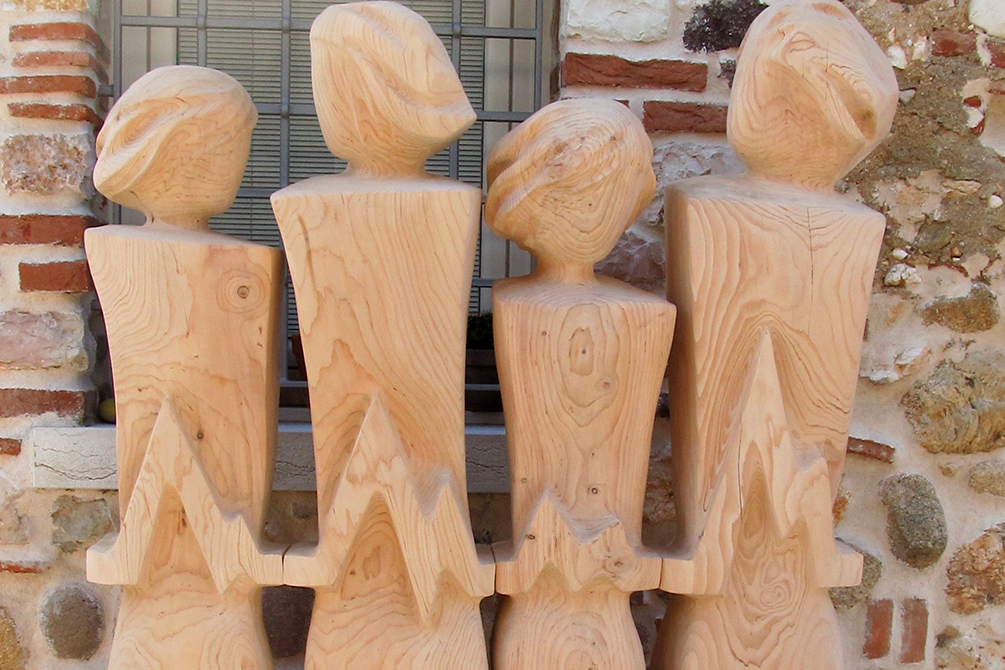
And this is what happened to the cedar. This lady came to Toni Venzo and spoke of her love for the tree and for her children. Toni dreamt and formed a project where he has created for her a unique set of human sculptures: there are 4 that can be interconnected to become one, and when separated are still related. These four human figures have, carved into their torsos, a signal of a heartbeat. In this case the signal of the heart is transformed into a cardiogram and the statues have a common life. Together they have a greater force, but even when kept separate the heartbeat forever creates bonds between them.

The sensitivity of the sculptor does not stop with the form. Toni decided not to treat the wood and leave it without polish so that all family members can enjoy the same scent even at a distance. If he were to lacquer or polish the sculptures, even with natural elements, it would limit the expressive power of its smell and, therefore, take away one key feature that makes it different from all the other wood carvings. Toni Venzo feels the life in the wood and knows that it continues to move and give off its perfume for many years.

We will continue to follow these sculptures of Toni Venzo in their travels to the homes of the several family members and seek out their responsive emotions.


powered by social2s
Great artisans hidden in the south - a touch of Puglia artists in the heart

We find the best of Puglia artists in Piemonte.The fairs of Artò and Artissimma in Torino, Italy in early November each year attract visitors not just from Piemonte but also many regional and international visitors.  

The quality of the arts and works are known to excite the visual sense and challenge the artistic mind. Energitismo sought out the exhibitions with our desire to find new top calibre artists and artisans to join Our Collections and Our Discoveries. In 2013, at Artò, there was an exhibition from Puglia artists that attracted much attention, not the least from Energitismo.

Torino may seem an unusual place to find those who treasure the white sands and warmth of Puglia, but in Torino Pugliesi and lovers of Puglia have found at least two reasons to seek out the Piemontese. The first, and most well known, is Slow Food, a culture for which the south is renowned. There the creation of a culinary masterpiece draws on the memories of the sands of time, fresh fruits from the sea and the simple natural herbs plus spices from the east. It is not subject of undue haste in the creation or the consumption, truly slow food and the Pugliesi relish in displaying their art in the kitchen.

The second, and less remembered presentation of excellence from Puglia was found this year at Arto - Puglia artists. Let us review just two of the outstanding people we met and attempt to evidence the wonder of their works.

The first of the works of the Puglia artists was a display of the traditional ceramics from Grottaglie. All visitors were attracted by a civil engineer, Antonio Vestita, who now proudly calls himself a ceramic engineer, as is the teller of this story. Antonio creates sculptures based on intricate mosaic ceramics that he builds ever so patiently in his laboratory. He uses coloured glazes with great care replicating and creating the historical designs of the past. Each work is an individual creation. His ceramic works, that belong in the galleries and museums, are integrated with three dimensional structures to create reflection and refraction of the colours.

Alongside Antonio Vestita, one found with joy Antonio Dattis, patiently carving the neck of a reproduction ancient lute. Behind and surrounding him were the great works of musical instrument creation, replicas in art and tone of the most intricate works of string instruments of the past 500 years. Antonio’s works are not a fluke; he undertakes extensive research to find the original drawings and instructions for the instruments. He seeks out instruments to photograph and paintings that show the instruments. His works may be found in some of the great museums and collections. Seek and you shall find – a true Collection piece - a great member of the Puglia artists.

powered by social2s
Sculptor of souls of the trees

Some men stand at the bottom of a cliff and have an undeniable urge to become part of the mountain, to scale the cliff and know the mountain. Other men stand among tall timbers and talk to the trees, finding their peace in the soft murmuring of the leaves, in the breath of each tree, in the community of the forest, in the strength of the trunks, and in the selfless protection the forest gives to other life, man, beast, bird or insect. A man can become a sculptor of souls of the trees.

Toni Venzo is such a man. Brought up in the foothills above Campese near Bassano del Grappa by a father who loved the forest and its timber, it was inevitable that the soul of the trees would infect his being. Toni’s father still roams the cherry woods sating his soul in the aroma, sounds, sight and touch of his trees.

Toni became a sculptor of souls of the trees, firstly with the cherry and later with many other grand trees. How does a man grow to become a sculptor if not through love of the medium with which he works. Standing in a forest, the woodsman feels the different breath and nature of each tree. He knows that his purpose is to give perpetual greatness to each tree he touches. Woodcarving with feeling.

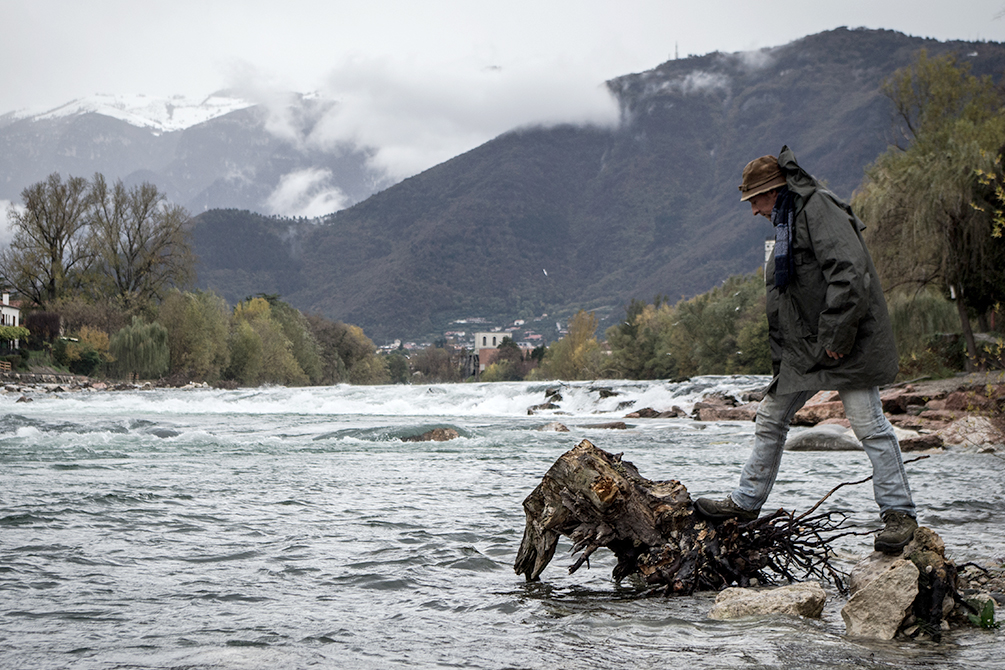
His first touch as a sculptor of souls of the trees is to create tragedy, to fell his friend with respect and admiration for the long life that has seen many wars and not enough peace. He then enfolds the tree trunk in his arms, keeping it cool and away from the radiant sun, letting it sleep for years as it slowly prepares itself for rebirth.

The sculptor visits the tree often and finally senses when it is ready to be transformed into a sculpted body. He may sit with the trunk for hours, breathing in the unique subtle aromas of the wood, letting the trunk give up its dreams for greatness to his welcoming being. It is now that he can sense the figure rising out of the trunk. It is time to gather his tools, take his friend to the studio – and sculpt. He roughs out the figure casting off chips of aromatic wood.

With each cut, the life gradually returns to the wood and reveals to the sculptor more of the soul of the tree, until, together, the statue and the man are formed in an immortal work of art of the sculptor of souls of the trees.

powered by social2s

Subscribe to Newsletter

Discover a territory through the emotions of the people that have lived it.