Churches & Places of Worship

Alatri. Church of St. Stephen

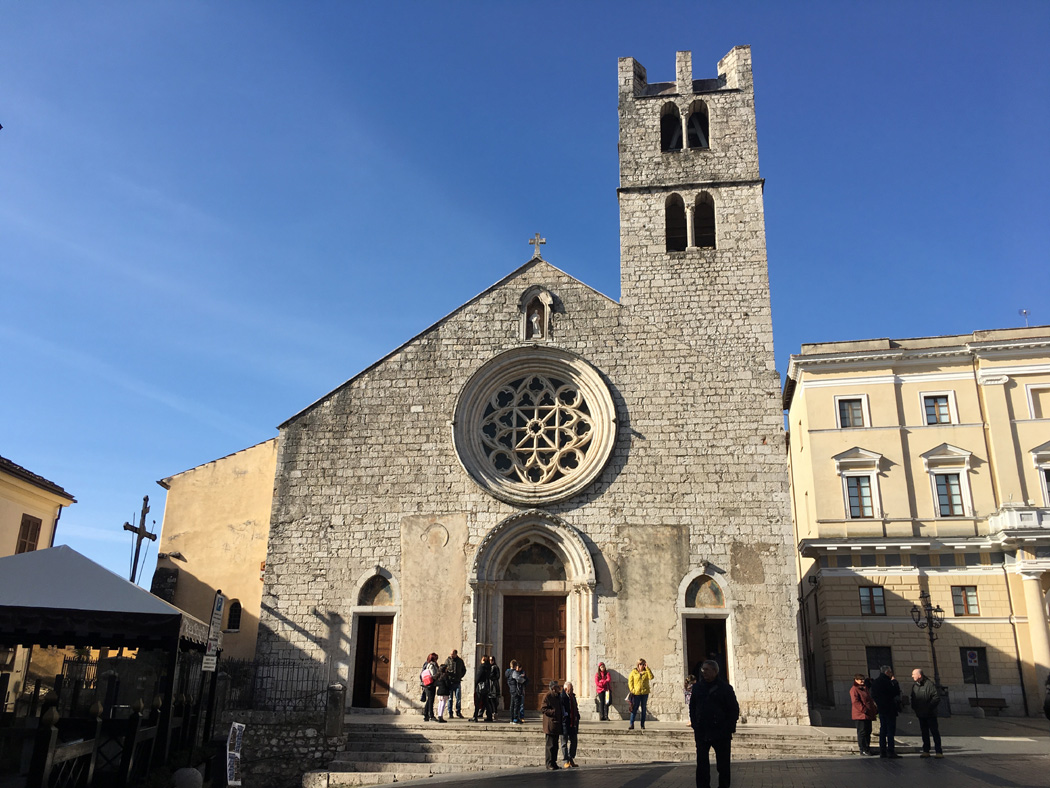
The St. Stephen's Church of Alatri dates from the late tenth century and is in the Romanesque style of the era.

It was modified and enlarged during the period of the commons, in 1284, by Cardinal Gottifredo of Raynaldo according to the Italian Gothic style.

The date and the name of Cardinal are carved in Gothic letters on two sheets on the doorposts of the portal and the Cardinal had played a major role during the crisis between the papacy and the German Empire.

The writing follows the style of Leonini verses, a poem with rhymes in use during the Middle Ages and were invented by a man named Monk Leo.

In the sixteenth century the church was changed again when its left aisle was closed to build the Annunciation Benedictine monastery, strongly supported and designed by Bishop Ignazio Danti in 1586.

The convent is still very active and was visited by Pope John Paul II in 1984.

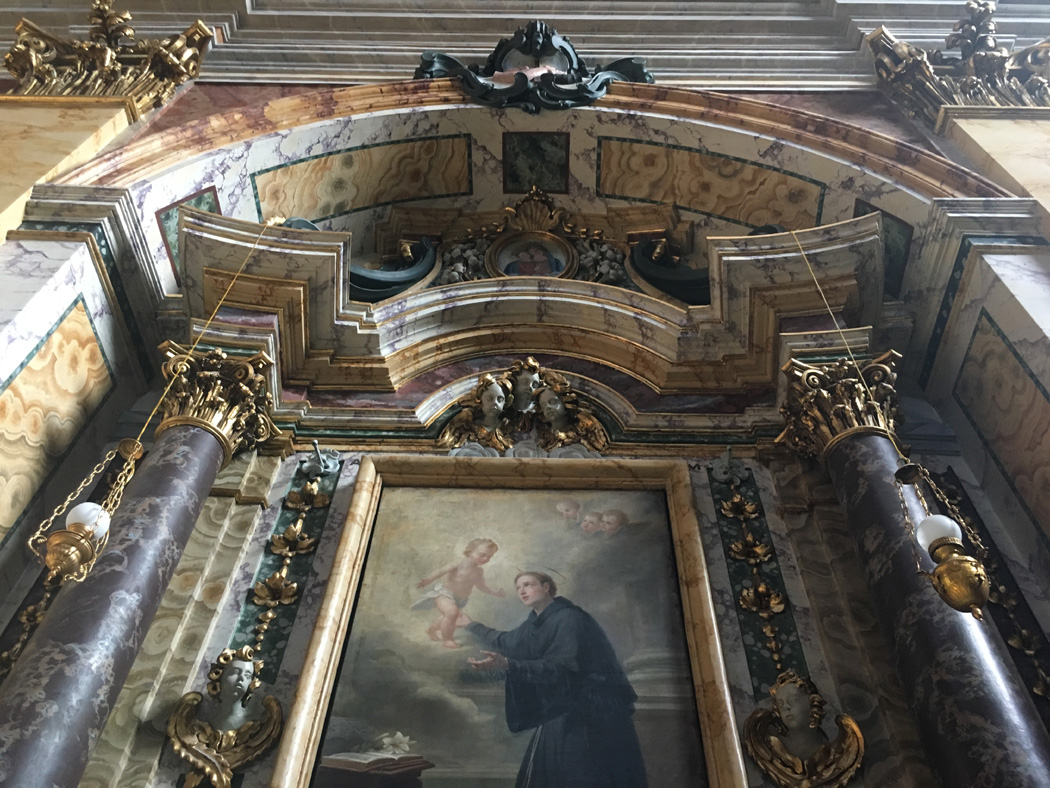
In the following centuries the church has undergone some more changes and the interior today is of late Baroque style.

Inside you will find a seventeenth century altarpiece with Saints Stephen, Benedict and Scholastica altar, and on the left wall a painting of the Calling of Matthew (La vocazione di Matteo) painted in 1739 by Filippo Palazzetti.

Of the original medieval building remains only the trefoil door, but it was moved from its original location, and a Crosier lion.

On the bell tower is a bell named by St. Benedict which dates back to the sixth century.

According to tradition, this bell was donated in 528 to the early cenobite (protocenobio) monastery of San Sebastian personally by the Saint of Norcia during a visit to Alatri.
 

powered by social2s
Alatri. Church of St. Francis

The St. Francis Church of Alatri was built in the second half of the XIII century in Gothic style.

The facade has a portal with pointed arches and a rose window with radial columns. T

he building and the attached convent were made by a community of Franciscan monks.

The convent is now an exhibition hall and in the gap between the walls was found an interesting fresco depicting a Christ Pantocrator (Christ in Majesty) at the center of a maze.

The church has one nave and the interior is in the Baroque style.

It houses a famous 'Descent from the Cross' of the seventeenth century Neapolitan school, some more seventeenth-century paintings and a cape dating back to the thirteenth century, which according to tradition is the cloak of St. Francis that the saint gave during his stay in Alatri 1222.
 

powered by social2s
Alatri. Collegiate Church of Santa Maria Maggiore

The collegiate church of Santa Maria Maggiore dates from the fifth century and was built on the foundations of a pagan temple dedicated to Venus in Alatri.

The renovations in 1200 give it the current appearance of the French Gothic with a large rose window built in the early fourteenth century by French workers.

The special feature of this rose is to have an internal part of square form reminiscent of a Church of Lausanne in Switzerland.

The interior of the church is in the Romanesque style and there are some important works of art such as the Madonna of Constantinople, a polychrome wooden sculpture of the thirteenth century, the triptych of the Redeemer by Antonio da Alatri, to the Virgin and Child with St. Saviour (from first half XV century) and the baptismal font of the thirteenth century.

The bell tower was added in 1394, it was higher and ended with a pyramidal roof; it was lowered after the collapse caused by an earthquake.

powered by social2s
Alatri. Cathedral of St. Paul

The St. Paul's Cathedral is located right on top of the Acropolis, on the remains of an earlier temple dedicated to Saturn, the mythical founder of Alatri.

The buildings include the Church of St. Paul and the adjacent Bishopric whose earliest records date back to 930, the early medieval period. Both buildings have been extensively modified in 1700s and present the style of that work.

The facade of the cathedral is made of stone and brick and was built between 1790 and 1808 by Jacopo Subleyras together with the bell according to the model of the major Roman basilicas.

The church has a Latin cross plan with three naves and a raised transept with a cosmatesco pulpit from 1222.

Inside lie the relics of Pope St. Sixtus I, patron of the city, within an ancient lead urn on whose cover is engraved with the inscription: " HIC RECONDITUM EST CORPUS XYSTI PP. PRIMI ET MARTIRIS ".

In the right aisle is conserved the body of the martyr St. Alexander, donated in 1640 to the church of Alatri.

The church is also famous for the 'Miracle of the Host Incarnate', i.e. a host which the faithful believe has turned into flesh in the thirteenth century.

This miracle was recognized by the Catholic Church as a 'mandatum' of Pope Gregory IX to Bishop Giovanni V on 13 March 1228.

The miracle is depicted in frescoes along the side chapels of the church.

powered by social2s
Church of St. Peter the Apostle

St Peter the Apostle’s church in Carpineto Romano was initially built in 1610 at the expense of Cardinal Pietro Aldobrandini.

The structure, located in the square, consists of three parts constructed in different eras: the central part, the church with the convent, was wanted by Cardinal Aldobrandini early in the seventeenth century.

On the right, the chapel of St. Francis, is dated in 1855 and on the left is the hospital wanted by Pope Leo XIII, now a rest home named after Leo XIII.

The facade of St. Peter the Apostle, recovered with travertine marble in the 1950s, has a gable inscribed the apostle Peter.

The interior, with a nave and barrel vault, has a wooden altar with two large reliquary closets and an altarpiece by an unknown representative of the church.  

Laterally there are two chapels with wooden statues by Fra Stefano Piazza Armerina (1685): on the right the Seven Sorrows of Mary, and on the left a Christ crucified.

These statues in the seventeenth century were hidden by two paintings of the 1600s, now placed on the wall The stigmata of St. Francis, attributed to the French caravaggista Simon Vouet, and Immacolata attributed to Fra Diego from Tavello.

In the back of the church there is a marble statue of G. Dupre donated by the Third Franciscan Order to Leo XIII.

From the sacristy it leads to the beautiful cloister of the seventeenth century, with a large central cistern, Pietro Aldobrandini weapons and 28 lunettes (arched window openings) frescoed with the history of St. Francis by Francesco Serbucci Tivoli (1685).

From here you can admire the vegetable garden and the forest of old trees, once supported by the Franciscan religious family.

Each year in the cloister of the "Dinner of the Cardinal" takes place.


powered by social2s
Church of St. John
Church of St. John

The Church of St. John in Carpineto Romano was significantly reowrked under the pontificate of Pope Leo XIII,.

Of the ancient furniture only the two "olea sanctum" remain with the coat of arms of Cardinal Amato Conti, Lords of Carpineto in the fifteenth century.

The interior, a basilica with an apse, has three naves separated by arches.

In the rotunda there is a Madonna surrounded by bearer saints, by the artist Virgilio Monti.

It is reached by a steep flight of steps.

The portal with its bronze panels is by the sculptor Tommaso Ambrosetti from Anagni, and tells the Carmelite Order's religious history, that in the pastoral house for two decades an important female monastery of strict cloister dedicated to St. Anne was placed.

powered by social2s
Church of San Sebastian

The Church of St Sebastian was originated in the seventeenth century as a votive chapel dedicated to Saint Sebastian and then it was partially restored in 1902 by Pope Leo XIII in Carpineto Romano.

It has a chiselled stone facade and a small bell tower by architect Berucci.

It has a single space with a small vestry on the side.

It has a wooden vault and on the altar a nineteenth century Roman picture representing the Martyr Saint Sebastian.

powered by social2s
Church of St. Michael the Archangel

The Romanesque church of St Michael dates from the thirteenth century and is located near the Civic Tower, built in the same period, and known as the Aldobrandini.

Inside is a frescoed chapel with an altar and a copy the ‘Flagellation of St. Michael the Archangel’ by Guido Reni.
 

powered by social2s

Recommended

Subscribe to Newsletter

Discover a territory through the emotions of the people that have lived it.