Churches & Places of Worship

Viterbo. Church of San Pellegrino

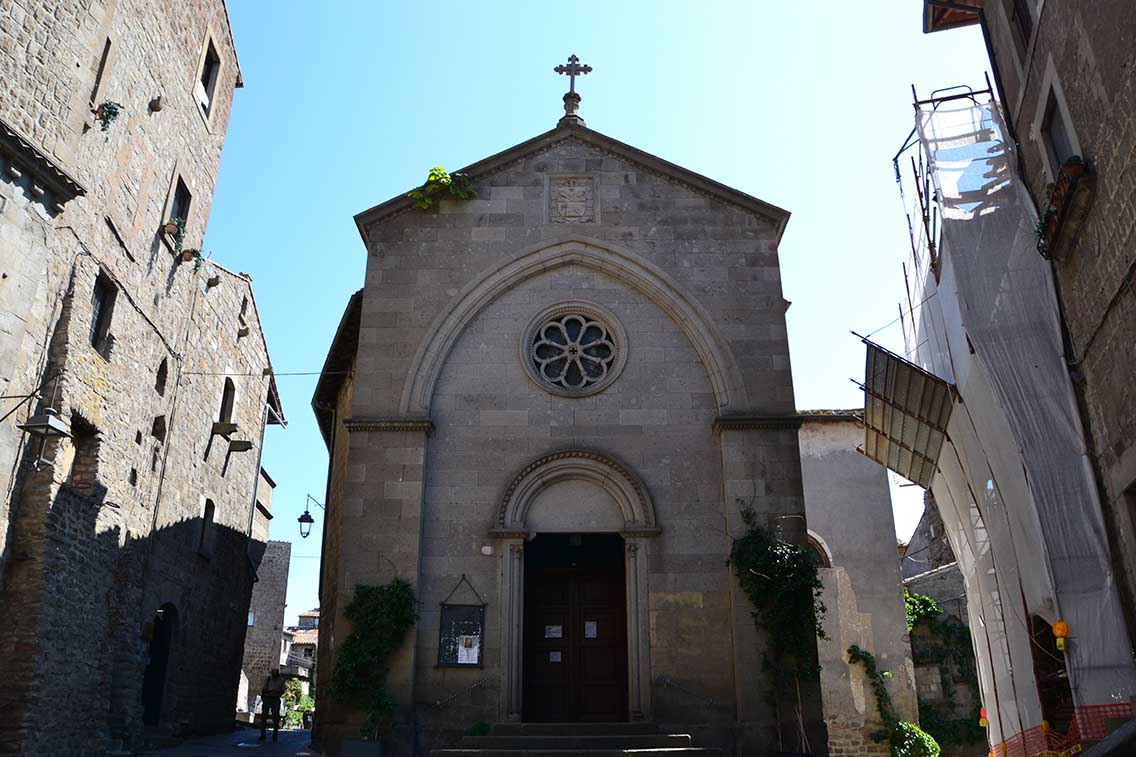
The church of San Pellegrino is located in the medieval Pellegrino district, the most characteristic and beautiful part of the city of Viterbo.

It is one of the first churches and is mentioned in a document of the Abbey of Farfa from 1045 which tells us that at that time it depended on the Abbey of San Martino al Cimino.

The church has lost its original Romanesque character having undergone many alterations.

In particular, in 1889 a new neo-gothic façade was created which clearly distinguishes itself from the style of the neighborhood but which characterizes it differently as a superposition of life experiences over the centuries.

The façade is in peperino stone and plaster and is characterized by a very large neo-gothic arch that encloses the main door and the central rose window.

You can enter the church through some steps thereby entering a unique environment with frescoes such as an Annunciation of the XV and others of the XVIII century.

The last restoration of the church took place after the bombings of the Second World War.

powered by social2s

The church of Sant' Andrea Apostolo (St Andrew Apostle) is located in the medieval district of Pianoscarano in Viterbo.

It dates back to 1148 when the municipality received land from the Abbey of Farfa to enlarge the city and build a church.

Over the centuries the church has had changes such as those following the collapse of the crypt in 1564.

From what appears it seems that the crypt was adder to the church later to turn it into a cemetery.

In fact its appearance is late medieval Gothic, and this could be one of the reasons for the collapse.

Another important architectural intervention was in 1902 when an attempt was made to restore the ancient Romanesque aspect of the church.

The facade of the church appears to be covered by a massive masonry portico with three small entrance arches and is characterized by a bell tower with two bells.

The interior has a single nave in simple stone without frescoes and this situation highlights the light that penetrates through the openings such as those in the apses.

The altar area is raised, a sign of the presence of monks, and is accessed via a staircase that occupies the entire church.

Some portions of the original frescoes can be admired in the left wall with "San Lorenzo and Santo Stefano" and in the underlying crypt, these date back to 1270 and are attributed to Ranuccetto da Viterbo.

The last restoration of the church took place after the bombings of the Second World War.

powered by social2s

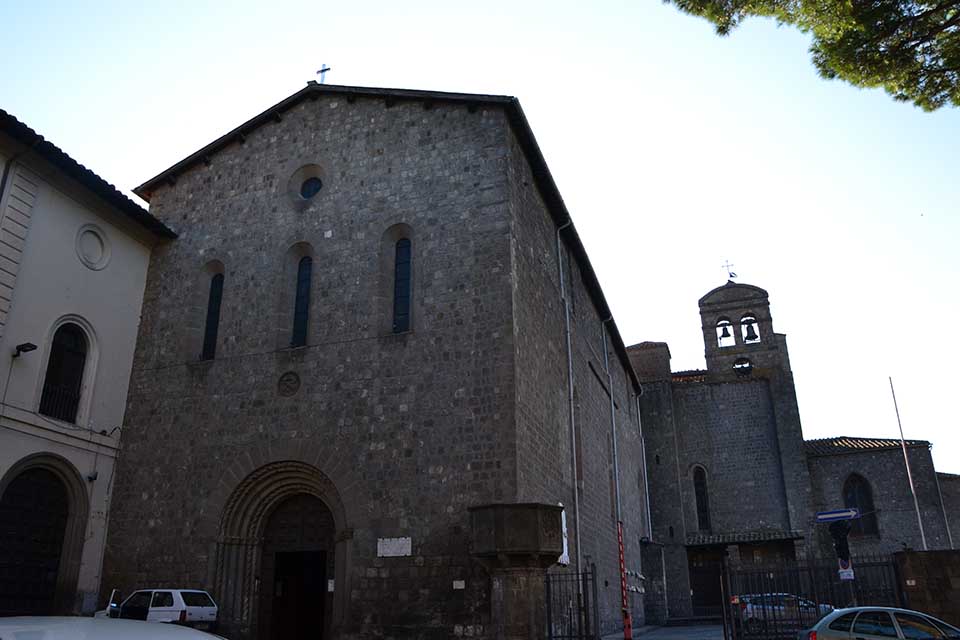
The Romanesque church of San Sisto is located just behind Porta Romana.

It was one of the first churches built in Viterbo, probably in the ninth century where the village of Vico Quinzano had formed.

Perhaps the church was built on an earlier pagan temple dedicated to the Fortune Goddess.

The fact that the church is the result of successive modifications immediately becomes evident by observing the internal difference in height between the altar area and the rest of the church which are separated by a large staircase and an arch.

Under the church there is a crypt and in general this also indicates a previous building.

Today in the crypt there is a monument in memory of the war dead.

The church was bombed for the first time by French soldiers in 1799 and a second time during World War II.

Later restorations brought it back to its original appearance, eliminating all the decorations and modifications made during the Renaissance and Baroque periods.

The church ends with an apse attached to the city walls and it has two bell towers.

One in Romanesque style is connected to the church but is no longer accessible and one with a clock has been made from a transformation of one of the towers of the walls.

On the right side of the church, a large organ was placed in 1964 and the central altar was made using a capital of a column.

powered by social2s
Viterbo. Church of Saint Peter

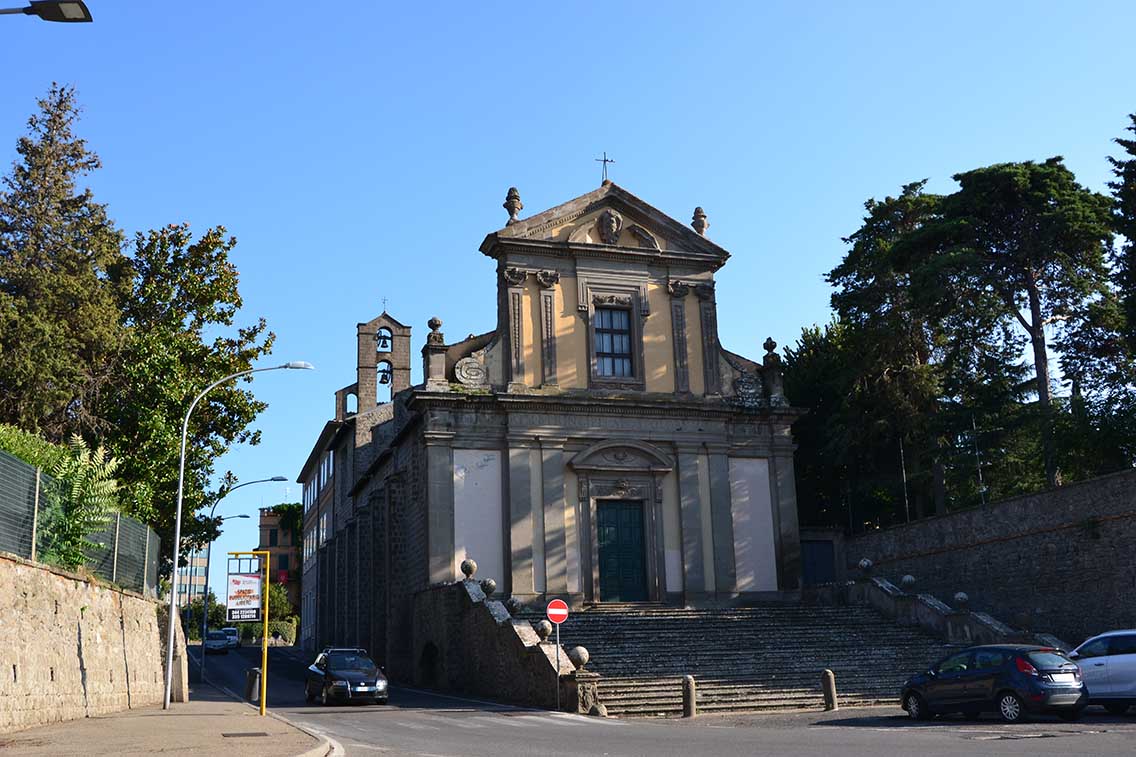
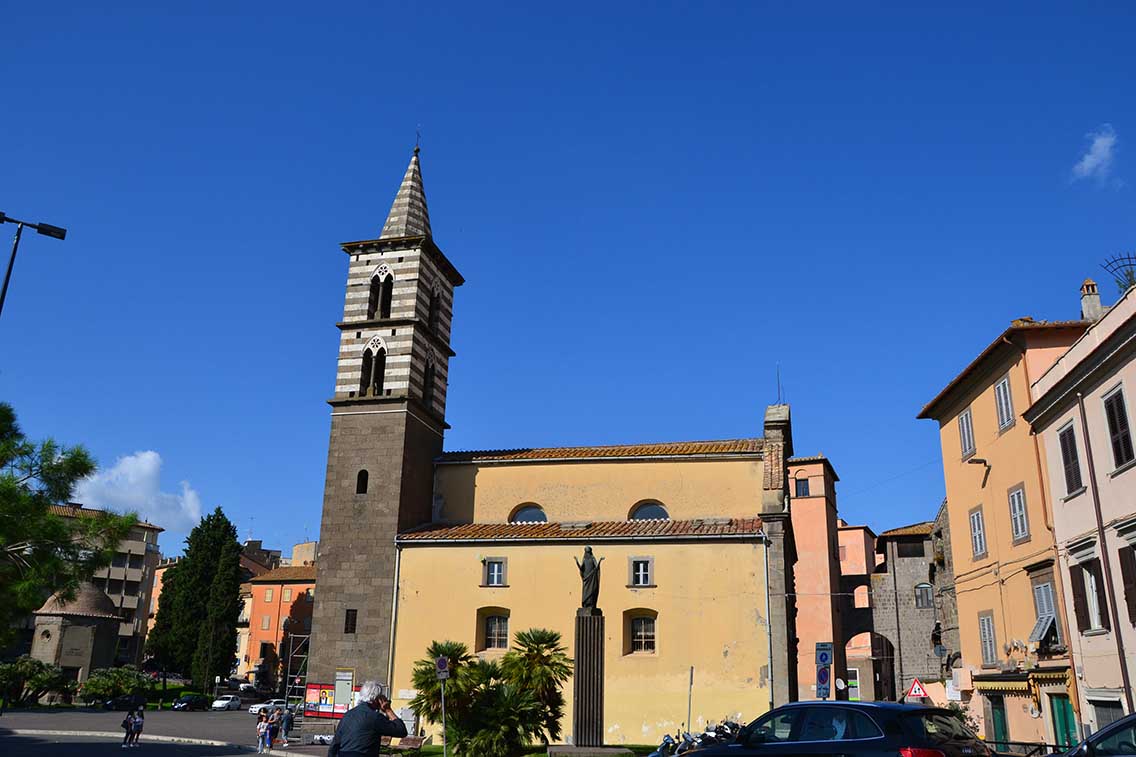
The church of Saint Peter dates back to the 13th century and is located at Porta San Pietro (Saint Peter's Door) a Viterbo.

Its current late Baroque style is the result of successive renovations of the 16th and 17th centuries.

The facade is separated in two architectural levels and enriched by a play of colours between white or yellow plaster and decorations in dark peperino.

The entrance is accessed through a wide staircase as wide as the facade of the church.

At the back there is a bell tower with two levels of bells that recalls the medieval origin.

Today the church is part of the St. Peter's Philosophical-Theological Institute affiliated to the Pontifical Athenaeum of St. Anselm of Rome where religious people come to study from all over the world.

powered by social2s
Viterbo. Church of Santa Maria della Peste - Memorial to the Fallen

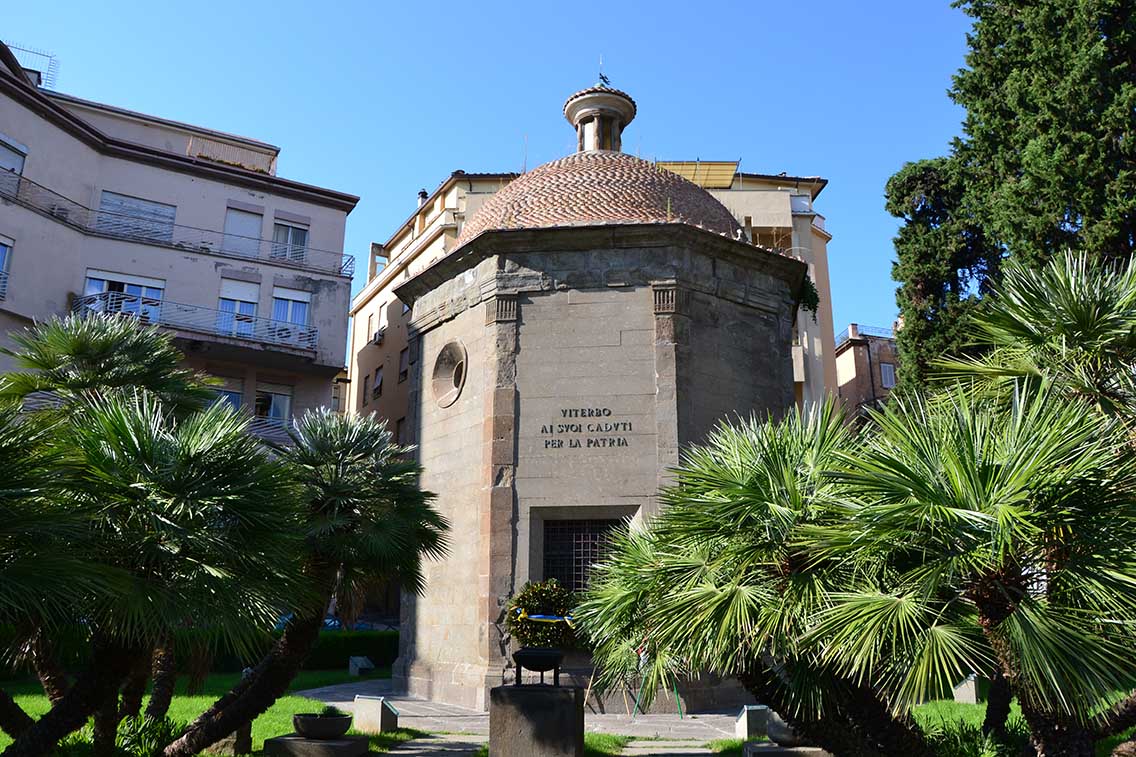
The small temple of Santa Maria della Peste was built in 1494 based on a promise made for the narrow escape from the terrible plague that had struck the Viterbo area in those years.

From an inscription on the glazed majolica floor we read that it was made by Paolo Mazzatosta (famous for a medieval palace in the historic centre) and a wheat farmer named Martino.

Legend has it that at this point a sacred image was found and that those who came to worship it were saved from the plague.

The building is an octagonal-shape little temple in an almost Renaissance style and ending with a dome with a small light opening.

The building on its various sides has an elegant entrance door in carved peperino stone and surmounted by a circular aperture and two openings.

In the 1930s, with the covering over of the Urcionio river and the consequent demolition of some houses, the small temple found itself in the middle of an open space and was chosen as a military shrine for the fallen of the First World War.

Inside you can admire frescoes representing Saint John and Saint Sebastian.
 

powered by social2s
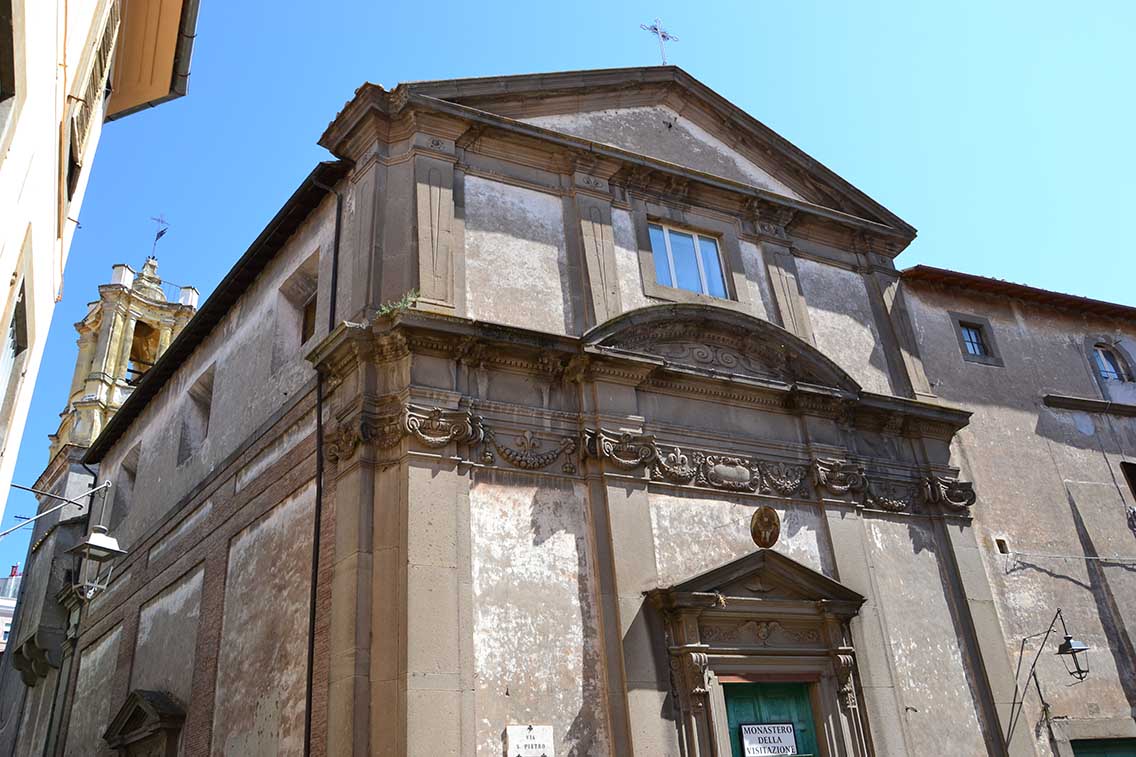
Viterbo. Church of San Bartolomeo and Monastery of the Visitation (known as the Duchess)

The first church of San Bartolomeo in Viterbo dates back to 1142 and housed the remembrances of Saint Lucia and Saint Eligius, who was the protector of the guild of silversmiths, goldsmiths and blacksmiths who gathered in a nearby house.

In 1557, the Duchess Girolama Orsini built a cloistered monastery to house the nuns of the order of Santa Chiara and inaugurated the Monastery of the Visitation.

To do this she bought a building adjacent to the church of San Bartolomeo.

But due to a problem with the religious order, the monastery was entrusted to the Cistercian nuns, who came from the convent of San Donato in Polverosa, and who still lead it.

In 1574 the church was entrusted to the nuns who closed the alley that separated the two buildings.

Finally in the early seventeenth century the medieval church was demolished to build a new one which is called ‘della duchessa’ in honour of Girolama Orsini Farnese.

The style therefore appears neoclassical enriched by floral decorations and a curvilinear element that separates the two sections of the facade.

On the entrance door there is the coat of arms of the Farnese family, the famous lilies, while on the entrance door there is a dove as a symbol of the holy spirit.

The church has a single nave with a rich coffered ceiling from 1672 made by Giovan Battista Magni of Modena.

Above the entrance there is a seventeenth-century choir with a nineteenth-century organ.

A baroque bell tower is placed at the back of the church and gives lightness to the whole complex.

The body of San Crescenziano, co-protector of Viterbo, is kept in the church.

After the Unification of Italy the monastery risked nationalization but the nuns succeeded in its redemption and the complex maintained its religious vocation.

powered by social2s
Viterbo. Church of Saint Francis alla Rocca

The church of Saint Francis alla Rocca and convent date back to 1237 when Pope Gregory X gave the Franciscans land on a hill in Viterbo with a small military garrison of Lombard origin.

St. Francis had died a few years ago and the papacy was intent on reuniting and reconciling the numerous orders of hermits who were being born, so supporting the development of the Franciscans seemed an excellent political move.

The church is also called the Pantheon of Viterbo because there are the monumental tombs of two popes, Clement IV with a sepulchre built by Pietro di Oderisio, and Adriano V, who died after just 39 days into his pontificate, with a sepulchre made by Arnolfo di Cambio.

Another important funerary monument is the one dedicated to Vicedomino de' Vicedomini who was elected pope but died before being proclaimed so a slab tells his story: "in one day he had both the throne of Peter and the sepulchral stone".

In the church there are also other tombs of cardinals who died during the conclaves that were held in Viterbo when it housed the papacy and the noblewoman Tornabuoni of Florence.

The façade of the church is in local stone of austere appearance with an entrance door inserted in an arch with friezes and three long and narrow openings.

On one side of the façade is a peperino pulpit from which they preached to those outside the church.

This was typical of other places of worship in Viterbo, that was built in 1426 for a visit of San Bernardino da Siena.

Among the other works to be admired is a table from 1572 that depicts the city of Viterbo with the Saints Antonio da Padova and Rosa da Viterbo and a large Gothic-style window in the shape of an ogive (Gothic arch) with a colorful mosaic window, made in 1951.

Like many religious buildings, the church underwent considerable modifications during the 17th century with Baroque additions that were later removed.

In fact the church and the convent were seriously damaged by the bombings of the second world war and in the phase of restoration it was chosen to restore the original medieval Romanesque aspect.

The convent connected to the church was nationalized in 1873 with the Unity of Italy and today houses a barracks that also incorporated the cloister of the convent. For the friars a small side building was built.

powered by social2s
Viterbo. Church of Saint John the Baptist (called Gonfalone)

The church of San Giovanni Battista (Saint John the Baptist) is one of the greatest masterpieces of the eighteenth century neo-Baroque in Viterbo for the pictorial cycle of the frescoes.

It is called ‘Gonfalone’ (Banner) from the name of the confraternity that keeps it and that welcomes visitors to discover the artworks and their history.

The brotherhood was born to free the Christian prisoners captured by the Turks and to guard the Gonfalone of the city.

In 1675 the Confraternity began the construction of this church to move its headquarters to a more prestigious place and made the exterior and the sinuous baroque facade of concave shape and characterized by an interesting play of colours between plaster and dark peperino stone.

Then the work stopped due to lack of funds.

Between the highs and the lows, in 1746 the architect Nicola Salvi intervened. He had already designed the Trevi Fountain in Rome.

A single internal space was thus created with four side altars and divided into an initial area and an oratory separated by a central altar.

The two spaces have been decorated and frescoed with different styles at different times.

The oratory was entrusted to two artists, Pietro Piazza of Parma origin and the emerging talented Giuseppe Rosi of Roman origin and the task was formalized in 1747. Pietro Piazza had worked on the Duomo of Perugia and on the Palazzo Reale in Turin and was the scenographer of the Tor di Nona Theatre in Rome.

For this reason, he was entrusted with the division of the spaces with the ceiling painting, the ornamentation and the geometric perspective while Giuseppe Rosi was entrusted with the figurative phase.

The Roman artist represented a valuable fresco of the birth of John the Baptist and his sermon. His last works were the monochromatic representations of the life of the saint.

In 1755 a competition was announced for the frescoes in the area of the church and three painters from Viterbo were chosen: Anton Angelo Falaschi, Vincenzo Stringelli and Domenico Corvi.The part relating to the construction of the frames and the geometric subdivision with ornaments was entrusted to Giuseppe Merzetti.

Vincenzo Stringelli was commissioned to supervise the works but something went wrong: in fact Marzetti was not sticking to the sketches and was creating on his own initiative. The dispute was resolved in favour of Stringelli but the painter did not seem to be a simple person and there was a new dispute.

The question this time directly concerned the Brotherhood, which challenged him that he had created fewer figures than the initial sketch (the painters were paid by the number of figures) and it was settled in favour of the artist and with an expenditure of 26 scudi and 95 bajocchi considered by the Brotherhood in its budgets as "completely capricious and superfluous expenses".

In any case, the final effect is that of a masterpiece and Mazzetti's perspectives and the figures of Stringelli, Falaschi and Corvi create an optical and artistic illusion that one never tires of observing.

In the church you can also admire the banner by Giovan Francesco Romanelli and painted on both sides. In fact, on the front is the baptism of Christ while on the back we can admire Mary Most Holy of redemption (called Madonna del Gonfalone) with Saint Bonaventura.

The banner is placed so that in the foreground we can admire the Baptism of Jesus from November 1 (all the Saints) until August 14, while the remaining days the Madonna appears as the main image.

Given the delicacy of the work, the Brotherhood then commissioned a copy of this work to carry in the procession.

powered by social2s

Recommended

Subscribe to Newsletter

Discover a territory through the emotions of the people that have lived it.