Churches & Places of Worship

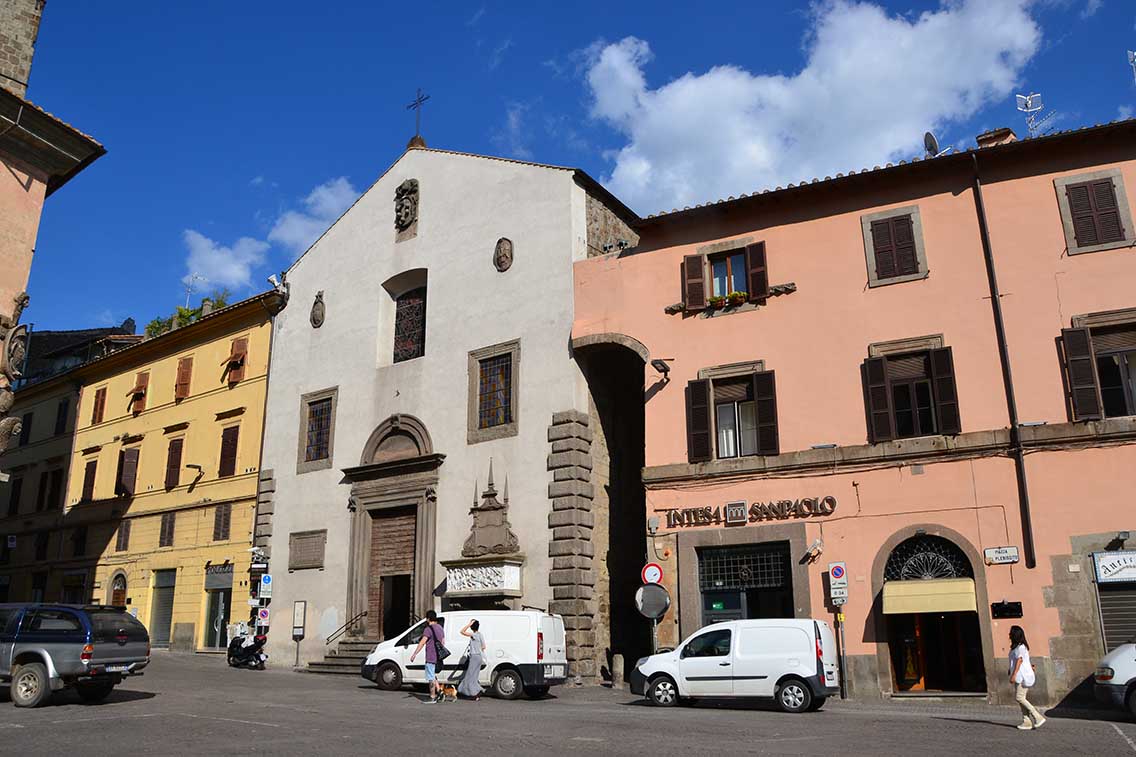
In the medieval heart of Viterbo there is the church of Saint John Evangelist which is immediately recognized by two large buttresses that connect the facade with the opposite building. They were probably built to stem a static problem in the building and unload its weight on neighboring buildings as well.

The church dates back to the 11th-12th century and owes its name Zoccoli to the ceramic cladding that once decorated the facade and which in the local language was called 'Ciocola'. Some of these majolica decorations can be seen in the large rose window that adorns the facade, if you have a telephoto lens.

In addition to the Romanesque rose window with its lateral sculptures of eagles, representing St. John the Evangelist, in the facade there is a door with an elegant frame with floral and geometric decoration and a lunette with a fresco of the saint.

The interior is simple and the church has three naves, which end with 3 apses divided by a series of columns made with overlapping elements, and a wooden hut roof.

Although the general style of the church appears Romanesque, this is partly desired with two restorations, one in 1880 and one after the bombings of the Second World War.

Among the works of art you can admire a Gothic style polyptych of 1441 made by Francesco d'Antonio Zacchi known as Balletta, a painter from Viterbo who represented a Virgin among the saints.

On one side St. Peter and St. John the Baptist and on the other St. John the Evangelist and St. Paul.

powered by social2s
Viterbo. Church of the Holy Trinity or Sanctuary of the Madonna Liberatrice

The first church of the Holy Trinity dates back to the 13th century and was built in Romanesque style by the Augustinian friars who dedicated it to the Trinity. 

The Order of the Augustinians was born in Tuscia at that time from the union of eremite communities and in 1244 under the influence of Pope Innocent IV it was officially recognised for the first time in Rome.

The church of the Trinity of Viterbo was consecrated in 1258 by Pope Alexander IV as reported in a plaque in the cloister.

Its second name of Sanctuary of the Madonna Liberatrice is due to a miraculous event that took place in 1320: it was May 28 when, in the suddenly dark sky, demons appeared in the form of crows, eagles and bats. 

The frightened population saw at a certain point the image of the Madonna appear, which had the appearance of that of a fresco that was found in the church of the Holy Trinity, and chased away the evil. 

The Madonna asked the citizens to pray to her in the church and since then she has been invoked by the Viterbesi, every time they feel threatened and from 1344 on Pentecost Monday there is a procession (today moved to the last Sunday in May).

The fresco of the Madonna and Child by the itinerant painters Gregorio and Donato d'Arezzo is protected by a shrine in a right side chapel.

The church was then destroyed by a fire and had its first reconstruction thanks to Pope Martino V Colonna in 1421. 

But the late Baroque-neoclassical style comes from the extensions of 1727 by the architect Giovan Battista Gazzale who also modified the orientation of the building.

The façade is made harmonious by a play of colours between the brick-red plaster and the decorations in gray peperino stone and is divided into two levels distinguished by columns in different style.

4 niches then exalt the figures of saints: the niches with Saint Augustine and Saint Thomas of Villanova in the lower part near the main door and the female ones of Saint Rita of Cascia and Santa Monica in the upper part. 

All the statues were made by Camillo and Vincenzo Pacetti, while at the centre of the church there is a balcony with the symbol of the Trinity in white travertine.

The interior appears in a late neoclassical style enriched with polychrome friezes and marbles with three naves and a cross plan.

It is surmounted by a dome frescoed with the scholars of the church among whom is Saint Augostine, illuminated by 8 recesses.

Among the other works of art we note the funeral monument to Cardinal Raimondo Perrault of 1505, a basin from the 1600s and paintings of the XVI, XVII and XVIII centuries.

But the true work of art is the Renaissance cloister of 1513 spread over two floors with a central fountain in peperino and enriched by 36 columns. 

On the lunettes of the inner walls of the cloister at the cross vaults and the openings of the cloister, it is possible to admire a pictorial cycle that tells the whole life of Saint Augustine. 

44 works created by the Roman painter Marzio Ganassini and by Giacomo Cordelli from Viterbo. 

The works were made thanks to a legacy of Giacomo Nisini, knight and nobleman, whose coat of arms is found in the cloister.

powered by social2s

The cathedral of San Lorenzo (Saint Lawrence) is located opposite the Palazzo dei Papi (Palace of the Popes) in the highest point of Viterbo.

Here there traces of an ancient Etruscan settlement, probably a temple dedicated to Hercules, were also found. The columns at the sides of the main portal are said to have come from this ancient temple.

In the 9th century, a first church was built, dedicated to San Lorenzo, which was later elevated to a cathedral by Pope Celestine III in 1193. The year before, the pope himself had declared Viterbo an episcopal see.

On April 5, 1268, precisely in this church Pope Clement IV excommunicated Conradin (Corradino of Swabia) and meetings of the conclave took place.

The nearby bell tower dates back to 1368 and is characterized by an upper part in stripes of peperino and travertine that create the characteristic play of colour of the Tuscan-Gothic style.

In this upper part the bell tower has 4 rows of finely worked marble mullioned windows and ends with an octagonal cuspid roof.

During the Renaissance, the church underwent considerable changes, such as a new façade commissioned by Cardinal de Gambara, whose name is carved into the string course, and inside the roof was changed with vaults, the church was lengthened by demolishing an apse and creating a choir gallery and the cardinal had 10 new chapels opened, destroying the original frescoes.

In 1887 the floor was then renovated following the cosmatesque style of the Romanesque.

But the real changes occurred as a result of the Second World War during which a bomb hit the church. The restoration brought to light the original Romanesque appearance and 8 side chapels that were closed.

Even the choir was separated from the church by reconstructing the ancient apse of the Romanesque church, the new environment that was thus formed with the superb wooden choir and frescoes of the seventeenth century that became the private chapel of the bishop.

Today the church appears with an austere appearance, with 3 naves in correspondence of 3 modern entrance doors in sculpted bronze by the artist Roberto Joppolo. The doors were inaugurated in 2009 by Pope Benedict XVI.

The naves are separated by 24 peperino columns with sculpted capitals and the roof is wooden trusses with tiles painted in 1460 by Paolo di Matteo.

Next to the cathedral is the museum of the cathedral chapter where there is also the bust of Princess Letizia Bonaparte, cousin of Emperor Napoleon III, who lived in Viterbo and went to the cathedral.

powered by social2s

The church of Santa Maria della Salute is located outside the city walls along the ancient Via di Valle Piatta in Viterbo where women of malfeasance used to be.

It was built in 1318 by the Master Fardo of Ugolino di Uffreduccio, a Franciscan notary and third order.

It was the chapel of a refreshment point for prostitutes who sought to redeem themselves.

But the Master did not succeed in his intent and in 1324 he left Viterbo to retreat to the Cimini Mountains.

The church was the object of criticism among the citizens for its magnificence, so much so that Pope Martin V Colonna decided to entrust the church to the attorneys, solicitors and notaries.

Today it belongs to the Viterbo Bar Association.

The church has a very unusual style for Viterbo, a two-coloured flat façade with square slabs of white and pink marble placed both horizontally and obliquely.

The entrance door has one of the most elegant and refined marble decorations of Viterbo. A series of columns with coloured marble and a frieze carved with two vine branches that intertwine and enclose human figures that represent mercy.

To a flat facade, then, contrasts a round rear, where there is an elegant and large mullioned window, so that the church seems to have the shape of a heart.

While on a lateral external wall there is a news-stand in the form of a mullioned window that protects a fresco of an Annunciation.

The interior is very simple and houses the tomb of Maestro Fardo who wanted to build it many centuries ago.

powered by social2s

The church of Santa Rosa is located near the birthplace of Santa Rosa and has a very exciting history, in fact its neoclassical style clearly stands out from the rest of the city of Viterbo.

The first church with a monastery attached was built around the 12th century by nuns who followed the order of Santa Chiara.

In 1258, Pope Alexander IV exhumed the body of Santa Rosa and had it brought to the church with a solemn procession from which he then started the spectacular procession of the Machine of Santa Rosa.

Since then, this is repeated every year and which has become a UNESCO World Heritage event.

The church was then destroyed by fire in 1367 and rebuilt even larger.

In the Renaissance, then, a great internal restoration profoundly changed the medieval style and erased the frescoes, but the last renovation was in 1850 by the bishop of Viterbo.

Today the church has a nineteenth-century style with a façade in peperino stone, that recalls a Roman temple, and the neoclassical interior. 

The church has three naves and a Greek cross plan with an octagonal dome in the centre. The dome was frescoed in 1917 with the 4 evangelists and saints.

On one side there is access to the monastery and to the rooms dedicated to Santa Rosa where there is the great baroque urn of 1699 in gilded bronze and silver which contains her visible body.

It is a true work of art with angels carved on the sides that protect the young woman's body.

Only a small part of the monastery is visible such as the council chamber with wooden carved seats and a room containing artistic masterpieces such as a polyptych of 1441 executed by Francesco D'Antonio Zacchi of Viterbo.

From this church the historical procession starts every year, in fact the ceremonies begin with the homage of the civil and religious authorities to the body of the saint (as it was established by a municipal resolution of 1512). 

The historical procession includes hundreds of assistants who parade with costumes belonging to different eras, starting from 1200 when there was the first procession that followed the body of Santa Rosa, until 1800. 

The procession closes with young girls who they wear a habit, like that of the saint in the urn, and carry baskets of roses and candles, a tribute to the Poor Clare nuns. 

The procession of the carriage of Santa Rosa ends then just at the foot of the square of this sanctuary.

powered by social2s

The church of St. Mary of Truth is located just outside the walls of the city of Viterbo.

Its construction dates back to 1281 but it was abandoned shortly after.

Then from 1350 the church and monastery were managed by the congregation of the Servants of Mary who expanded the building.

According to an ancient legend, its name derives from the fact that in 1446 some children had seen the Madonna in this place and shouted "It is the truth, it is the truth!".

From this moment a period of great splendour began with believers who contributed to its decorations like the Mazzatosta family who built one of the most beautiful medieval chapels frescoed by Lorenzo da Viterbo.

The chapel has a vaulted roof and the frescoes in the sails represent the four evangelists, each flanked by a prophet and a scholar of the church.

On the sides of the chapel you can admire the history of the Madonna, from the Annunciation to the Marriage of the Virgin set in medieval Viterbo.

The chapel has a majolica floor and a grille originating from the fifteenth century that was restored after the second world war.

Its location outside the walls has made it a centre of passage for many foreign communities such as Germans, Corsicans and Slavs and a reference point for guilds such as stone masters, weavers, wool masters and masons.

After the Unification of Italy, this church was nationalized and became a gym until 1912 when it became a civic museum.

The bombings of the Second World War greatly damaged it and with its reconstruction the museum was moved to the nearby convent and the church reverted to religious worship.

The external façade in simple peperino stone has the shape of a hut with a central sixteenth-century door.

It is framed and decorated with two small statues of the Madonna and an Announcing Angel, and a circular window above the door.

The interior has a single nave and a Latin cross plan and the lateral parts are the splendid chapel of San Sebastiano with precious frescoes such as a Madonna with Child from 1591.

The other wing houses a superb Pinchi reed organ from 1986 with 31 registers on three manuals and pedal.

The nearby convent with its cloister now houses the Civic Museum.

powered by social2s
Viterbo. Church of Sant’Angelo in Spatha

The church of Sant’Angelo in Spatha is one of the oldest churches in Viterbo and was part of the first nucleus of Vico Biterbo.

Its foundation dates back to around 1078-1088 and the council of the village was announced by the sound of the bells of its bell tower, which today no longer exists.

In 1092 it was declared a Collegiate, that is one governed by a college of 12 priests.

The name of Sant’Angelo in Spatha comes from the Spatha family who had it as their responsibility.

The original Romanesque façade was destroyed with the bell tower in 1549 and rebuilt by Pope Pio IV Medici, whose coat of arms is clearly visible at the entrance next to that of the Piccolomini.

Originally the church had 3 naves with 3 apses, while with the reconstruction of the XVIII century it is a single space in neoclassical style.

Among the works of art inside it, a triptych and a fourteenth-century crucifix and a Madonna and Child among the saints of 1600 by Filippo Cavarozzi from Viterbo.

Another noteworthy work is an altar in baroque carved gilded wood.

Its façade is today in simple plaster and is adorned by the sepulchre of the Bella Galiana, an Etruscan-Roman sarcophagus supported by two columns and with a depiction of the fight between a sow and a lion.

The history of Bella Galiana takes up the legend that Viterbo was founded by Trojan refugees.

In accordance with their history, the inhabitants of Viterbo raised a large white pig (troia) to which a young virgin was offered each year on Easter Sunday.

When this lot fell to the beautiful, transparent-skinned Galiana, a lion ran to her aid and took her with him to the forest.

Since then human sacrifices were stopped, the church of Santa Maria della Scrofa was built while Galiana grew and was admired by all for its beauty.

But the fate of the girl was not so lucky, because a Roman soldier tried to have her at all costs and her father decided to kill her rather than leave her to the Roman.


powered by social2s

The medieval church of Santa Maria in Poggio in Viterbo is known as the Crocetta dates back to the 11th century.

It takes its name from the fact that it was built on a small hill (poggio).

The 'Crocetta' name derives from the cross drawn on the tunic of the monks who have been guarding it since 1603.

In the small cemetery next to this church the body of Santa Rosa was buried.

Then it was dug up by Pope Alexander IV who wanted to move it to a larger church, today the sanctuary of Santa Rosa.

From the procession of this transfer in 1258 comes the procession that is still celebrated every beginning of September and that was declared a World Heritage Site event by UNESCO.

Because of its position on a slope, the church is accessed through a double staircase that starts from a medieval square where the Crocetta Fountain is located.

The helicoidal double ramp staircase dates back to 1738.

The church was destroyed by the bombings of the Second World War and was then faithfully rebuilt outside while inside is a more modern style.

powered by social2s

Recommended

Subscribe to Newsletter

Discover a territory through the emotions of the people that have lived it.