Churches & Places of Worship

The church of Saint Joseph is fairly recent and was started in 1929 as a project of the architect Codini.

The building is very simple and bright with a regular stone facade characterized by an entrance door.

It has a polychrome ceramic lunette, representing the Holy Family, and a large white rose window.

The interior has a single nave with two side rooms and ends with an apse while the roof is in wood and brick trusses.

The high altar, the lectern and the baptismal font are in polychrome ceramics, all made by the artist Mario Vinci in 2001.

The church has interesting stained-glass windows that give it unique and impressive lighting.

powered by social2s

The church of the Madonna de Giglio is located in the hamlet of Zepponami of Montefiascone.

It is of recent construction, dating from 1854 and has a neoclassical style.

The simple gabled façade is enriched only by an entrance door with a peperino frame.

It hides the richness of the decorations and the colours of its interior executed by Cesare Viali in 1867.

The interior has a single nave with a painted barrel-vaulted roof and ends with an apse in which there is an altar and the image of the Madonna del Giglio placed here in 1866.

The altar was made in 2001 in pottery painted by the artist Mario Vinci.

Note that the carriage for the processions of the Madonna del Giglio is the same used to transport the image for the first time to the church.

It is still used in solemn religious celebrations on the fourth Sunday after Easter.
 

powered by social2s
Montefiascone. Church of Corpus Domini

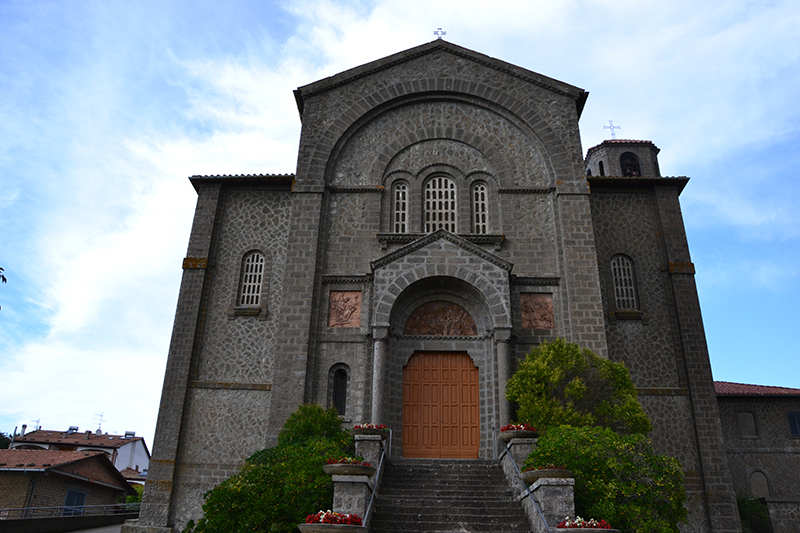
The church of Corpus Domini is located right on the Via Francigena at 100 km from its destination, the tomb of Saint Peter in Rome.

The building dates back to the 1920s and was the work of by architect Tullio Passarelli .

Even if the original church had a dome that was demolished after structural failures and was replaced by a flat roof.

The façade is characterized by a threshold that protrudes from the rest of the building, with a large arch and steps leading to the entrance door.

A lateral bell tower completes the image of the church that with its local stone structure is well integrated into the surrounding environment.

powered by social2s
Montefiascone. Church of Saint Peter

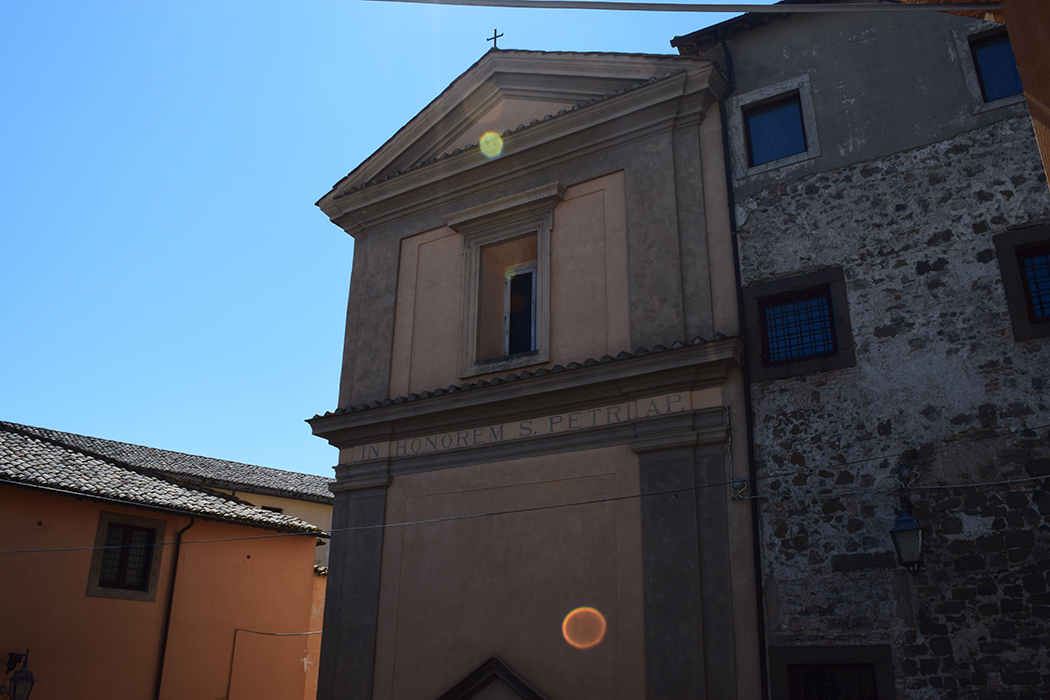
The small church of Saint Peter is located inside the historic centre of Montefiascone.

It was an integral part of the Benedictine monastery present since the Middle Ages although the current appearance is due to the eighteenth-century restructuring work.

In this historical period the monastery held the pharmacy of the village and was a point of reference for all the inhabitants.

The neoclassical façade is divided into two levels divided by a stringcourse and false columns (pilasters) and finishes with a triangular tympanum.

The entrance door has a simple frame and is surmounted by a triangular frieze.

The interior has a single nave with two carved altars. It ends with an altar carved with decorations and stuccos that surround a canvas attributed to Andrea Casali representing the Madonna with Child and Saints that dates back to the mid-eighteenth century.

The Madonna is seated on a throne, with the Child in her arms, between Sant'Anna, Santa Scolastica, San Luigi Gonzaga, San Francesco di Paola and San Nicola di Bari.

Near the choir, in an area that connected the church to the monastery.

There is a niche with frescoes from the fourteenth century that represent the Trinity and in the side walls are depictions of the Virgin and the Annunciation Angel.

powered by social2s

San Pancrazio is located in the countryside towards the lake and is one of the oldest churches in Montefiascone.

It dates back to the ninth century, as evidenced by a document written by Pope Leo IV.

The simple structure in Romanesque style is a small local square stone building with a gabled roof.

It has a bell gable with a bell on one side.

On the façade, just above the peperino-framed door, there is a single-lancet window which is now incorporated into the structure.

The interior is a single space that ends with an apse and the area of the altar is slightly elevated.

In the apse one can still recognize a fresco representing Christ on the cross between San Pancrazio (to whom the church is dedicated) and Santa Margherita, protector of Montefiascone.

Above the cross one can recognize the dove of the Holy Spirit.

powered by social2s
Montefiascone. Church of Santa Maria delle Grazie

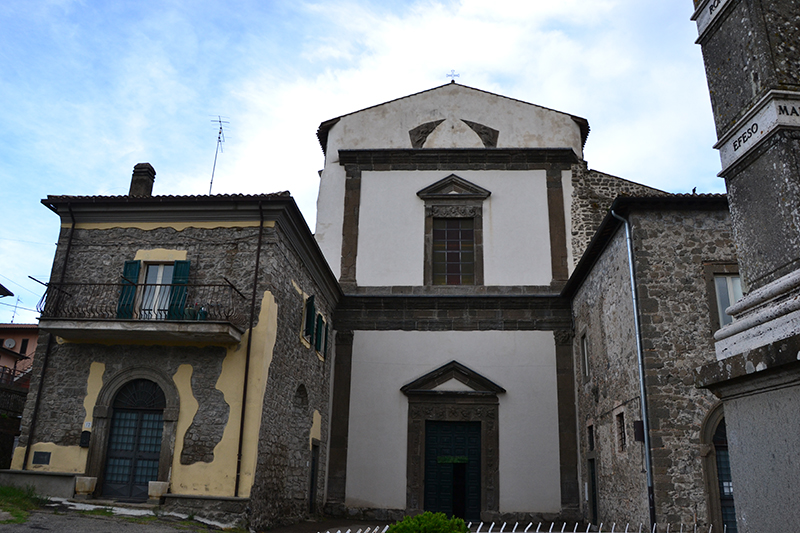
The church of Santa Maria delle Grazie is among the oldest in the district in Montefiascone.

It is located a short distance from the Basilica of San Flaviano along the Via Francigena in a square dedicated to the Madonna that has a statue on a high column completed in 1954.

Originally it was connected to a hospital to accommodate the pilgrims who were going to Rome to the tomb of St. Peter the Apostle and the first records date back to 1333.

After a period of decline, in 1492 it was rebuilt by the community of Montefiascone and in its shape and structure we can recognize the different architectural styles.

The façade today is set back from two neighbouring buildings and has a simple style with white plaster and local stone profiles. The second level is separated by a string course and each level is characterized by a large opening while the central door has a decoration with a triangular tympanum.

The interior has a Latin cross plan with an elegant dome and the central nave has two niches with medieval frescoes, while the rest of the church has baroque decorations.

The imposing high altar dates back to the seventeenth century and frames the fourteenth-century fresco of the Madonna delle Grazie from which the church takes its name.

The fresco was part of the original chapel and was detached and inserted into the altar in 1695 during modernization works.

The two arms of the church also end with highly decorated baroque altars.

Other frescoes to be appreciated are a San Sebastiano and San Rocco dating back to the fifteenth century and frescoes of San Nicola di Bari, San Matteo, San Bernardino of Siena built in the sixteenth century and located in the niche of the left wall of the central nave.

In the niche of the right wall there are frescoes of the late fifteenth century that represent a Madonna enthroned with Child between St. Anthony of Padua, St. Luke, St. Monaco and San Lorenzo.

powered by social2s

The church of Saint Francis is located just outside the town of Montefiascone along the road to Marta.

It was part of a convent that from 1875 was transformed into a civil hospital.

History tells that the church was founded in 1222 after the passage of St. Francis through Montefiascone during his mission to the Kingdom of Naples.

The church is a simple building with a gabled façade in local squared stone.

It is enriched by a simple entrance door with a lunette and a double-lancet window in carved peperino stone.

The interior has a single nave with side niches and a barrel-vaulted roof.

The eighteenth-century style is very detached from the simplicity of the external facade.

The interior is enriched with works of art including a nineteenth-century painting showing a bishop between Santa Lucia, San Giacomo Pellegrino and a martyr.

Among other works of art, a Crucifixion with Saints and an eighteenth-century painting depicting San Filippo Neri and San Bonaventura in adoration of the Virgin.

Today the church is the chapel of the hospital and of the ancient convent the well of the cloister can be recognized.

powered by social2s

The church of San Bartolomeo was commissioned in 1693 by Cardinal Barbarigo.

It has a very regular austere facade with two levels of decorations and a pediment on top.

The geometry is made even more evident by the two bell towers on the sides at the back of the building each ending with a flat roof.

With this shape, the church is easily recognizable.

The interior of the church has only one nave and a decorated arch separates the area dedicated to the faithful from that of the celebrations of the mass.

The arch is supported by two columns ending with a finely carved Corinthian capital while a sculptural group with angels decorates the arch.

Above the entrance door is a precious ancient organ.

The regular eighteenth-century style of the interior decorations is enriched by numerous works of art.

Among them, a precious gilded wooden tabernacle and a painting representing the Martyrdom of St. Bartholomew while on the ceiling above the altar the Gloria of San Bartolomeo is painted.

powered by social2s

Recommended

Subscribe to Newsletter

Discover a territory through the emotions of the people that have lived it.