Churches & Places of Worship

Bolsena. Sanctuary of Santa Cristina

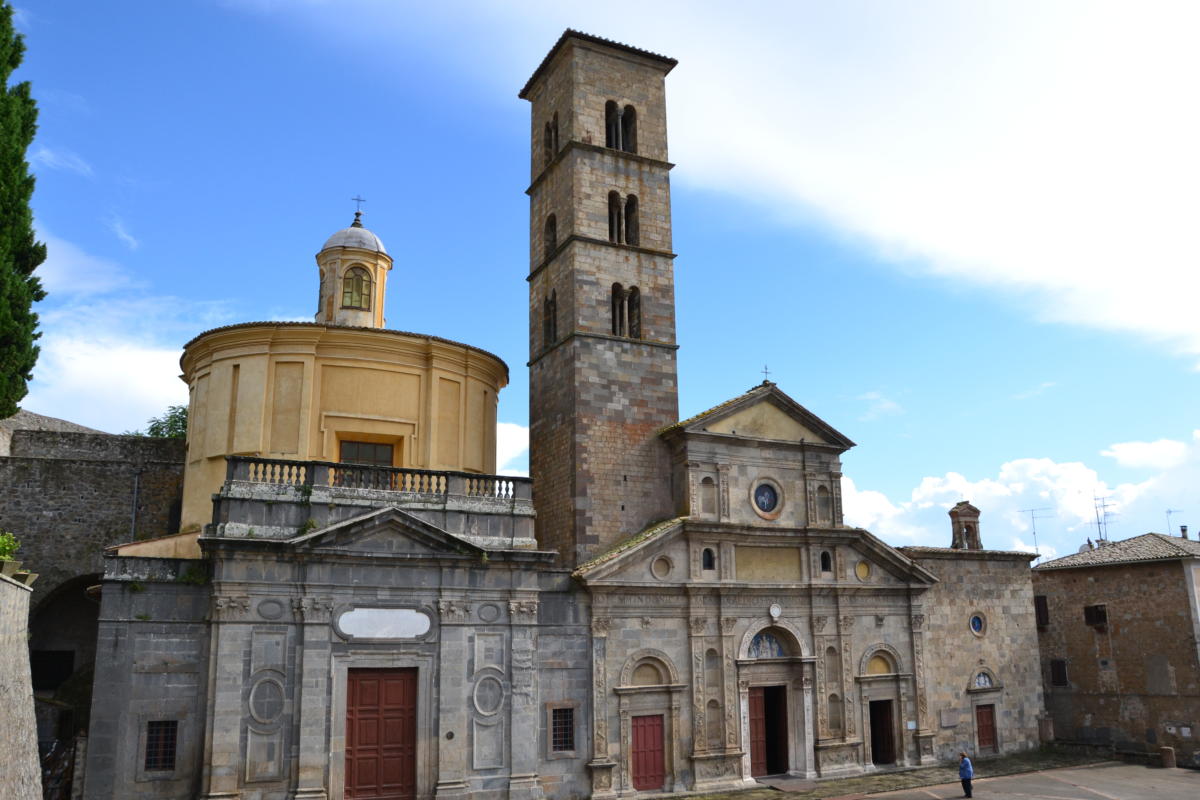
The complex of the sanctuary of Santa Cristina in Bolsena appears as a set of three churches side by side with styles belonging to different centuries: one Romanesque-medieval, one Renaissance and one baroque.

According to a tradition, the complex was begun thanks to the devotion of Matilde di Canossa and Pope Gregory VII to Santa Cristina, and the Pope consecrated the church in 1078.

The church on the right is a simple parallelepiped-shaped local stone facade that ends with a sail-shaped bell tower with a bell.

The building dates back to the eleventh century and the simple facade is enriched by a lunette above the entrance door with beautiful white and blue glazed ceramic work with images of the saint.

The second building is a true masterpiece of Renaissance art and was commissioned by cardinal Giovanni de' Medici who had it built between 1493 and 1495 by the sculptors Francesco and Benedetto Buglioni of Florence.

The church has three naves and on some parts of the walls can be recognized frescoes of the fourteenth to sixteenth century while behind the main altar there is a polyptych by Sano di Pietro.

This church has a high bell tower with levels of mullioned windows dating back to the 13th and 14th centuries.

The third building dates back to 1639 and is called the chapel of the Miracle as it houses the relics of the miracle of the Eucharist, from which the feast of Corpus Domini was born.

This chapel is a circular baroque jewel with an altar and two side chapels.

On the altar is the reliquary containing the stones with the sign of Christ's blood from the miracle of 1263.

The complex then ends with the Chapel of Santa Lucia and the catacombs of Santa Cristina, an early Paleochristian necropolis with over 1600 graves dating back to the III-V century AD.

It is no coincidence that the catacombs start from this point and the graves are concentrated near that of Santa Cristina. In fact in the past it was believed that the day of the universal judgment was better to be found near the body of a saint who surely would have been brought to paradise by Jesus.

Some of the marbles that closed the catacombs were then used as part of the floor in the construction of the basilica where some slabs with epigraphs can be recognized.

In the final cavern from which you descend to the level of the catacombs, there is a large terracotta icon and the statue of Santa Cristina lying on a sepulchre that were created by the artist Benedetto Buglioni.

This cavern was once entirely frescoed and you can see some traces of the drawings.

In this area is the earliest sacred complex and the altar on which the miracle occurred.

In the altar you can also see the stone with the footprints of Santa Cristina as a girl.

The story goes that little Cristina was thrown into the lake during the persecutions with a stone around her neck and that miraculously this stone floated and brought it back to shore. These are the first footsteps that Santa Cristina left out of the lake when she put her feet on the muddy banks.

The miracle altar is an artistic masterpiece of the 8th century and is known as the "altar of the 4 columns" because it is all enclosed within a canopy.

Here the Eucharistic miracle of Bolsena took place in 1263 when a priest who was celebrating Mass saw the host bleed during his consecration as the Body of Christ. These relics are meanwhile preserved in the Cathedral of Orvieto.

All the area around the complex has seen many changes and over the centuries hospitals and welcoming centres were created to welcome the many pilgrims who came to visit.

Also because Bolsena is located along the Via Francigena, the road that leads to Rome to the tomb of the Apostle Peter, it was one of the most important streets of the Middle Ages.
powered by social2s
Bolsena. Church of San Salvatore

The church of San Salvatore dates back to the fifteenth century and is located on the upper part of Bolsena just outside the walls and in front of the Rocca Monaldeschi della Cervara.

The inside of the church was destroyed by a fire in 1914 and then rebuilt following the original design.

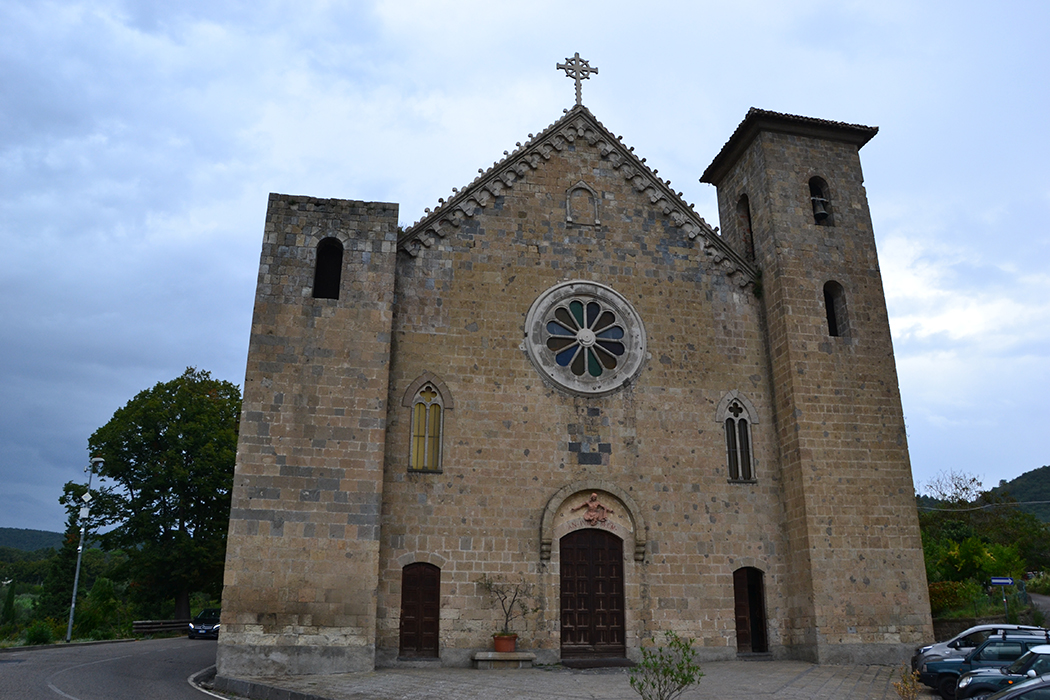
On the outside it looks like a gothic style building with a facade and two tower-shaped bell towers, one on either side.

One of the bell towers is without the top floor and this gives the building an original appearance.

The church has three entrances, the main door having a stone frame and in the lunette there is a ceramic sculpture with the image of the Saviour.

Above the main door there is a marble rose window with stained glass, while above the two side doors two mullioned windows give light to the inside of the church.

The interior has a single nave with niches with paintings and the walls have strips of stones of two colours, ochre yellow and grey.

The church is enriched by a refined carved marble altar and a special baptismal font, originally of the Middle Ages, octagonal in shape with colourful ceramic paintings on its sides.

powered by social2s

The church of St. Andrew the Apostle dates from the fifteenth century and the Pofi Statutes of 1569 show the veneration of St. Andrew.

The building was destroyed during both World War I and WW II.

Outside one can see the old parts and the more recent ones such as the facade.

This facade, whose author is unknown, is the most architecturally important part and is the work of Milanese mastery.

powered by social2s

 
The history of the church of San Pietro and the Franciscan Convent of Pofi is truly unique.

In 1699 Pope Innocent XII gave a favourable opinion to the construction of the new monastery and church in the province.

He granted the request of Giovanni Battista De Carolis of Pofi who had asked him to make it happen ‘on your Earth’.

In 1704 they were completed.

The church has undergone changes and now has two main aisles, of which one is older, and four chapels with one particularly large.

Above the altar is a large altarpiece depicting the Virgin enthroned, work of the Franciscan painter Fra Pietro Copenhagen (called the Danish Raphael).

Under the central altar there is a statue in terracotta of the Dead Christ, by a late nineteenth century Neapolitan.

powered by social2s

The Romanesque church of St. Antonino was built in the eleventh century.

It is built where the saint had miraculously caused a water source to appear in Pofi.

It has an interesting portal and several frescos including a Last Judgment, painted on the inside counter reminiscent of the "Divine Comedy".

Legend has it that under the church of St. Anthony is the pagan temple of Aesculapius, and, surprisingly, the Pofi coat of arms depicts a snake coiled around an oak.

According to some scholars the name Pofi could come from the Greek phrase "Hoi ap'ophios" or "those of the snake" in reference to the god Aesculapius.


powered by social2s
Ariccia. Santuario di Santa Maria di Galloro

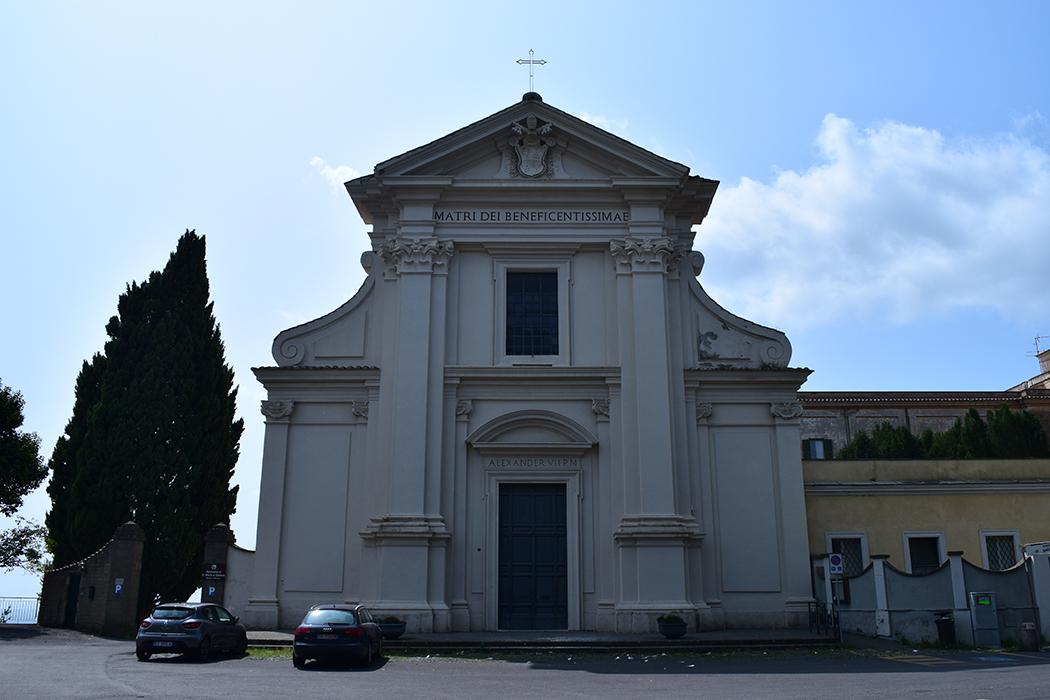
Il santuario è stato realizzato nel 1624, dove tre anni prima era stata ritrovata una immagina della Madonna, e Galloro è il nome della località di Ariccia in cui si trova la chiesa.
La sua facciata è stata eseguita con i consigli del grande architetto Gian Lorenzo Bernini che in quel periodo lavorava con la famiglia Chigi. A lui si deve anche la sistemazione dell’area interna in cui si trova l’altare maggiore.
Oggi è ancora una dei santuari mariani più visitati ed è sede di una casa per ritiri spirituali.

powered by social2s
Monte Porzio Catone. The Tuscolano Hermitage of the Camaldoli

The hermitage of San Romualdo was founded in the early seventeenth century to give the Order of the Camaldolese a location near Rome in Monte Porzio Catone.

This area was chosen because it already housed some hermits and the hermitage was started in 1600 thanks to a fundraiser.

The fundraising was slow and so the first cells were ready only in 1607.

In 1680, women were forbidden to enter (this rule still applies) and the only woman to enter was the Borghese princess who donated part of the decor of the chapel.

To understand the spirit of the centre we can tell the story of Passionei cardinal who made many changes to the hermitage that were not required. At his death, all these changes have been torn down by the hermits.

powered by social2s

Recommended

Subscribe to Newsletter

Discover a territory through the emotions of the people that have lived it.