Churches & Places of Worship

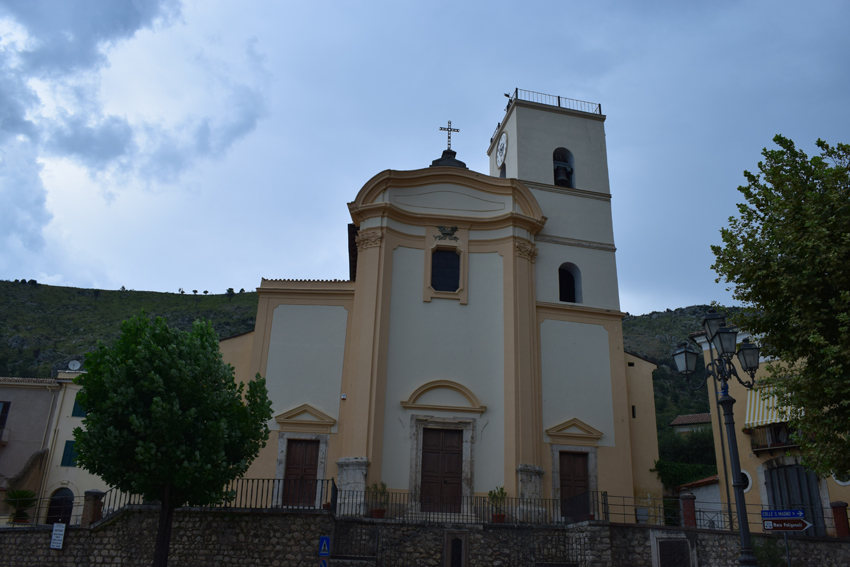
The original church of SS. Assunta in Roccasecca dates back to the eighteenth century.

It was destroyed by the bombings of 1943 during the Second World War.

Then it was then rebuilt in the same place as the previous one.

From this episode it is also called "of wood" or "of the Swiss gift".

The current style recalls that of the past with a simple facade with two levels and a nearby bell tower with an uncomplicated structure.

The interior has a single nave with decorations of some columns and inlaid wooden works
powered by social2s

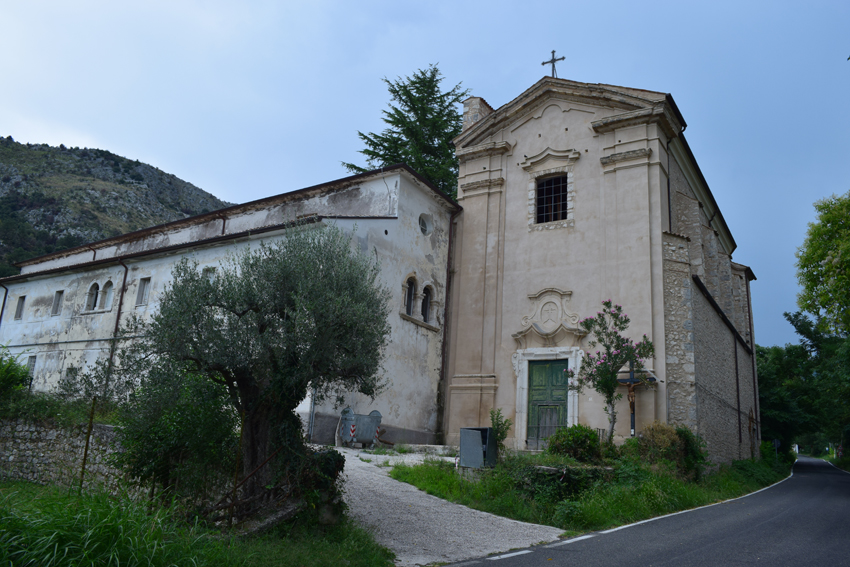
The church of San Vito sul Melfa was built along the Via Latina corresponding with a Roman bridge over the Melfa river.

It was built where where probably existed Roman structures.

Traces of Roman architectural elements and epigraphs are visible embedded in its walls, while the slabs of the floor were probably taken directly from the bridge.

The first information on its existence dates back to the deeds of donation found in the archive of Montecassino and dating back to the first half of the year one thousand.

Initially the church and its small Benedictine monastery had been placed under the control of the monastery of St. Paul in Rome.

Then given to Rainaldo the bishop of Aquino, with a bull of Pope Alexander III of 1175 that put an end to a dispute between the bishop and the monastery.

The convent was abandoned in 1270, as evidenced by the inventory for the delivery of goods to the bishop of Aquino, but continued to be inhabited by other friars.

It suffered damage from river floods and was rebuilt until it assumed its current shape.

powered by social2s
Roccasecca. Church of the Cemetery

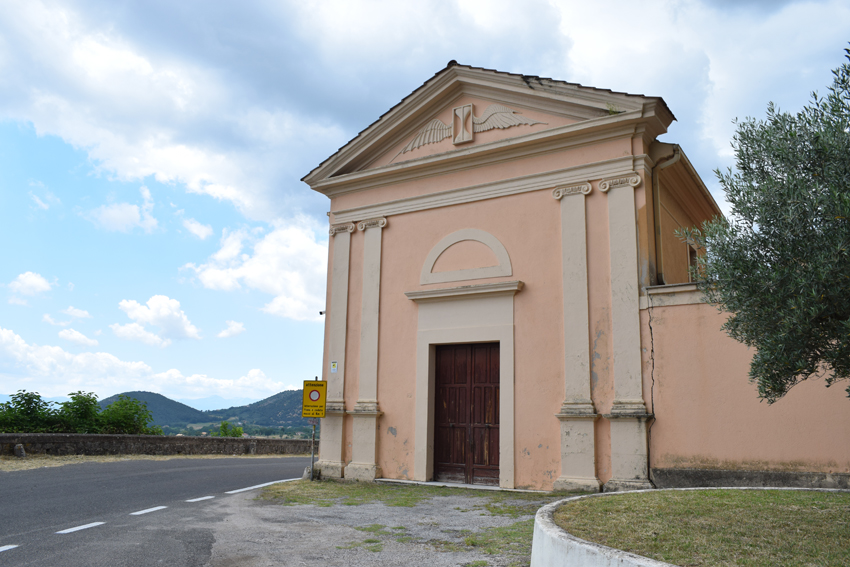
The monumental cemetery of Roccasecca is located at the end of the city and at the beginning of the Tracciolino road, near the large statue of St. Thomas.

The entrance is characterized by two small churches in the neoclassical style.

Thy are placed on each side at the end of the entrance.

On the upper part of which is a high relief that represents an hourglass with the wings.

A tree-lined avenue leads into the monumental area holding the noble chapels.

powered by social2s

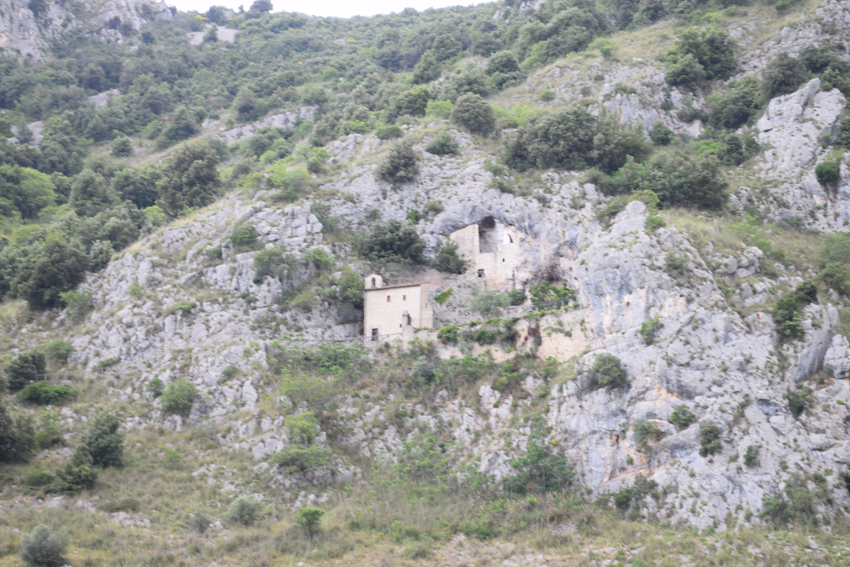
The hermitage of Saint Michael in Roccasecca was built on Mount Asprano, inside a rocky inlet that forms a kind of cave.

The hermitage is located under the cliff of the castle and can be reached via the village of Caprile.

The construction began around one thousand and was already mentioned in the 'Cronache di Cassino' (Chronicon Casinense - Cassino Chronicle) in 991 when it was acquired by the abbey.

Inside there are two rooms and, in the one used for worship, beautiful 11th century frescoes adorn the wall behind the altar.

The painting is in Byzantine style and represents the Ascension of Christ enclosed in an oval with at the sides angels blessing Our Lady and the Apostles.

Another nineteenth-century fresco representing a crucifixion was moved to the church of Santa Maria delle Grazie in Caprile.

Until the middle of the last century, people who died of infectious diseases were buried in this hermitage.

powered by social2s

The original church of the SS. Annunziata in Roccasecca dates back to the mid-fifteenth century.

In 1750 was demolished to build the current one in Baroque style.

The façade is characterized by soft sinuous lines that draw a sort of curvilinear pyramid in the sky. 

On this curve are the two statues of St. Thomas and St. Peter Martyr, patron saint of the village.

The interior is in Baroque style and has three naves and is shaped like a Latin cross.

The central nave ends with an altar behind which there is a wooden choir dating back to the nineteenth century, that has particular style and elegance.

Above the choir is a painting by the Neapolitan painter Francesco de Mura while the dome and the roof of this area are frescoed.

In the side wings are important paintings of the eighteenth century Neapolitan school and a copy of the painting 'The Last Supper' by Paolo Veronesi.

Among the valuable works of the chapels of the side aisles there is a canvas dating back to the sixteenth century of a Madonna with Child in the presence of San Biagio and Sant Antonio Abate.

Above the choir is an ancient organ.

In 1843 the church received the title of "Collegiate insigne"

powered by social2s
Roccasecca. Church of Santa Margherita

The church of Santa Margherita in Roccasecca has a clear Baroque style.

It has an arched façade that seems to show a theatrical setting.

Initially the church had only one nave, but Roccasecca housed a bishop's residence and the church was demolished and rebuilt with three naves.

Only the bell tower recalls the previous construction.

Inside there are some paintings of the seventeenth century while the frescoes of the dome are recent by Antonio Norari di Sora and date back to 1991.

In the access stairway there is a bronze bas-relief by the sculptor Egidio Ambrosetti of Anagni

powered by social2s
Roccasecca. Church and Convent of Saint Francis

The church and the convent of St Francis are located outside the town of Roccasecca along the road that leads to Colle San Magno.

The convent dates back to the 14th century but was then rebuilt in the eighteenth century and the style of the church is baroque.

During the Second World War this had been the seat of the German command directed by Frido von Senger und Etterlin who had control of this area near to the Gustav line.

Recall that the Gustav line cut Italy from the Tyrrhenian Sea to the Adriatic Sea and passed through Cassino and nearby Monte Cairo.

The convent had been chosen because it was close to the mountain, hidden in a pass, not visible from the valley, and difficult to reach by bombers who had to fly around among the peaks.

But after the first bombing the command was moved to the nearby Colle San Magno.

powered by social2s
Roccasecca. Hermitage of the Holy Spirit or of the Most Holy Trinity

The hermitage of the Holy Spirit in Roccasecca has been created from a natural cave on Monte San Nicola and is located near the entrance to the Gole del Melfa and is visible from the Tracciolino.

Tracciolino is the famous route created by the Bourbons to link the Valle del Liri with the Val Comino.

The complex seems to be on a precipice in the gorges through which the river Melfa flows.

In a nearby cave above the sanctuary you can see an interesting hydraulic system for collecting rainwater to allow the survival of the monks.

The sanctuary was probably started before the year one thousand. In another nearby cave one can see a bed made of polished stone which according to tradition is the same as that of Saint Benedict at Subiaco.

powered by social2s

Recommended

Subscribe to Newsletter

Discover a territory through the emotions of the people that have lived it.