Churches & Places of Worship

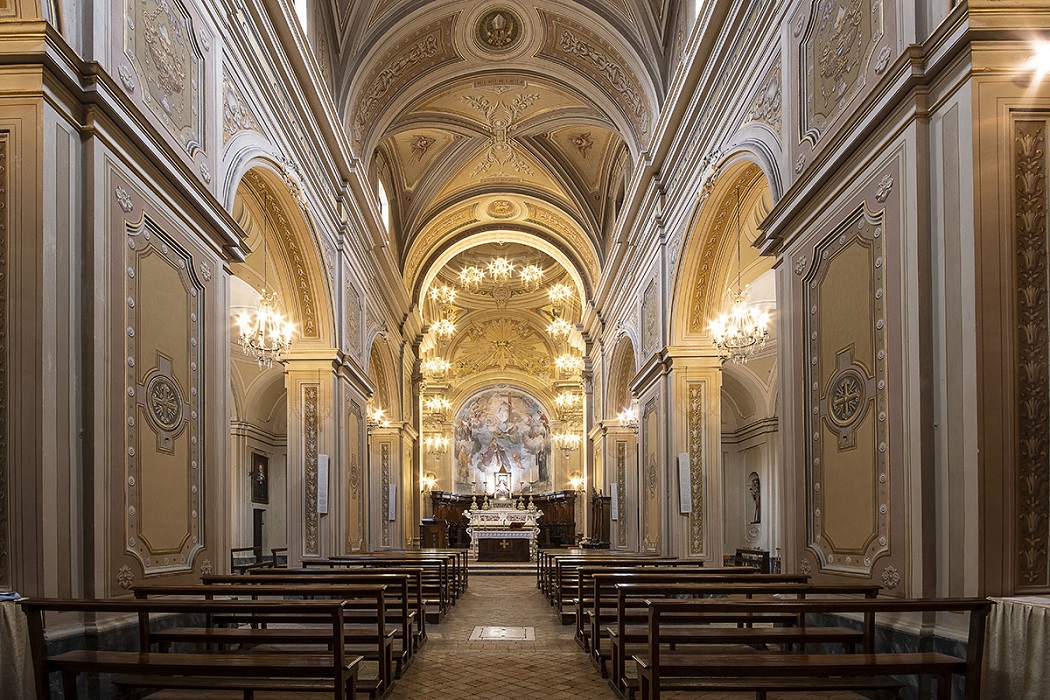
Sanctuary of the Olive Tree

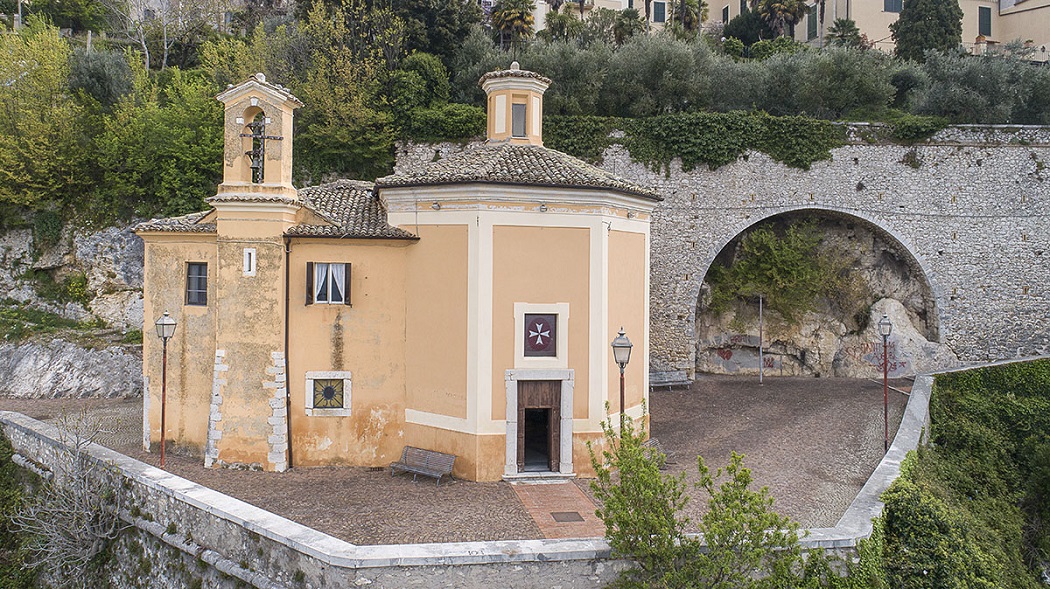
The sanctuary of Olive tree - santuario dell'Olivello was built on the site of the discovery in 1722 of an image of the Madonna who is said to have miraculously saved herself.

Initially in this place, in fact, there was the Little Gate to access the original church of Santa Salome.

But after the collapse caused by the earthquake of 1350 everything seemed to have been lost.

A shepherd with his flock had climbed among the hills and found the sacred image painted on a rock.

The name of Madonna dell'Olivello derives from an olive tree that had grown next to the image.

The church was built around the image.

Then it was protected on the surrounding land with walls and terraces thanks to the free work of many inmates.

It has an octagonal plan with an entrance door in Romanesque style.

It was then enlarged thanks to Cardinal Bisleti who moved part of the rock behind the image to the point where today the rock with the Madonna dell'Olivello is in the centre of the church.
powered by social2s

The small but tall church of the Holy Family is located adjacent to the monastery of Santa Maria dei Franconi in Veroli.

It houses the remains of the blessed Sister Maria Fortunata Viti.

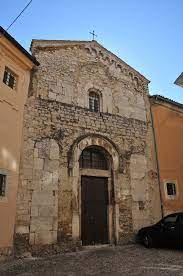
The church was consecrated in 1580 and the façade has an eighteenth-century style divided into three levels.

The lower part has an entrance door and a single side window because the other has been incorporated into the monastery.

The upper one has two central openings at the door all covered with a gable roof.

powered by social2s

The church of St Paul dates back to 1804 and was built on a pre-existing church in Veroli.

Probably that building was also built on a pre-existing structure as there are some medieval addittions in the facade.

The interior has the shape of a Greek cross and is surmounted by a large dome.

A large bell tower is located slightly back from the façade.

The church suffered from bombing during the Second World War that destroyed the dome and the roof.

The restoration work was completed in 1959.

The history of this district of Veroli, called Piagge Atinati, is very interesting for the link between the cities of Veroli and Atina.

It all dates back to the fall of the Roman Empire and the arrival of the Visigoths in 419 who destroyed Atina.

Its inhabitants, in chains, were freed by the Verolani and were protected by the powerful polygonal walls until they later returned to Atina.

Documents that testify to the friendship between the cities date back to 1615 and 1753 and are kept in the Biblioteca Giovardiana.

powered by social2s
 Church of Santa Maria dei Franconi

The church of Santa Maria dei Franconi in Veroli dates back to the 13th century.

It was built over the 11th century oratory of Sant'Onofrio, a place with two areas bounded by 6 columns.

The building then became an integral part of a monastery of Benedictine nuns founded in 1580.

Like all buildings in Veroli it was damaged by the earthquake of 1350 and rebuilt with parts that have different styles.

The lower part of the façade is in Romanesque style and in the fabric of the stones we recognize the closing of openings near the entrance door.

The interior of the church dates back to the seventeenth century and there is a 1674 fresco of a Crucifixion with the background of the city of Veroli, in the inner part of the portal, and other seventeenth century frescoes in the chapels.

The church bears witness to the presence of the Order of the Templars in Veroli both for the name (Franconi is one of the names with which the Templars were called) and for some Croci Patenti (Mantova Cross) engraved in two of the entrance pillars.

Symbols of crosses and roses that intersect recall the movement of the Rosicrucians.

powered by social2s
Basilica of St Erasmus

The church of St Erasmus was founded in the place where St. Benedict and his disciples had stopped in Veroli in 529 during their journey to Montecassino.

The first oratory was funded by Valentinian, a citizen of Veroli who later became a monk and was abbot of the monastery of San Pancrazio al Laterano. In the twelfth century the Benedictines were replaced.

Over the centuries the church has been renovated several times as observed looking at the different styles of the façade. A Romanesque portico with arches and an eighteenth-century upper portion, a late Baroque style access stairway,.

Three apses are coming out of the back wall of the church and a Romanesque bell tower built from a Roman tower.

In correspondence with the arches of the access portico, we can see figures of animals from whose mouths ornamental friezes emerge and which in the stories are considered connections both with the east and with the Benedictine world.

The interior is in eighteenth-century style with three naves with three apses.

The church houses masterpieces such as a large canvas from 1747 by Sebastiano Conca (or perhaps by T. Kuntze), a painting of the Baptism of Jesus.

A gilded silver chalice from the 14th century when the miracle of the Consecrated Host took place and that is utilised once a year during Tuesday after Easter celebrations.

powered by social2s

The initial core of the cathedral of Sant'Andrea in Alatri was built over the main temple of the ancient Verulae when all the pagan temples were turned into christian places of worship.

It was then enlarged and altered several times including after the earthquake of 1350.

The current structure in Baroque style dates back to the seventeenth and eighteenth-century transformations except for some parts such as the Gothic rose window of the facade.

The bell tower was built on top of a Roman tower.

The interior has three naves and is rich in decorations and stuccos. In the apse behind the altar there is a sumptuous wooden choir of 1624.

In a chapel to the right of the altar is the large treasure of relics and works of art that has accumulated over the centuries from the twelfth century.

Among them, a silver polptych of the sixteenth century, paintings made by Buccatti di Alatri and a canvas depicting the " Martyrdom of St. Bartholomew "attributed to the Polish painter Kuntze.

About 1200 parchments are kept in the chapter archive dating from the 9th century onwards.

powered by social2s

The church of Santa Maria delle Grazie dates back to the fourteenth century, when the population of the castle began to look for more comfortable places to live closer to the fields and began to form the village of Caprile, and the church was called "Visitation of the Blessed Virgin".

The original Romanesque style of the church can still be glimpsed in the facade and in the external forms.

The current church was restored in 1759 (as one reads on a plaque inside) and its style is influenced by neoclassical style.

Outside, along the side, you can see a large fresco of 1625 representing St. Christopher.

On the lunette above the entrance door to the church you can see a fresco of a Madonna with Child dating back to the fifteenth century.

The interior has only one nave and at the four corners there are 'coretti' which you can reach with stairs.

The style is neoclassical with some Baroque influence in the decorations of stuccos, friezes and ornaments.

The church has two altars: the side one next to the wall has the tabernacle and is adorned with an oil painting on a panel depicting the Madonna of the Rosary.

This work is framed by fourteen panels of the Way of the Cross that date back to 1586.

Behind the high altar there is a 16th century painting representing the 'Visitation' by Fabrizio Santafede, from the Neapolitan School.

Other very important works are a very revered statue of the Madonna del Rosario, carved from pear wood and dating back to the early sixteenth century.

The painted wood statue of San Vincenzo Ferreri, which dates back to the eighteenth century.

Above the entrance door, in the choir, there is an imposing organ built in 1865 by Pietro Saraceni.

The church has two impressive bell towers: the lower one is more recent and has two splendid clocks, the taller one has four bronze bells that make the tolls seem heard throughout the Valle del Liri.

powered by social2s

The small church of Holy Cross - Santa Croce is located just outside the walls of the old castle of Roccasecca.

It was built by the Counts of Aquino who were very devoted to the Holy Cross.

The structure looks like a single small room, partly carved out of the rock, with a wooden roof.

The facade has a door and two small side openings.

Probably in this church St. Thomas was baptized, and who was born in the nearby castle.

For years it has been the mother church of the village.

powered by social2s

Recommended

Subscribe to Newsletter

Discover a territory through the emotions of the people that have lived it.