Churches & Places of Worship

Anagni. Church of St. Andrew the Apostle

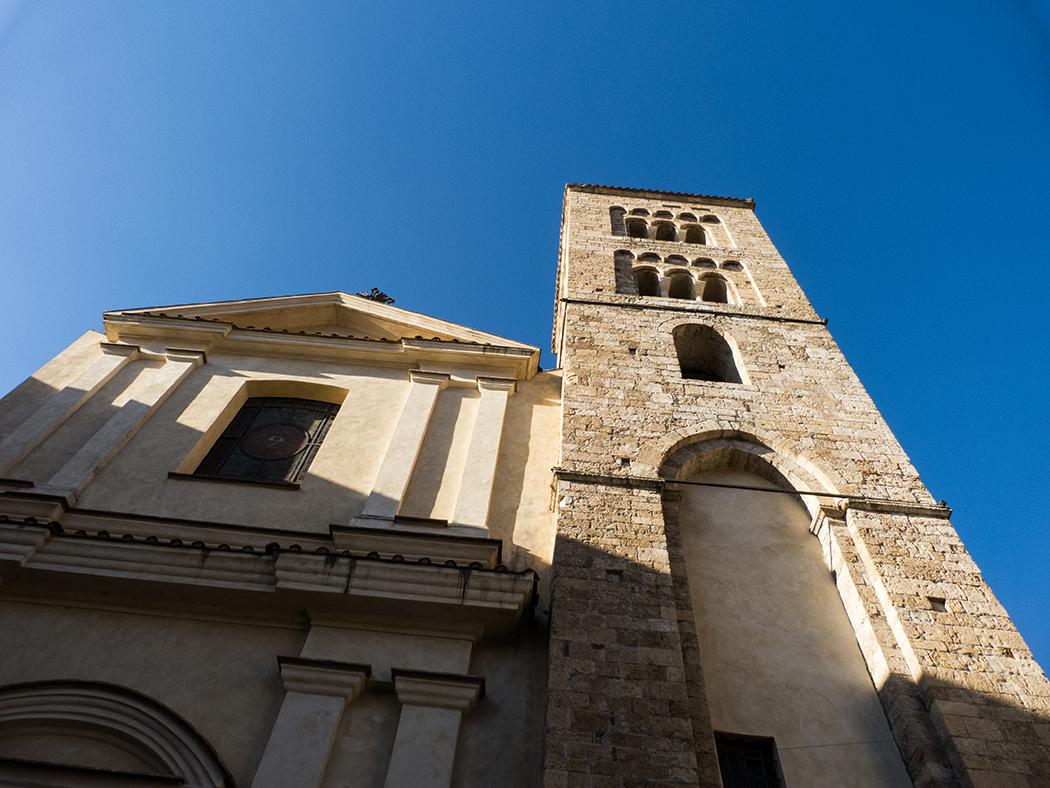
The Church of St Andrew the Apostle is one of the oldest churches in Anagni and it is referred to in documents shortly after the year one thousand. It is located right in the heart of the medieval village and not far from where the ancient Roman baths were located.

It was constructed on a previous building of the VI-VII century, the ancient church of San Vito, which today is visible in the crypt.

The church underwent a first transformation around 1263. The medieval origin is testified by the Romanesque bell tower with a large Gothic arch and three levels of openings: one with a single window and two levels with three-light windows. The strange form is due to the fact that once this was the entrance to the Romanesque church.

At the base of the bell tower you can notice a medieval bas-relief inserted in the wall that represents a zoomorphic figure, an animal ridden by a warrior.

The church was rebuilt in the eighteenth century and the façade dates back to 1760 with an entrance door framed with a stained-glass window illuminating the interior. The interior has a single nave that ends with a rectangular apse characterized by a precious Cosmatesque floor.

In the chapel dedicated to the Saviour there is a precious triptych, a fourteenth-century panel with the image of the Saviour and on one side the Madonna with Saint Andrew and Gregorius Francisci (the donor) and on the other side San Magno and Santa Secondina.

powered by social2s

The Church of Saint Angelo is located in the medieval part of the city of Anagni and dates back to the thirteenth century.  It then underwent several reconstructions in the Baroque period and finally in the eighteenth century during the neoclassical period.

The current façade is very geometric with a portico with four arches dug into a square facade. To mark the importance of the building, a temple-shaped decoration with three columns emerges from the façade. The rear, on the other hand, still reveals the Romanesque features of the church with an apse with decorations of pilasters and arches.

The interior has three naves with neoclassical decorations and an elegant inlaid marble altar. Behind the altar is a painting of St. Michael the Archangel while defeating the demon who crushes with his left foot.

The church is enriched by a hexagonal baptismal font with eighteenth-century bas-reliefs and an important organ. Among the works of art there is some 15th century Byzantine iconography representing a Madonna with Angels. In the church there is the statue of Saint Anthony of Padua that is carried in procession on June 13th.

The church is run by the Conventual Fathers from the 16th century, while the adjoining convent is owned by the municipality.

powered by social2s

The Church of San Prancazio is located in the medieval heart of Anagni and already in 1280 it was one of the 24 parishes of the city.

From 1556 to 1746 it hosted the Clarisse nuns, in fact this religious order had been transferred from San Pietro in Vineis and remained there until the consecration of their church dedicated to Santa Chiara, the foundress of the order who was canonized to Anagni in the 1255 by Pope Alexander IV in the cathedral. The worship of Santa Chiara is very strong in Anagni and a Palio is dedicated to her in August.

The church has a neoclassical style slightly advanced compared to neighbouring buildings with which it is joined by a circular connection. It has only one entrance door decorated in local stone and an opening at the door and under the closing gable. A small bell tower with two bells completes the image of the exterior.

The interior of the church was later renovated in Baroque style with many gravestones that recall the buried families including that of a certain Carlo Menenti who had made a war loan to Giuseppe Garibaldi.

In the column of the baptismal font one can read a Roman inscription referring to Senator Marco Arrio but it is back to front.

powered by social2s

The Church of Saint Augustine has a late Renaissance style and the arrangement of the church and convent were stared by Augustinian monks in 1479 but the building was destroyed by the Duke of Alba in 1556.

At that time the Pope was at war with Philip II of Spain and Anagni played a role of bastion against the Spanish advance and of logistic support for the papal troops. Anagni was besieged and then captured and sacked by Spanish troops.

The works of rebuilding the church were then resumed and completed in 1575 and subsequently it had a new structure around 1790-95. At that time, the French troops, in their work of dismantling the papal state sold a large part of the convent, which was used as the barracks by the carabinieri, and they left only one house for the parish priest.

The façade is divided into three vertical sections with a single entrance door adorned with a pediment that is enclosed in an illustration of a large arch. The interior of the church has a circular plan with a central dome and three chapels and the main altar has a splendid seventeenth century canvas representing the Virgin with St. Augustine.

At the entrance there are two other side chapels: the left one dedicated to the Virgin with a precious painting of a Madonna with Child and the right one dedicated to the fallen of the Great War. It is a real peculiarity in which are represented the images of all the youth of Anagni who participated in the First World War, losing their lives in the conflict.

A special note: in the great film by Mario Monicelli dedicated to the Great War with Vittorio Gassman and Alberto Sordi, the chaplain is invited to read a letter from a soldier who came from Anagni.

powered by social2s

The Church of San Giovanni de Duce was built in the area of the ancient Forum of Anagni, probably above the ancient temple of Saturn, and today is located in a square along the main street not far from the cathedral. The square was generated from a Roman terrace. It is called the Church of San Giovanni de Duce because this was the name used to describe the Duke Caetani.

The first news of the church dates back to the thirteenth century but nothing remains of that medieval building. The current church dates back to 1745 when it was completely rebuilt in Baroque style and consecrated to Saint John Evangelist and Saint Benedict.

The façade is in white marble with three entrance doors, the central one of which is highlighted by a decoration with two columns supporting a lunette with a tympanum. It is divided by a string course into two levels and by the decorations of the tympanum. The interior has an almost square shape with a central dome.

Among the works of art inside there is a painting of the 1700s made by Giovanni Battista Gaulli, called the Baciccia, who was a friend and follower of the great Bernini, and another representing St. Francis Caracciolino in front of the Blessed Sacrament and flanked by an angel.

An inscription on a column recalls the baptism of Sister Claudia de Angelis, the foundress of the Cistercian Sisters of Charity who run the Palace of Boniface.

The church and the adjoining convent are managed by the Carocciolini fathers and in part is dedicated to a school.

powered by social2s
Anagni. Cathedral of Santa Maria

The Cathedral of Santa Maria is the symbol of the splendour of the Anagni and its history intertwines much with the sacred. It was built on the ancient pre-Roman acropolis, where there was a temple dedicated to Ceres and an ancient mithraeum that can still be visited in the basement and which is called the Oratory of St. Thomas Becket.

Its construction is due to the efforts of the bishop Peter of the Lombard princes of Salerno, on the spot indicated by San Magno who appeared to him in a dream and asked him to build a church dedicated to Our Lady and that he would find the necessary funds in Constantinople. In fact, when he arrived in Turkey he met the emperor Michael VII, thanks to the vision of San Magno, who financed the completion of the church.

The facade of the church is in sandstone, the local stone, in Romanesque style just as the bell tower which is separately located in the square in front of the main entrance of the church. The bell tower reaches 30 meters in height and has 5 levels of openings with single lancet windows, mullioned windows and triple lancet windows.

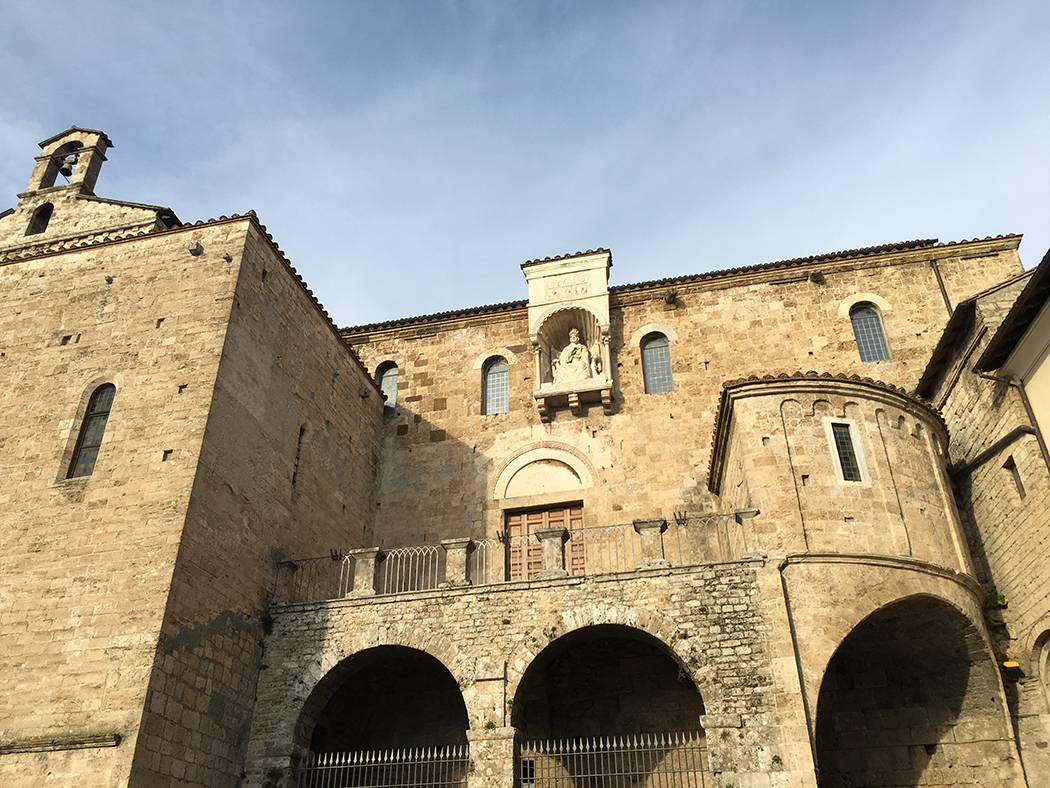
The sides of the church are equally interesting with the Loggia delle Benedizioni with the marble statue of Boniface VIII, seated on a throne set in a shell and inserted in a sort of canopy, which dominates Piazza Innocenzo III. The back of the cathedral has an even greater charm with the staircase around the three apses of which the central is finely decorated by a loggia with arches and columns.

The three front doors have three lunettes in the three naves. The central one has a Byzantine decoration and a head of a wolf and an ox that recall a legend. It is said that Bishop Peter performed the miracle of convincing a wolf to tow the cart with the stones along with the ox to help the construction of the cathedral. The interior has Gothic arches and a splendid Cosmatesque floor, which is made by the famous family of Roman marble masons.In the central apse is the throne of the bishop made by the bishop Landone around 1262 while the balustrade that separates the area is recent and dates back to the twentieth century.

The cathedral has a chapel on the right side dedicated to the Madonna della Misericordia while on the right side there are three important chapels: the Lauri Chapel, the baptistery and the thirteenth century Cappella Caetani.
Inside the church there are a few 13th century frescoes while the real masterpiece of medieval art is in the crypt under the church, a totally frescoed environment with three naves with 12 columns, a vaulted roof and a cosmatesque floor.

It is called the 'Sistine Chapel of the Middle Ages' for the magnificence of the paintings and their state of conservation and for the meaning of the pictorial cycle. The crypt is dedicated to San Magno and a section of the frescoes is dedicated to the history of the saint, who is also the patron saint of Anagni.

The first section near the entrance is dedicated to the cycle of life with the 4 seasons of man and the 4 elements, but also it contains the twelve signs of the zodiac and a correlation between microcosm and macrocosm.
Another section is dedicated to the philosophy of Plato and the doctor Galeno while a great cycle tells the ancient testament until the apocalypse. All the frescoes were made between the beginning of the 12th century and the middle of the 13th century by three different artists' workshops.

A side aisle leads to the cloister with a lapidary and a cistern. In a building connected to the cathedral is the Treasury Museum which houses religious objects, sacred vestments and a rare reliquary set of Thomas Becket decorated with Limogés enamels.

powered by social2s
ph Claudia Bettiol
Casalvieri. Church of Madonna di Loreto

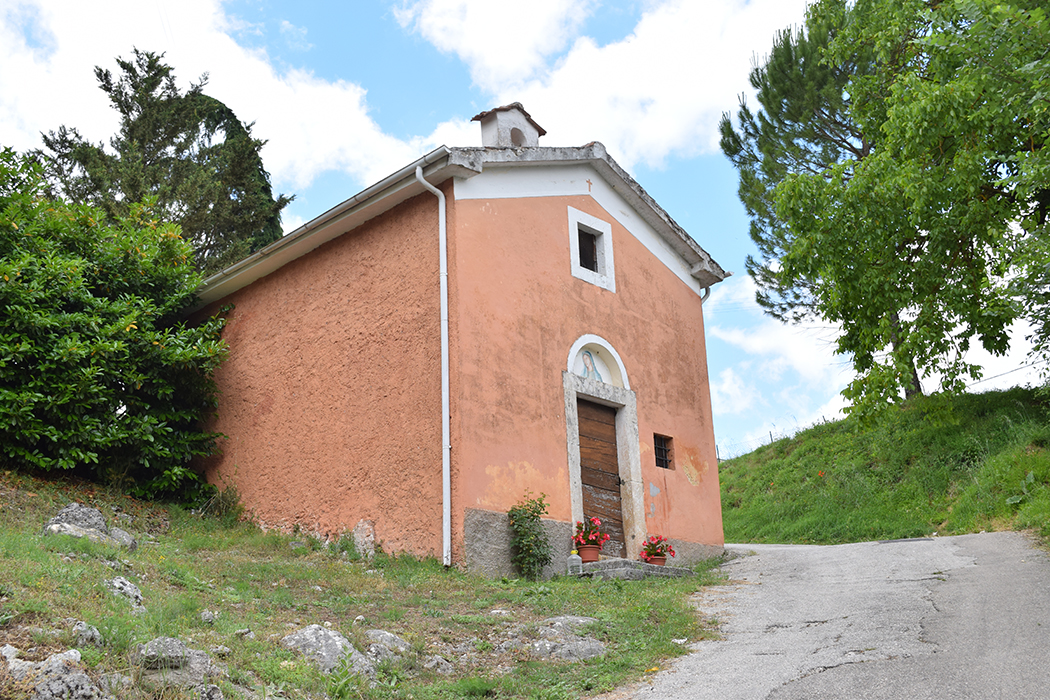
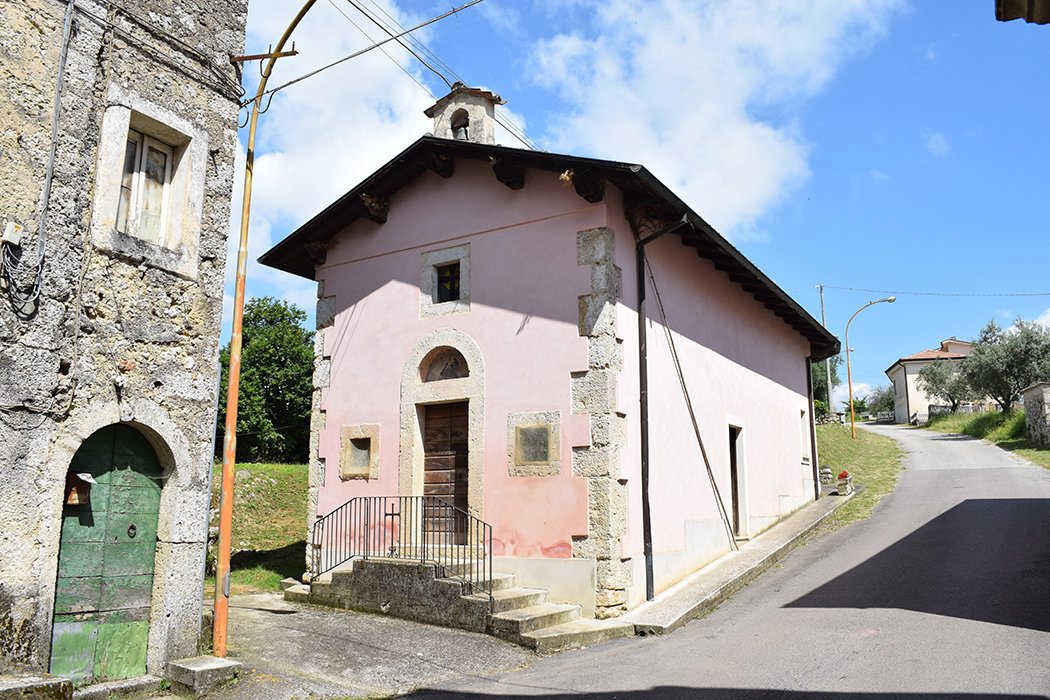
The Church of Madonna di Loreto is located in the hamlet of Frittata of Casalvieri.

It is a simple rectangular building with a gabled roof. 

The façade is adorned with an entrance door with a marble frame on whose sides there are two small openings also with marble frames. 

Inside there is the statue of the Madonna di Loreto to whom a festival is dedicated in the month of August during the Frittata Festival.

powered by social2s

Recommended

Subscribe to Newsletter

Discover a territory through the emotions of the people that have lived it.