Churches & Places of Worship

The small chapel of St. John the Baptist is located is in the center of the village of Proceno.

A simple plaster facade with a central door and a rose window.

Inside there is a unique room covered with a cross vault and enriched by a marble altar on which stands a painting of the saint.

There are many legends in the area concerning the relationship between St. John the Baptist and St. John the Evangelist in connection with ancient Etruscan pagan rites.

The two saints would represent the summer and winter solstice and would have clear references to the duo Janus.

powered by social2s

There are many stories around the construction of this small church of the Madonna del Giglio.

It is located on a hill just before the entrance to the village of Proceno.

According to one tradition, the church was built on a previous Etruscan temple dedicated to the goddess Ceres.

Other stories trace its construction back to the apparition of the Madonna with a Lily in the hands of a shepherdess.

She requested to build a chapel on an aedicule where one of her images was already to be found.

The shepherdess went to the Sforza family who had it built after considerable popular pressure.

The style of the church appears today unidentifiable.

A simple stone structure has been enriched by three large openings (in proportion to the church) with a door and two side windows framed by elaborately carved marble.

powered by social2s

The church of Saint Martin is located outside the town of Proceno.

Originally was part of a monastery that was closed and demolished with the arrival of Napoleon.

The initial construction dates back to 1200.

The façade is made of local stone that is very linear and simple, enriched only by a door and a circular opening.

The door is in Gothic style with a bezel that once must have housed a fresco.

The convent was founded by the Benedictines and delivered in 1258 to the Friars Minor Conventua,l who remained there until the arrival of Napoleon.

On the long side of the church there is an opening that once probably connected to the monastery.

This side is a frescoed area that was part of the interior of the monastery.

The church has a small sail shaped bell tower.

powered by social2s

The church of the Holy Saviour is the main church of Proceno and was probably built on the site of the first fortress of the town.

The bell tower was likely to have been carved out of the small castle tower.

Today it is located in the centre of the three districts of Proceno: the Centre, the Salaiolo and the Poggio.

The church was rebuilt after the 1919 earthquake that brought down the ceiling vault.

The facade looks like a mixture of styles with the lower part in stone with a Gothic portal and the plastered and squared upper part.

On the lunette of the entrance door there is an image of the Madonna with a child in terracotta.

In the upper part of the church there are three openings: a window and two niches that house statues of saints.

The image of the Blessed Sacrament to which the church is dedicated is found in a sculpture in the rosette of the façade.

The interior has three richly decorated naves in the sixteenth century style while the vault above the main altar is still in gothic style.

There are some frescoes of the fifteenth century on the walls.

Near the altar there is an original enamelled terracotta lectern with the image of Sant'Agnese.

powered by social2s

At the highest point of the village of Proceno there is a building with a circular base.

It is a chapel dedicated to Sant'Agnese Segni from Montepulciano, patron saint of the town.

Its construction dates back to 1879 on the site where the convent once stood.

The chapel has an entrance characterized by a Renaissance doorway that comes from the Sforza palace.

In the facade, two windows that today have artistic glazing that makes the light filter in an evocative way. 

The dome has a skylight and is frescoed with simple geometric decorations.

Above the plain altar there is an image of the saint.

A high relief painting in terracotta recalls the arrival of the saint in Proceno.

powered by social2s
Church of Santa Maria Assunta - Our Lady of the Assumption

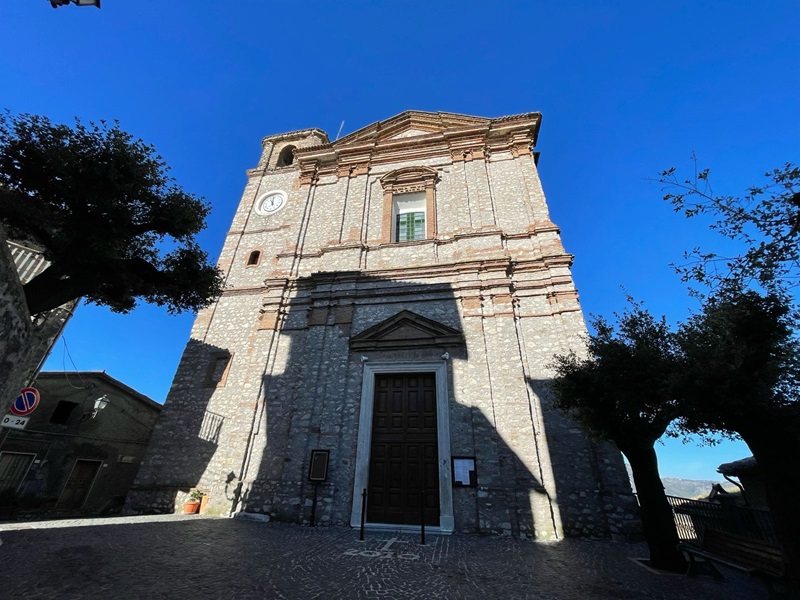
The church of Santa Maria Assunta was built on the highest point of Rocca Santo Stefano and dominates the skyline of the town. It was probably built as a chapel for the nearby castle and over time it expanded to take on its current appearance.

The last major renovation dates back to 1749, as shown by a plaque inside the church that reports the contribution of the population to its construction. While some documents report that the design of the church was made by architect Aristide Pozzi inspired by the church of Simmate in Rome and that the organ was commissioned to a famous company from Affile.

The church was consecrated in 1876 by Cardinal Raffaele Monaco La Valletta.
The church was then damaged by the 2009 earthquake and restored the following year.
The facade is made of exposed stone which, together with bricks, are worked in such a way as to highlight architectural motifs and ends with a triangular-shaped tympanum.
The bell tower is integrated into the façade although placed in a slightly set back position.
The interior has a single nave with side chapels with altars and works of art framed by round arches and barrel vaults. The main chapel is dedicated to the Assumption of the Virgin with Saint Stephen and Saint Benedict painted by a student of the school of the cavalier Menfi.

powered by social2s

The convent of Santa Maria del Giglio in Bolsena was built in the seventeenth century near the church dedicated to the Madonna del Giglio that had been built near a medieval shrine.

The monastery was located along the ancient route that connected Viterbo with Orvieto.

It was a resting place for those who wanted to go and see the relics of the Eucharistic miracle kept in the cathedral of Orvieto.

The flow of pilgrims was remarkable such that in the eighteenth century they built two other wings that led to the current form. In the nineteenth century the north wing was raised by a plan to accommodate more people.

Since 1997 it has become a holiday home and a cultural centre run by 'Points of View', a secular but Franciscan community.

powered by social2s

Recommended

Subscribe to Newsletter

Discover a territory through the emotions of the people that have lived it.