Churches & Places of Worship

Arpino. Church of the Archangel Michael

The church of the Archangel Michael in Arpino was built over a pagan temple dedicated to Apollo and the nine Muses.

This has been deduced from the nine niches carved into the rocks near the altar and an inscription on a tombstone of 1700s.

The first church probably dates from the VIII century, although the first written documents are in the Abbey of Monte Cassino and relate to a donation of 1104.

In confirmation of its history, there is a bell dated ‘MC’ (1100).

Its importance is demonstrated by the fact that in 1400 the church was the residence of the Bishop of Sora.

Its present Baroque appearance is due to a restoration and reconstruction following the 1654 earthquake.

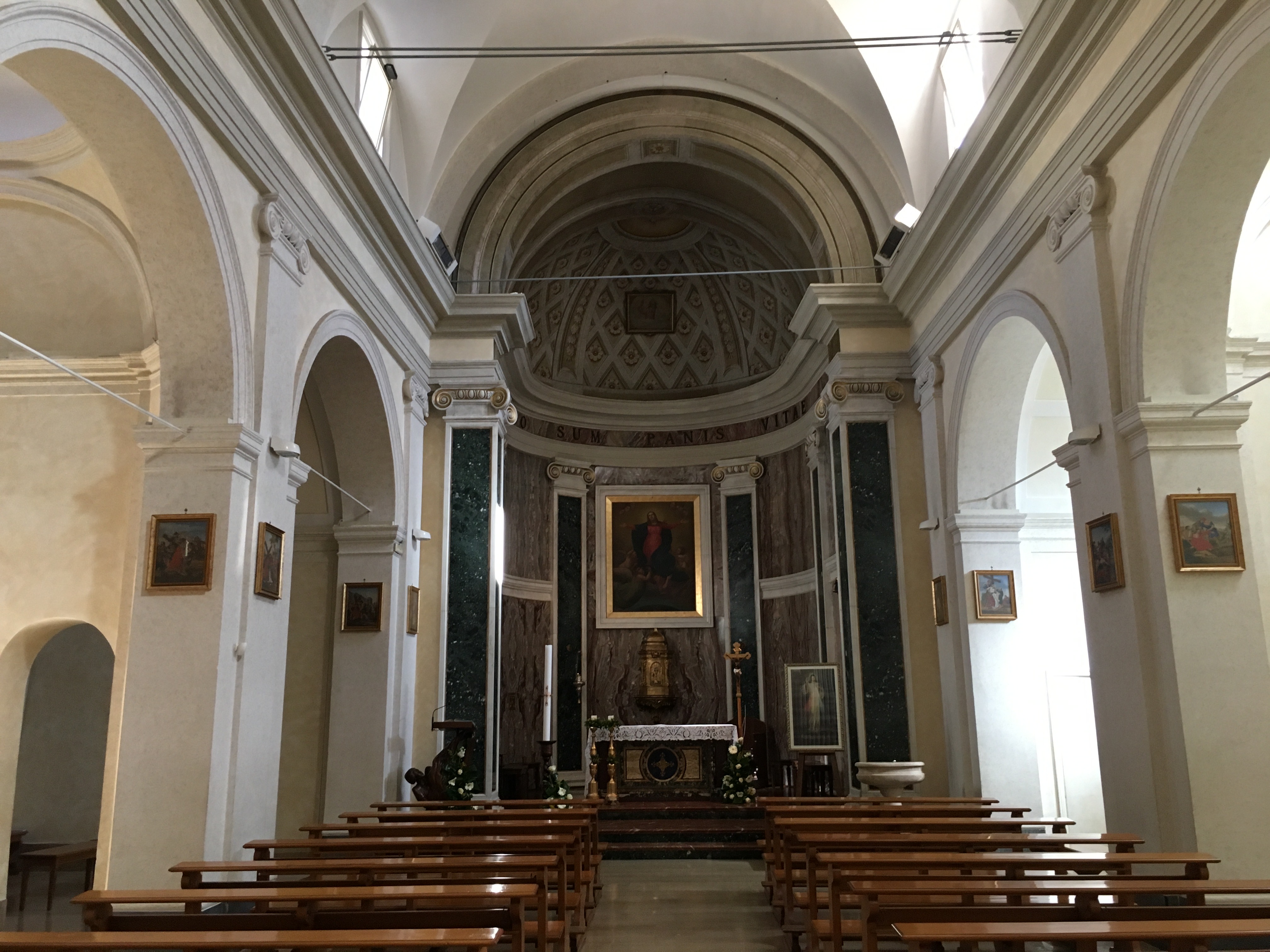
The church has a plan of a Latin cross and has three naves with side chapels. Inside, above the altar, there is the painting of 'The Archangel Michael victorious over Lucifer' by Cavalier d'Arpino.

The church contains an interesting Via Crucis with 14 stations carried by Cavalier d'Arpino and paintings by Francesco Curia, Dionysius Ludovisi and other Tuscan School.

The furniture is then completed by a splendid eighteenth-century organ and inlaid wood works of the great craftsman Michael Stolz as the pulpit and baptistery.

Michael Stolz worked extensively in Arpino and is buried in this church.


powered by social2s
Prossedi. Church of Santa Maria Extra Moenia

The church of Santa Maria Extra Moenia (outside the city walls) in Prossedi is also known as "Church of Strammetta".

It dates from the nineteenth century and it was the chapel of the princes of the family Gabrielli where family members were buried such as Augusta Bonaparte and Placido Gabrielli

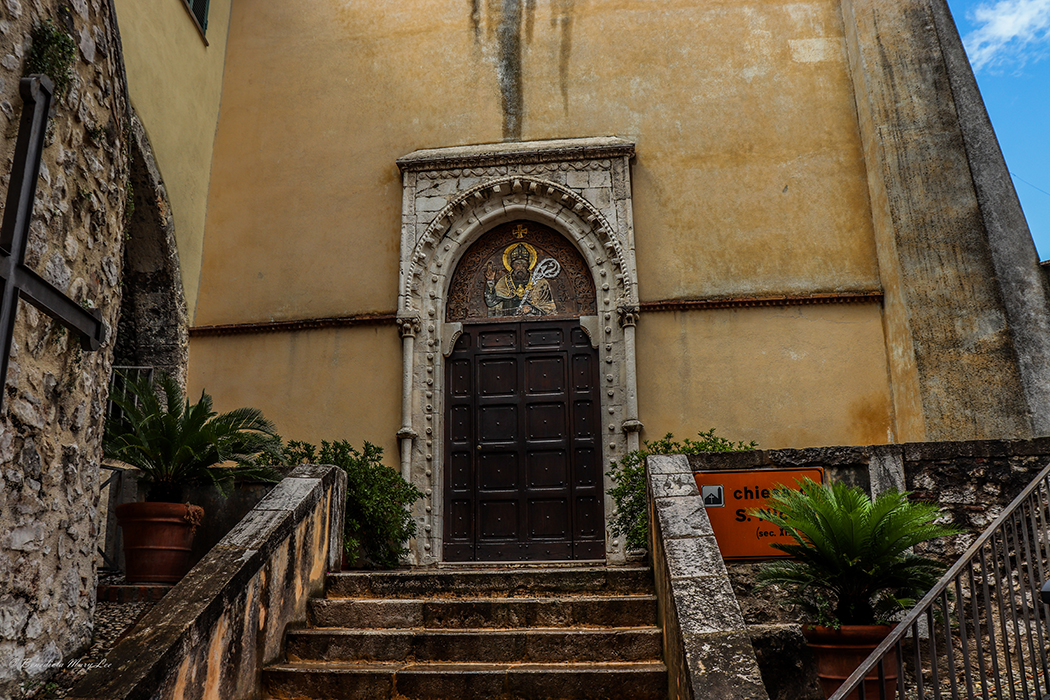
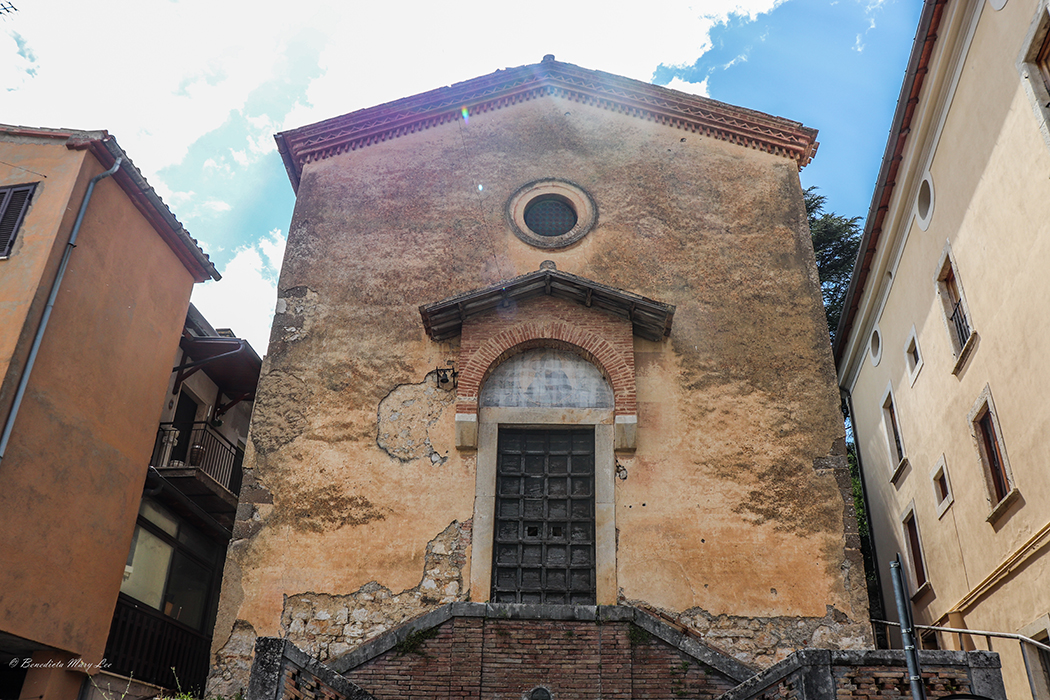
It was built in an elevated position and is entered through a spectacular staircase with two facing flights protected by an elegant brick balustrade.

The facade is simple with the classic gabled form enriched by a decoration in bricks and plaster above the door that frames a fine mosaic representing the Madonna with Child between roses and lilies.

The mosaic is the work of Adolfo de Carolis, the drawings of artist Napoleone Parisani, and were obtained in 1902. The facade is completed by a round window in the centre just above the mosaic.

The interior is full of bright decorations made with frescoes, mosaics and ceramics with a predominance of the colours: blue, pink, green and yellow.

The altar made of tiny polychrome mosaics is a true masterpiece.

All decor and furnishings were made by Napoleone Parisani, who has left clear masonic symbols such as the type of Templar cross.

Above the altar was a triptych depicting the Madonna and Child flanked by St. Augustine and St. Placido, also made by Parisani, that is now in Prossedi Castle.

powered by social2s
Prossedi . Church of St. Nicholas

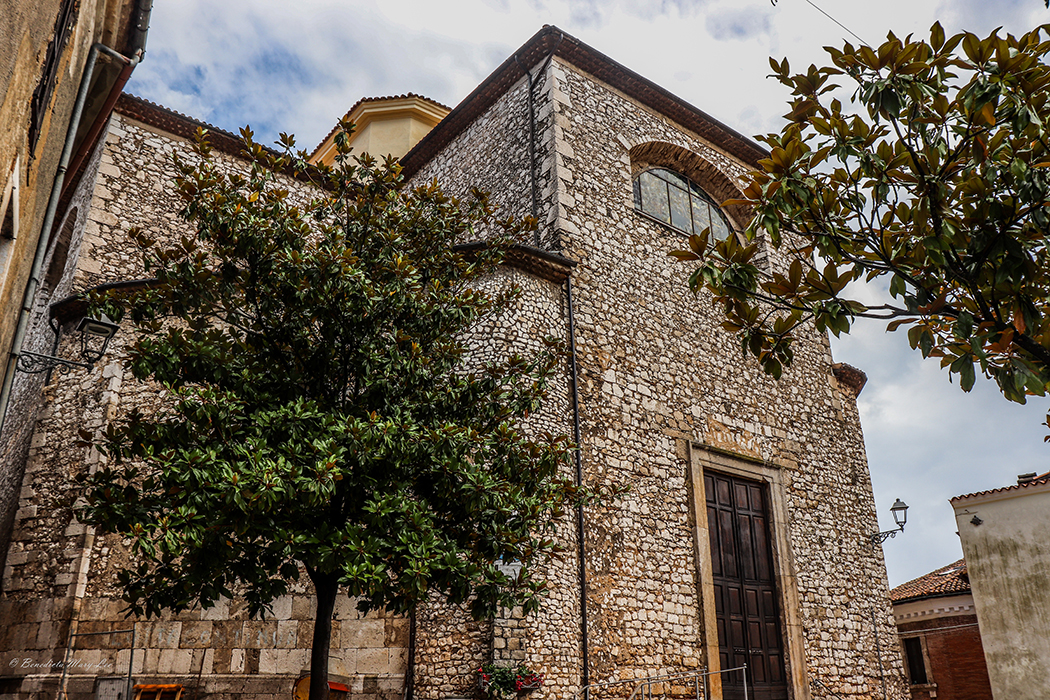
The church of St. Nicholas in Prossedi dates from the thirteenth century and is the oldest in town. It is in Romanesque style and for years had been abandoned and used as a stable to shelter animals.

In 1900 the population with support of Prince Gabrielli found the funds to finance the restoration and in 1902 the church was reopened.

The church has a simple facade adorned by a beautiful fourteenth-century doorway framed by carved marble in Cistercian Gothic style that also protects a wooden bas-relief of St. Nicholas.

The façade is completed with a simple but elegant carved stone rose window of the fourteenth century that lets in a very attractive light.

The interior has a nave with wooden roof supported by big Gothic arches. The large altar is in a raised position, above a stone staircase with 8 steps bounded by a marble balustrade.

Among the works inside the church there is the painting of "Maria Santissima Advocate Nostra", better known as the "Madonna of Vicovaro", a town near Rome. This image is highly revered and is a copy of a picture that is located in Vicovaro.

Legend has it that in July 1863 the Virgin in the painting in Vicovaro moved her eyes and a pilgrimage began of the faithful to pay homage to the painting.

Among these faithful who went there was also Don Gaspare Olmi from Prossedi who was so affected that he commissioned a painter in Rome a copy of the painting.

The picture was exhibited in the ancient church of St. Nicholas and on 6 June 1864 also the lady of Prossedi moved her eyes in front of some young people.

The bells rang in celebration and on May 31, 1964 Pope Paul VI granted the right to place a golden crown on the image of the Madonna of Prossedi.

powered by social2s
Prossedi. Church Sant'Agata

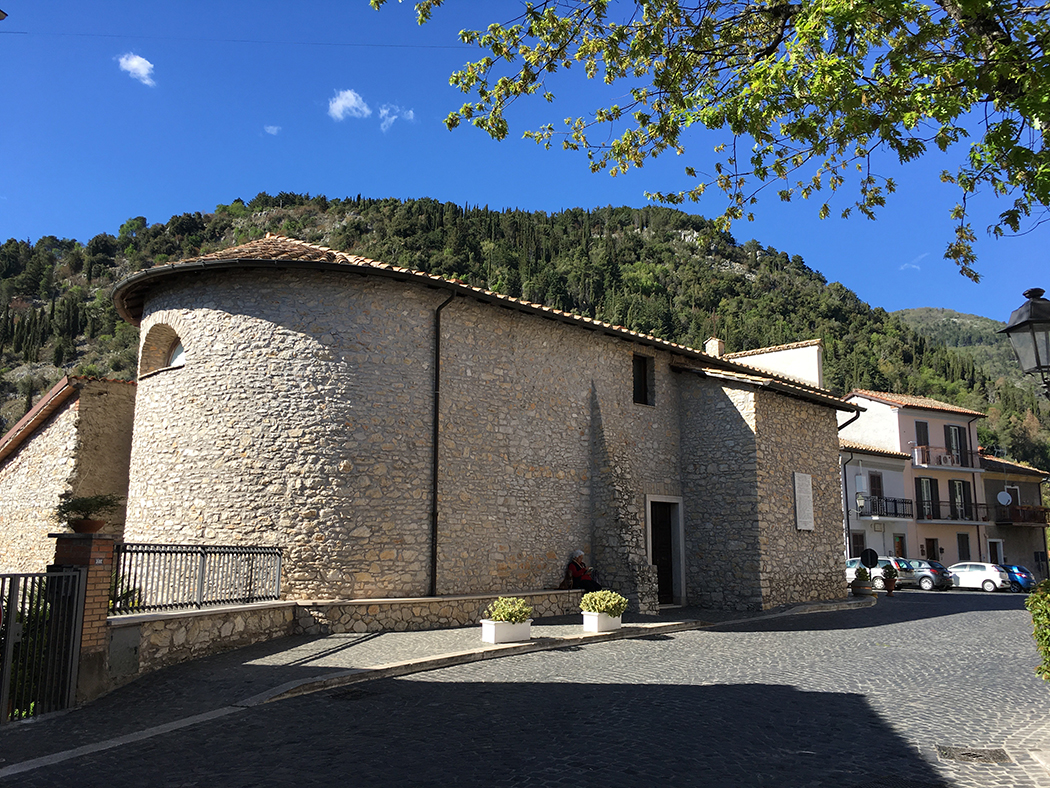
The Sant'Agata church stands on the highest part of Prossedi and dominates the town.

Its construction began in 1655 and expanded in the late 1700s but work was interrupted several times due to lack of funds.

The church was completed in 1829 and dedicated to St. Agatha, virgin and martyr.

Of neoclassical style, it has a plan of a Greek cross with apses and chapels in the corners of the cross.

The sacristy belongs almost certainly to the early construction as in fact does the plan of the church with a central dome.

In the sacristy, there is a beautiful carved wooden confessional from the seventeenth century Roman school.

Behind the altar there is a majestic wooden choir with 13 finely decorated places.

On a wooden loft in the doorway is located a large pipe organ from 1861, the work of the organ builder Peter Pantanella.

powered by social2s
Cerreto Laziale San Sebastiano

The church of San Sebastian in Cerreto Laziale dates back to 1572 and was a simple building with walls painted by the same artist as the monastery of St. Scholastica in Subiaco.

Located inside is a sixteenth-century statue of the saint in coloured stucco.

In 1851, a small organ was introduced.

The simple facade of the building has a supporting structure framed in travertine from the sixteenth century and two small windows protected by iron bars.

powered by social2s
Cerreto Laziale chiesa Santa Maria Assunta

The church of Our Lady of the Assumption - Santa Maria Assunta in Cerreto Laziale dates from the twelfth-thirteenth century and has three naves with three chapels on each side and a semicircular apse.

The church was extensively rebuilt in 1860 with new interior and a new bell tower.

On the high altar is an important gilded wooden tabernacle of the seventeenth century and a wooden crucifix of the XV century.

The chapel with St. Sebastian sculpture is enhanced by a small dome that provides appealing filtered light.

The pipe organ is from 1815.

powered by social2s
Zagarolo. Church of the Holy Announced di Zagarolo

The church of the Holy Announced di Zagarolo dates back to 1500 and was built by the Colonna family.

The façade is in neoclassical style with five orders and the entrance door is underlined by two travertine columns that support two Roman capitals. The dome is adorned with a graceful Baroque-style onion lantern.

The interior is fairytale-like with rich stuccoes and Baroque ornaments. The plant is a Latin cross with a single nave with communicating chapels.

The bell tower was obtained from an original octagonal tower of Lombard origin.

powered by social2s
Sutri. Church of Holy Cross

Probably this church of Holy Cross in Sutri dates back to the Crusades but the first document that mentions it is from1658.

The church was connected to the nearby hospital and for many years was used as a city cemetery.

The church is very simple, one room with tiled floors and wooden ceiling and is home of the Arch-confraternity of the SS. Sacramento, Santa Croce and Gonfalone.


powered by social2s

Recommended

Subscribe to Newsletter

Discover a territory through the emotions of the people that have lived it.