Churches & Places of Worship

Campagnano di Roma. Collegiate Church of San Giovanni Battista

The Collegiate Church of San Giovanni Battista in Campagnano di Roma was built in 1515 on the remains of an older church.

It has two entrances separated by a gradient, in fact the church was built on a slope. The main entrance is located off the Fontana Secca and has a large staircase.

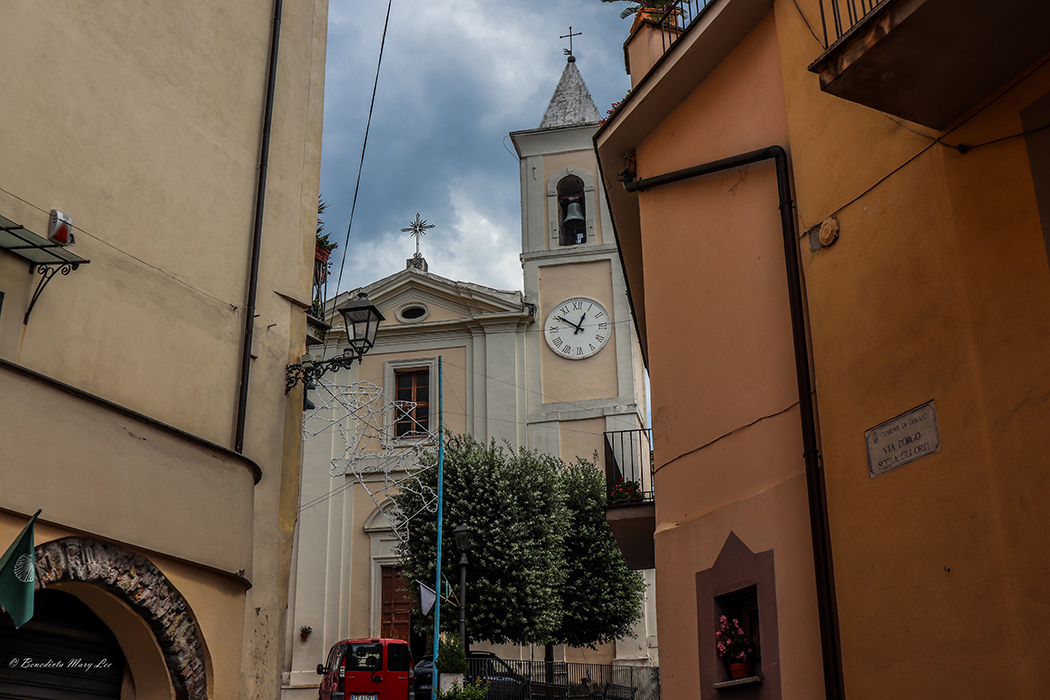
The façade is simple, plastered with an entrance door with a Gothic arch decorated with a marble frame, and is partially covered by a house on one side while the bell tower is on the other.

The entrance door is not in the center of the church. Note the 4 floors of the majestic Baroque bell tower of 1602 that ends with a bell-shaped roof, the symbol of Campagnano.

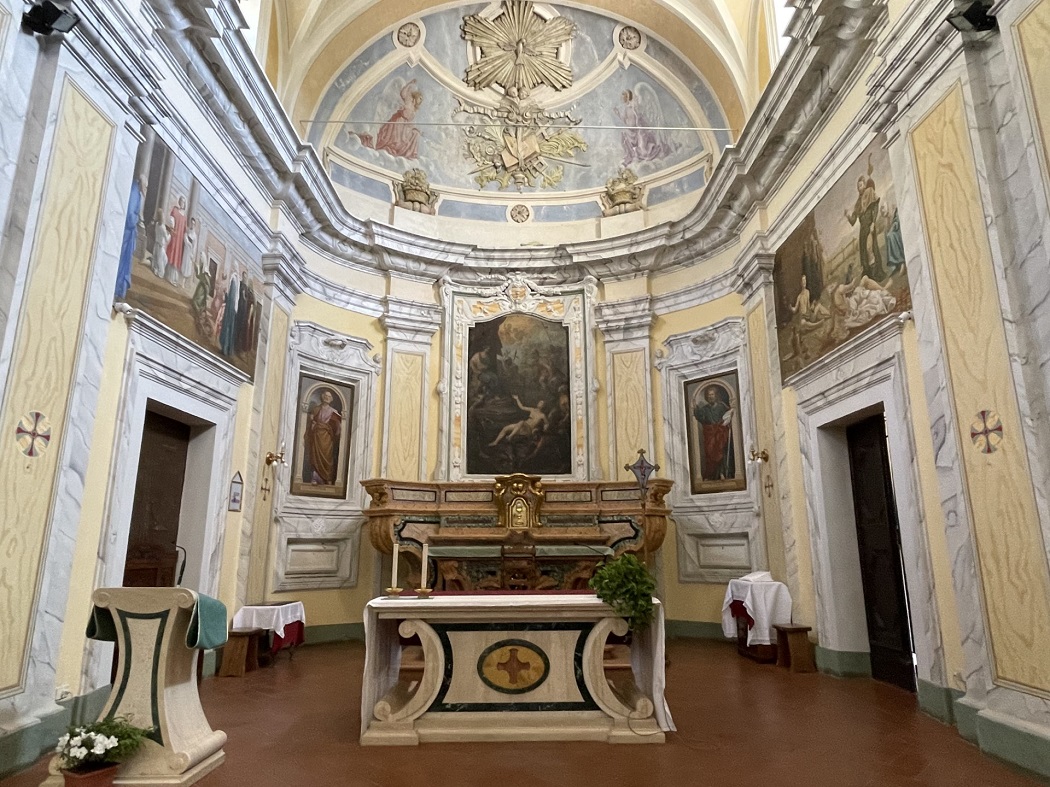
Inside the church has 3 naves separated by a row of round arches. The church has 16th century frescoes in many parts.

The part of the finely inlaid choir and a wooden ceiling with the sculptures of the 4 evangelists of 1582 made by Giacomo del Duca are of considerable value.

The ceiling of the church is coffered with a reproduction of San Giovanni Battista and is richly decorated and on the part above the entrance there is a choir and a beautiful 18th century organ.

Two beautiful side chapels are dedicated to San Rocco and the Madonna and feature ornate and carved sculptures that were once carried in procession.

powered by social2s

The church of St John in Patrica is now in Baroque style, but its origins are medieval.

The first building was built on the ancient walls near a city gate. The large vestibule was realized precisely on the remains of an ancient round tower.

During the seventeenth century it was destroyed and the subsequent reconstruction in the Baroque style finished in 1760.

The interior has a single nave and six side chapels and, just above the entrance area, there is an old organ of the seventeenth century made by an artisan company of Affile, a nearby town.

Behind the altar there is a painting that represents "The Baptism of Christ" made in the mid-eighteenth century by Niccolò Dalla Piccola, artist of Pope Clement XIV's court.
 

powered by social2s

The church of St Peter in Patrica dates from the thirteenth century and was transformed in the nineteenth century, changing the orientation.

On the left side of the facade can be seen the remains of the medieval building.

The plan of the church is a Latin cross with a semicircular apse and eight chapels. The church has a dome that ends with a lantern.

The facade has a base in lava stone and is crowned by a pediment with a papal coat of arms made by Gaudioso Grossi.

Inside the chapels are altars, valuable paintings and statues.

The high altar stands isolated in the sanctuary, surrounded by an imposing nineteenth-century wooden choir and topped with a big altarpiece.

Above the entrance door there is a magnificent wooden choir which once supported an organ, now replaced by a large harmonium.

The sacristy has an altar with a painting taken from the Our Lady of Peace. The bell tower is on the left side of the facade.

It is the largest church in the diocese of Ferentino and is surely disproportionate to the size of the town, it can accommodate more than 2,000 people.
 

powered by social2s
Patrica. Church of St. Francis Xavier

The church of St. Francis Xavier - Chiesa di San Francesco Saverio di Patrica has an austere stone facade, dating back to the mid-nineteenth century.

The interior has a Latin cross plan and two side chapels.

It is popularly known as the "Church of the friars," the name by which it was called by the monks of the Congregation of the Most Precious Blood of Christ that have built it.
 

powered by social2s

The church of San Rocco in Patrica is in neoclassical style and its construction took place in two phases, beginning in 1912 and ending in 1964.

It was built outside the ancient city walls, near a tower and close to the homonymous port.

As per tradition, in fact, near the entry gates were two small churches of the sixteenth century dedicated to St. Rocco and St. Sebastian that had to protect the inhabitants from the plague.

The facade in peperino has an elegant loggia in the lower part.

The interior is simple with a single nave and the high altar the bottomof which is enhanced by the statue of San Rocco between two angels.

On the right side of the altar, behind a small door, there is a steep staircase with 60 steps connects up to St Peter's church.

powered by social2s
Patrica. Church of Our Lady of Peace

The church of Our Lady of Peace in Patrica is located at the beginning of the path that leads to Monte Cacume.

It was built by the Jesuits at the end of the nineteenth century near an older church that had been destroyed.

It is imposing built with simple white local stone and is enriched by a valuable classical portal which you can reach by climbing a small white marble staircase.

The church has a single nave covered by painted vaults and inside is an interesting cycle of frescoes representing the Madonna painted in 1889 by Lucari.

The faces of the figures of the frescoes are those of real people, because the painter used as his models the inhabitants of Patrica.
 

powered by social2s
Church of St Lawrence

The original church of St Lawrence - San Lorenzo in Gerano dates from 1000s and had been built just outside the Castrum.

Initially it was used as a cemetery and inside stand out the different areas depending on the importance of the deceased: the priests in the sanctuary, members of Zilli family near the front door, and men, women and children in areas near the main altar balustrades.

The interior in the Rococo style was designed by the architect Camporesi and built by G.F. Fontana in 1797.

The church has a remarkable organ of the seventeenth century and in its interior is an altarpiece by Domenico Fiorentino representing the martyrdom of San Lorenzo.


powered by social2s
Gerano. Church of the Annunciation

The church of the Annunciation in Gerano is part of a small complex built around the fifteenth century to house the sick who were to be transferred to Tivoli.

It was therefore the typical hospital-hospice built just outside the town walls.

The interior has frescoes of the sixteenth century and a canvas of 1742 by Ranucci which represents the Annunciation.

powered by social2s

Recommended

Subscribe to Newsletter

Discover a territory through the emotions of the people that have lived it.