Churches & Places of Worship

Capranica Prenestina Chiesa Maria MAddalena 1 - Bettiol - 19

The original church of the Magdalene in Capranica Prenestina dates back to the fifteenth century as can be seen from Romanesque bell tower with three levels.

According to the story, it would have been built by Martino V Colonna. But the real surprise of the church takes place with a remake of the church in 1520 by Giuliano Capranica.

With its small dome of the school of Bramante, the Church of the Magdalene is a pleasant surprise among the simple historical centre architectures.

 It is a round building with a fine portico of seven arches. From the central archway, behind the church, a balcony consists of two Corinthian columns supporting an entablature that dominates the view.

The story says that the original drawing was made by Bramante while construction was entrusted to its architect Domenico Massimo.

All the rest of the church was later changed by the Barberini family in the eighteenth century who introduced the late Baroque style by deleting the original Renaissance style.

The barrel vault of the nave is painted with the figure of Mary Magdalene to whom the church is dedicated. On the altar there is a baroque statue of Mary Magdalene.
 

powered by social2s
Genazzano. Church of St. Pius

The church and convent of San Pio in Genazzano were built on the ruins of an ancient Roman imperial villa probably inhabited by the emperor Antonino Pio.

The villa was still visible until 1838 when it was described by Senni in his book 'Memoirs of Genazzano'.

In 1910 a mosaic floor was discovered which is now in the Museo Nazionale delle Terme in Rome.

The monastery dates back to the middle of the fifteenth and seventeenth centuries and the marble portal inscription refers to Pius II Piccolomini.

The lunettes of the cloister are decorated with frescoes by Vincenzo Manenti and depict St. Francis.
 

powered by social2s
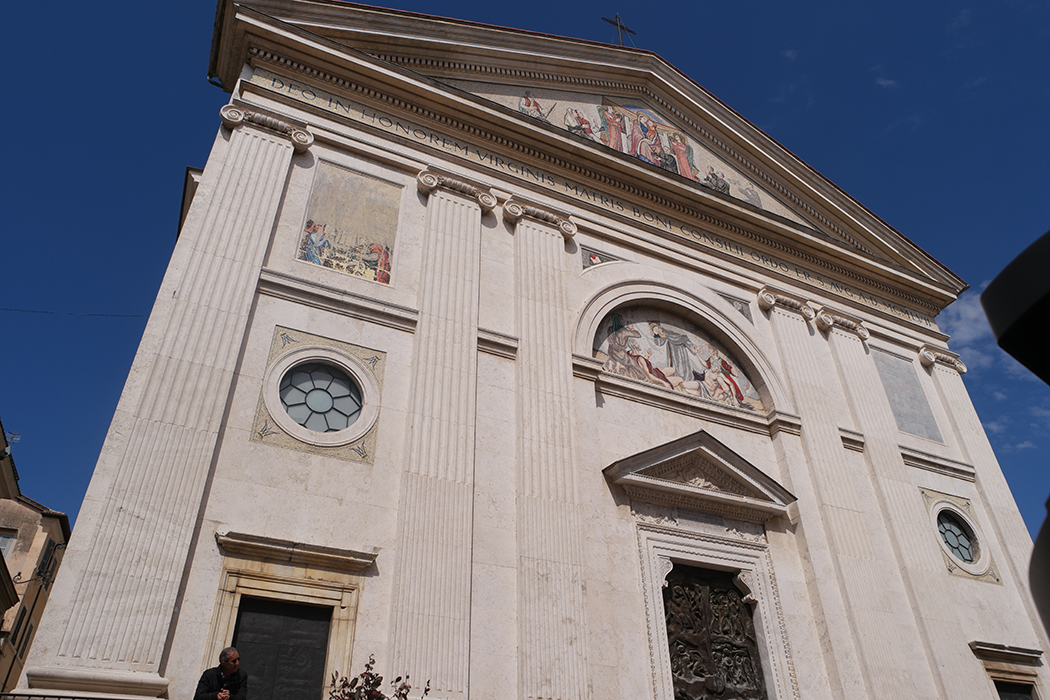
Genazzano- Santuario Madre del Buon Consiglio Campanile by Benedicta Lee

The sanctuary of the Mother of Good Counsel was built in Genazzano on a previous church where a miraculous event had occurred.

The original church of the tenth century was converted into a cemetery .

The conversion began in 1356 by Giordano Colonna.

The church was built to guard and venerate an image of Mary, called Mother of Good Counsel, which according to legend is from a church of Scutari in Albania.

The image was supposed to have arrived carried by the angels on the day of April 25, 1467 after the Muslims arrived in Albania.

The angels are said to have settled on a small church that Beata Petruccia was building.

Since then the entire population helped to finish the building that soon became a pilgrimage destination and the image is still in the sanctuary. The scene is told in a beautiful painting.

The church is now in an eighteenth-century style and is rich in works of art such as the original balustrade with cherubs and drapery marble that is attributed to Bernini.

Behind the altar is a large organ of 1930 instead of frescoes that are now in the museum on the ground floor.

The museum houses the works of many artists who over the centuries have wanted to pay homage to the sacred image and splendid 'vestments' from the sixteenth and seventeenth centuries.

The museum also houses the bell that on April 25, 1467 announced the arrival of the image.

In the refectory there is a fresco by Taddeo Conza depicting the miracle of the loaves and fishes.

The sanctuary was visited by many popes, including Pope Urban VIII, Pius IX, John XXIII and Giovanni Paolo II.

powered by social2s
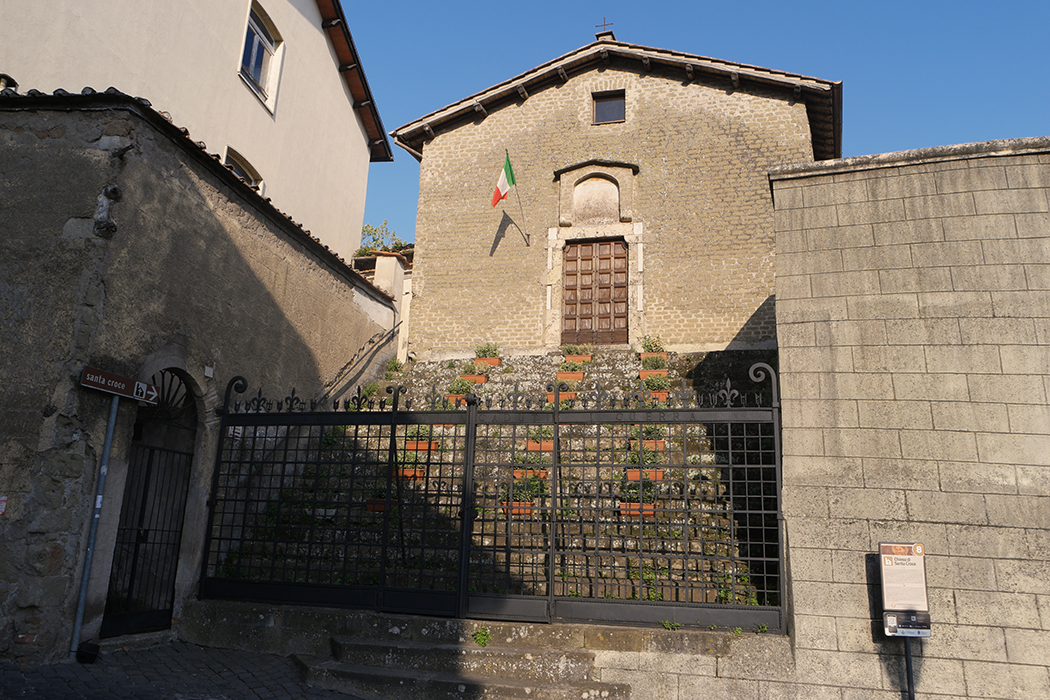
Genazzano- Chiesa di Santa Croce by Benedicta Lee

The church of the Holy Cross in Genazzano is located on a steep staircase right next to 'Porta Romana'.

Its location inside the city walls and its style date back to the Middle Ages and probably belonged to the monastery of Subiaco, which at the time controlled much of the territory of this part of Lazio.

In 1400 Antonio Colonna built a hospital next to the church which remained in use until the bombing of 1944.

The facade is very simple, with just a doorway surrounded by a frame and a picture frame must have had a fresco, that leaves one to imagine the beauty of the interior.

The interior is a single very appealing space totally frescoed with the fourteenth and fifteenth century paintings that make up three cycles. The first includes the portraits of Saint Catherine of Alexandria, St. Anthony Abbot and St. Francis.

The church is adorned with a font obtained from a capital and is closed to worship.
 

powered by social2s
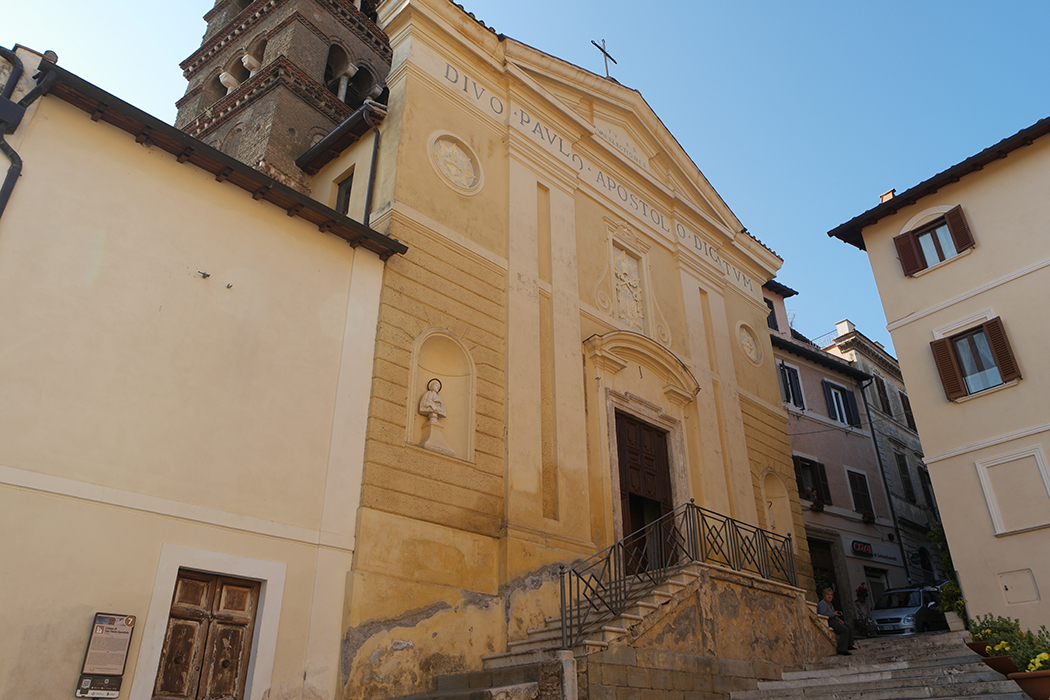
Genazzano- Chiesa San Paolo Apostolo by Benedicta Lee

The original church of Saint Paul Apostles in Genazzano dates from the thirteenth century and is mentioned in a document of 1277.

The current interior dates back to the eighteenth century refurbishment and the style is late Baroque.

The facade, however, was rebuilt in 1829 and the strict lines are softened by the side niches with busts of St. Peter and St. Paul of the fourteenth century.

The interior has three naves and the left incorporates the bell tower which was originally detached from the building.

The church contains many valuable works such as a marble niche of 1512, flanked by the busts of St. Peter and St. Paul from the thirteenth century, and a baptismal font of the sixteenth century.

The altar is decorated with an altarpiece depicting Mary, St. Peter and St. Paul.

The decoration of the church recalls the Ninfeo Bramante in the park outside the walls built by the Colonna.

A grand organ by Malvestio di Padova enriches the spirituality of the church.

Next to the church, the splendid Romanesque bell tower with three levels of mullioned windows reveals the medieval origins and gives a touch of originality to it all together.

powered by social2s
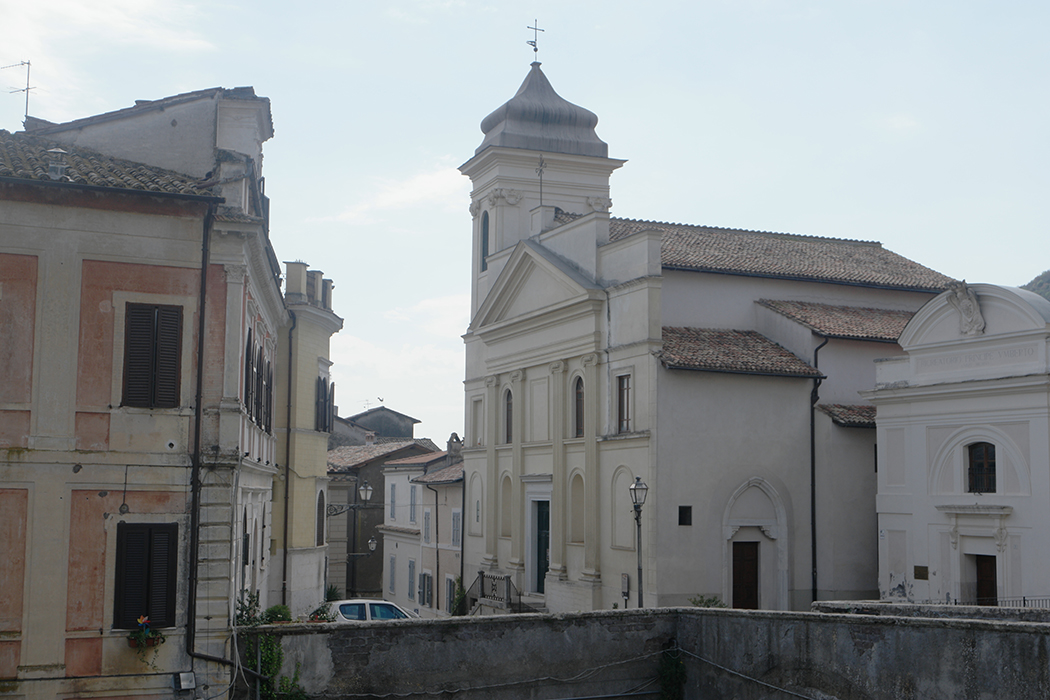
Genazzano- Chiesa di San Nicola by Benedicta Lee

The original Church of St. Nicholas in Genazzano dates back to the Middle Ages and the church is mentioned for the first time in the statutes of Genazzano from 1277.

It is dedicated to St. Nicholas of Bari, the patron of Genazzano, and was part of the castle. Perhaps here was baptized papa Martino V Colonna who, having become pope, has refurbished and enriched it with valuable works.

Part of the church was demolished in 1616 for the creation of a new perspective onto the Colonna Castle.

With these demolitions and reconstructions in the Baroque style, the church has assumed a unique appearance.

In fact, the interior of the church, three aisles with side chapels, is a strange mixture of late Gothic and Baroque styles.

The wonderful cosmatesco floor and polychrome wooden ceiling are opposed to the Baroque altar decorations in white stucco and gold, with Corinthian columns.

The church ends in an apse with a wooden choir dating back to the mid-eighteenth century.

The church contains a number of tombstones, including one dedicated to the Princess of Goti, Flavia Amalafrida Theodinanda, held in exile in Genazzano, and John Brancaleone.

Above the front door is an eighteenth-century organ of the famous family of organ builders of Catarinozzi.

powered by social2s
Genazzano. Church of Saint John

The small church of Saint John is located in the square below the Colonna castle in Genazzano and was mentioned for the first time in a deed in 1356.

Its simple form of a neoclassical temple reveals the many works of modification that have taken place over the centuries.

The church consists of a nave, with small side chapels, which ends with a presbytery for the high altar.

The church is characterized by a simple flat wooden roof and an organ placed above the entrance door.

Inside are kept some valuable works including a holy water font carved in the fifteenth century, a marble baptismal font with a fifteenth-century wooden cupola and a wooden statue of the Madonna.

powered by social2s
Campagnano di Roma. Sanctuary of Santa Maria del Sorbo

The sanctuary of Santa Maria del Sorbo is located in the picturesque Sorbo Valley and has long been disputed between Formello and Campagnano di Roma.

It was built on the site where once there was a castle founded around 996 following the Saracen invasions of the 10th century.

It was the period in which the inhabitants took refuge in fortified centers in which there was always a chapel which, in Campagnano di Roma was dedicated to the Madonna. In the Middle Ages it was owned by the Monastery of San Paolo and later by the Orsini Family.

In 1427 a church was built next to the abandoned castle in honor of the Virgin represented by an icon of a Virgin and Child on the altar, an icon that the Orsini family donated to the Carmelitano Order.

A legend tells another story about the construction of this sanctuary and the icon that would hide a miracle.

It is said that a boy with a broken arm went to graze the pigs in the Sorbo Valley and noticed that every day he observed a sow moving away and returning after a few hours. One day he followed her and found her settling under a tree almost in the form of a prayer.

Looking through the branches of the tree, he saw an icon of the Madonna and Child.

The image spoke to him and told him to go and inform the inhabitants of Formello and build a shrine there.

To make herself believe, Our Lady performed the miracle of healing the young man and making him return to normal.

The inhabitants of Formello did not believe him, while those of Campagnano di Roma followed him and built the current sanctuary with a convent that immediately became a destination for pilgrimages.

Today the sanctuary has a church with a bell tower and a part of the original convent, while other ruins are next to it.

The church has a simple facade, which highlights the internal division into three naves, and the bell tower is immediately next to the entrance.

The interior is simple with white walls, aisles separated by a series of arches, just highlighted by peperino, and a trussed wooden roof.

On the bottom apse there is a series of 15th century frescoes that represent the Virgin in the center and two rows of saints that pay homage to them.

In addition to the icon of the Madonna with Child, in the church there is a particular wooden crucifix of a Christ that mingles with a tree.

powered by social2s

Recommended

Subscribe to Newsletter

Discover a territory through the emotions of the people that have lived it.