Churches & Places of Worship

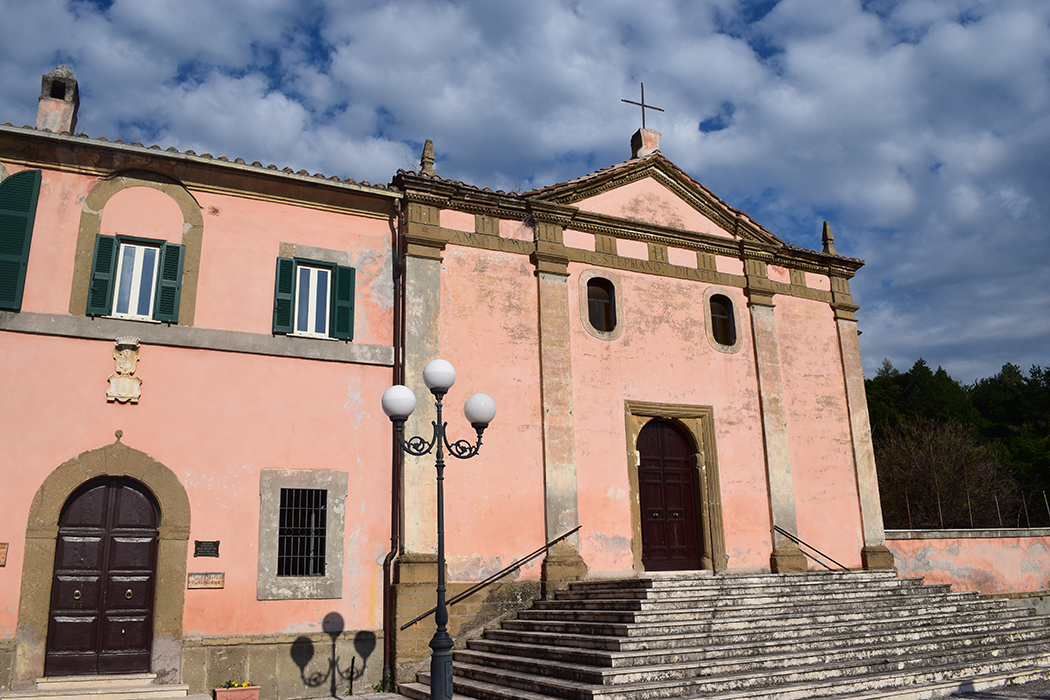
Poli. Church of Saint Stephan

The original church of Saint Stephan was a medieval building consecrated in 1138 and was located outside the walls of Poli.

In 1628 the church was also renovated with the addition of a college thanks to the Dukes of Poli.

The dukes offer a land to S. Giuseppe Calasanzio to build a school for the inhabitants of the village.

In this church there are the tombs of the dukes' family and the last restoration work dates back to 1723.

The fresco of a crucifixion attributed to Taddeo Zuccari is to be found in the apse.

powered by social2s
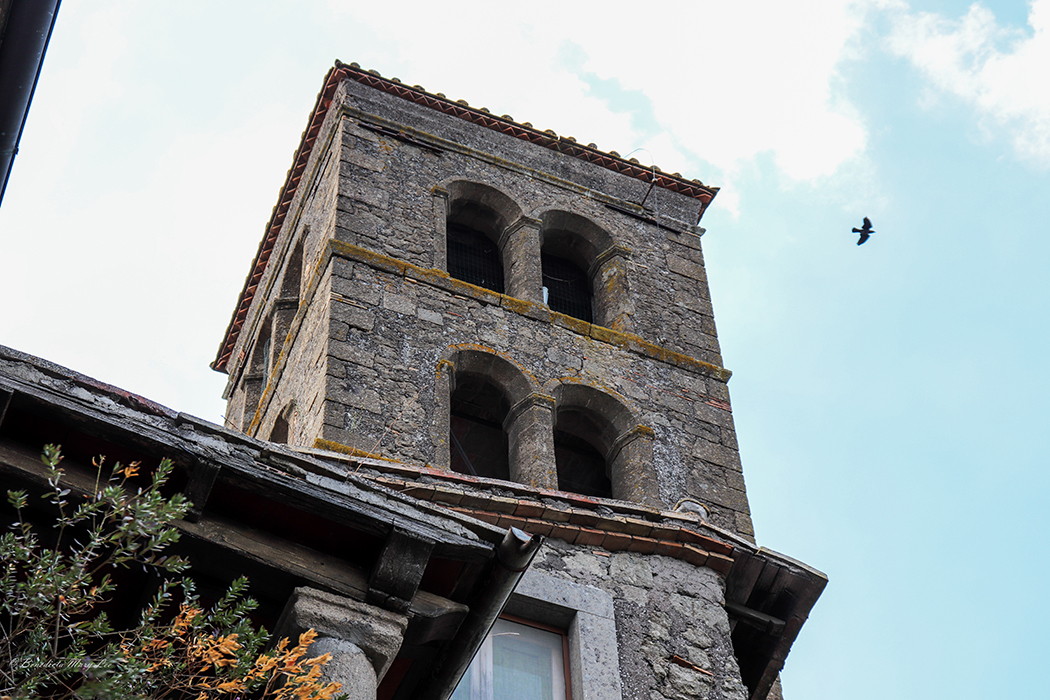
Bomarzo. Bell tower of the cathedral

In Bomarzo, the bell tower of the Cathedral of Santa Maria Assunta, in Romanesque style with a succession of mullioned windows, was built with blocks of peperino on a previous structure of Etruscan origin. The tower is equipped with a clock.

Note a Roman plaque depicting a man and a woman and which can be found between the structure of the bell tower. In the Middle Ages various materials of Roman origin were frequently reused in the construction of churches and palaces.

powered by social2s
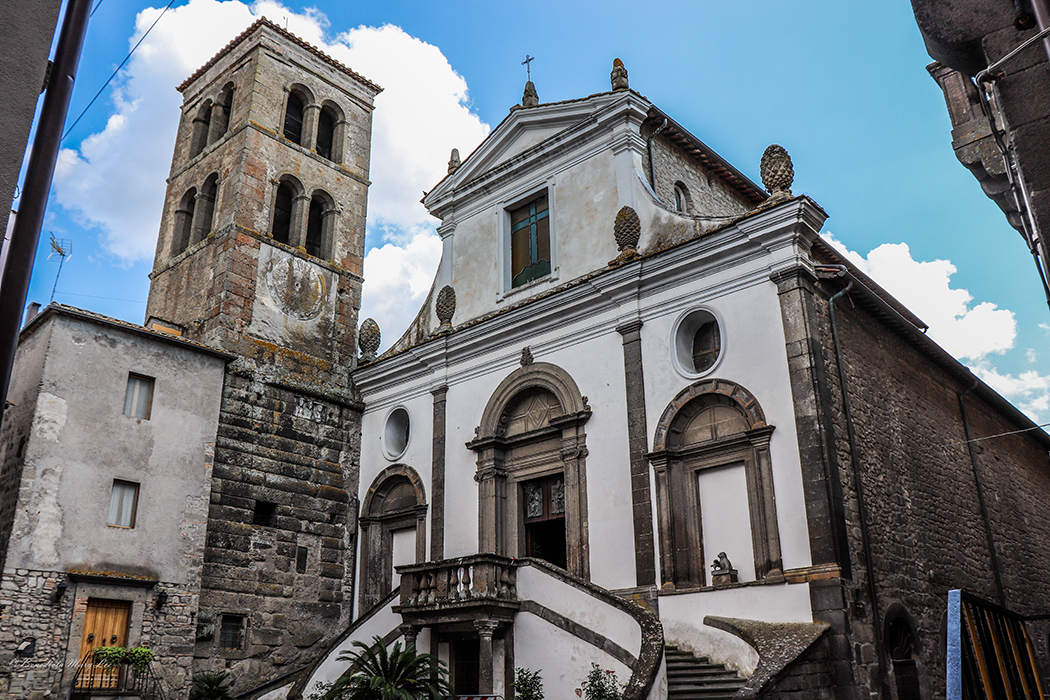
Bomarzo. Cathedral of Saint Mary of the Assumption

Bomarzo has been an important religious center since the beginning of evangelization, so much so that pope Sabinian, who was pontiff between 604 and 606, should have been born in this town.

The ancient village must have had its own church since the paleo-Christian period and the first church of Santa Maria is very old and was built on remains of Etruscan origin, as can be seen from its base.

The church then underwent modifications and modernizations over the centuries starting from the 9th century.

The current form dates back to the 15th century according to Brunelleschi's style and was started by the Orsini family and completed by Giulia Farnese. The facade in peperino and plaster is characterized by a horseshoe-shaped access staircase that leads to the entrance floor of the church.

The interior has three naves divided by pillars in peperino, the classic local stone. The altar is adorned with an altarpiece representing the miracle of Sant'Anselmo who frees Bomarzo from Totila, king of the Ostrogoths who had invaded the Italian peninsula at the fall of the Roman Empire.

The body of Saint Anselm is kept under the altar and is carried in procession on the feast dedicated to him.

The two side naves end with an altar dedicated to San Sebastiano on the left and an altar dedicated to the Madonna del Rosario on the right. They are enriched by frescoes and works of art such as a canvas depicting the Virgin of the Rosary (16th century), a Majesty of the Umbrian school (15th century) and a Roman marble sarcophagus with a lid from the Carolingian era.

A beautiful 17th-century representation of Saint Anne and the Virgin Child from the Lombard school is located above the confessional. Note also a canvas of the martyrdom of San Giovanni Battista from the 16th century and one of San Carlo Borromeo.

powered by social2s
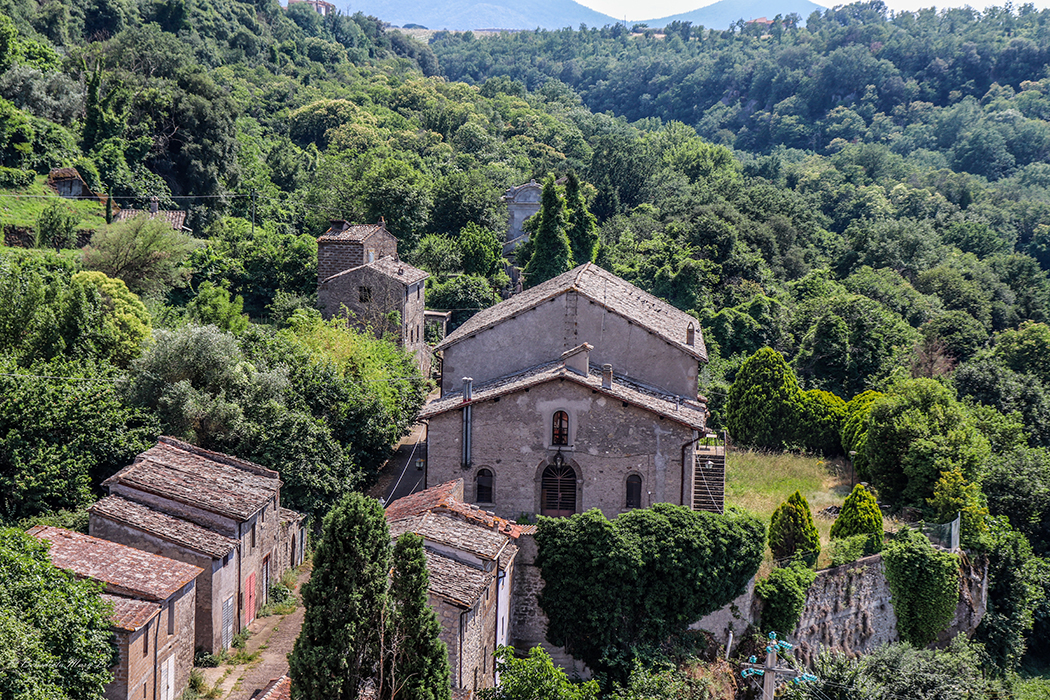
Bomarzo. Church of Saint Mary of the Valley

The elegant church of Saint Mary of the Valley - Santa Maria della Valle is located between the Sacred Wood and the village of Bomarzo. It has a particular white marble facade with 8 marble columns and a triangular tympanum. The church appears raised and is accessed via a small ramp that ends with steps.

Two of the columns are interrupted by the entrance door to the church.

The church was built by the Lante delle Rovere family who modified a previous building of worship.

powered by social2s
Bomarzo. Church of the Risen Christ

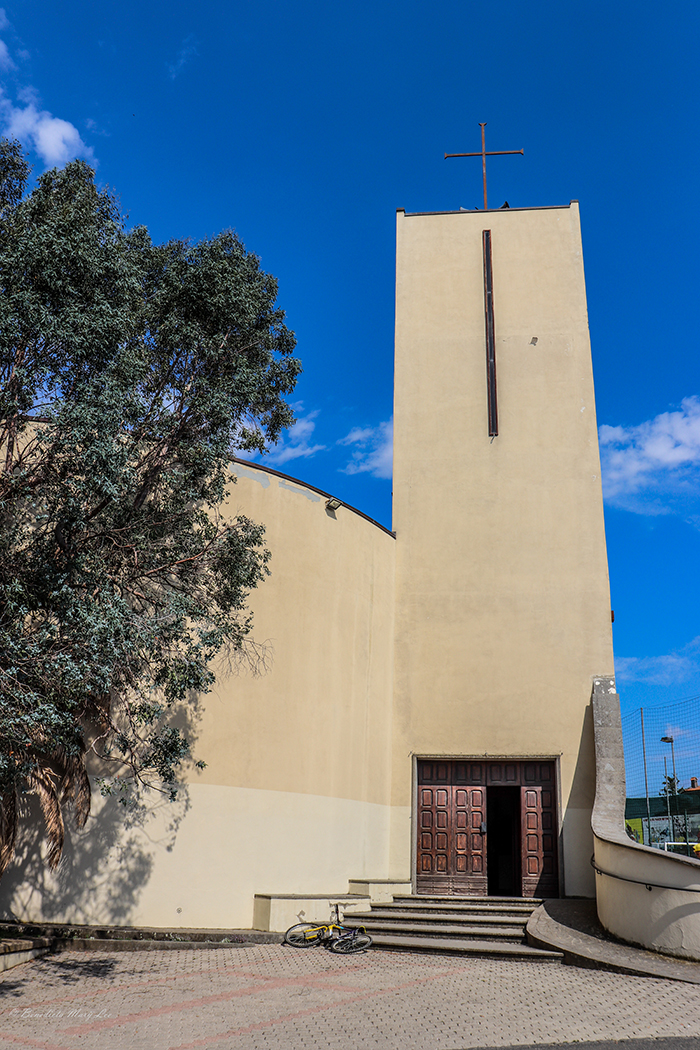
The church of the Risen Christ is a modern church in the new districts of Bomarzo. The structure has simple lines that delimit clean spaces. A circular plan with smooth plastered concrete walls.

The church is entered through the square bell tower, also in smooth concrete with a long slit that allows light to enter.

powered by social2s

In front of the fortress is the Church of Jesus, made entirely of red brick and completed in 1798, it features a neoclassical facade where there are clear references to the view of the Church of Jesus in Rome designed by Vignola.

On the main altar is the "Simulacrum(representation) of the Dead Christ", a fifteenth wood carving and an object of special devotion.

The altar on the right houses the "Beheading of the Baptist" by Antonio Circignani (known as Pomarancio).

The Church of Santa Maria dei Servi is through the Porta Romana (Roman Gate) and dates back to the thirteenth century.

Together with the convent it was built by the Order of the Servants of Mary. It has undergone repeated renovations until the eighteenth century but conserves the typical conformation adopted by monastic orders characterized inside by a hall and a square apse with a cross-vault.

The church is now home to the Diocesan Museum and hosts, as well as what remains of the fresco by Perugino "Deposition from the Cross", an interesting collection of paintings religious subjects.

The Church of St. Peter, dating from the thirteenth century, is located on the edge of the ancient city walls, and has a beautiful view of Mount Cetona and Valdichiana, looking through the ancient Porta del Castello (Castle Gate).

Here he was located the Confraternita dei Disciplinati that in 1508 commissioned a Perugino fresco on the back wall dedicated to "Sant'Antonio Abate among the Saints Paul Eremita and Marcello". It was stripped from the wall and then transferred to canvas as a result of the severe earthquake 1861.

The Church of St. Augustine, built outside Porta Fiorentina (Florentine Gate) in the second half of the thirteenth century, is part of a great and ancient monastic complex. Inside, among the paintings, those of the Savini and Nicholas Circignani stand out.

powered by social2s

Since the thirteenth century, the Oratory in Città della Pieve was the seat of the Company dei Disciplinati or of the Whites.

On the back wall is the fresco by Perugino depicting the Adoration of the Magi.

The work, created in 1504, is among the richest and more ‘crowded’ of the works of this Pievesi Master: history is depicted as a long knightly procession that is lost in the distance in one of the most vast landscapes created by Vannucci.

It is just in this scene that you can recognise that it is a view from Città della Pieve towards Trasimeno and the Val di Chiana.

Vannucci inserted characters with the postures and very elegant costumes that echo, in their returning to the ancient statuary, a neo-hellenistic and Virgilian world.

For the colours, the design structure and softness of the depicted landscapes, this work is considered an absolute masterpiece to admire quietly so as not to miss the thousand exquisite details that give harmony to the whole.

powered by social2s

Recommended

Subscribe to Newsletter

Discover a territory through the emotions of the people that have lived it.