Churches & Places of Worship
The church of Sant'Egidio was remodeled in the sixteenth century in Corchiano.
It has a more ancient origin that is deduced from the oculus (cirular opening) in the façade and the six windows with round arches on the sides.
The building has a single nave that ends with an apse above which rises a belfry.
The apse and the presbytery are decorated with frescoes attributed to Bartolomeo Torresani.
The church of the Madonna del Soccorso in Corchiano dates from the fifteenth century and has a special feature.
In front of the facade, on a pedestal, there are four columns of lava stone that probably formed an access porch.
The central portal is finely decorated and the interior has three naves with trussed ceiling.
The nave ends with an altar in baroque style and in the right aisle is the Chapel of Paradise with frescoes of the life of the Virgin painted by Lorenzo, Bartolomeo and Alessandro Torresani.
The church of saint Blaise in Corchiano dates back to the second half of the fifteenth century.
Its interior has valuable votive frescoes that line the walls but without order and precise iconographic references.
They were made around 1468 by Lorenzo da Viterbo and his pupils, including the Master of Corchiano.
Among the frescoes are a 'San Biagio Enthroned and Two Holy Bishops' attributed to Antonio da Viterbo.
The church of Saints Peter and Callisto was built in the thirteenth century in Civitella d'Agliano and modified several times in the following centuries.
It shares the seventeenth-century bell tower with the church of Madonna delle Grazie.
Inside is a valuable altarpiece of the eighteenth century, attributed to Mazzanti depicting the Virgin, St Peter and St Callistus.
The church of Our Lady of Grace in Civitella d'Agliano dates back to the seventeenth century.
It is in some way connected to that of saints Peter and Callisto with which it shares the seventeenth-century bell tower.
Inside there is a precious fifteenth-century fresco attributed to Antonio del Massaro da Viterbo called Pastura.
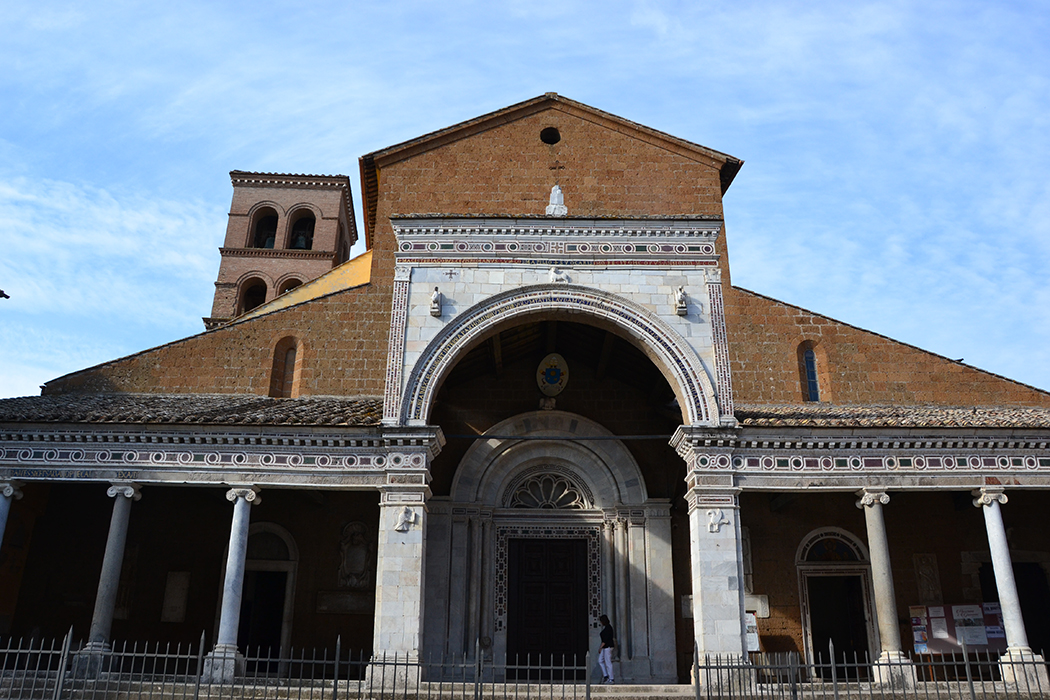
The Civita Castellana cathedral, the Santa Maria Maggiore church, was built in Romanesque style by Cosmati, the most important family of Italian marble of the twelfth century, and renovated around 1740.
Of the original church remains the entrance porch and the open bell tower with three rows of mullioned windows.
The central access portal to the cathedral is adorned by four Corinthian columns and two lions squeezed between the two men's feet: they are the evil that prevents the faithful gaining access to salvation.
The altar consists of an early Christian sarcophagus of the third century. Of great interest is the crypt under the main altar, dating from the seventh century.
It is said that the eighteenth-century organ of the cathedral was played by Mozart in 1770 during his trip to Rome.
The church of St. Sigismund is located in the small village of medieval Pianiano of Cellare and dates back to the Middle Ages.
It was enlarged and restored in the eighteenth century, following the arrival of Albanian immigrants.
Inside is a beautiful holy water font decorated with three irises, symbol of the Farnese family.
The church of Sant'Egidio was built in 1520 by Cardinal Alessandro Farnese on the design by Antonio da Sangallo the Younger.
It is a small jewel of Renaissance architecture and is at the centre of a small valley of Cellere.
The exterior is characterized by three identical facades.
The plan is a Greek cross and has a recessed central dome.
It has a beautiful hexagonal floor and many frescoes of the sixteenth and seventeenth centuries.
The drawings of the original design can be found in the Uffizi Gallery in Florence.




Follow us