Churches & Places of Worship

The church of Our Lady of Grace of Anguillara Sabazia is on the shore of the lake of Bracciano.

It is important because in here is the fresco of a Madonna with Child, which in 1796 would miraculously move its eyes.

The event is celebrated each year with a festival.

The façade is preceded by an arched portico which was added at a later time and is accessed from the central one.

Originally the church was very simple with a gable, a circular window and a small bell gable.

The interior is in the form of a Greek cross and ends with three apses with altars and the vaulted ceiling is decorated with fake rose windows.

powered by social2s

The church of Saint Blaise di Anguillara Sabazia has a rustic and austere facade that shows that it has not been finished and a door with a masonry frame. On one side is the parish house.

The church was built after the sack of Rome in 1527 after the destruction of San Nicola. San Biagio became the patron saint of Anguillara Sabazia on April 26, 1834.

The tall and narrow building is covered by a barrel vault and side windows that give it a mystical aspect. It has a single nave, with four chapels and side altars, which ends with an apse and a dome.

The altarpiece dates back to the 16th century and was made by Giovanni Battista Ricci, who also frescoed the church of S. Marcello al Corso in Rome, the Basilica of S. Giovanni and the Scala Santa in Laterano.

Inside you can admire the artistic pictorial decorations made by Torildo Conconi, a well-known Lombard painter, and a wooden sculpture of the Virgin Mary (on a bank of clouds, surrounded by three orphans, who appears to San Girolamo Emiliani) made by the sculptor Santifaller of Ortisei in Val Gardena.

The statue of Saint Blaise of Sebaste, Bishop and Martyr is located in a niche of the apse and is carried on the shoulders in a procession. along the streets of the town and up to the collegiate church, on February 3, the day of the patron saint's day. As a tradition, at the end of the solemn mass there is the rite of the "anointing of the throat" of which San Biagio is the protector.

The machine of the procession is carried on the shoulders by the Archconfraternity of S. Giovanni Decollato and of the SS. Sacramento, born in the mid-fourteenth century, from spontaneous associations of the faithful to help the poorest and assist those sentenced to death.

The Archconfraternity is divided into two branches to pay homage to the Eucharist and Mercy, the Red branch and the Black branch.

powered by social2s

Originally the church of San Francesco di Anguillara Sabazia dates back to the 13th century and was part of a Franciscan convent demolished in the 1950s.

The facade is very simple in local stone with a tympanum and a central rose window.

The building has a single nave with the altar area covered by a cross vault.

The church suffered the 'sack of Rome' in 1527.

The convent was entrusted to the Franciscans until 1870 and then abandoned and used as a warehouse, although it had valuable 15th and 16th century frescoes inside.

The back wall is frescoed with a cycle by the Viterbo painter, Domenico Velandi, and represents the Madonna fra SS. Apollonia, Lorenzo, Giovanni Battista, Francesco, Leonardo and Silvestro pope.

The back wall behind the main altar remains in good condition

powered by social2s

In Bagnoregio, the cave of San Bonaventura is an ancient Etruscan tomb where it is said that it housed Saint Francis when he was called by the parents of Giovanni Fidanza to bless and cure their sick child.

When San Francesco healed him he told him in Latin 'bona ventura' (good luck) and so the child's name was changed to Bonaventure (Bagnoregio, 1217/1221 approximately - Lyon, 15 July 1274).

With this name he entered the Franciscan convent and later became a brother, philosopher and theologian.

He was also bishop, cardinal and general minister of the Franciscan Order and is considered one of the most important biographers of St. Francis of Assisi and a friend of St. Thomas Aquinas.

He is revered as a saint by the Catholic church that celebrates him on 15 July
 

powered by social2s
Bagnoregio. Small Temple of Saint Bonaventure

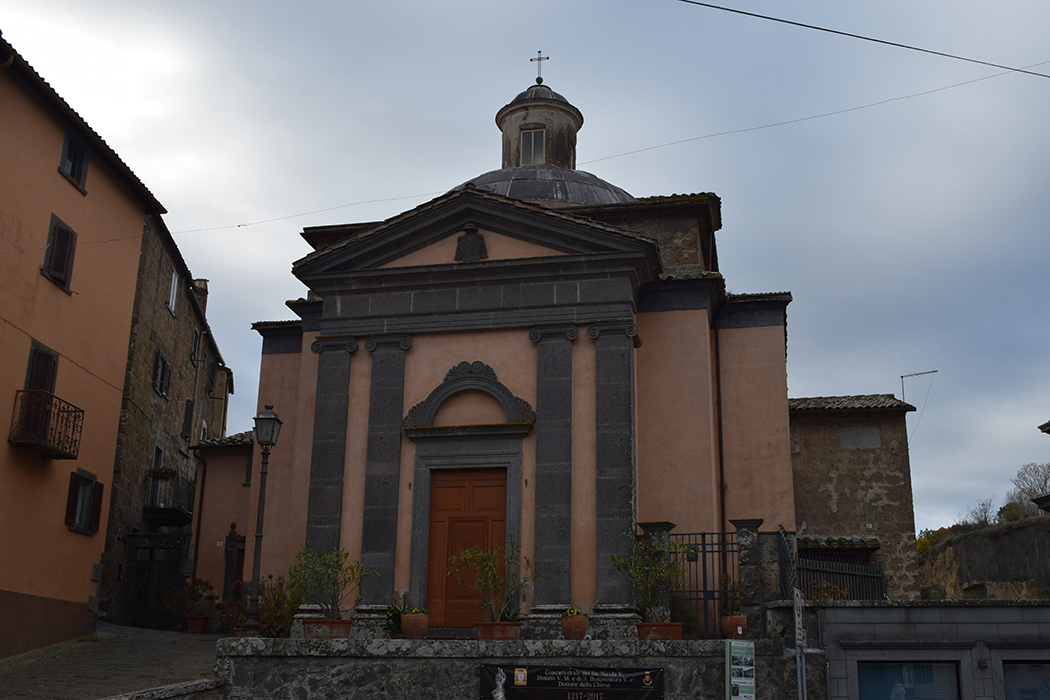
In Bagnoregio, the small temple of San Bonaventure is located just on the right of Porta Albana.

Originally it was dedicated to Sant'Angelo but in 1632 it was bought by the Venerable Company of Saint Bonaventure, the philosopher considered the second founder of the Franciscan Order of which he was at the helm.

The building has a Greek cross plan with a dome and the church was renovated in 1856 according to the project of the architect-painter Pietro Gagliardi.

Inside you can admire two altarpieces, a fresco on the right representing the Madonna del Popolo and a canvas placed behind the main altar depicting the Sacred Heart of Jesus and St. Bonaventure.

powered by social2s
Bagnoregio. Convent of the Minors or of Old Saint Francis

In Bagnoregio, the convent and church dedicated to Saint Francis dates back to the 13th century.

It was later modernized in the 18th century by the architect Francesco Tiroli.

According to history, it is in the old convent where the prayers of St. Francis healed St. Bonaventure when he was a sick child.

It was then thanks to a miracle of St. Bonaventure that a rich woman of Alviano donated the money to make the facade and the door of the church.

The convent today welcomes the students of the high school of Agriculture.

powered by social2s

In Bagnoregio, the church of the Annunciation or of Sant'Agostino dates back to the 11th century.

In 1300 had its first modernization according to the Gothic style of the time.

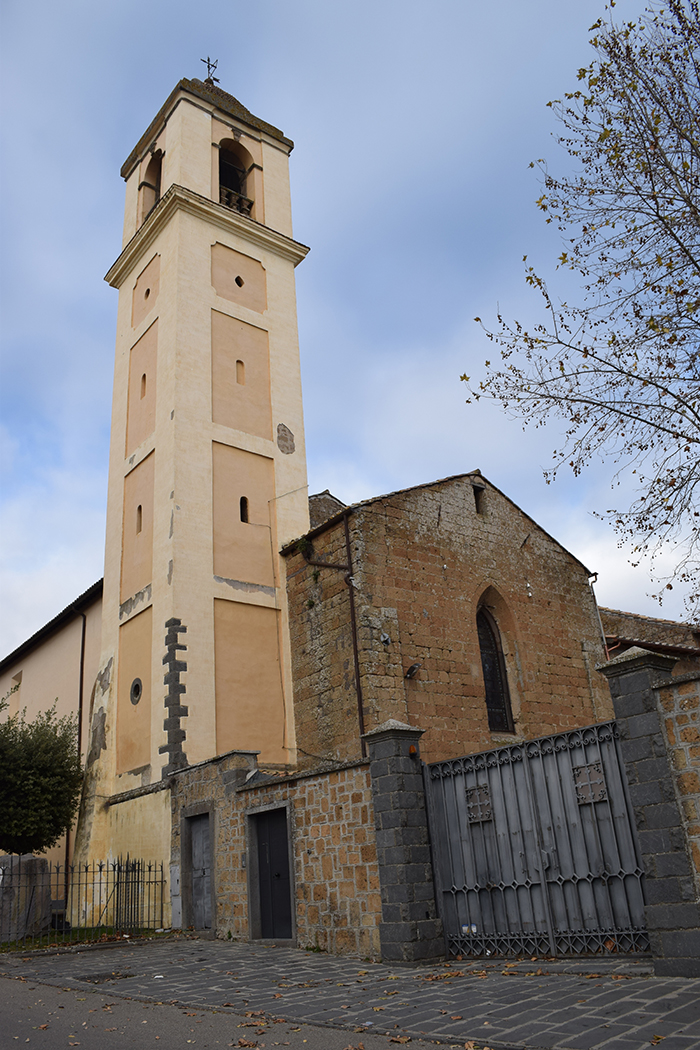
Next to the church is the Augustinian convent with a 16th century cloister made of terracotta by Ippolito Scalza, designed by the architect Michele Sanmicheli with a well from 1604 at the centre of the cloister and a slender bell tower built in 1735.

Inside the church there are paintings of great value by Taddeo di Bartolo and Giovanni di Paolo and some valuable frescoes of the 15th century depicting S. Antonio di Padova and S. Antonio Abate, S. Monica, a Madonna with child, SS. Bartolomeo and Giacomo.

Behind the high altar there is a magnificent wooden crucifix from the 1400s.

powered by social2s
Bagnoregio. Cathedral Saints Nicholas Donatus and Bonaventure

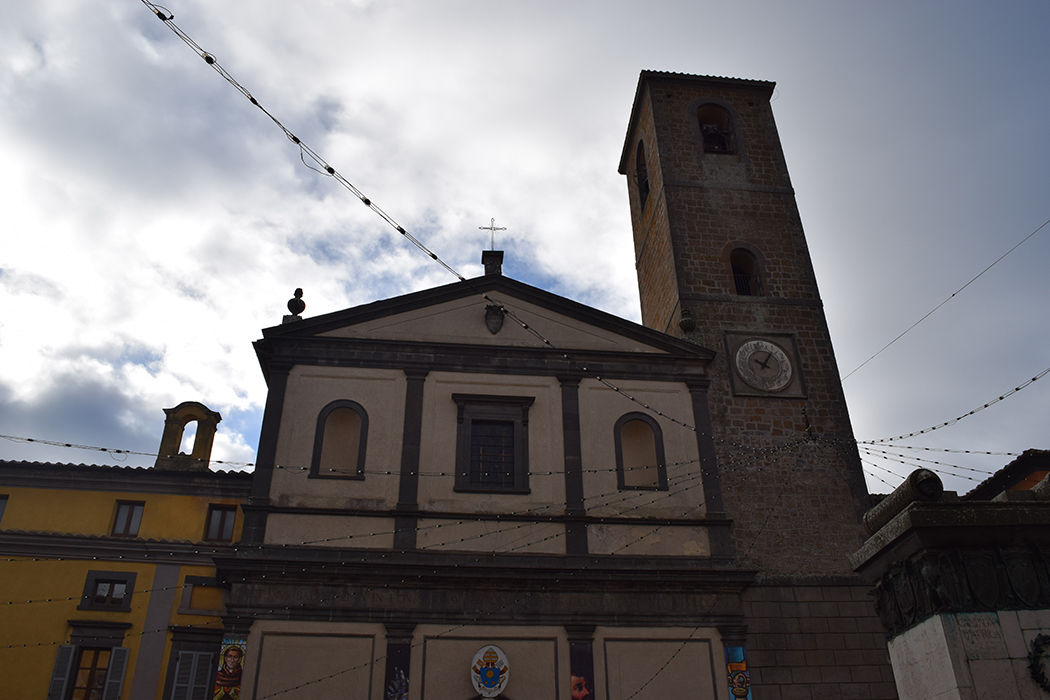
In Bagnoregio, the cathedral Saints Nicholas, Donatus and Bonaventure is built on the foundations of a previous one that probably dates back to 440, and in the past it was dedicated to the Madonna della Neve.

In 1581, Bishop Tommaso Speradio transferred the parish and collegiate church of Saint Nicholas, which had suffered damage, while it was necessary to proceed to the construction of a new church.

This was never built and the Madonna della Neve church was enlarged and reopened to the public in 1606 with the new name of San Nicola di Bari.

In 1695 a violent earthquake compromised Civita di Bagnoregio and the cathedral of San Donato was transferred to the collegiate church of San Nicola for fear of collapses.

So in 1700 the modernization works were completed and the new church was consecrated to the Saints Nicholas and blessed.

Finally, in 1779, the church was further enlarged and dedicated also to Saint Bonaventura.

The current facade dates back to 1841 and inside there are works of great value such as a gold and silver case in the form of a blessing arm containing the bones of the the arm of Saint Bonaventure.

Among the others, a painting by Vanni depicting the Magdalene and a 12th century bible in parchment, probably belonging to Saint Bonaventure.

powered by social2s

Recommended

Subscribe to Newsletter

Discover a territory through the emotions of the people that have lived it.