
Church of Sant'Antonio Abate in Collefosse,
- Benedicta Lee
- Category: Churches & Places of Worship


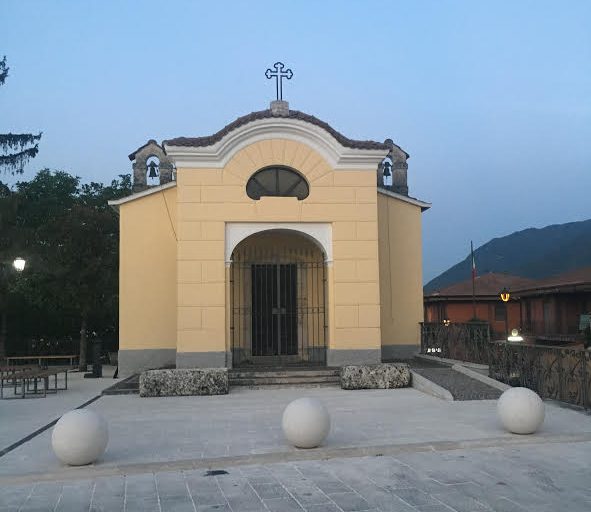
Like many Italian towns, there is also a little church in Casalvieri dedicated to this holy patron of plague patients.
The church of San Rocco is open in August, the month in which Saint is celebrated.

The sanctuary of Saint Mary of Roses - Santa Maria delle Rose of Casalvieri was started on April 20, 1636.
It replaced a chapel located on the site where the Virgin Mary had appeared in a rose garden to a small mute shepherdess with grazing sheep.
The shepherdess regained her speech after the appearance.
The church has an ornate facade in diamond shaped bossage, and originally had a single nave with six side chapels.
At the end of the nineteenth century the church was expanded with the addition of two side aisles.
The building has been damaged due to several earthquakes (1654, 1915, 1980 and 1984).
Inside are two wooden sculptures of the Neapolitan school: a crucifix of the mid-seventeenth century, and a statue of the Annunciation of the eighteenth century.
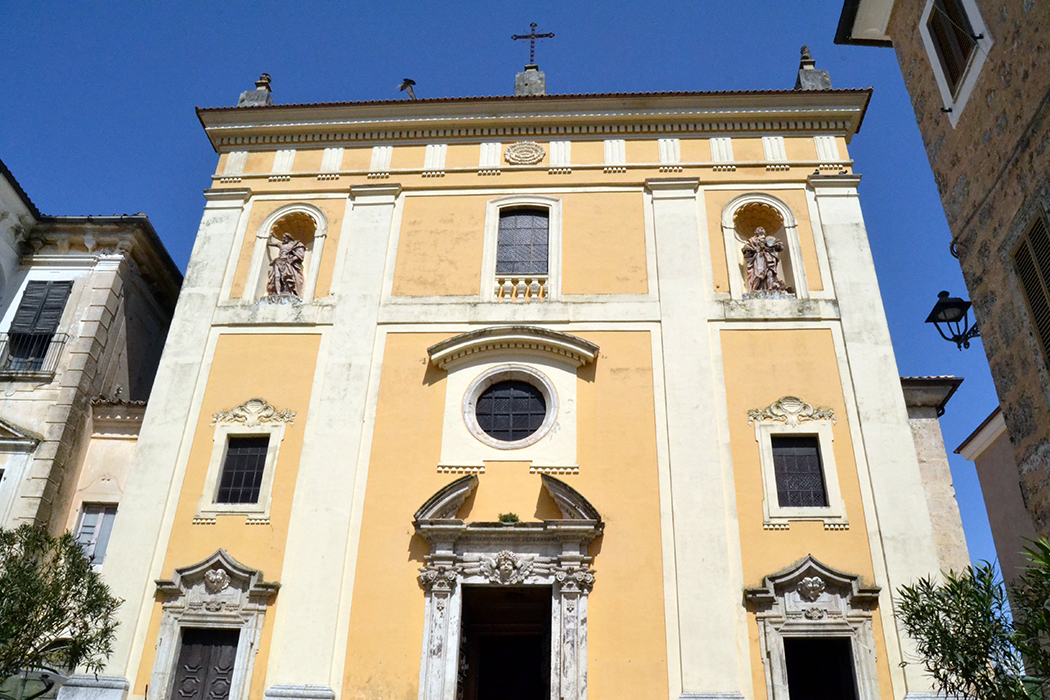
The Church of Saint John the Baptist, Evangelist is Baroque but dates back to the Middle Ages.
It was restructured in the 18th century under the leadership of the architect Giacomo del Sole.
The simple facade is enriched by baroque friezes and two niches with statues of the saints.
The interior has three aisles and is in a beautifully worked baroque style.
The church ends with a carved wooden choir surmounted by a perfectly functioning organ.
Above the altar that is decorated with gold plucked wicker is the urn (or sarcophagus) with the body of the patron Saint Onorio of Casalvieri, which is opened twice a year, during the feast of the saint, to show the body protected by a glass bowl.
In one of the side chapels there are wooden statues and paintings by Cavalier d'Arpino and Fabrizio Santafede.
Of great value is a "Deposition of Saint Sebastian", which was painted with the influence of Caravaggio.
The magnificent Abbey of San Nilo in Grottaferrata is a Byzantine Catholic Church in Italy. It is a medieval fortress and has ruled this area for many centuries.
Its story started in 1004 when St. Nilo the Younger, hegumen (head of the Abbey) of the Greek Byzantine monks, escaped from Calabria because of the Saracen raids.
he founded the Abbey on spacious grounds given to him by Count Gregory I of Tusculum. The Abbey, also known as the Abbey of Santa Maria di Grottaferrata, was consecrated in 1024 by Pope John XIX.
The strong link between the monastery and the Counts of Tusculum meant that, in 1037, Benedict IX granted it the rights to the territory of Albano and called the abbot Bartolomeo as a counsellor. In the twelfth century, Callistus II declared the abbey subject solely to the Holy See and free from the jurisdiction of the bishop. The monastery came to own vast land ranging from Albano to the Labicana.
In 1379, during the schism of the West, the monks abandoned the abbey again, under the protection of the Caetani lords of Marino. In 1462, Pius II interrupted the series of perpetual abbots and gave the abbey in commenda (contract of work) to Cardinal Bessarion, who was followed by Giuliano della Rovere.
Cardinal della Rovere built the walls with a crenellated parapet walk, with cylindrical towers on three sides, and the palace of the Commanda, probably designed by Giuliano da Sangallo, or perhaps by Bramante. The access bridge to the Abbey brings you to the courtyard with a large statue of St. Nile and the Sangallo portico.
From 1626 to 1738 the Abbey was ruled by the Barberini and was then despoiled by Napoleon's troops.
The abbey was then run by the Basilian religious sect who follow the Byzantine rites of the Church of Constantinople. The Monastery, in fact, was founded about 50 years before the Eastern Schism but Catholics can participate in the Byzantine rites of San Nilo and receive the sacraments.
The abbey has an important library which houses more than a thousand ancient manuscripts and about 50,000 volumes of great value, some dating back to the years of the founding of the Abbey and having belonged to San Nilo.
Since 1931, the Abbey has had a famous Laboratory of Ancient Book Restoration where it has restored the famous "Atlantic Codex" by Leonardo da Vinci and many manuscripts recovered from the flood in Florence of 1966. The Abbey is also home to an archaeological museum with a rich collection of archaeological finds.
The church dates back to 1300 and was dedicated to Our Lady of Mount Carmel and then to St. Anthony in 1870.
The nearby convent is mentioned for the first time in the fourteenth century, and was built by the Ricci family, the same family as Fra Tommasso (Brother Thomas), still revered and studied.
Inside six monks lived, four lay people and two priests, who were dedicated to religious activities, crafts and agricultural work and the monastery had 500 hectares enclosed by a boundary wall.
With the confiscation of religious property by Gioacchino Murat, in 1808, the convent was auctioned and bought by Cavalier Giovanni Tempesta.
Afterwards, the Confraternity of the Most Holy Rosary bought the church.
In 1872, a wing of the convent was transformed into a School of Architecture in the summer of 1878, even Princess Anne Caroline Bonaparte stayed.
The sanctuary of San Donato is dedicated to the holy bishop who gives its name to the town of San Donato Val di Comino and was probably built by Benedictine monks from the nearby Abbey of Montecassino.
The first document of the sanctuary dates back to 778 when the Duke of Spoleto, the Lombard Hildebrand, gave the church and the territory of San Donato to the Monastery of San Vincenzo al Volturno.
There are traces of the initial small church.
The current building is 26 meters long and has three naves with a dome 18 meters high.
Inside there are frescoes by Gaspare Capricci representing the most significant moments of the holy life.
The bell tower was originally a thirteenth-century watch tower.
Page 115 of 140


Follow us